Chapter 9 · 16 min read · 21 min listen
Varrick in the Deeps
The humming went first.
It did not stop all at once. That would almost have been better. It went out the way lamps go out along a street when the oil runs short: here, and then there, and then two together, and then a whole stretch at once. Four hundred sleepy voices had been murmuring out of the mouth of the Galleries, soft as bees; and now there were nine hundred, and now there were six, and now Wren could pick out single voices among them, the way you can count the last few stars before a cloud covers them.
Then, somewhere far off, an Hour-Stone that had been silent all through the hush rang out once, wild and wrong, as if something had struck it in passing. The note hung in the Galleries for a long time. Nobody answered it.
Mira stood on the ledge at the edge of the Cleft with her face turned towards the Galleries and her hands pressed flat against her chest.
“The songs,” she whispered. “Someone is stopping the songs.”
Cinder was growling. She stood stiff-legged on the stones with every hair along her back on end and her tail-spark flaring white, staring into the dark mouth of the tunnel they had just come out of; and Wren, who had learned in Emberwick what that growl meant, felt the cold come creeping over her skin before there was any cold to feel.
Then a voice came out of the Galleries.
It came from a mile away, and it was as clear as if the speaker stood at Wren’s shoulder. It was smooth and pleasant and quite unhurried, and it did not shout. It did not need to. The Galleries carried it for him, into every curling tunnel and every sleeping house in Deepholm.
“Good evening,” said the voice. “Please don’t be alarmed. I am looking for a lamp.”
Wren knew that voice. She had last heard it on top of the Great Beacon, in the wind, offering her the world.
Old Ash, lying on the sledge, closed his eyes. “Hm,” he said, very quietly. That was all. But Wren saw his long hand tighten on the pole beside him until the knuckles went white.
“Varrick,” whispered Tobin. “How can he — we came down a hole, we fell, there’s no road, how could he possibly—“
“He followed us,” said Wren. Her mouth had gone dry. “He’s been following us all the way. Ever since the Grey Gate.”
The first Delvers came running out of the Galleries a few minutes later.
They came clicking — frantic, rattling clicks, all at once, so that the tunnel-mouth was full of a sound like hail on a roof — and they came stumbling and crowding, with no care at all now for silence. Mothers with babies tied on their backs. Old men leaning on younger ones. Children clinging to anybody’s hand. They poured out onto the ledge, and stopped short at the edge of the Cleft, swaying, clicking at the drop.
Mother Hessa came among them, with a basket on her arm as if she had grabbed the first thing she could find, and a small child holding each corner of her apron. She was not humming.
“Gran!” Mira caught at her sleeve. “What is it? What’s happened?”
“Grey men.” Hessa’s brisk voice was shaking. “They came down the hole these Roof-folk fell through. Cold came with them, child. Such cold. And things with them that are not men at all. Your clicks go through them.” She shuddered. “Anyone they touch stops singing. They just — stop. They sit down where they are and they don’t know their own songs.” She drew a breath. “They took Gorrim’s boy.”
“Tavi?” Mira’s face went white. “Not Tavi—“
“He ran towards them. You know how he is. He thought it was a game.” Hessa’s voice cracked. “He’s sitting in the Great Echo-Hall, and he’s quiet. Tavi. Quiet. The Speaker’s carrying him out, but the Speaker is slow, and the grey men are behind him. The Elders have sent everyone to the Black Stair. Burning or no Burning, it’s the only way out.”
Wren looked at the stream of Delvers pressing out onto the ledge, and at the narrow, swaying bridge, and at the endless black Stair beyond it. There were hundreds of them. There would be more. And they could not see the bridge. They would have to feel their way across it, one by one.
“Who’s Tavi?” she said to Mira, low.
“He’s nine. He’s—“ Mira swallowed. “He follows me everywhere. He thinks I’m the cleverest person in Deepholm. He’s always asking me to tell him about the Warm Man, though his father says not to. He wanted to feel your warm thing. He asked, in front of everyone.” She tried to smile, and could not. “He’s a nuisance.”
Wren thought of a small freckled face with two teeth missing. She thought of a thin voice saying Wren, you’re the betht. She thought of that same face gone grey, sitting on a cold step, not knowing her name.
She did not say anything. She found that she could not.
“Child,” said Old Ash.
He had pushed himself up on one elbow on the sledge. His face was grey with pain, but his eyes were quite steady, and he looked at her the way he had looked at her across his table in the Leaning Tower, as though he could see straight through to the back of her head.
“The bridge is there,” he said. “And the Stair. You could be across it before the first of them. You could be halfway up before Varrick reaches this ledge. He wants the lamp, not these people.” He paused. “And these people, I’ll remind you, were going to lower you into a pit at the high turn.”
“What about you?” said Wren.
“I can’t climb a thousand steps, child. You know that. I’ll do very well here.”
“Rot,” said Wren.
But she went to the bridge.
She did not quite know why. Her feet took her. She stepped out onto the first slat, and it swayed under her, and the cold air of the Cleft came up past her from the dark below. Ahead of her, at the far end, the doorway of the Black Stair stood open, and beyond it the steps went round and up into the dark. A thousand steps. And at the top, the Greywaste, and the wind, and the pale sun, and the long road to the Bright Mountain. Nobody would blame her. There was nobody to blame her. Everything costs, said the small sharp voice at the back of her head, and this has nothing to do with you, and you have paid enough.
She took a second step. The bridge creaked.
Behind her, on the ledge, a child was crying — a thin, frightened wail, on and on. And over it, she heard Mira’s voice. Mira was not running. Mira was standing at the mouth of the Galleries with one hand on the wall, calling out names into the dark, one after another, tck, tck, finding the lost ones by their echoes and sending them on towards the bridge. She was not going to cross. Wren could hear it in her voice. She was going to stand there and call until the cold came.
Wren stood on the bridge with the lamp in her hands.
I should like to tell you that she made up her mind in a noble flash, like a knight in a story. She did not. She stood there for what felt like a very long time, and she was very frightened, and she was also extremely cross.
“Rot,” said Wren, out loud, to the Cleft. “Rot and blast.”
And she turned round, and went back.
“Tobin,” she said, when she reached the ledge. “Get them over. All of them. One at a time, holding the rails. You’re good at — at organising things. Tell them where to put their feet.”
Tobin stared at her. “Where are you going?”
“In there.” She pointed at the Galleries with her chin. “To fetch the slow ones.”
“Wren, you can’t, that’s — that’s exactly where he is—“
“I know where he is.” She looked at Mira, who had turned towards her voice. “Coming?”
Mira was already at her side. Cinder was already ahead of them both.
They went back into the Galleries with the lamp held high, and they did not trouble to be quiet now. The ribbed walls went streaming past, pale as ivory. And the Delvers coming towards them out of the dark — stumbling, clicking, lost — stopped as they passed, and turned their blind faces towards the lamp.
“Warm,” one of them said, an old woman with her hands out in front of her. “Oh — it’s warm.”
And Wren saw something she had not expected. The Delvers did not flinch from it. Not now. Behind them was the cold, the dreadful creeping cold that stopped songs; and here in front of them, coming the other way, was a warmth like a hearth. They could not see the light. They did not need to. They turned towards the warmth the way cold hands turn towards a stove, and they followed it.
“This way,” said Wren. “Keep close. Follow the warm. Mira, tell them.”
Mira told them. She told them, quick and low, and they gathered behind Wren in a long, stumbling line, holding one another’s sleeves. Wren led them back round the curling Galleries towards the Cleft, and then went back again for more, and then again. She lost count of how many times.
On the fourth time, they met Speaker Gorrim.
He was coming slowly along the Gallery towards them, the great proud Speaker, alone. His Elder’s robe was torn. In his arms he carried a boy of about nine, long-limbed and pale, with his head lolling against his father’s shoulder. The boy’s eyes were open. He was not crying. He was not doing anything at all.
Gorrim stopped. He clicked, once, and Wren knew he had found her.
“You,” he said. “Roof-girl.” His deep slow voice was rough. “This is your doing. You and your fever. You brought them down on us.”
“Probably,” said Wren. “Come on.”
She held out the lamp towards the boy. She did not quite know why. But Gorrim swung away from it, sharp, and turned his shoulder between it and his son.
“Keep your sickness away from my child,” he said. “Haven’t you done enough?”
There was no time to argue. Because at that moment Cinder, who had been padding ahead, stopped dead in the middle of the Gallery and set her four feet and snarled. And the cold came round the curve of the tunnel.
It came like water coming under a door. It came along the floor first, so that Wren felt it through her boots, and then up her legs and into her stomach, and her breath smoked in front of her face. Mira clicked, fast — tck-tck-tck — towards the bend, and then again, and her face went blank with fear.
“There’s nothing there,” she whispered. “Wren, there’s nothing there. My clicks go straight through. But it’s so cold—“
Wren held up the lamp.
They were there.
They filled the curve of the Gallery from wall to wall: grey shapes, tall and thin and faceless, like smoke poured into the outline of a person. They did not walk. They drifted. Where they had passed, the pale ivory stone of the walls had gone a dull dead grey, as if the colour had been licked off it. And behind them, ringing on the stone, came the tramp of boots.
The Hollows shrank from the lamp. They always did. They bent away from it like grass in a wind, and hung there at the edge of its light, and waited.
“Back,” said Wren. Her voice came out much smaller than she wanted. “Everybody back. Slowly. Speaker — back.”
And for once in his life, Speaker Gorrim did what somebody else told him.
They went back along the Galleries step by step, Wren last of all, walking backwards, with the lamp held up in front of her like a shield. The Hollows came after them as fast as they went, and no faster: a grey wall of cold, always at the very edge of the gold. Behind the Hollows, Wren could see the Knights now. Grey armour, grey faces, empty eyes, marching in step. And at their head, walking easily, his grey cloak swinging, came a tall pale man who was not hurrying at all.
They came out onto the ledge at the edge of the Cleft.
Tobin had done well. Wren saw that at once, with a quick hot rush of pride. He had them lined up along the ledge, the Delvers, each one holding the sleeve of the one in front, and he was standing at the head of the bridge, his spectacles crooked, calling softly — “Left hand on the rail. Good. Next step. Mind the gap, it’s wider, that’s it” — and they were going over, one by one, and on the far side Mother Hessa was gathering them in at the foot of the Black Stair. Dozens were across. But there were so many still waiting. And not one of them had started up the Stair.
Wren backed up until she stood beside Old Ash’s sledge, in front of all of them, with the lamp held up. Mira stood on one side of her, and Cinder on the other. Behind her, Gorrim set his son down gently on the stones.
Captain Varrick stepped out of the mouth of the Galleries, and stopped, just at the edge of the light, and smiled at her.
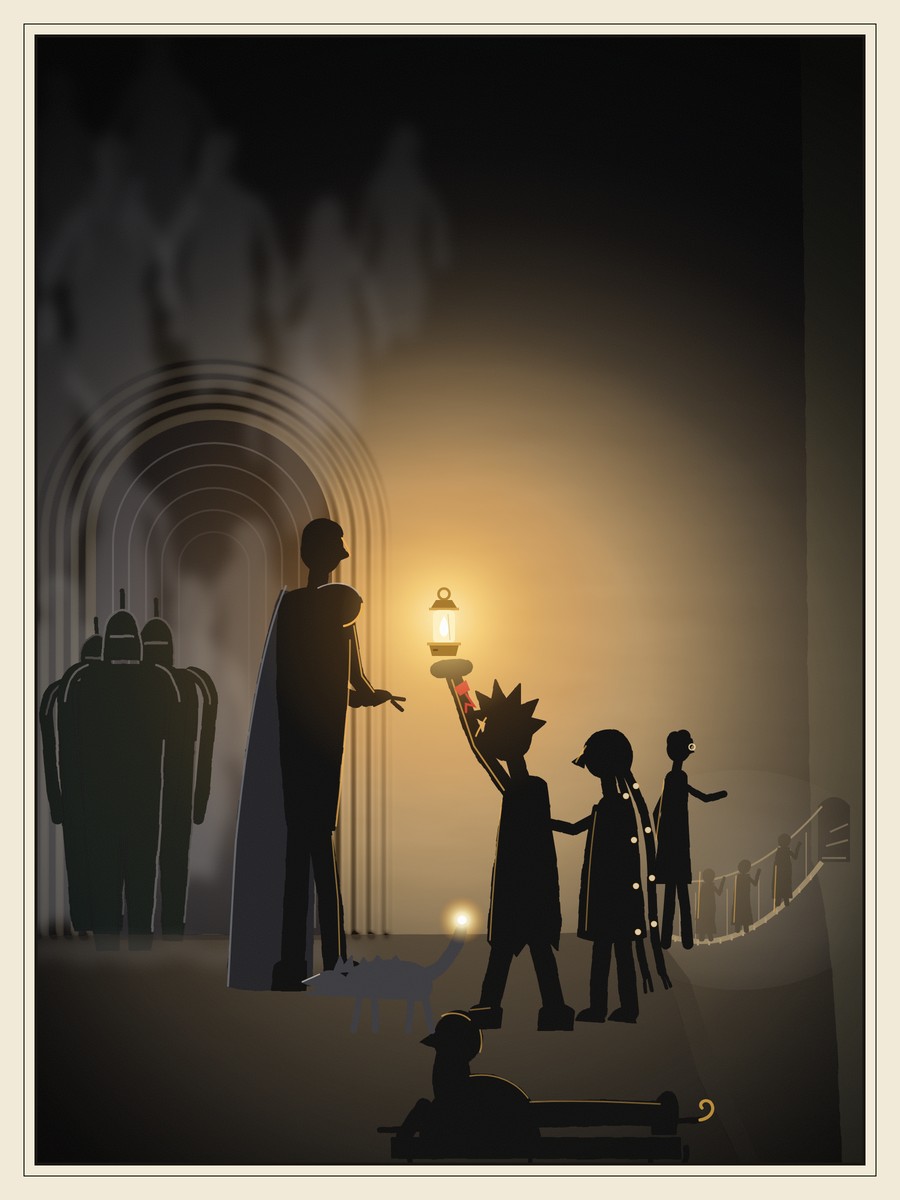
He had not changed since the night of the Beacon. Tall, pale, grey-eyed, in grey armour that made no noise, with a grey cloak hanging from his shoulders. His Knights stood behind him in the tunnel-mouth like a row of grey statues. The Hollows hung behind them in the dark. Varrick drew off his gloves, one finger at a time, and Wren saw him rub his thumb, without seeming to notice, across the palm of his right hand.
“Good evening, Wren Ashby,” he said. “You have led me a long way. Across the Waste. Through the mothwings. Down a hole in the world.” He looked round at the ledge, at the crowding Delvers, at the swaying bridge, with polite interest. “And here you are, holding the door for the very people who meant to drop you down a well. I confess I find that hard to understand.”
“Nobody asked you to understand it,” said Wren.
“Quite right.” He inclined his head. “Let me be plain, as I was before. I can’t take your lamp. You know that. It must be given. I am not here to take anything. I am here to make an offer.”
“I’ve heard your offers.”
“Not this one.” He nodded towards the bridge, and the Delvers feeling their way across it, and the dark mouth of the Stair beyond. “A thousand steps. In the dark. The old ones. The little ones. And my Hollows, I should tell you, do not tire, and do not make a sound. These people find their way by echoes. They will never hear them coming.” He let that sit a moment. “Or. You could give me the lamp. And I will take my Knights back up the way I came, and my Hollows with them, and not one more voice in Deepholm will stop. You have my word.”
He smiled at her, quite kindly.
“Give me the lamp, child, and I leave them their songs.”
The ledge was silent. Even the crying child had stopped. Wren felt every blind face on the ledge turn towards her, listening. She felt Mira’s hand find her sleeve and hold on.
And the worst of it — I must tell you this, because it is true — was that a part of her wanted to. Not for herself. For Tavi, lying on the stones. For the old woman who had held out her hands and said warm. Just hand it over, said a voice in her that sounded almost kind. Just once, give it up, and let it be over, and let them sing.
Then there was a scraping sound behind her.
Old Ash was getting up.
He did it the slow, dreadful way, with his pole planted on the stones and both hands on it, hauling himself up off the sledge onto his one good leg. His face was the colour of ash. Tobin started forward to help, and Ash waved him off without looking. He stood, at last, swaying, leaning on the brass-hooked pole, very tall in the gold light, his singed white beard on his chest. He looked across the ledge at Captain Varrick.
“Lad,” he said.
Only that.
And Varrick went still.
It lasted one heartbeat. Wren saw it, and she was always sure afterwards that she had seen it, just as she had on the top of the Beacon. His left hand had closed over his right palm, over the old scar, and was holding it. And his grey eyes, looking at the old man leaning on his pole, were not quite grey.
“You used to sing the night-song on the wall,” said Old Ash, low. “Louder than any of us. Out of tune, every time.” He drew a breath. “Do you remember the words, lad? Because I do.”
Varrick’s hand fell from his palm.
“That was somebody else, old man,” he said. His voice was as smooth as ever, but it had come a moment late. “You buried him a long time ago.”
“No,” said Old Ash. “I never did. I’ve been waiting.”
For an instant something moved in Varrick’s face, and was gone. Then he turned his back on the old man, as if he had not spoken, and looked at Wren again, and his voice was oiled iron.
“I am a patient man,” he said. “I will wait, as well. My Knights will hold this ledge. Your bridge is narrow and your Stair is long, and the old man cannot climb a single step of it. Think it over, Wren Ashby. When you are ready to be sensible, I shall be here.”
He stepped back into the mouth of the Galleries. The Knights closed in front of him, shoulder to shoulder, grey and silent. And beyond them, at the very edge of the light, the cold came creeping, and waited.
Wren stood on the ledge with the lamp in her hands.
She looked at the bridge, swaying, with its long, slow line of blind Delvers feeling their way across. She looked at the Black Stair beyond it — a thousand steps in total dark, where the Hollows would come without a sound, and nobody who climbed it would ever hear them. Whoever went up those stairs would need the light. And whoever stayed on this ledge, with the Knights at the tunnel-mouth and Old Ash who could not climb, would need it too.
There was only one lamp. And there was only one of her.
Slowly, without wanting to, she turned her head; and she looked at Tobin.
Chapter 9 complete
Varrick in the Deeps