Chapter 8 · 17 min read · 21 min listen
The Whispering Galleries
Have you ever tried to be perfectly silent? Not just quiet, but silent: no cough, no sniff, no creak of a shoe? It is much harder than it sounds. Most people manage it for about a minute. Wren and her friends had to manage it for most of a night.
It began badly, because Tobin woke up talking.
Wren had crept back into the hush-room and put her hand on his shoulder, and he sat bolt upright on his blanket and said, quite loudly, “Actually, I’ve been thinking about the drainage—“
Wren clapped her hand over his mouth. Outside the door, Pell’s snoring stopped.
Nobody moved. Tobin’s eyes went very wide over the top of Wren’s fingers. In the dark Wren could hear her own heart, and Mira’s breathing, quick and light by the door, and nothing at all from Pell. One breath. Two. Three.
Then there was a great snort, and a scratching sound, like a large Delver scratching his ear; and the two-note snore began again, exactly where it had left off.
Wren took her hand away from Tobin’s mouth very slowly. She put her lips against his ear and breathed, “Not one word. Not one.” Tobin nodded so hard his spectacles fell off into his lap.
Old Ash, it turned out, was already awake. When Wren leaned over him he only raised one white eyebrow, as if to ask whether she had enjoyed her evening. Cinder had already moved from Tobin’s collar to the old man’s chest, and sat there with her tail-spark glowing a low, eager red.
Mira had brought a sledge.
It was the kind the Delvers used for hauling cut stone: a flat bed of dark wood, low to the ground, on two long runners rubbed with fat until they shone. When Mira pushed it with one finger, it slid across the floor of the hush-room without a whisper. Tobin looked at it the way other boys look at a cake. Wren could see the explanation building up inside him like steam under a pot-lid, and she gave him a look, and he swallowed it.
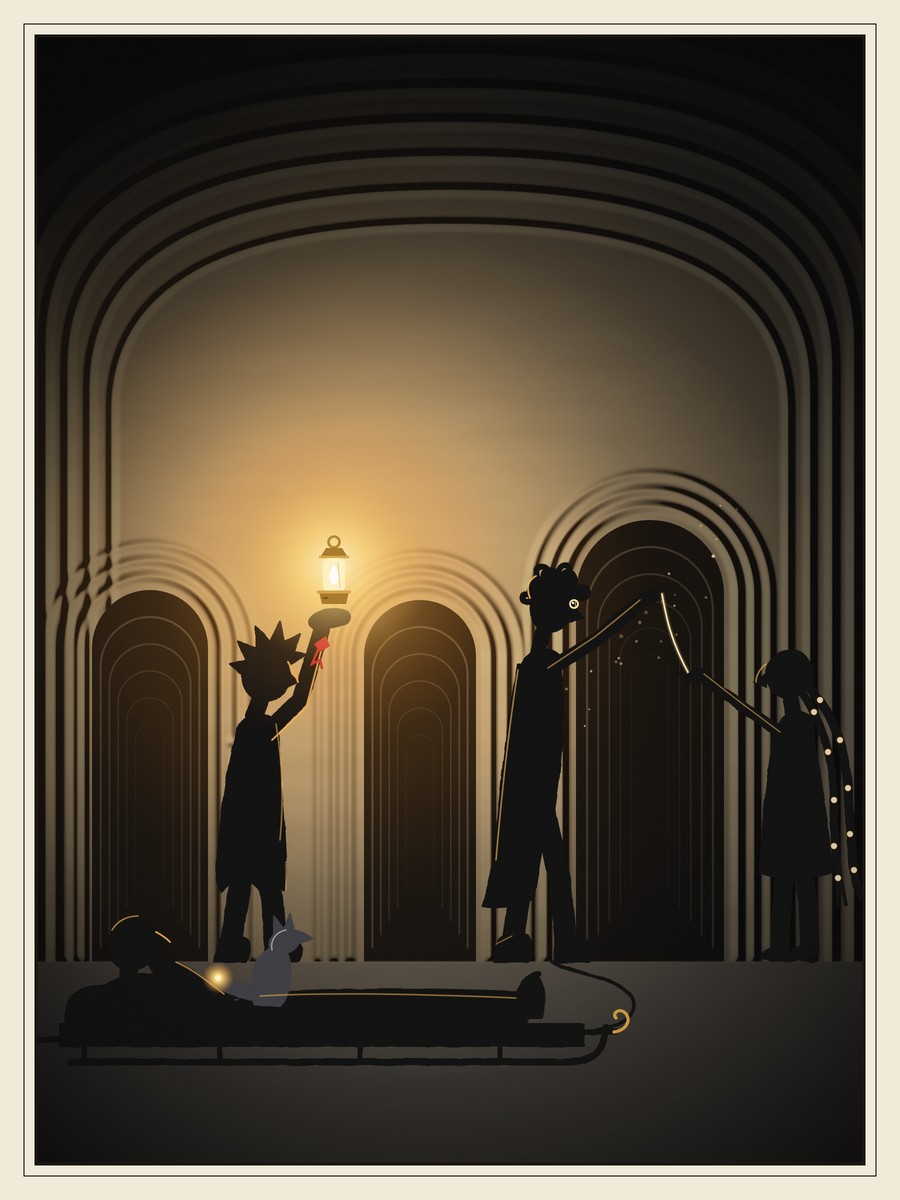
Between them they got Old Ash off his litter and onto the sledge. His bad leg would not bend, and his face went grey and tight about the mouth; but he did not make a sound. They laid his long brass-hooked pole along beside him. Cinder settled on his chest like a small grey hearthrug.
Then Mira did something Wren did not expect. She took Wren’s wrist, turned it over, and tapped once on the inside of it with two fingers. Then twice. Then three times, quick and hard. She did the same to Tobin, and then, gravely, to Old Ash, who watched her with great interest.
Wren worked it out. One: go. Two: stop. Three— Mira tapped three again, hard, and pressed Wren’s arm down towards the floor. Three: hide.
Wren nodded. Then, because Mira could not see a nod, she tapped once on Mira’s wrist. Mira smiled in the dark.
They went out past the guards. Tobin and Wren took the rope at the front of the sledge, and Mira walked ahead, and Old Ash slid along behind them on the greased runners as smoothly as a boat on still water. Pell’s feet were stretched right across the passage. They had to lift the front of the sledge over them, inch by inch, with Ash’s weight on it, while Pell snored and Oddny hummed and Tobin’s arms shook. Halfway over, Oddny’s humming caught and wobbled. Everyone froze, the sledge held up in the air between them.
Oddny smacked twice, and said, very distinctly, “Mushrooms.” Then the humming went on.
They set the sledge down on the far side of his feet, and went on into the dark, and none of them dared to breathe out until the humming and the snoring were a long way behind.
The Whispering Galleries began at the end of a passage that no one in Deepholm had any reason to walk down. There was an old stone doorway, carved with rings, and beyond it the floor sloped gently away into a tunnel that was not like any tunnel Wren had seen.
Mira stopped at the doorway and put her mouth right against Wren’s ear for the last time.
“No one walks the Galleries,” she breathed. “Your fever-thing may come out now. But from here — nothing.”
Wren took out the lamp.
The tunnel was round, and smooth, and ribbed all along its length with long, curving ridges, like the roof of a mouth. It curled away ahead of them in a slow spiral, and the ribs curled with it. In the lamplight the stone was pale and polished as old ivory. Tobin’s mouth fell open. He lifted both hands and made a shape in the air — and Wren knew, as clearly as if he had shouted it, that he had understood exactly how it worked and was going to burst if he could not tell somebody.
She shook her head at him. He shut his mouth and nodded, and looked, for a moment, close to tears.
Then they stepped inside, and they heard Deepholm.
It came out of the walls all round them, faint and clear, the way the sea comes out of a shell held to your ear. Four hundred Delvers humming in their sleep, a soft low murmur like bees in a summer hedge. The slow drip of the water-gates, closed for the hush. Somewhere a baby fussing, and a mother’s voice hushing it. Somewhere, a long way off, someone laughing at a joke Wren would never hear. All of it carried down the Galleries to them, clear and small and near, as though the whole of Deepholm were a doll’s house and they had put their ears to its walls.
Wren stood very still with the lamp in her hands. Then she understood what it meant. If they could hear a baby fussing a mile away, then a mile away, if they made one sound, somebody could hear them.
Mira tapped her wrist once. Go.
They went.
I will not tell you every step of that journey; there were thousands, and all of them slow and silent. But I will tell you how they found the way, because it took two of them together.
The Galleries were not one tunnel but many, curling and crossing and splitting like the roots of a tree. At every place where two of them met, someone long ago had cut a mark into the wall at the height of a Delver’s hand — a little cluster of grooves and dots — and Mira would stop, and lay her fingers on it, and read it, and tap once on Wren’s wrist and turn. Usually she did not need to. But at home Mira found her way by clicking, and she could not click here. One tck in the Galleries would have rung out like a dropped pan. So she walked with one hand always on the wall, and Wren saw, after a while, that she was not quite as sure of herself as she pretended.
At the fifth crossing, Mira laid her fingers on the wall and stopped.
She moved her hand along. She moved it up, and down, and along again. Wren held the lamp close. There had been a mark there once; you could see where. But a sheet of stone had cracked away from the wall, long ago, and taken the mark with it, and there was nothing left under Mira’s fingers but a smooth broken face. Three tunnels led on from the crossing. Mira turned her head one way, and then the other, and Wren saw her lips press tight together.
And then Tobin did something clever.
He had been walking all this while with his lips moving, counting, and his ink-stained fingers twitching at his sides as if they were drawing. He had been making a map of Deepholm in his head ever since they arrived; he could no more help it than Cinder could help stealing biscuits. Now he set down the sledge-rope, very gently. He took hold of a loose thread at the cuff of his coat, and pulled, and pulled, until he had a length of it as long as his finger. He held it up in front of the first tunnel. It hung straight down. He held it in front of the second. It hung straight down.
He held it in front of the third, and the thread stirred, and lifted, and leaned — very slightly, but quite certainly — into the tunnel, as if something in there were breathing it in.
Tobin turned round with his face blazing, and pointed up, and then pointed at the tunnel, and then made a winding motion with his finger, round and round and up. Air. Going up. The Stair.
Mira could not see any of that. So Tobin, after a moment of flapping, took her hand, and put her fingers very lightly on the end of the thread, so that she could feel it lean.
Mira turned towards Tobin with an expression Wren had not seen on her face before. It was the look one craftsman gives another. She found his wrist and tapped once, firmly: yes. Then she patted his arm in a way that was not any signal at all, and only meant well done.
Tobin went pink to the ears. He picked up the sledge-rope again and pulled with a will, and somewhere about the next crossing Wren noticed that his hands had stopped shaking. He had forgotten to be frightened. He had been far too busy.
It was at the eighth crossing that Wren nearly ruined everything.
There were two ways on. Mira read the mark and tapped Wren’s wrist once and turned to the right. But Wren had stopped. She was standing at the mouth of the left-hand tunnel with her face lifted, because she could feel air on it — cool, steady air, flowing up past her. She knew that kind of air. She had spent her whole life in chimneys, and she knew a draught going up the way a sailor knows the wind. Up meant out. Up meant the Stair.
She pulled on Mira’s sleeve and pointed left, hard, forgetting for a moment that Mira could not see her point.
Mira found her hand and tapped twice. Stop. No.
Wren tapped once. Yes. This way.
Mira tapped twice again, harder, and then again, and her blind face was turned towards Wren, and it was not cross. It was asking.
Every bone in Wren’s body told her she was right. She was always the one who knew the way. She had never followed anybody anywhere, not since she was four years old. Following was how you got caught. Following was how you got sold.
Then she thought of the Story-Wall, and the girl who had sat alone in the dark believing in something she could not see.
Trust her, thought Wren. It was the strangest thought she had ever had. It was like stepping off a roof in the dark.
She tapped Mira’s wrist once, and turned right.
Not long afterwards, their tunnel curled round and ran for a little way beside another one, with only a wide crack between them, and Wren held up the lamp and looked through the crack. It was the left-hand tunnel. It ran for twenty paces more and then simply stopped, at the lip of a hole. A great round black shaft went straight down out of the floor, into nothing. Out of it came a slow, cool breath of air, rising steadily up past the edge. It was the draught she had felt.
There was no sound from that shaft. None at all. The lamp-light went down into it and did not come back.
Wren did not need anyone to tell her what it was. Her stomach turned over. She looked at Mira’s back, walking steadily ahead with one hand on the wall, and she did not say anything — she could not, of course — but she reached out and touched Mira’s shoulder, just once, lightly. Mira did not turn round. But she put her own hand up, and laid it over Wren’s for a moment, and then went on.
They nearly came to grief three more times before the end.
The first time was Cinder. The sledge had stirred up a little puff of old dust from the floor, and Cinder put her nose into it, and Wren saw the fox’s whiskers twitch, and her eyes begin to cross, and her mouth begin to open. Wren lunged across the sledge and pinched Cinder’s nose shut between finger and thumb. Cinder’s eyes bulged. Her whole body jerked once, silently. And two small, indignant puffs of golden sparks shot out of her ears and floated gently down onto Old Ash’s beard, where he patted them out without a word. Cinder glared at Wren for a full minute afterwards. Wren had never been so glad to be glared at.
The second time was Tobin’s spectacles, which slid off his nose as he bent to ease the sledge over a ridge. Wren caught them one inch above the stone floor, and Tobin looked at her with such enormous gratitude that she nearly laughed out loud, which would have been worse than the spectacles.
The third time was the patrol.
Mira heard it first. She stopped dead, and her hand shot out and found Wren’s wrist, and tapped three times — hard, quick, frightened. Hide.
Then Wren heard it too. It was coming along a cross-tunnel ahead of them, from the direction of the city: a soft tck... tck... tck-tck, very quiet, and the pad of bare feet. Several pairs. And the Galleries carried it to them so clearly that it seemed to be happening right beside Wren’s ear.
A Delver night-patrol. And a Delver clicked, and the click came back off whatever was there — stone, or sledge, or a girl holding her breath — and then he knew.
Wren pushed the lamp deep inside her coat and did up the buttons over it, and the dark fell down on them like a sack. She felt Tobin’s arm go rigid beside her. Mira was pulling at them — pulling them sideways, towards the wall — and then Wren’s shoulder sank into something soft and cold and damp. Moss. A deep pad of it, hanging down over a hollow in the wall like a curtain. Mira pushed them all into it, one after another, and dragged the sledge in after them with Old Ash on it, and pulled the moss closed.
Even her own breathing sounded muffled, as if someone had wrapped her head in a quilt. In here, a click would not come back.
The patrol came on. Tck. Tck-tck. They were right outside. They were level with the moss. She could feel the lamp burning warm against her ribs, and she pressed her arms over it as tightly as she could, and she thought: they can’t see it. They can’t see it. But they can feel warm.
One set of feet stopped.
There was a long pause. Wren could hear a Delver breathing, slow and deep, on the other side of the moss, a hand’s breadth from her face. Beside her, Tobin was shaking all over. On the sledge, Old Ash had taken his own sleeve between his teeth.
“Warm,” whispered the Delver.
And the Galleries took the word and carried it away. Wren heard it go — warm... warm... warm... — running off down the curling tunnels in every direction, growing fainter and fainter, out towards the sleeping city and beyond it, until it seemed that the whole of the Deeps was whispering it.
“Hush, Doran,” whispered another voice, sharp and cross. “You’ll wake the Elders. It’s only the hot spring under the sixth gallery. It always does that.”
...the Elders... the Elders... only the hot spring...
A grunt. The feet moved on. Tck. Tck-tck. Fainter, and fainter, and gone.
They stayed in the moss a long time after that. When at last Mira pulled the curtain back and Wren took out the lamp, she saw that Old Ash’s face was the colour of tallow, and wet, and that there were teeth-marks in his sleeve. But he caught her eye and gave her a small, crooked smile, and raised one finger to his lips, as if to say that she was doing very well.
The Galleries ended without warning. The ribbed tunnel curled round one last time and simply opened out, and they were standing on a ledge at the edge of a great black emptiness, with cold air moving on their faces.
Wren lifted the lamp.
A chasm lay in front of them, so wide that the lamplight barely reached its far side, and so deep that it did not reach the bottom at all. Across it, swaying very slightly, hung a rope bridge: a narrow walk of pale stone slats threaded on rope, with two rope rails at the height of Wren’s hands. And on the far side, at the end of the bridge, the rock rose up sheer; and cut into the foot of it was a doorway. Beyond the doorway, a stair went up. It turned almost at once, and was gone into the blackness, round and up and round and up.
“There,” whispered Mira. It was the first word any of them had spoken in hours, and it was so soft that even here, out of the Galleries, it hardly stirred the air. “That is the Cleft. And that is the Black Stair. A thousand steps, and nothing at the top but the open Waste.” She let out a long, shaky breath. “We are out. You may speak now. Softly.”
Tobin opened his mouth. Everything he had not said for the whole night came out of it at once, in a rapid, ecstatic whisper.
“The ribs,” he whispered. “Did you see the ribs? They’re reflectors, and the spiral means the sound doesn’t spread, it travels, it’s a speaking-tube miles long, and the moss, it’s a damper — Mira, who worked out the curve? It would take Guild engineers a century to—“
“Tobin,” whispered Wren.
“Yes?”
“Shut up.”
“Yes,” said Tobin happily. “Sorry. Yes.”
Mira laughed without a sound, her shoulders shaking. And Wren stood on the ledge at the edge of the Cleft with the lamp warm in her hands, and the bridge in front of her, and the Stair beyond it going up towards the open sky, and thought that she had never in her whole life been so tired, or so proud of anybody, or so nearly free.
That was when the ground moved.
It was not much, at first. A shiver under their feet, as though something very large, very far off, had turned over in its sleep. A trickle of grit pattered down from the roof of the Galleries behind them. The rope bridge swung, and creaked.
Then it came again — a long, deep, grinding shudder that went right up through the soles of Wren’s boots and into her teeth. Dust poured down from the dark overhead. Cinder leapt off Old Ash’s chest with every hair on end. Tobin grabbed the sledge-rope.
And from the mouth of the Galleries behind them, carried out to them along a mile of curling stone, came a sound like a great door breaking.
Then, one by one, all the faint far sounds of sleeping Deepholm — the humming, and the snores, and the murmur of a thousand dreaming voices — began to stop.
Chapter 8 complete
The Whispering Galleries