Chapter 10 · 17 min read · 22 min listen
The Black Stair
The Delvers had a name for the place at the bottom of the Stair, and Mira had told it to Wren as they ran back and forth through the Galleries. In the old Delver tongue it was one long humming word, and it meant where the songs stop.
Wren had thought that a horrible name. Now, standing on the ledge with Varrick’s Knights at her back, she understood it.
It was a cavern so tall that the lamplight never found the roof, and across the middle of it ran a crack in the world. The floor simply ended in a ragged lip of stone, and beyond the lip there was nothing — no bottom, no sound, only a cold breath coming up out of the deep as if something very large were asleep down there. Over the crack hung a Delver bridge of plaited rope as thick as Wren’s arm, with slats of pale stone threaded on it like beads. It was so narrow that two people could not have passed on it without one climbing over the other. On the far side, cut into the rock, was a doorway. And through the doorway, going up and round into a blackness so complete that the lamplight seemed to stop at the edge of it, was the first of a thousand steps.
Behind them, Deepholm was going quiet.
That was the worst thing, worse than the cold. Wren had never once heard the city of the Delvers silent. Now, far back along the tunnels, the sounds were going out one by one, the way lamps go out along a wall. A song would be running, and then it would stop in the middle. A child would be crying, and then it would not be.
“They are all still there,” said Mira. She had her head tipped towards the Galleries, her pale face perfectly still. “Hollows at the back. Then men in iron. Then him.” She did not say Varrick’s name. None of the Delvers would.
The ledge was still crowded with Delvers, hundreds upon hundreds of them, pale and frightened, carrying their children and their old people and their bundles, and all of them clicking at once, so that the vast cave rattled like rain on a slate roof. Those who had crossed had stopped at the foot of the Stair, and those still waiting had stopped at the lip of the crack.
None of them would go up.
“Why won’t they go?” said Wren. “It’s right there!”
“It is not the bridge they fear,” said a deep, slow voice behind her. “It is what is at the end of it.”
Speaker Gorrim stood at the edge of the crowd. Only that morning he had called them liars in the Hall of Answers. Now his fine grey robe was torn at the hem, and in his arms, wrapped in a blanket, he held his son. Tavi’s eyes were open. He was looking at nothing. His round face was the colour of old candle-wax.
“No Delver has climbed the Black Stair in three hundred years,” said Gorrim. “The stone of it is broken. There are gaps where the steps have fallen, and holes in the wall that go nowhere, and in the stair the echoes lie. Listen to my people. When one Delver clicks, he hears the world. When four hundred click at once, they hear only each other. On that stair we would be blinder than you.”
“A thousand clicks is no clicks at all,” said Mira quietly. “It’s a Delver saying. I always thought it was a silly one.”
Wren looked up at the black doorway. Then she looked down at the lamp in her hands, and she knew — the way you know you are going to be sick a moment before you are — exactly what was going to have to happen. And she did not want to know it at all.
Four Delver stone-carriers had lifted Old Ash off the sledge into a sling-chair made of rope and a door, and they had set him down on a flat rock near the bridge. His bad leg was splinted from ankle to hip. He could not have climbed ten steps on it, let alone a thousand, and he was more cross about it than Wren had ever seen him.
“Hm,” he said, when she knelt beside him. He did not ask what she was thinking. He never needed to.
“The stair needs a light at the front,” said Wren, in a rush. “Somebody who can see the gaps and shout back. The Delvers can’t see the lamp, but Mira says they can feel the warm on their faces. So if the warm goes up first, they’ll follow it.”
“Yes,” said Ash.
“And somebody has to stop the Knights crossing the bridge behind them, or they’ll catch everybody halfway, on the broken bits. And whoever stops them has to be somebody who doesn’t mind the dark, because there won’t be any light down here once the lamp’s gone up.” She swallowed. “I’ve been in the dark all my life. Chimneys are dark. I’m good in the dark. Mira’s better. And Cinder doesn’t care about anything.”
At her feet, Cinder sneezed a small shower of sparks, as if to agree.
“So it’s us down here,” said Wren. She did not look round, but she knew where Tobin was. He was standing three paces behind her, and she could hear his breathing. “And the lamp goes up. With him.”
“Me,” said Tobin. His voice cracked straight down the middle.
“It’s simple arithmetic,” said Wren. “You said that once, on the Beacon stair. You’re no good in the dark. I am. So I hold the bridge, and you carry the light. It’s the only sum that comes out.”
“Wren, I froze,” said Tobin. “In the stream-bed. You saw me. Ash got hurt because I stood there like a — like a hat-stand — and you said—“
“I know what I said.”
She had said a great many things in the stream-bed, with Ash lying on the stones and the Hollows drifting away into the dusk. She had called him a nob’s boy with a bag full of spanners, who should have stopped at home with his father. She had said it to hurt, and it had, and she had been glad. She was not glad now.
“You can carry it for me,” she said. “Just up the stair. Just till I get there. Then you give it back, and—“
“Child,” said Old Ash.
Wren stopped.
He laid one long cold hand over hers, over the lamp. His eyes, under their white brows, were very kind and very sorry.
“You know its law,” he said. “It will not burn for a borrower. It is not a coat, to be lent for an evening and asked back at the door. If the lad carries it for you, he carries a cold lump of brass up a black stair. If you want it to burn for him, you must give it to him. Truly. With nothing held back and nothing asked.”
“And then it’s his,” said Wren.
“And then it’s his.”
“And it doesn’t come back to me. Not unless he wants to give it.”
“Hm,” said Ash, very gently. “No. It does not.”
This is the part of the story, I think, that Wren found hardest to tell afterwards. Not the bridge, and not the dark, and not the Knights. This.
You may think it ought to have been easy. After all, she had given the Flame away once before, at the top of the Great Beacon, and it had cost her nothing. But that had been the Flame. She had poured it into a bowl and kept the lamp. This was the lamp itself — the dented brass, the little hook on top, the crack in the chimney she knew better than the lines on her own palm. It was the first thing in her life that had ever been given to her. It had come back to her out of the canal and out of the tannery mud. It had lit Nettle’s freckles back into her face. It was the only thing she had ever owned that nobody could take off her.
And nobody was taking it off her. That was the whole trouble. She had to hand it over, freely, to a boy who had frozen in a stream-bed — and then go and stand on a bridge in the pitch dark without it, and trust him to climb all the way and not drop it, and not run, and not decide at the top that it was his now and he would rather keep it. Which was what anybody would decide. Which was what she would have decided, once.
Everybody always takes everything in the end. The old feeling came up in her, the oldest one she had.
And then, right behind it, another feeling, quieter, that she had not had for very long at all. What is given, grows.
From the tunnels, close now, came a long sigh of cold air, and somewhere a singing-stone stopped humming in the middle of its note.
Wren stood up and turned round.
Tobin was as white as paper.
“I’ll drop it,” he said. “I really might. I’ll get halfway and freeze again, with four hundred people behind me in the dark, and—“
“Hold out your hands, you great lump,” said Wren.
He held them out.
She put the lamp into them. Then — because it was not done yet, because she could feel her own fingers still curled round the brass as if they had a mind of their own — she made herself let go. One finger. Then the next. Then all of them.
“It’s yours,” she said hoarsely. “Not lent. Not for me. Yours. I’m not asking for it back.” And she said the words that she had said to Nettle and Mrs Fenn and Gristle Mott. “Here. It’s for you. You don’t have to do anything.”
For one dreadful moment the flame shrank down to a little blue bead, as if it were thinking about going out. Wren’s heart stopped. It’s not enough, she thought. I’m still holding on, inside, and it knows.
Then the lamp blazed.
It went up in Tobin’s hands like a struck match, white-gold and roaring-bright, brighter than Wren had ever seen it in her own. The light leapt across the cavern and found, far overhead, a roof of hanging stone like a forest upside down. It washed over the crowd on the cliff-edge, and four hundred pale faces turned towards it at once — not because they could see it, but because they could feel it, warm on their cheeks, like the breath of an oven door. A soft, astonished murmur went through them, all the way to the back.
Tobin stared down at the lamp, with the light in his spectacles and his mouth open.
“It’s warm,” he whispered. “Wren. It’s warm.”
“Course it is,” said Wren roughly. “It’s yours.” She turned away fast, before anyone could see her face. “Now go on. Before I change my mind.”
They did it the Delver way, because there was no other.
The longest rope in Deepholm was a hand-line for lowering stone into the deep quarries, so long that six men had to carry the coil. They paid it out over the bridge and up into the doorway, and every Delver who could walk took hold of it with one hand. Tobin went first, with the end of the rope knotted round his waist and the lamp held up before him. Behind him came Speaker Gorrim with Tavi tied on his back in the blanket, the boy’s grey head lolling on his father’s shoulder. Then the stone-carriers with Old Ash in his sling-chair, and Mother Hessa scolding them to mind his leg. And behind them, the whole of Deepholm, a long pale river of people flowing over the bridge one at a time and up into the dark.
Wren stood at the far end of the bridge, beside the doorway, with Mira and Cinder, and watched the light go.
She saw it through the doorway, swinging and climbing round the first curve of the wall above her. Then she saw only the glow of it on the stone. Then the glow faded, and the Delvers on the bridge became shadows, and then only sounds.
And then there was no light at all.
Wren looked down at her wrist, out of habit. She could not see her ribbon. She could not see her hand. She knew without seeing it that her mother’s ribbon was grey again, the colour of dishwater and dust.
“You are breathing like someone who has run a long way,” said Mira softly, out of the dark.
“I’m fine.”
“You are not fine.” A hand found her sleeve, cool and very sure. “That was the bravest thing I have ever heard. I could hear your heart doing it.”
“Shut up,” said Wren. But she did not pull her sleeve away.
Tobin was counting.
“Fourteen. Fifteen. Sixteen.”
The Black Stair felt as if it had been built by someone who wanted to be left alone. It wound round a central pillar of rough black rock, and the steps were narrow and uneven, some as high as his knee and some so shallow he stumbled on them. The lamp made a little golden room around him, six steps up and six steps down, and beyond that the dark simply stood there, waiting, like water outside the glass of a diving-bell.
He felt the rope at his waist tighten and slacken. Every pull was a person.
“You are shaking, boy,” said Speaker Gorrim, just below him. “The rope tells me.”
“Yes. Sorry. Technically it’s an involuntary response of the—“ Tobin stopped. “Yes. I’m shaking.”
“So am I,” said Gorrim, after a moment. “Climb anyway.”
At the forty-first step there was a gap. Three steps had broken away into the black, and on the far side the stair went on as if nothing had happened.
“Gap!” called Tobin, and the shaft threw his voice back at him from every direction at once. “A long step! Keep to the wall side!”
The message went down the rope behind him in a ripple of soft clicks and murmurs, passed from mouth to mouth into the dark. Then Gorrim’s hand closed on his shoulder. “Show me with the warm,” he said. “Hold it where I must put my foot.”
Tobin held the lamp low over the far side. He felt Gorrim lean, and stretch, and step — the big man and the grey boy on his back — and land. Then he stood holding the light out over the hole for what felt like an hour, while the Delvers came across one by one, following the warmth on their faces to the place where the stone was. And not one of them fell.
By two hundred his legs were burning. By two hundred and fifty his voice was a croak from calling gap and loose step back down the line.
It was at two hundred and ninety-four that the draught came.
He felt it first on the back of his neck — a breath of cold coming up the shaft from far below. Not the ordinary cold of stone. The other cold. The cold that came with Hollows. It flowed up the stair, and Tobin heard the Delvers gasp, one after another, all the way up the line, and then it reached him.
And the lamp dipped.
Only a little. It leaned over in the draught, and shrank, and spat — and for one terrible moment Tobin was not on the Black Stair at all. He was on the thirtieth step under his father’s Hall, with his mother’s night-lamp hissing out in his hand and the whole world going black.
He stopped dead. His feet would not go up. The golden room around him seemed to shrink to three steps, and then two, and the dark leaned in.
It’s going to go out, said the frightened voice inside him, and it was not small any more; it was enormous. It was never meant for you. It was Wren’s. You’ll freeze, just like the stream-bed, just like always, and they’ll all—
“I can’t,” Tobin whispered. “I’m sorry. Somebody else should — I should give it to somebody else—“
“There is nobody else,” said Gorrim. His voice was not unkind. It was only very tired, and very certain. “There is a girl on the bridge in the dark, who gave you the warm. There is my son on my back. There are four hundred people holding a rope that is tied to you. You are the one with the warm, boy.”
Tobin shut his eyes. It made no difference to the dark. It never did.
And into his head, without his asking, came the Greywaste: the first night out of Emberwick, with the grey grass hissing and Old Ash saying the Lamplighters’ Psalm into the fire in his slow dry voice — and underneath Ash’s voice, years and years away, his mother’s, saying the very same words at his bedside. That night he had only been able to remember the first line. He had whispered it over and over to his little night-lamp until his hands stopped shaking.
He opened his mouth. His voice came out a croak.
“Though I walk through the gloaming,” said Tobin Harrowgate, “I will fear no dark—“
He put his foot on the next step.
“for the Flame is with me. It goes before me on the road; it keeps the watch while I am sleeping.”
And the next.
The rest came back to him then, all of it, as if someone had put it into his hand. “The night is long, but it is not for ever. My light was lit by another’s hand, and no dark can take it from me. So I will walk in the Flame’s keeping, all my days, until morning comes.”
There was a pause. Then Gorrim’s deep slow voice said the words back to him, stumbling, the way you say words in a language not your own. And behind Gorrim, Mother Hessa said them, and behind Hessa the stone-carriers, and the words went down the rope just as the clicks had done, down and down the Black Stair into the dark, until the whole shaft was full of four hundred voices murmuring, like the sea heard from a long way off.
I will fear no dark, for the Flame is with me.
The lamp stood up straight in the draught. It stopped spitting. It burned.
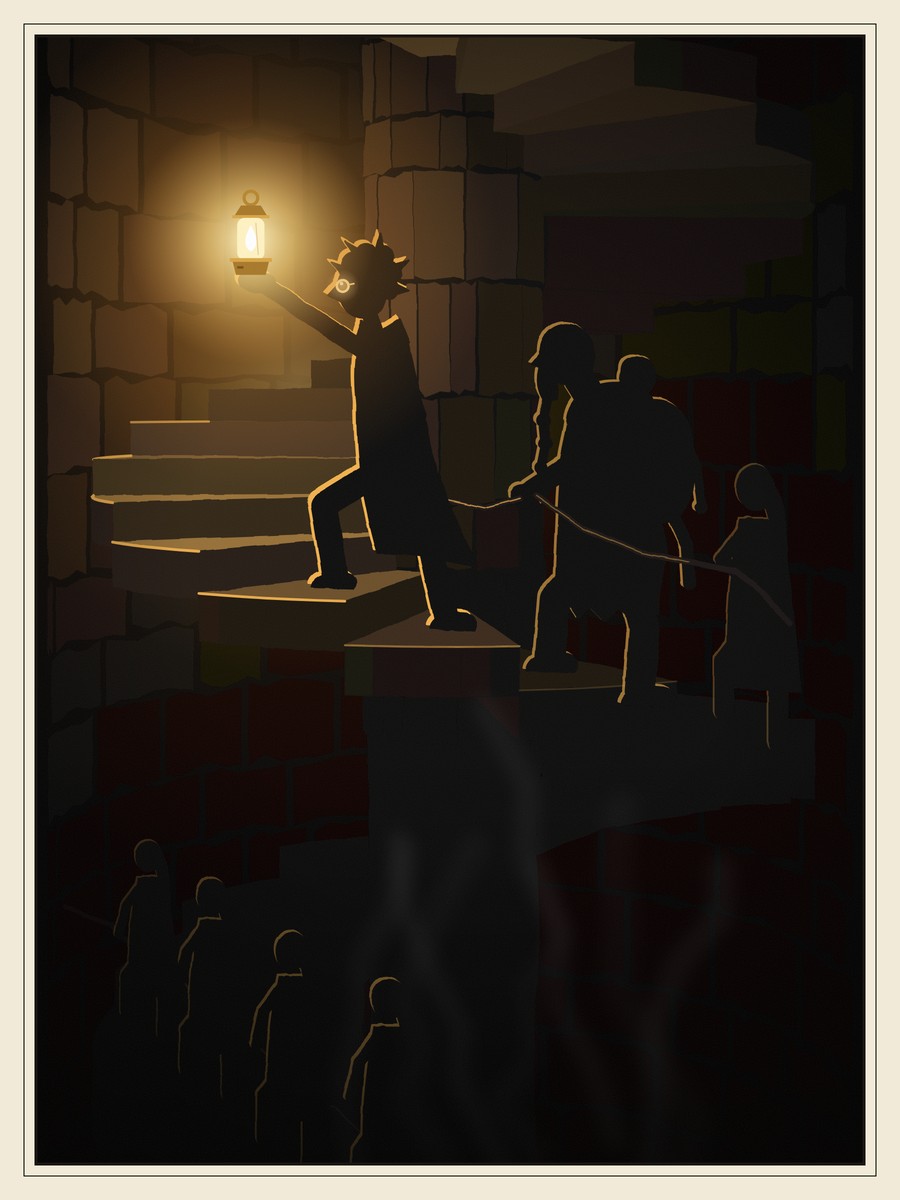
Tobin climbed.
And there was something else, though he never told anyone about it but Wren, much later, and he went red when he did. A little way above the gap in the wall, he became aware that he was not cold any more. Not the front of him, where the lamp was — that was always warm. The back of him: his shoulders, and the back of his neck, where the Hollow-draught had touched. It was as if someone were climbing just behind him, between him and Gorrim, close enough to touch. Someone very tall, who was not in the least out of breath. Someone warm.
He did not look round. He knew that if he looked there would be nobody there.
But his hands, he noticed, had stopped shaking.
“Two hundred and ninety-nine,” he said aloud, and his voice was steadier. “Three hundred. Three hundred and one.”
And from far, far below — so far that it came up the shaft as the ghost of a sound — he heard the groan of thick rope taking a heavy weight, and a clang of iron on stone, and a girl’s voice, in a dark with no light in it at all, shouting.
Chapter 10 complete
The Black Stair