Chapter 7 · 17 min read · 22 min listen
Mira’s Secret
Pell snored in two notes, and Oddny hummed.
That was the first thing Mira taught Wren, in a breath of a whisper, with her mouth so close to Wren’s ear that it tickled. All Delvers hum when they sleep, a low, contented sound like a pot simmering at the back of a stove; and Pell, who was large, added a snore on top of it, one note going in and a lower one coming out. So long as the two guards were making their noises, they were asleep. If either noise stopped, they were not.
“And then,” breathed Mira, “we are in a great deal of trouble. Come.”
Wren had never in her life crept anywhere behind somebody else. She was the one who knew the roofs and the flues; other people crept behind her. But she did as she was told. She scooped the lamp up off the floor of the hush-room and did up every button of her coat over it. She left Tobin on his blanket with his spectacles folded on his chest like a dead beetle, and Old Ash lying straight and still on his litter with his bad leg packed in Hessa’s moss-paste, his eyes open on the roof, saying nothing at all, and Cinder curled on Tobin’s collar. Cinder opened one eye as Wren passed. Then she shut it again, as if to say that she had seen nothing and would swear to it.
Mira stepped over the guards’ feet without a sound. Wren stepped over them with a great deal of care and almost no sound, and the humming and the two-note snore went on, and grew fainter behind them, and then there was only the drip of water and the soft pad of Mira’s bare feet, and the dark.
Mira did not walk like someone in the dark. She walked like someone in her own kitchen. Every few steps she made a small sound with her tongue against the roof of her mouth — tck — and listened, with her head a little on one side, and then went on, turning left, ducking under something Wren could not see, stepping long over something else. Wren held on to the back of her tunic and followed.
“How do you do that?” whispered Wren.
“I ask the stone where it is,” said Mira. Tck. “And it answers. Everything answers, if you ask it properly. Your head is about to — duck.”
Wren ducked. Something cold and rough brushed the top of her hair.
“Your people never listen,” said Mira, and Wren could hear that she was smiling. “You walk about the Deeps like falling rocks.”
“We’ve got eyes,” said Wren, a little stung.
“So I have heard,” said Mira politely. “They do not seem to be much use to you.”
At last Mira stopped, so suddenly that Wren walked into her.
“Here,” she said. And then, in a different voice, quieter and more careful: “No one else knows about this place. Not Gran. Especially not the Elders. I found it when I was six, and I have never brought anyone. Not once.” She paused. “You must promise not to laugh.”
“Why would I laugh?”
“Because everyone does,” said Mira simply.
“I promise,” said Wren.
Mira knelt and felt along the bottom of the wall. There was a scrape of stone on stone. Cool air breathed out at them from a gap no higher than a dog-kennel, and Mira wriggled into it like an eel. Wren went after her on her elbows, the way she had gone through a hundred flues, and came out into a space she could not see at all — only feel, from the way her breathing came back to her, that it was small and round and very still.
“Now,” whispered Mira. “Now you may have your warm thing out. The stone is too thick for anyone to feel it.”
Wren undid her buttons and took out the lamp.
I want to tell you about the Story-Wall properly, because it was one of the most beautiful things Wren ever saw. But I must tell you first that it was not made to be seen at all. It was made for hands.
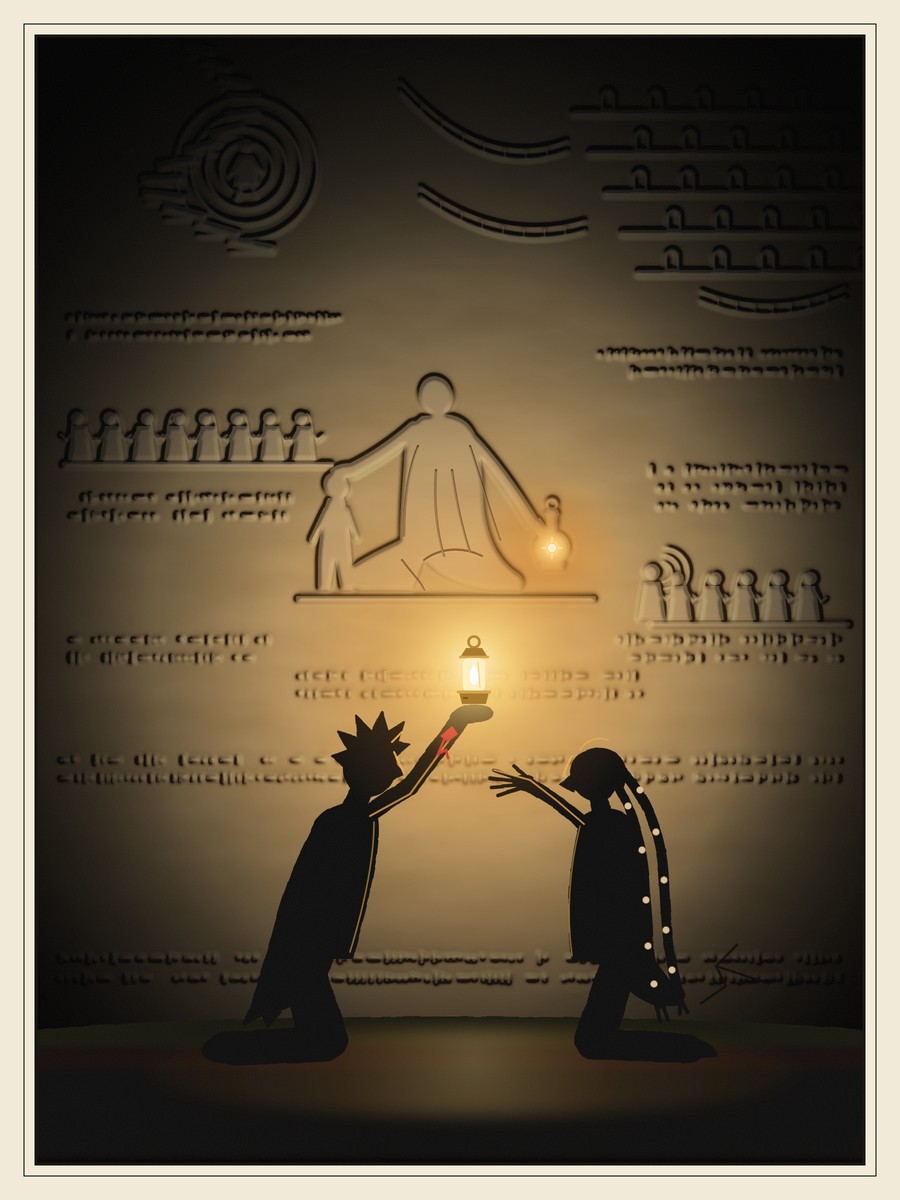
The chamber was round, like the inside of an egg, and not much bigger than Wren’s garret in Soot Lane. One whole side of it was a single sweep of pale stone, smooth as a cheek, running from the floor to high over their heads. And every inch of it was carved. There were Delvers, no taller than Wren’s hand, with their long fingers and their heads tipped to one side, listening. There were tunnels, and the terraces of Deepholm, and rope bridges hanging like cobwebs. And all through it, between the pictures, ran rows of tiny ridges and dots and grooves, which must be writing, though it was like no writing Wren had ever seen on a shop sign.
In the light of the little lamp every carving threw a small soft shadow beside it, and the whole wall seemed to rise up out of itself and stand there, alive. The people who had made it had never once looked at it. They had only known it was true to fingers.
Mira went to the left-hand end of the wall, where the carving began low down, and knelt, and laid her fingertips on the first row of marks. The stone was worn smooth there, Wren saw, as though a great many fingers had rested on that place over a great many years — and then, for a long time, only one small pair.
“It is called the Wall of the Warm Man,” said Mira. “It is older than Deepholm. I know it by heart. But I like to read it anyway. It is different, reading.”
Wren sat down cross-legged on the cold floor, with the lamp in her lap. Mira’s fingers began to move along the stone.
“In the long dark, before the songs were counted, a Man came down the Stair.”
Wren looked where the fingers went, and saw a long stair spiralling down out of the top of the wall, and a figure coming down it. All round him, on every side, the carvers had cut ring after ring in the stone, like the rings that spread on water when you drop a pebble in.
“He was warm,” read Mira. “Where he walked, the stone was warm after him.”
“Those rings,” said Wren softly. “Round him. What are they?”
“That is how we carve a sound,” said Mira. “A loud one — a song, or a bell. That is what a thing feels like to the fingers when it fills a room.” She tipped her head. “But he was not making a sound. The old carvers felt something coming off him that filled the Deeps, and they did not know how else to show it. So they carved it like a song.”
Wren looked at the rings spreading round the little stone man, and then down at the lamp, and at its light spreading out across the floor and her own knees in a soft gold ring. She did not say anything.
“He did not click, and he did not stumble. He walked as one who knows the way.
“He sat with the Delvers and ate their bread, and learned their songs, and sang them a new one.
“He laid his hands on the eyes of the children, and said: Here is a thing you have never heard of, and you will not believe it. There is a light. You cannot hear it, and you cannot hold it, but it is warm, and it is coming.”
Mira’s fingers had come to the middle of the wall. Wren lifted the lamp and leaned closer.
The Warm Man was carved larger here, kneeling. Before him a small Delver child stood with its face turned up. One of the Man’s hands rested on the child’s eyes, very gently. The other was held out a little to the side, and in it was something small, round-bellied, with a narrow chimney and a little hook on top.
Wren’s heart gave one hard knock against her ribs.
It was only a shape in the stone. It could have been a jug, or a bell, or a bird-cage. The carvers had never seen a lamp in their lives; how could they have carved one? And yet in the very middle of that little shape someone had set a bead of pale crystal no bigger than a pea, polished by years and years of fingers. As Wren leaned close, the light went into the crystal and caught there; and for the first time in longer than anyone in Deepholm could have told you, the little bead in the Warm Man’s hand shone gold.
“What is it?” said Mira sharply. “Your breath has gone strange.”
“Nothing,” said Wren. “Go on. Read the rest.”
Mira laid her fingers on the last lines, under the kneeling Man.
“Do not be afraid of the dark. It is not as deep as it sounds.
“One day you shall see. One day, all of you shall see.
“Then he went up the Stair, and the stone was warm behind him for a hundred years. Keep the stone warm, for he will come again.”
She took her fingers off the wall and folded her hands in her lap, and the little round chamber was very quiet.
“The children used to be told it, long ago,” said Mira at last, in a brisk, careless voice that was not quite brisk enough. “But the Elders said it was only a story to frighten children, because what is more frightening than a thing you cannot hear or touch? And it made the little ones restless, always asking when he was coming back. So they stopped telling it, and somebody walled up this room. All that is left of him now is the Burning that comes up the Black Stair to eat naughty children’s ears. They forgot the Man, and kept only the warm, and made it frightening.” She shrugged. “Then I found the gap. I was looking for a lost spoon.”
“Did you find the spoon?”
“No,” said Mira. “I found this. I told everyone about the Warm Man, when I was small. They laughed, and then they were sorry for me, which was worse. Speaker Gorrim told Gran I was a dreamy child who would grow out of it.” She lifted her chin. “I have not grown out of it.”
“But you’ve never seen it,” said Wren. “Light. You don’t know what it is. How can you believe in something you’ve never seen?”
Mira was quiet for a moment. Then she said, “How do you believe in the far side of a tunnel?”
“What?”
“When you are in a tunnel, and it goes on and on, and you cannot hear the end of it yet. You don’t sit down and say, there is no far side, because I have not got there. You feel the air moving on your face. And the air is coming from somewhere. So you keep walking.” She turned her face towards Wren. “I have felt the air on my face all my life. That is all. Something is coming from somewhere.”
Wren had nothing to say to that. She was a girl who believed in exactly what she could hold in her two hands, and not a crumb more. You could not eat a promise. You could not sell a story. And here was this girl, who had never seen anything at all, who had sat alone in the dark for six years with her fingers on a wall, believing.
Then Mira said, in a small voice with no mischief in it whatever, “Wren. Your warm thing. Is it — is that what the Wall means? Is that the light?”
I am sorry to say that Wren did not answer at once. A lifetime in Soot Lane is not undone in a week; and a small sharp voice at the back of her head said: careful. It’s yours. It’s the only thing that’s ever been yours.
And then another thought came, and pushed the first one out of the way, the way Cinder pushed her way into a warm lap. It cannot be bought, stolen or earned. Only given.
“I don’t know what your Wall means,” said Wren slowly. “But there’s an old man back in that cave who’d tell you there was a man once, who walked about with a lamp, lighting people’s lamps for nothing. And this is his lamp. Ash says.” She looked at the gold bead shining in the stone hand. “I don’t know if it’s the same man. I don’t know anything. But—“
She stopped. And then, before the small sharp voice could say anything else, she leaned forward, took Mira’s hand, turned it palm upwards, and put the lamp into it.
“Here,” she said gruffly. “You hold it. I’m giving it you to hold.”
Mira went absolutely still.
Wren had a quick cold flash of fright. She thought of Grubb in Crookback Market, yelping and shaking his burned fingers.
But Mira did not flinch. Her long pale fingers closed round the dented brass slowly, carefully, the way you might close your hands round a bird that has flown in at the window. The little flame stood up calm and golden in its cracked glass, and its light lay on Mira’s face — her thin, clever face, which had never once in its life been lit by anything — and turned it, very faintly, the colour of a peach.
“Oh,” said Mira. Just oh, very quietly, the way you say it when you step into warm water.
“It isn’t sickness,” she whispered. “They said it was sickness. It’s like when Gran sings the long song for the new babies, and you feel it here.” She pressed one hand flat against her chest. “But in my hands.” She held the lamp up close to her face and tipped her head as though she were listening to it. “It answers. I can’t hear it, but it answers.”
There was a lump in Wren’s throat the size of a walnut, and she did not care for it at all. “You can’t see it, though. Can you? Not even a bit.”
“No,” said Mira. “Not even a bit.” And then she smiled — a wide, sudden, delighted smile. “I can’t see your lamp, Wren. But I can feel that it’s true.”
They sat a long while after that, with the lamp passed between them, and Mira asked questions. The hardest was: what is a colour? Wren tried to tell her about the ribbon on her wrist, how it was dull everywhere else in the world, and here, near the lamp, it was red.
“What is red?”
“It’s—“ Wren had only known the word herself for a little while; it still felt new in her mouth. “You know when you come in out of the cold, and you hold your hands near a fire, and they go all prickly, and it hurts a bit, but it’s a nice hurt? It’s like that. But for your eyes.”
Mira considered this for a long time.
“I think,” she said at last, “that red must be a very good colour.”
“It’s the best one,” said Wren. “So far.”
Then Mira, without seeming to think about it, began to hum.
It was very soft, the way you hum to yourself when you are happy and do not know anyone can hear. And Wren felt every hair on her arms stand straight up.
She knew that tune. She had heard Hessa hum it over her basket only the evening before, and before that she had hummed it herself, on a straw mattress in a cold garret, on a hundred nights when she could not sleep. Morning comes, morning comes — and then the place where it always stopped, where there was only an ache.
Only Mira did not stop. Mira went straight on into the ache, as easily as walking through a door, and she was singing now, very low, in her careful Delver voice:
“— and the dark shall not keep us.”
Then she went back to humming, and the tune wandered on without words.
“What was that?” It came out much too loud, and bounced round the chamber. “What did you say? Sing it again!”
Mira jumped. “It is only the Wall-song, the one the Warm Man taught — the Waking Song, the grandmothers call it. It is carved at the bottom.” She put Wren’s hand on a row of marks near the floor, worn smoother than the rest. “But the stone has cracked there, and most of it is lost. I only have that one line. And nobody knows what the first part means. Morning. We have no word for it down here. It is only a sound.” She tipped her head. “Why? Do your people know it?”
Wren sat with her hand flat on the carved stone under the Warm Man’s feet, and could not speak.
And the dark shall not keep us.
It was only one line. But it was one more than she had had an hour ago, and nobody had sold it to her, and it had not come in a sweet cold voice at the top of a tower, promising her the rest if she would only give something up. It had simply been given: carelessly, by accident, by a blind girl humming in the dark. She said it over to herself once, without making a sound, so as to be sure of it, and tucked it away the way she tucked the lamp inside her coat.
“My mum knew it,” she said gruffly. “That’s all. Long time ago.”
Mira did not ask anything more. She only found Wren’s hand, and gave it back the lamp, and held on for a moment longer than she needed to.
When they had crawled out and pushed the stone back over the gap, Mira did not lead Wren straight back to the hush-room. She stood in the dark passage with her head on one side.
“They will lower you into the Silent Pit at the high turn,” she said. “All four of you. You can shout and shout down there and nothing comes back. Not even your own voice.” Her voice went hard and fierce. “The Wall says he will come again. I have believed it every day since I was six. And now you have come down out of the dark carrying something warm, and they want to throw it into a hole where no sound ever returns. No. I will not let them.”
“They’ll throw you down after us,” said Wren.
“Very likely,” said Mira. “You asked me for help, Wren Ashby. I heard how hard it was. So I am giving it.” She turned her face up the passage, and her voice dropped low. “There is a way out of Deepholm that the guards do not walk. It goes through the Whispering Galleries. They were cut for messages, long ago, and they are shaped so that every sound carries for miles. A whisper at one end can be heard at the other. A sneeze can wake half of Deepholm.” She paused. “So we will go now, before the high turn. And all the way through, none of us will make a single sound.”
Wren thought of Tobin, who could not cross a room without explaining it. She thought of Old Ash, who could not walk. She thought of Cinder, who sneezed sparks whenever she was cross.
“Right,” she said faintly. “Easy.”
And far off in the dark, outside the hush-room, Pell went on snoring in two notes.
Chapter 7 complete
Mira’s Secret