Chapter 6 · 17 min read · 21 min listen
The Elders’ Judgment
The high turn of the Hour-Stones is the loudest sound in Deepholm. Wren had not known that. She was asleep on Mother Hessa’s mats, with the lamp in the crook of her arm and Cinder across her feet, when every singing-stone in the city struck at once; and she sat bolt upright with her heart going like a hammer, quite sure that the roof of the world had fallen in.
It was only morning, or what passes for morning in a place that has never had one. The great note went rolling away down the cavern until it was only a shiver in the stone; and in the quiet afterwards, Wren heard the chime-curtain ring, and Dask’s lathe-turned voice saying, “The Elders will hear you now.”
The Hall of Answers was shaped like the inside of a shell.
Wren could tell that much before she uncovered the lamp, from the way the sound behaved. Every little noise they made — the scuff of her boots, Tobin’s cough, the creak of Ash’s litter — went curling away round a great smooth wall and came back from the other side, softened and multiplied, like a whisper passed from mouth to mouth. Hundreds of people were in that hall; she could hear them breathing and clicking under their breath. But not one of them spoke.
“Uncover the warm thing,” said the deep slow voice from the night before. “Let us all feel what it is.”
Wren drew out the lamp.
The hall leapt out of the dark around her. It was round and very high, and the walls went up in tiers of carved stone benches, ring above ring, like the inside of a great curled seashell, and every bench was packed with pale, white-braided Delvers. All of them flinched as the warmth reached them. A murmur ran round the tiers and came back doubled.
At the centre of the floor, where the company stood, was a single flat round stone, polished smooth by centuries of feet. “The Answering Stone,” Mira had told them on the way. “Whatever’s said on it, every seat in the hall hears. You can’t mumble on the Answering Stone. Tobin, you’ll hate it.”
Facing it, on a ledge of carved rock, sat seven Elders. And in the middle of the seven sat Speaker Gorrim.
He was the biggest Delver Wren had seen: broad as a door, with a white beard plaited past his belt, and great slow hands resting on his knees. His face was heavy and lined and very still, like a cliff that has been rained on for a thousand years. When the warmth of the lamp reached the Elders’ ledge, the other six turned their faces aside. Gorrim did not. He set his jaw against it, the way a man sets his shoulder to a door, and kept his blind pale eyes straight on the place where Wren was standing.
Down on the lowest bench, beside Mother Hessa, Mira sat with her hands folded in her lap and her chin up. Further along, a small boy was bouncing — Tavi, wriggling with excitement, with a grown-up’s hand clamped on his shoulder to keep him on the bench.
“Elder Ruen,” said Gorrim. “Speak the matter.”
A thin old woman at the end of the ledge rose. Her voice was dry and quick, like twigs snapping.
“Four Roof-folk came down through the Waste at the edge of the Low Hum,” she said. “Three, and a beast. One is hurt. One carries a thing that burns without fire, and makes all who come near it hot and strange. Two of the patrol are sick with it still. They say—“ she paused, as if the word tasted odd — “that it is light.”
A ripple of laughter went round the tiers: not cruel, quite, but the laughter of grown-ups when a child says something silly at table.
“Who speaks for the Roof-folk?” said Gorrim.
“I do,” said Old Ash.
He had made the Delvers prop him up on his litter, and his beard was combed, and his long hands were folded on his blanket; and in spite of the splints and the greyness of his face he looked, Wren thought, more like a king than anybody she had ever seen.
“My name is Ash,” he said. “Once I was Master Lamplighter of Emberwick, a city on the Roof, as you call it, far to the south. These are my companions. We are travelling to the Bright Mountain, and we fell into your country by accident, and we are sorry for the trouble we have brought you. We will go as soon as you show us the way.” He bowed his head, as far as the litter would let him. “And we are grateful for your bread.”
“Courteous,” said Gorrim. “Hrrm.” It was a low rumble, like a boulder settling, and nothing like Ash’s dry little hm. “And what is this thing your girl carries, Master Lamplighter, that makes my people sick?”
“It is a lamp,” said Ash. “There is a Flame in it, which was given to her. It makes no one sick. It is warm, because it is a Flame, and it gives light, because that is what a Flame is for.”
“Light.” Gorrim said the word slowly, turning it over. “My grandmother told me of light, when I was smaller than my son. Go not up the Black Stair, little one, she said, for at the top there is the Burning, and it will eat your eyes. Every child in Deepholm is told so. It is a good tale. It keeps children off the Stair, which is a thousand steps and kills those who climb it carelessly.” He leaned forward a little. “But I am not a child, Master Lamplighter. And I have never yet met a grown man who believed it.”
“If I m-may,” said Tobin.
Wren shut her eyes. She could not help it.
“Light,” said Tobin, stepping onto the Answering Stone, where his voice came back at him from every side so that he jumped, “is — technically — it’s what comes off a flame, and when it hits things it bounces off them into your eyes, and that’s how you — how you see them.”
“Into our eyes,” said Gorrim.
“Well — yes.”
“And yet here is your light, if you call it so, burning before the whole of Deepholm. And not one eye in this hall has seen anything at all.”
“That’s — that’s because—“ Tobin’s face had gone red; Wren could see it plainly, which made it worse. “Because your eyes have never — I mean, possibly, in the dark, over generations, they—“
“Are you telling the Elders,” said Elder Ruen sharply, “that there is something wrong with our eyes?”
“No! No, I — not wrong, exactly, just — different—“
The laughter came again, louder, and went round the shell of the hall and came back louder still. Tobin stepped off the Answering Stone with his ears scarlet, and stood behind Ash’s litter, and did not say anything else.
So Wren did the only thing she could think of. She walked onto the Stone herself and held the lamp out towards the Elders’ ledge in both hands.
She did not argue. She had heard what arguing got you. She only stood there and held it out — not like a weapon, and not like a thing for sale, but the way she had held it out on the bakery step in Soot Lane — and said, “Here. Feel it. It’s for you. You don’t have to do anything.”
And the lamp blazed.
It went up gold and white, so bright that Tobin cried out and Ash closed his eyes and smiled. The light ran up the tiers of the hall to the very top, and every carved spiral in the walls lit up with those threads of hidden colour, rose and green and gold, all the way round, like a necklace being lifted out of a box. The warmth went with it, and rolled up over the benches like a wave; and the whole of Deepholm, all those hundreds of people who had never been warm in their lives, gasped at once.
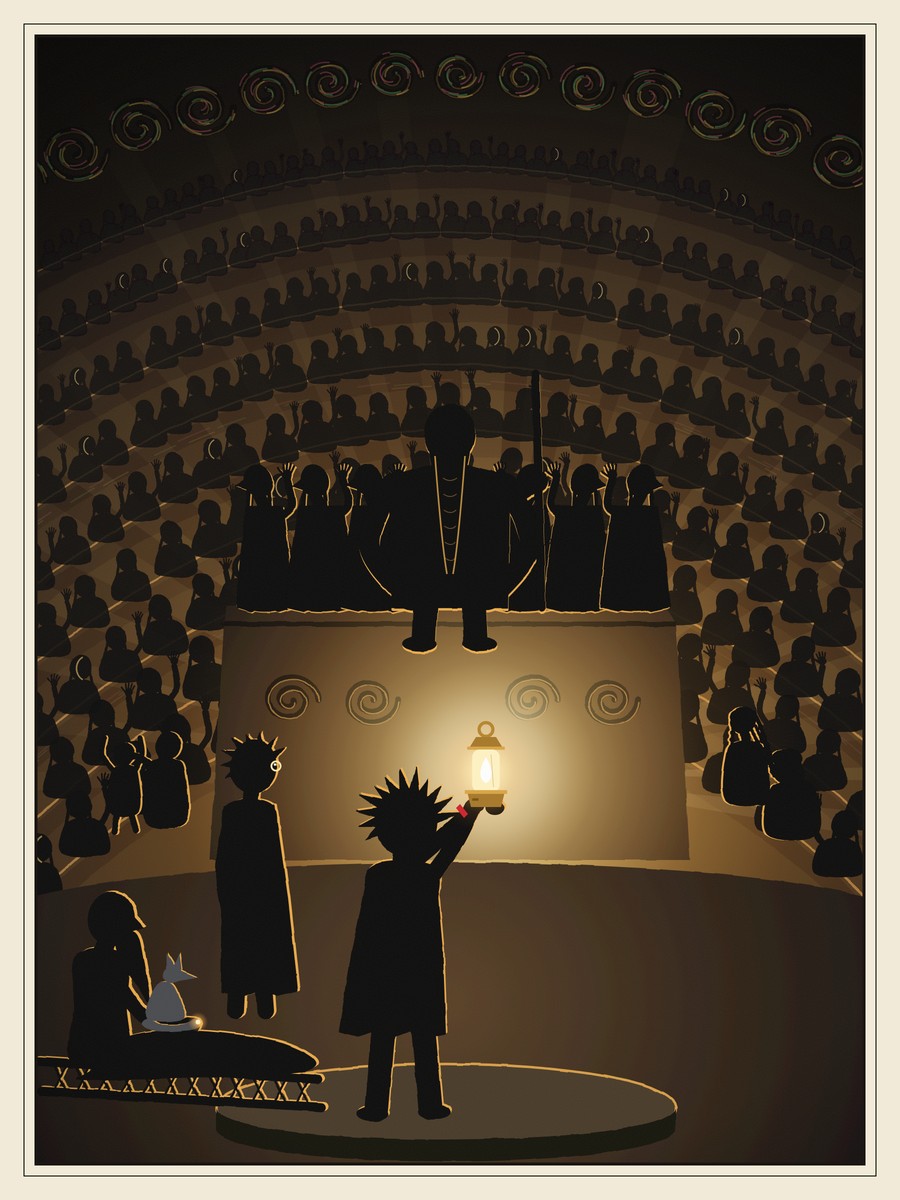
Some of them cried out in fear. A baby began to wail. But some of them — Wren saw it, and would remember it — some of them, here and there among the tiers, an old man, a girl, a woman holding a child, did not flinch away. They sat quite still with their faces turned into the warmth and their mouths a little open, as though they were listening to something a very long way off.
Gorrim rose to his feet.
“Enough,” he said; and the word went into the stone and came out of every wall. “Cover it.”
Wren did not move.
“Cover it, Roof-girl.”
She covered it. The hall fell back into blackness, and in the blackness she heard hundreds of people breathing hard, and a woman sobbing, and the baby still wailing; and Gorrim’s voice went on, slow and heavy as a cartwheel.
“A trick,” he said. “A hot stone in a box, such as any of our own smiths could make, if they wished to frighten fools. They carry a fever-stone in their coats, these Roof-folk, to make us sick and afraid — and then tell us nursery tales to explain it.” He paused. “Hear me, Deepholm. I do not say they mean us harm. Perhaps they believe their own tale. Perhaps the old man has carried his hot stone so long that he has forgotten it is only a stone. But hear this also.”
The hall was absolutely silent.
“Above us is the Waste. And on the Waste, of late, walk the cold ones. You have heard them. Our patrols have heard them, through the Roof, at the edges — the grey ones, the silent ones, who pass over and leave the moss dead behind them. And now these four come down through the Roof, out of the very place where the cold ones walk, with a fever in a box and a story in their mouths.” His voice did not rise. It only grew heavier. “I am Speaker of Deepholm. I will not risk my people on a story.”
“Speaker.”
It was Mira.
Wren heard her stand up on the lowest bench — heard the soft tick of the beads in her hair — and heard Mother Hessa whisper, “Mira—“
“Speaker,” said Mira, very clearly, “I was set to guard them. Let the guard speak.” She did not wait to be given leave. “I’ve walked beside them from the Waste to the Low Hum. I’ve held my hands to the warm thing. It isn’t a sickness, Speaker, I know sickness, I’m Hessa’s granddaughter. It doesn’t feel like a fever. It feels like — like standing next to someone who’s laughing. And the old stories don’t only talk about the Burning. The oldest ones say—“
“Enough.”
Gorrim did not say it loudly. He did not need to, on that ledge, in that hall. The word came down on Mira like a stone lid on a well.
“You are a child,” he said, “and you were set to guard, not to speak. Hessa. Take your granddaughter home.”
There was a short silence. Then Wren heard Mira sit down. But in the dark, from where she sat, came one small, clear sound, so quiet that nobody who was not listening for it would have noticed.
Click.
Wren did not know what it meant. She found out later that in Deepholm, one click alone, said soft and straight at somebody, means I’m here.
The Elders gave their verdict in a way Wren had never heard before, and hoped never to hear again.
They hummed. Each of the seven, one after another, sang a single long note into the dark, and the notes went round the shell of the hall and met each other. Where they agreed, Mira told her afterwards, they made one sound, round and whole. Where an Elder disagreed, the note would sit against the others and jar, like two bells that do not belong together. Wren listened hard. Five notes came together, deep and sure. Then a sixth. And the seventh — she was nearly certain — wavered, and rubbed against the rest, and then gave way and fell in with them, and was lost.
“It is heard,” said Gorrim. “At the next high turn, the Roof-folk will be taken to the Silent Pit, and lowered into it, with their warm thing and their beast. Let what they carry be carried where it can harm no one.”
There was a sound all round the tiers, like a great sigh going round. It was not a cheer. Wren found out afterwards why. The Silent Pit, Mira told her, was a shaft at the far end of the Deeps so wide and so deep that a stone dropped into it made no sound when it landed — or if it did, the sound never came back. For a Delver there is nothing worse. In the Pit you cannot click and hear an answer. You cannot hear a wall, or a floor, or a friend. You cannot hear where you are. Those who go down into the Silent Pit do not come up again; and the Delvers do not sing songs about them afterwards, because there is nothing to sing.
“Father,” came Tavi’s voice, high and anxious, from the far side of the hall. “Father, can I feel the warm thing first? Just once? Before it goes in the—“
“Be silent, Tavi.”
And that was the end of the trial — except for one thing, which I put in only because it is true. As the Delvers lifted Ash’s litter to carry him out, Cinder, who had sat through the entire judgment on his chest without moving a whisker, stood up, faced the Elders’ ledge, and sneezed. A spray of sparks went up into the dark and came down — Wren saw them by their own small light — directly in Elder Ruen’s hair.
Elder Ruen made a noise like a startled goose, and Wren felt a good deal better.
They were put in a hush-room for the night: a small square cell cut into the rock, with a door of heavy stone slabs on a rope, and two Delvers sitting outside it: a large one called Pell, and a smaller one called Oddny.
Hessa had been allowed to bring blankets and bread. She had not hummed once. She had laid her hand for a moment on Ash’s shoulder and said, “Deepholm isn’t all one note, Lamplighter. I want you to know that,” and gone.
Now the water-gates had been closed for the hush, and the Hour-Stones were silent, and in the cell there were only the small sounds of three people who were not asleep and were pretending to be.
The lamp burned on the floor between them. Wren had uncovered it the moment the door shut.
“There’s usually a way,” said Ash at last, into the quiet. He was lying very straight, with his hands folded on his chest and his eyes on the low rock roof. “Hm. Sometimes it walks in on its own feet. I’ve noticed that.”
“A pit,” said Tobin, to the ceiling. His voice was quite steady, which was somehow worse than if it had shaken. “With no sound. With no — I couldn’t. I really couldn’t. I think I’d rather the Hollows.”
Nobody answered him. Cinder got up, walked across Wren, lay down on Tobin’s chest, and put her chin on his collar; and after a while his breathing slowed.
Wren lay on her side and looked at the flame.
She knew what they needed. She had known it since the hall. They needed somebody who could walk in the dark, and knew the bridges, and the touch-roads, and the way out — somebody who belonged here and could go where they could not. They needed help.
And Wren Ashby did not ask for help. She never had. Not from Mott, not from Grubb, not from the pie-man on Tallow Bridge when she had not eaten in two days. Asking was the first step to owing, and owing was the first step to being owned. She had said it’s given door after door in Soot Lane, and meant it. But that had been giving. This was the other thing: holding out your own empty hand. Her whole self curled up tight at the thought of it, like a hedgehog.
She thought about the Long Table, and bowls coming out of the dark from hand to hand, and nobody counting. What the deep gives, the deep shares. She thought about the child kicking his heels on the bench, who had taken her bread without a word, as if being given things was the most ordinary thing in the world.
The chime-curtain on the far side of the stone door rang, very softly. Then came a door-note she had not heard before: one high, clear tone, like a single drop falling into a still pool.
Wren sat up.
“I’m not supposed to be here,” whispered Mira, through the crack beside the stone slab. “Gran thinks I’m asleep. So does Pell. Pell is asleep. Listen — he’s humming. We all hum in our sleep. While he hums, we’re safe.”
Wren crawled to the crack and put her face to it, and the lamplight fell through in a thin gold line, and lit one pale grey eye and the edge of a braid.
“Mira,” she said.
And then nothing else came out.
The words were right there, three little words, and they would not move. It was like trying to lift a coal-sack with one hand. Behind her, she knew without looking, Ash was watching, and was not going to say anything at all.
Mira waited. She was good at waiting; Wren had noticed that about her. At last she said, quite kindly, “You breathe very loudly when you’re being proud. Did you know?”
“Shut up,” said Wren. And then, all in a rush, before she could stop herself: “Mira. Help us. Please.”
It came out cracked and much too small. But the strange thing was — and Wren thought about this for a long time afterwards — it did not feel like paying. She had braced for coins going out of her hand, for board money going on the slate. Instead it felt like putting something down. Something heavy, that she had been carrying so long she had forgotten it was not part of her.
“Yes,” said Mira at once.
“You haven’t even—“
“I’d have said yes before you asked. I said yes in the Hall of Answers. Didn’t you hear me?” Click. One soft click, straight at Wren through the crack. I’m here. “But I’m glad you asked. I think you needed to hear yourself do it.” There was a faint scrape, and the rope on the slab-door creaked, and the crack began, very slowly, to widen. “Bring the warm thing, Wren. Not the others. Not yet. Just you.”
“Where are we going?”
The door stood open. In the lamplight, Mira’s face was very serious, and very bright, as if there were a lamp inside it too.
“I’m going to show you something,” she said. “Something in the deepest part of the Deeps that nobody else knows about. I’ve been there more times than I can count, all on my own, and I’ve never once shown it to anybody.” Her pale eyes rested, calm and unseeing, just to one side of Wren’s face. “You’ll understand when you see it. You’ll be the first person who ever has.”
Chapter 6 complete
The Elders’ Judgment