Chapter 5 · 16 min read · 21 min listen
The City of Echoes
The first thing Wren learned about Deepholm was that it had been built by people who did not care in the least what anything looked like, and cared enormously how it sounded.
She learned it on the bridge.
There was no warning. One moment there was stone under her feet; the next there was something that swayed, and creaked, and gave a little when she trod on it, and from somewhere a very long way below came the hiss of running water. Wren stopped dead.
“Rope bridge,” said Mira, behind her. “Keep walking. Stopping is the worst thing you can do on a bridge. It makes the bridge think you’re unhappy.”
“I am unhappy.”
“Yes, but the bridge doesn’t need to know.”
Wren walked, with her teeth clenched, and every step the bridge sang under her — a low, twanging note that went up as she reached the middle and down again towards the far side, so that she could tell, without seeing anything, exactly how far she had come. When she was nearly across she understood that this was on purpose. Somebody had strung the bridge so that it would tell you where you were.
After the bridge there was a ramp, and after the ramp a long ledge with a wall on one side and on the other nothing at all but the great humming dark, and all along it were doorways — Wren could hear them as they passed, each one breathing out a different sound: a mutter of voices, a child’s laugh, a pot bubbling, somebody snoring like a saw. Before some of the doors hung curtains of thin stone slips threaded on cords, and when anyone brushed past they rang softly, like teacups shaken in a basket.
“Chime-doors,” said Mira. “So you know who’s coming in. Everyone in Deepholm has a door-note. You hum it at the curtain, and then the people inside know it’s you, and not a stranger, and not a thief.”
“You have thieves?” said Wren, cheering up slightly.
“Not really,” said Mira. “But it’s polite to hum anyway.”
The Delvers brought them at last to a round room cut into the cliff of the ledge, set down Ash’s litter on something soft, and went away — all but Mira, who unpicked the cord from Wren’s wrists with quick light fingers.
“There,” she said. “Don’t run. There are three bridges between you and anywhere at all, and you can’t hear a single one of them properly. You’d fall off and then Dask would say I’d guarded you badly, and he’d be right.”
Wren rubbed her wrists. Then she pulled the lamp out of her coat.
She had been wanting to do it for so long that her hands shook a little. The light filled the round room in one warm breath, and there were Tobin, blinking and filthy and pushing his spectacles up his nose with both hands as if to make sure they were real; and Old Ash on a heap of woven mats, grey in the face, with Cinder curled on his good knee and her tail-spark beginning to glow again; and Mira, sitting cross-legged in the doorway with her face turned up into the warmth like a cat on a sunny step.
Then Wren went to the door and held the lamp out, as high as she could reach, and looked at Deepholm.
I wish I could show it to you as she saw it. But I cannot, because she saw so little of it, and that was the most astonishing thing of all.
The lamp’s light went out from the doorway in a gold ring, perhaps thirty paces each way, and then it simply stopped, the way a voice stops in a large room. Above that ring there was no roof that she could see. Beyond it there was no far wall. There was only darkness — not empty darkness, but darkness so full of sound that it seemed to move, the way a crowd moves even when you cannot see the faces in it.
And within the ring, everything was carved.
Every surface. The ledge they stood on was cut into long, shallow ridges like ripples in sand, which Mira said were roads: three ridges meant a bridge ahead, two meant steps, and a single smooth groove down the middle meant this way home. The wall above the doorways was carved in great sweeping spirals, so deep you could have put your arm in them to the elbow, and when the hum of the city passed across them they softened it, and gentled it, and sent it on. A little channel of water ran along the foot of the wall in a stone gutter, and every few paces the gutter had been shaped into a small lip, or a step, or a cup, so that the water fell and splashed and tinkled at a dozen different pitches as it went: a whole tune, played by one thin stream, over and over, all day long. Across the gap in front of them, just at the edge of the light, stood a column of pale stone, fluted like the pipes of an organ and taller than six men; and it hummed. Wren could feel it in the lamp’s brass.
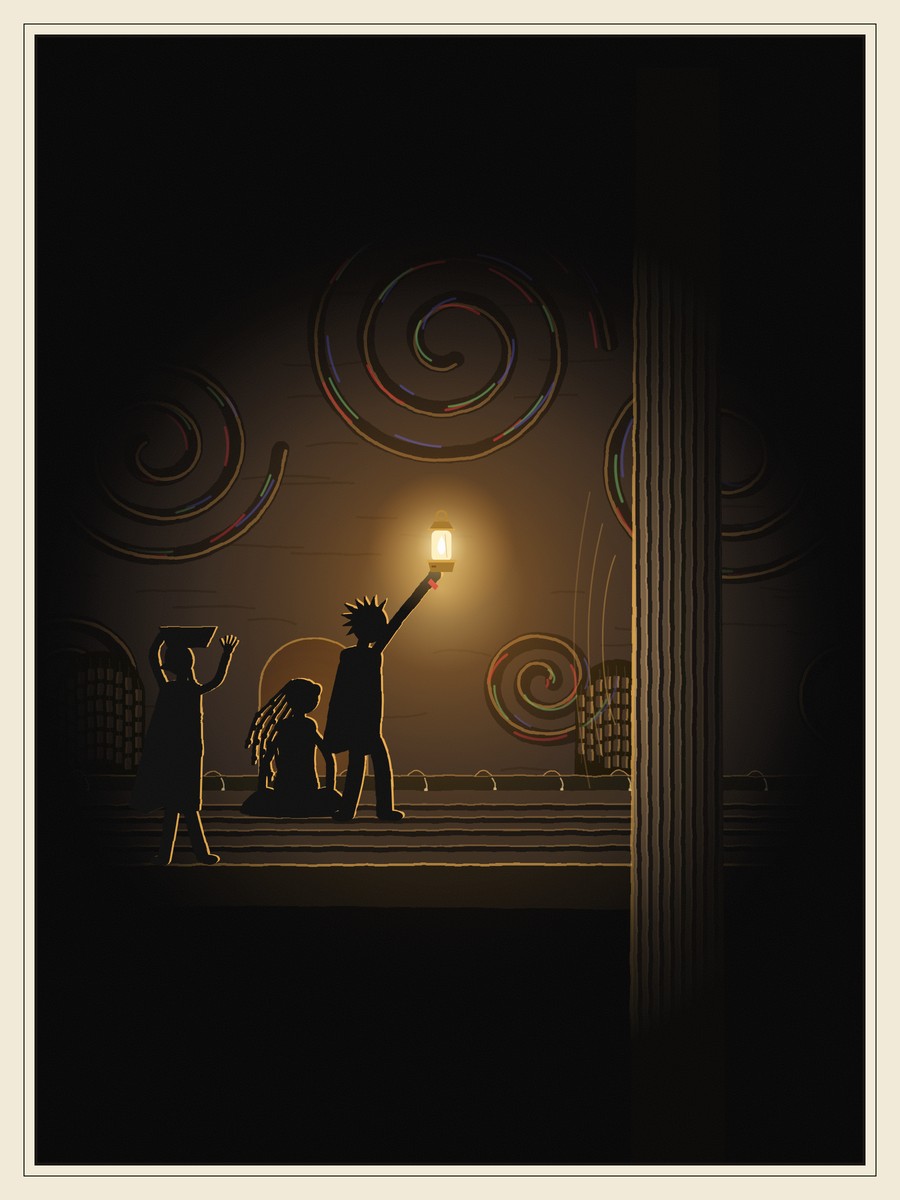
“Singing-stone,” said Mira. “One of the Hour-Stones. The water strikes it at every turn. That’s the low hum it’s making now, so it’s nearly the low turn, which means supper.” She tilted her head. “Why are you so quiet? Your breathing’s gone all round and soft.”
“It’s—“ Wren hunted for the word and could not find one. “It’s beautiful.”
“Is it?” Mira sounded pleased, and a little puzzled. “How can you tell? You haven’t even touched it.”
There was something else, too, that Wren did not mention, because she did not know how. The walls were not the dull grey of the Greywaste. Close to the lamp, in the carved spirals, there were veins running through the stone — fine threads and ribbons of colour that came out as the light touched them and faded as it moved away. One was the colour of her ribbon. One was the cut-grass colour of Mira’s bead. One was a colour like nothing she had words for, deep and still, like the hush in a room after somebody has sung. Nobody in Deepholm had ever seen them. They had been there in the dark all along, waiting, the way the red had been in her ribbon.
A Delver came along the ledge carrying a basket on her head. As she drew near the doorway she slowed, and flinched, and put up one hand towards the warmth; then she went past on the far edge of the ledge, as close to the drop as she could go, clicking anxiously.
“She thinks I’m catching,” said Wren.
“Everyone does,” said Mira comfortably. “Don’t mind it. Most people here have never been warmer than a bowl of soup.”
Mother Hessa came at the low turn, while the great column was still humming.
They heard her before anything else: a door-note at the chime-curtain, round and low and pleasant, like a pigeon on a roof — and then she simply kept humming, all the way in, and all the time afterwards, as though she had forgotten how to stop. She was a short, broad, quick old woman with a face as creased as a walnut and white braids wound round and round her head like a loaf, and she carried a basket that clinked, and she smelled strongly of pepper.
“Gran,” said Mira. “These are the Roof-folk.”
“So I hear. So does the whole of the Low Hum.” Mother Hessa set down her basket, turned her face towards the lamp, flinched, frowned, and turned it firmly away again. “Which is the leg?”
“Mine,” said Old Ash, from the mats. “Good evening, madam. Hm. It is very kind of you to—“
“Hush. I’m listening.” She knelt beside him and laid her hands flat on his leg, below the knee, and was silent. It was a strange sort of silence — very busy, Wren thought, the way a person is silent when they are reading. Her fingers moved an inch, and pressed, and moved again. Ash hissed through his teeth.
“An old hurt,” said Hessa at last, “and a new hurt on top of it, and a long fall on top of that, and a stubborn old man on top of the whole heap, walking on it when he should have been lying down.” She sniffed. “You’re lucky it’s not broken. It’s thinking about it.”
“I’ll ask it to think again,” said Ash.
“You’ll lie still for ten days, is what you’ll do, or I’ll sit on you.” She began pulling things out of her basket: a pot of grey moss paste that made Cinder sneeze sparks all over the mats; strips of soft woven cloth; two long splints of a pale, light, springy stuff that Tobin said afterwards must be some kind of cave-reed. “And if you so much as think about standing up, I’ll hear you thinking it.”
Wren felt a small, mean flicker of satisfaction. Nobody had ever told Old Ash what to do before. He was taking it like a lamb.
Then Mother Hessa stood up, dusted off her knees, turned round, and laid a cold wet cloth across Wren’s forehead.
“What’s that for?”
“Warm-sickness,” said Hessa. “You’re burning up, child. I could feel it from the door. Keep that on and drink this.” She pushed a cup into Wren’s hands. It was full of something pale and thin that smelled of mint and mushrooms.
“I’m not sick! It’s the lamp! It’s—“
“Yes, yes,” said Hessa kindly, in the voice of somebody who has heard a great many fevered people say a great many strange things. “Drink up.”
Behind her, Ash made a noise into his beard that might have been a cough. It was not a cough.
Wren drank, because it was easier than arguing, and it was not bad — a good deal better than Ash’s tea, which was not saying much. And while she drank, Mother Hessa went on humming as she packed up her basket: an old, slow, swinging tune, round and round, like somebody rocking a cradle.
Wren lowered the cup.
She knew that tune. She did not know how she knew it — she had never been within a hundred miles of this place — but she did. It went down where hers went down and turned where hers turned, and for a moment her heart did something odd and painful, like a foot missing a step on a dark stair.
“That song,” she said. “What is it?”
“Mm?” said Hessa. “Oh — an old hush-song. Every grandmother in the Deeps knows it. Mira, take these Roof-folk to the Long Table, or they’ll eat my mats.” And she was gone through the chimes, still humming, before Wren could ask anything else; and the tune went away along the ledge, getting smaller, until the water in the gutter covered it.
The Long Table was the great eating-hall of the Low Hum, and Wren never saw it at all.
“You’ll have to cover the warm thing,” Mira said. “There’ll be hundreds of people. They’ll all think they’ve caught something and nobody will eat, and then there’ll be leftovers, and nobody in Deepholm knows what to do with leftovers.”
So Wren wrapped the lamp away again, and Mira took Tobin’s sleeve and Wren took the back of Tobin’s coat, and they went out into the dark like a very small and very unhappy procession.
Wren was unhappy all the way there — bumping, stumbling, catching her shins on everything in Deepholm that could be caught on — but Tobin, in front of her, was not. Tobin was talking.
“The bridge,” he was saying. “The way the note changes as you cross — it must be the tension in the ropes, they’ve tuned the lengths so the pitch tells you your position, that’s — that’s actually brilliant. And the spirals on the walls, those are baffles, they’re absorbing the echo so the city isn’t deafening, and the water channels — Mira, does the water drive the Hour-Stones directly, or is there some kind of escapement, a—“
“I don’t know what an escapement is,” said Mira. “The water fills a stone cup. When the cup’s full it tips, and strikes the stone. Then it empties and starts again.”
“That’s an escapement!”
“Then that’s what it is. You don’t need to shout. I’m holding your sleeve. Low rock.”
He ducked without slowing down. “And the — what were they — the ridges on the floor—“
“Touch-roads. Your feet are on one now. Can you feel it? Two ridges. Steps coming.”
“I can feel it. I can actually feel it. Mira, this is the most—“ He stopped so suddenly that Wren walked into the back of him. “Oh,” he said, in a different voice. “Oh. I’ve forgotten to be frightened.”
“Have you?” said Mira. “I wondered when you would.”
Wren said nothing. But she held on to the back of his coat a little less tightly after that, and more as if she were walking with him than being towed.
They heard the Long Table from a long way off: a hall full of voices and the scrape of bowls, with a waterfall at one end that filled the whole place with a deep, soft roar, like a giant breathing in his sleep. There were children chasing each other under the benches, clicking and shrieking. And as Wren came in, groping for the edge of the bench, she knocked over somebody’s cup, trod on somebody’s foot, and sat down, very hard, in somebody else’s lap.
A shout of laughter went down the table.
“Why do the Roof-folk walk like that?” said a young voice in delight, from the other side of the board. “Like they’re carrying soup on their heads?”
“Tavi,” said a woman’s voice reprovingly.
“But they do! Listen to them! Bump, bump, ow! Didn’t anyone ever teach them to click?”
“They come from a place that’s all light, Tavi,” said Mira, with great dignity, helping Wren off a stranger’s knee. “They’ve never needed to. It’s like a fish that’s never learned to walk. You don’t laugh at a fish.”
“I would,” said Tavi. “If a fish walked into me.”
He came round the table, quick and bold as a sparrow, and before Wren could stop him he had put both small hands on her face — her forehead, her nose, her sharp chin — as lightly as moths. Then he did the same to Tobin, and jumped back with a squeak.
“This one’s got glass on his face!”
“They’re called spectacles,” said Tobin, a little stiffly.
“What do they do?”
“They help me to — well — see.”
“Does that help?” said Tavi doubtfully, and was hauled away by his collar by a grown-up who said something low about your father and the Speaker’s son, of all people.
Then the bowls came.
That was the part Wren remembered afterwards, longer than the bridges or the carvings or even the hush-song. They came down the table from hand to hand, out of the dark: a warm bowl of something thick and savoury with mushrooms in it, and a round of flat, chewy, faintly sweet bread, and a cup of water so cold it tasted of stone. Somebody put a bowl into her hands. Somebody else put bread on top of it. Nobody asked for anything. Nobody counted. Nobody said that’s yours or that’s mine, or who’s paying for the strangers? The bowls simply came, and people ate, and when somebody’s bowl was empty somebody else’s hands filled it.
Wren found that she had already slipped half her bread into her pocket — quickly, without thinking, the way she had done at every meal in her life, in case there was no next one. She sat with her hand over it in the dark and felt her face go hot.
“What do I owe?” she said, under her breath, to the woman on her left. “For the food. What’s the — what does it cost?”
The woman stopped eating. “Owe?” she said. She sounded genuinely puzzled, as though Wren had asked her what colour Tuesday was.
“She means,” said Mira, from Wren’s other side, “who does the bread belong to.” And then, to Wren, gently: “It doesn’t belong to anybody. The deep grows the mushrooms. The deep gives the water. All we do is carry it from one pair of hands to the next. What the deep gives, the deep shares. That’s all. It’s the first thing anybody learns here — before walking, nearly.”
Wren sat very still.
Then, slowly, she took the bread out of her pocket. There was a child next to her on the bench — she could hear him, small and snuffling and bored, kicking his heels — and she found his hand in the dark and put the bread into it. He took it without a word, as if it were the most ordinary thing in the world. In Deepholm, I suppose, it was.
She did not say anything about it, and neither did Mira. But a little later, when Wren put her hand to her coat, she could feel through all the folds that the lamp had grown warmer.
Further down the table, a small child was wailing that it was not tired, and would not go to sleep, and would not, and would not.
“Hush now,” said its mother, in a cheerful sing-song, “or the Burning will come up the Black Stair and eat your ears. Hot, hot, hot! Nibble, nibble!” And the child shrieked with laughter, and so did the children round it, and the mother laughed too.
“They think light is a bogeyman,” Tobin whispered, close to Wren’s ear. He sounded shaken. “Like a goblin, or the — the sort of thing you make up to frighten babies.”
Wren put her hand flat against the warm place over her heart, and said nothing.
Then a voice spoke from the head of the table, and the whole hall went still.
It was not a loud voice. It did not need to be. It was so deep and so slow that it seemed to come up through the stone bench into her bones, and every other sound — the bowls, the children, even the waterfall, somehow — drew back from it a little, the way a crowd draws back for somebody it is used to obeying.
“I hear,” said the voice, “that the Roof-folk who fell through the Waste are eating at the Long Table. And I hear that one of them carries a warm thing that makes our people sick.”
Nobody answered. Down the table, someone set a bowl down very carefully, so that it would make no sound at all.
“At the high turn,” said the voice, “they will come before the Elders. They will bring the warm thing with them. And we will hear what they are.”
There was a creak of a bench, and slow footsteps going away, and the clatter of the hall came back, but quieter than before.
Mira’s hand found Wren’s sleeve under the table. Her voice was the lowest Wren had heard it yet.
“That was Speaker Gorrim,” she said. “Tavi’s father. He’s head of the Elders, and he’s not unkind, and he’s not a fool. But he doesn’t believe in stories, Wren. Not one. Whatever you do tomorrow—“ her fingers tightened — “don’t tell him it’s light.”
Chapter 5 complete
The City of Echoes