Chapter 4 · 17 min read · 21 min listen
Down Among the Delvers
There are two kinds of dark in the world. There is the ordinary kind, which you find in a cupboard or under the bedclothes; wait in it a while and shapes come creeping back — the edge of a door, the gleam of a cup. And there is the other kind, which is found only deep under the earth, where no light has fallen since the world was made. Your eyes never grow used to that kind. It is like having your eyes shut and open at the same time.
Wren lay at the bottom of the long slope of stones in the second kind of dark and tried to work out which way was up.
Everything hurt a little and nothing hurt a lot, which she decided was good. And the lamp — she clutched at her coat — the lamp was still there, a hard warm lump against her ribs, wrapped tight where she had stuffed it when the mothwings came. Not a thread of light got out. She had done that so well that now she could not see her own hand.
“Tobin?” she said. Her voice came back from somewhere high up, smaller. “Ash?”
Stones slithered to her left. “I’m — here. I think.” Tobin’s voice was thin and shaking. “I’ve lost my spectacles. No — they’re on my face. They just aren’t doing anything.”
“Ash?”
A long pause. Then, from below and to the right, slow and dry as ever but with something tight underneath it: “Here, child. Hm. Still in one piece. Mostly.” A breath sucked in through teeth. “The leg has opinions.”
Then a cold nose pushed into Wren’s ear, and a small warm weight pressed against her side and stayed there. Cinder had her tail curled under her, the spark buried deep in her fur as she had hidden it in the swarm, and only the faintest red prickle showed where it lay. It lit nothing, not even Cinder.
Wren sat up. “Right,” she said, because somebody had to say something. “I’m getting the lamp out.”
Her fingers were on the top of her coat when Old Ash said, very quietly, “Wait.”
“Wait for what? We can’t see a—“
“Listen.”
She listened: pebbles trickling, water dripping somewhere far off, Tobin’s breath going much too fast. Then it came again — the sound she had half hoped she had imagined.
Click.
It came from somewhere above them on the slope: a small, dry, neat sound, like a fingernail tapped on a slate. Then another, from the right. Click. Click-click. Then from behind, and from the left, and from — Wren’s skin crept — almost beside her, so close she could have reached out and touched whatever was making it.
“Wh-what is it?” breathed Tobin. “Beetles? Some cave beetles, actually, make a noise with their—“
“Hush, lad.”
The clicks moved. That was the worst of it. They were not scattered about like crickets in a hedge; they were going somewhere. They came down the slope in a long, careful ring, and did not knock loose a single stone. Wren knew how hard that was. The hair stood up on her neck. Whatever was coming was better at the dark than she was.
She slid her hand into her boot, where she kept her knife.
“Keep the lamp hidden, child,” said Ash, very low. “We don’t know what it will do to them. Or what they’ll do about it.”
The clicking stopped. Then a voice spoke out of the dark — a man’s voice, low and soft and oddly musical, as if each word had been turned on a lathe before it was let out.
“Four,” it said. “Three large. One small, with fur. One breathes like a bellows. One is hurt — I hear the leg. And one—“ a pause, and a sniff — “one is warm.”
“Warm?” said a woman’s voice, sharp.
“Warm like a fever. Can you not feel it? From here.”
A murmur went round the ring. Wren caught the words sick, and the Roof.
“We’re not sick,” she said loudly. “We fell. Down a hole. Out of the sky, I suppose, as far as you lot are concerned. And we’re not stopping, so you can just show us the way out and—“
“It speaks,” said the man’s voice, with interest. “And rudely.”
“I’ll show you rude—“
Then a great many things happened very fast. A net dropped over Wren’s head and shoulders, soft and heavy and smelling of mushrooms. Cinder snarled and sneezed, and a shower of sparks went up, and for half a heartbeat they lit — a shoulder, pale as candle-wax, a white braid, an open hand — and then dark again. Somebody yelped. Tobin cried out. Ash said, “Peace! Peace, we mean no harm—“ and then grunted with pain.
Hands found Wren’s wrists in the dark — quick, cool, sure hands that seemed to know exactly where her wrists were before they touched them — and then let go at once, as if she had burned them.
“Ai! Hot as a hearth-stone. Don’t touch her. Net her and leave her be.”
Wren kicked at nothing, and missed, and kicked again, and was sat on, firmly, by someone who smelled of moss.
“Enough, child,” came Ash’s voice. “There are twenty of them, and they can see us, and we cannot see them.”
“They can’t see anything! It’s pitch black!”
“Hm,” said Old Ash. “Are you quite sure?”
They were not, as it turned out, killed. They were not even hurt, apart from Wren’s pride, which had been sat on. Somebody worked the knife out of her fingers, and her hands were tied in front of her with a soft cord by someone who took great care not to touch her skin. Then the voices went off to argue in low, singing murmurs, and somebody new sat down beside her on the stones.
“I’m set to guard you,” said a voice. “Please don’t run. You’re very bad at running. I’ve been listening.”
It was a girl’s voice, about Wren’s age, clear and precise, every word set down like a cup on a saucer — with something under the neatness that sounded very like a person trying not to laugh.
“I’m the best runner in Soot Lane,” said Wren.
“Soot Lane must be full of light, then. You run like someone who’s used to knowing where the ground is before her feet get there.” A pause. “Down here the ground doesn’t tell you. You have to ask it.”
Click. Wren jumped. It had come from right in front of her nose.
“Sorry,” said the girl. “I was looking at you.”
“Looking at me?”
“Hearing you. It’s nearly the same word, in the old speech.” Click. Click. The sound moved round her, curious as a cat. “You’re smaller than your voice. Your voice is twice your size.” There was a small rustle, as if the girl had drawn her knees up. “I’m Mira. Mira of the Low Hum, granddaughter of Hessa. Clear echo to you.” She waited. Then she added, helpfully, “That’s when you say And a true return. It’s rude not to.”
Wren said nothing at all, which was ruder still.
“Oh, well,” said Mira. “Never mind. What’s your name? I can’t keep calling you the warm one inside my head. It makes you sound like soup.”
In spite of everything — the dark, the cord, Ash’s breath hissing somewhere off to the right — Wren felt the corner of her mouth twitch. “Wren,” she said. “Wren Ashby.”
“Wren.” The girl tried it the way you might try a sweet. “A small quick sound. It suits you. What does it mean?”
“It’s a bird.”
“What’s a bird?”
“It’s — a little brown thing. It flies.”
“What’s brown?”
“It’s a colour.”
“Ah,” said Mira wisely. “One of those. And this warm thing in your coat. Is that a bird too?”
Wren’s arms tightened round her middle before she could stop them. “It’s a lamp.”
“What’s a lamp?”
“It makes light.”
There was a short silence, and then Mira laughed. It was not an unkind laugh. It was quick and surprised and delighted, the laugh of someone who has been told that the person in front of her keeps a dragon in her pocket.
“Light,” she said. “You carry light about in your coat. Like in the nursery stories. Like the Burning that comes up the Black Stair for children who won’t go to sleep.”
“It’s not a story. It’s real. It lets you see.”
“I can see.”
“Not properly—“ Wren stopped, because she had heard what she was saying, and it sounded stupid even to her. “I mean — it lets you see things that are far away. Without touching them. Without clicking at them. You just look, and there they are, all at once, every one of them.”
“How horrible,” said Mira, interested. “All at once? How do you know which one to listen to first?”
Wren did not know. She sat in the dark with her mouth open, which at least nobody could see.
“What does it feel like?” said Mira, more quietly. “Your light. When it’s on you.”
Wren thought of the garret in Soot Lane, and Mrs Fenn on her step saying her children’s names. “Like when somebody says your name,” she said slowly, “and they’re glad it’s you.”
There was a long pause. The clicks had stopped.
“Show me,” said Mira.
“You can’t see it.”
“Show me anyway.”
Wren looked — out of habit — towards where Ash had been. She could not see him, of course; and he did not say anything. So she worked her tied hands up to the front of her coat, and fumbled it open, and drew the lamp out into the dark.
Light poured out of it like water out of a broken jar. After that blackness Wren had to screw her eyes shut, and when she opened them she saw — all at once, every one of them — the people who had caught her.
There were about twenty, standing in a ring on the fallen stones, and they were pale: not grey, like the greyed, but pale like the inside of a shell, like a candle that has never been lit. Their hair was white, even on the young ones, and worn in many small braids. They carried long staves and coils of net, and their feet were bare. Their eyes were open, large and pale as pearls; and not one of those eyes turned towards the lamp. Not one. Instead every face in the ring had flinched sideways, the way your face flinches from an oven door, and every hand had come up, palm out, as though to keep off a heat.
“Cover it,” said the man with the lathe-turned voice — Dask, Wren learned afterwards he was called; tall and bony, with a white beard braided into two points. “Cover it, girl. It’s spreading.”
But the girl beside Wren had not flinched. She was thin and sharp-elbowed and a little taller than Wren, with a pointed face and a great many braids, and in every braid were threaded small round beads of polished stone that ticked softly against one another when she moved. She had put out both her hands towards the lamp — not palm out, to keep it off, but palm up, the way you hold your hands out to be given something.
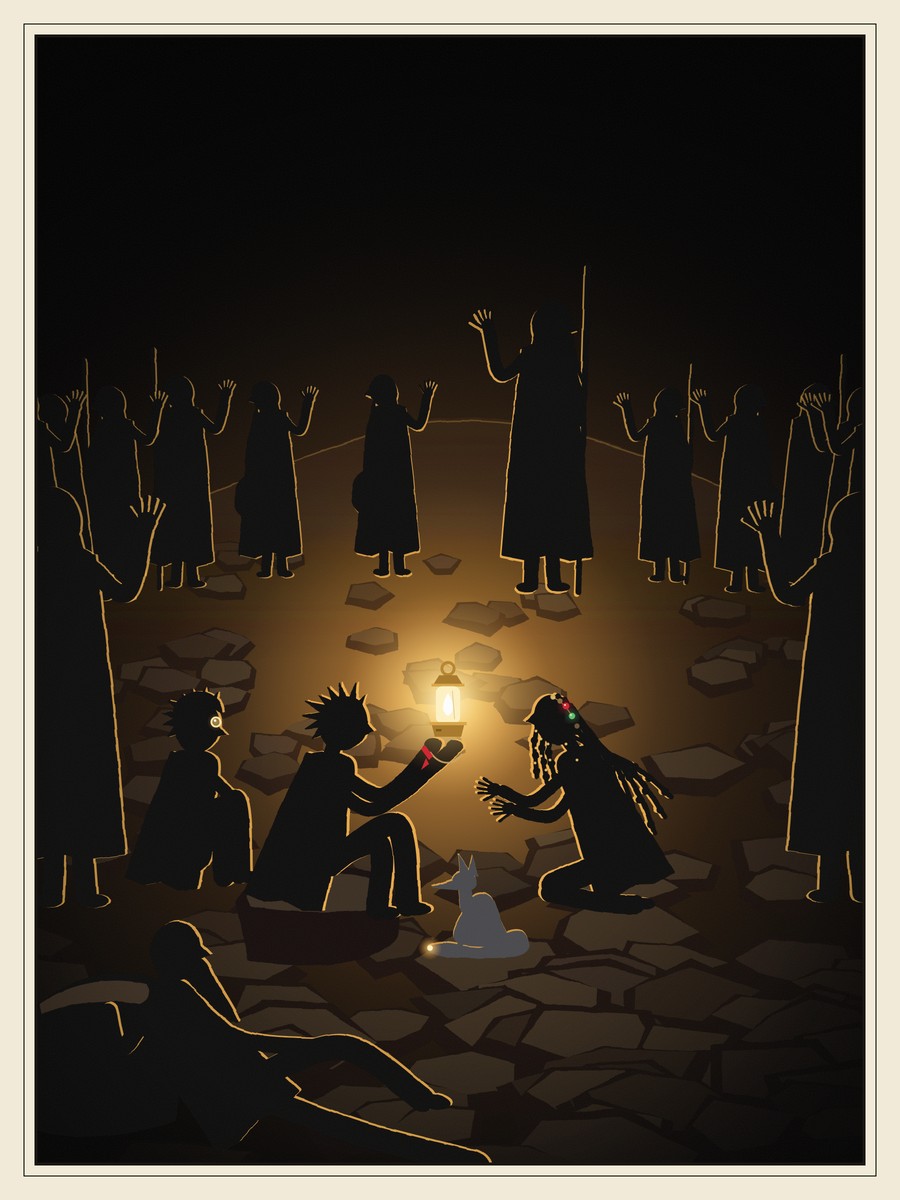
“Oh,” said Mira, very softly. “Oh. It’s like standing next to someone who’s laughing.”
Her eyes, the pale grey of a morning mist, rested a little to one side of the lamp, quite calm, not searching for anything. But her face was turned straight into the warmth, and she looked so astonished and so pleased that Wren, who did not usually notice faces unless they meant trouble, noticed hers and did not forget it.
Then Wren noticed something else. One of the stone beads in Mira’s hair, just above her ear, had caught the light, and it was not pale any longer. It had gone the same deep, glad colour as the ribbon on Wren’s own wrist. The bead beside it was a colour she had no name for at all: a cool, bright colour, like the smell of cut grass.
“Mira,” said Dask. “Away from it.”
“It isn’t hurting me.”
“It will. Fevers start pleasant. Away.” He turned his pale face towards Wren, and she understood with a jolt that he knew exactly where she was, and exactly how tall. “Cover it, Roof-girl, or I will cover it for you, and I would rather not touch the thing.”
Wren looked at Old Ash. He lay among the stones with his leg out at an angle she did not like, his face grey with pain. But he caught her eye, and nodded once.
“Do as they ask, child,” he said. “We’re guests.”
“We’re prisoners.”
“Guests who happen to be tied up. It happens to the best of us. Hm. Mostly to the best of us.”
So Wren wrapped the lamp in her coat again; and the dark came down like a lid; and the last thing she saw before it closed was Mira’s face, still turned towards where the warmth had been, smiling.
They made a litter for Ash out of two staves and a net. Four of the Delvers — that was what they called themselves, Mira said: Delvers, of Deepholm — lifted him onto it as gently as a basket of eggs, and when he gasped they stopped and waited without being asked. Cinder rode on his chest with her chin on his beard.
Dask ruled that the warm thing should stay with the warm girl. “She’s sick with it already,” he said. “No sense spreading it.” So Wren walked at the back of the line with the lamp bundled against her and a Delver holding the far end of her cord at the full stretch of his arm, as though she were a dog with something catching.
Then they set off into the second kind of dark, and kept going.
I should like to tell you that Wren was brave about that march. She was brave about most things. But she had never in her life been led anywhere she could not see, and it turned out she did not like it at all. The floor rose and fell without warning. Once she walked straight into a point of rock hanging from the roof, and sat down hard.
“Low rock,” said Mira’s voice, from up the line.
“Thanks for the warning,” said Wren, holding her forehead.
“I gave it. You were listening to your own feet.”
But it was not Wren whom Mira was walking beside. Wren could tell that, from the voices. It was Tobin.
He had not said a word since the net. But Wren could hear his breathing a few places ahead, quick and high and shallow. She knew that breathing. She had heard it in the dry stream-bed, just before the Hollows came, when he had frozen and Ash had stepped in front of him; and she had said things afterwards she was still not sorry for, quite. She could not think what to say now. So she said nothing, and listened to him breathe.
Then she heard Mira say, quietly, “May I?”
“M-may you what?”
“Put my hand on your sleeve. Only your sleeve. You’re breathing like a bird in a box.”
There was a silence. Then Tobin said, in a very small voice, “Yes. Please. Thank you. I’m — I’m not very good in the dark. I’m not — actually, I’m terrible in it. I always have been. I’m sorry.”
“Why are you sorry? You’ve never been here before. The dark’s only where everything is, before you’ve been introduced to it.” Mira’s voice was perfectly matter-of-fact. “Shall I introduce you? Listen. There’s water on your left, running fast, quite small — you could step over it. Hear it?”
“Y-yes.”
“The roof’s coming down in front. Not yet. Soon. Your voice will sound close when it does — say something.”
“Something,” said Tobin. Then, a few steps on, “Something. Oh. It — it went flat.”
“It did. Duck.”
He ducked. Wren, behind, did not, and caught her ear on the rock, and said a word that Mrs Fenn would not have liked.
They went on like that for a long time. Mira told him the dark the way you might tell somebody a road: here a wide place, where his footsteps went out and didn’t come back; here a stretch of stone worn smooth as soap by bare feet over hundreds of years. And Tobin — Wren could hear it happening — Tobin began to listen. His breathing slowed. After a while he began to ask questions. Then he began to count.
“Four hundred and twelve,” he said at last, sounding almost like himself. “Paces, since the slope. I’m trying to keep a map. In my head. If I know the distance and the turnings—“
“Four hundred and fourteen,” said Mira. “You don’t count your stumbles. Your stumbles are steps too, you know. They still get you somewhere.”
Tobin laughed. It was a small, shaky laugh, but it was a real one; and Wren, trudging behind with a lump on her forehead, felt something she did not much like. It was as if she had been carrying something heavy for a long way and had just watched somebody else pick up the other end of it without being asked — and she did not know whether she was glad or cross.
“Is your friend always so loud?” Mira called back. “He thinks very loudly.”
“He’s not my friend,” said Wren. “He’s just — Tobin.”
“Ah,” said Mira. “One of those.”
It was after what felt like hours that the air changed.
Wren felt it first on her face: a breath of moving air, cool and damp and enormous. Then her footsteps changed. All the march they had slapped back at her off close walls. Now they went away from her, out and out, and came back so faint and so late that they seemed to belong to somebody else.
The line stopped. Somebody up ahead hummed one long, low note — and from far off in front and below, as if the whole dark had been waiting for it, another note answered.
Then another. Then a dozen. Then more than Wren could count, high and low and between, until the black air in front of her was humming like the inside of a bell: a sound so big and so deep that she felt it in her teeth and in the soles of her feet. Under it, water was falling — not one stream but hundreds, splashing and trickling and tumbling, each one at its own pitch, so that they made a kind of tune together that never quite repeated. And under that, there were voices. A great many voices, talking and calling and laughing, children shrieking somewhere, a hammer ringing on stone, the creak of rope; and through all of it, everywhere, like rain on a roof, the soft dry sound of a thousand tongues going click.
Mira’s voice came out of the dark, close beside Wren’s ear. She must have dropped back down the line without a sound.
“There,” she said, and Wren could hear that she was smiling. “That’s Deepholm. Hush now, Roof-girl, and listen. You’ll never hear it for the first time again.”
And Wren, who had never in her life stood still to listen to anything that was not a threat, stood still in the dark with her hands tied and the lamp warm against her heart, and listened.
Chapter 4 complete
Down Among the Delvers