Chapter 3 · 16 min read · 20 min listen
Mothwing Weather
By the middle of the morning it was as warm as a kitchen, and the Greywaste was holding its breath.
Not a blade of grass moved. Not a twig stirred on the dead trees. The air lay over the plain thick and heavy and close, like a blanket that has been left too long in front of the fire, and the pale sun hung in it without a single cloud to keep it company. After a week of wind and frost it ought to have been pleasant. It was not. It was the kind of warmth you get in a shut-up room where somebody has been ill.
“I don’t like it,” said Wren, who had not said anything to anybody since breakfast.
Nobody answered her. That was how it had been all morning.
Old Ash was sitting on a stone with his bad leg stuck out in front of him, and Tobin was kneeling in the grass a little way off, working at something with his knife and a coil of wire and his whole attention. He had been at it since first light. He had not looked at Wren once. Wren had not looked at him either, except all the time, out of the corner of her eye, which does not count.
At last Tobin stood up and brought the thing over to Old Ash.
It was a crutch. He had made it out of a forked branch from a dead tree, stripped and trimmed, with a crosspiece lashed into the fork with wire and padded thickly with cloth so that it would sit soft under an arm. Wren looked at the cloth and knew it. It was Tobin’s spare shirt — the one he kept something wrapped up in at the bottom of his pack, which she had never asked about.
“It ought to take about half your weight, sir,” said Tobin, not quite looking at anyone. “If you lean on it properly. The fork spreads the load, you see, and the wire’s brass, so it won’t rust, and I’ve cut it to the length of your — well, I measured you while you were asleep, actually. I hope you don’t mind.”
Old Ash took the crutch and turned it over in his long hands. Then he fitted it under his arm, and got up — slowly, but he got up — and stood leaning on it, with his pole in his other hand, looking down at the boy.
“Hm,” he said. “That’s a good piece of work, lad.”
Tobin went pink to the tips of his ears.
Wren turned away and pretended to be very interested in a dead tree. She did not know what was the matter with her. She felt hot and cross and miserable, all at once, and she wanted very badly to say something, and every time she opened her mouth the wrong words were waiting behind her teeth.
They went on slowly that day, because there was no other way to go. Old Ash swung along between the crutch and the pole, his jaw set, and at every hundred paces he stopped and breathed, and they stopped with him. Nobody complained. Cinder, who had decided that the crutch was a new kind of stick put there for her benefit, tried twice to carry it off while Ash was resting on it, and the second time Old Ash sneezed at her. This surprised her so much that she sat down in the road and stared at him, and did not try again.
Towards noon they found Hartsease Spring. It was not much of a spring any more: a dip in the ground with a ring of old stones round it and a few inches of brown water at the bottom. But it was water, and it was cold, and they filled the skins and drank until their stomachs sloshed. Even Cinder drank, lapping noisily with her tail stuck straight up behind her like a candle. Tobin drank three times, very politely, as if the spring might be offended if he stopped.
It was there, sitting on the stones of the spring with his leg up, that Old Ash looked round at the still, heavy air, and sniffed, and said what he had been thinking all morning.
“Mothwing weather.”
“What’s that?” said Wren — and then, because the question had come out of her before she could stop it, she went red.
“A warm, still dusk after a cold spell,” said Old Ash. “Very like this one. The mothwings sleep in the ground all the cold weeks, under the roots of the dead trees. And when a day like this comes, they wake up and come out, all together, and go looking for light.”
“Moths?” said Wren. “Moths? We had moths in Soot Lane. They ate Mott’s best jacket. Nobody was frightened of them except Mott.”
“Not that sort of moth.” Ash held out his hands, as wide apart as a dinner-plate. “Mothwings. Their wings are like old glass, the coloured sort, in a window with the light behind it. Only grey, of course, out here. Everything’s grey. And they’re gentle, child. They don’t bite. They don’t sting. They’ve never meant harm to a living thing.”
“Then what’s the trouble?”
“The trouble,” said Old Ash, “is that they love light more than anything in the world. More than food. More than their own lives. And there are thousands of them. When a swarm finds a light, it settles on it. One on top of another, and another on top of that, until the light’s under a heap of them as big as a haycart. And whoever is holding the light is under the heap as well.” He looked at Wren, and at the bulge in the front of her coat where the lamp was. “They’ll smother a lantern in a minute. They’ll smother a man in five. Not because they want to. Only because they can’t bear to be anywhere else.”
Nobody said anything for a while.
“Well,” said Tobin at last, in a small voice. “That’s a horrible way to be loved.”
Wren said nothing. But she put her hand flat on the front of her coat, over the lamp, and kept it there for the rest of the afternoon. And she found herself thinking, without at all wanting to, of the way she slept every night with her fingers pressed against the brass, as if letting go of it for one moment might lose it for ever.
They did not see any mothwings all that afternoon, and Wren began to think that Old Ash had been making a fuss about nothing. But as the sun sank down the sky, pale and swollen in the heavy air, the stillness grew stiller, and the warmth grew warmer, and the grey grass round their feet seemed to be waiting for something.
They stopped for the night beside a stand of dead trees on a low rise. Tobin was gathering sticks. Old Ash was easing himself down onto the ground with his crutch. Wren had taken the lamp out of her coat and set it on a stone, the way she always did, to warm the place up before the fire was going.
And something came out of the dusk on soft, slow wings, and landed beside it.
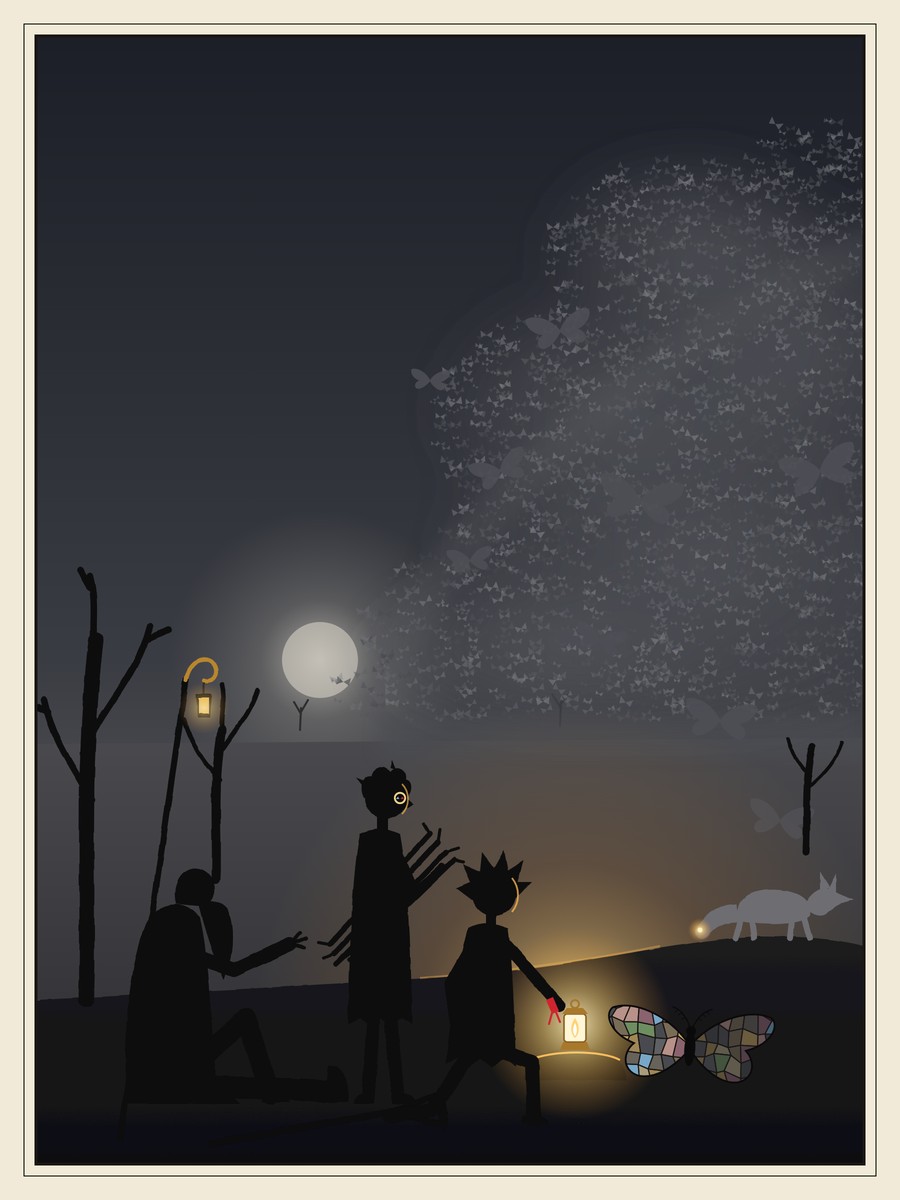
It was a moth. That is to say, it was shaped like a moth: a plump, furry body as long as Wren’s hand, two feathery feelers, and wings. But the wings were as big as the pages of a book laid open, and they were not dusty and brown like the wings of a Soot Lane moth. They were made — or seemed to be made — of a hundred tiny panes, each one set in a thin dark line like the lead in a window. Out in the dusk they had been grey. But the moth had come down within a hand’s breadth of the lamp, and in that light, as Wren watched, the little panes began to change.
They went faintly gold, first. Then one or two of them, near the edges, went a soft, deep colour like the inside of a shell. Then a pane went the colour of Wren’s ribbon, and another the cool fresh colour of the grass round the waystone, and one, right at the tip of the wing, went a colour Wren had never seen and did not have even the beginning of a name for, a clear bright colour like a far-off sky.
The moth sat beside the lamp with its great wings spread out, quite still, as if it were warming them. It looked as though it had come home.
“Oh,” said Tobin.
He had come up beside Wren without her noticing, with an armful of sticks, and he was staring at the moth with his mouth open.
“It’s like the window in the Guild Hall,” he whispered. “The big round one, over the stairs. My mother used to take me to look at it when I was small. There’s a story in it, in pieces of glass. Only you couldn’t really see the story, because all the glass had gone grey.” He swallowed. “I never knew it was meant to look like that.”
Wren looked at him sideways. In the lamplight his face was turned towards the moth, and his spectacles had two tiny coloured wings in each lens.
Now, she thought. Say it now. Tobin, what I said in the gully—
She opened her mouth.
And Cinder whined.
It was not a growl. It was a long, high, frightened whine, which Wren had never heard her make before. The ember-fox was standing at the top of the rise with her nose pointed out across the plain to the east, and every hair on her body was standing on end.
Wren looked where she was looking.
The plain was rising.
That is what it looked like, at first. The whole grey Greywaste to the east, as far as she could see, seemed to be lifting up off the ground in the dusk, the way dust lifts off a carpet when you beat it. Then it was not the plain. It was something coming up out of the plain — out of the grass, out of the roots of the dead trees, out of the ground itself — thousands and thousands of somethings, rising together into the still warm air in a vast, soft, rolling cloud. And there was a sound coming with it. It was the softest sound Wren had ever heard. It was like rain on a roof a long way off. It was the sound of wings.
The cloud turned in the sky, slowly, like a flock of starlings turning. And then it began to come towards them.
“Hide it,” said Old Ash. His voice cracked like a whip. “Hide it, child. Every scrap of light. Now.”
Wren snatched up the lamp and stuffed it into the front of her coat, and the lone moth beside it rose up in a flurry and went blundering after it, battering softly at her chest. She did up the coat over the lamp, all the way to her chin, and wrapped her arms round herself on top of that, and held on.
The light went out of the world.
Old Ash had pinched out his own little lantern on the hook of his pole. Tobin had kicked dirt over the beginnings of the fire. And Cinder — Wren saw it in the last of the dusk — Cinder curled her tail right round under her belly and lay on it, and buried the spark deep in her fur, until there was nothing to see of it but the faintest red prickle, like a coal at the very bottom of a dead grate.
Then the swarm came over them, and there was no more dusk at all.
It was like being caught in a snowstorm, if the snow were soft and warm and as big as books. The wings were everywhere. They brushed against Wren’s face and her hands and her hair; they whispered past her ears; they filled the air so thickly that the sky disappeared. It was not frightening at first. It was almost beautiful — the softness, and the hush, and the great slow beating all around. And then they began to land.
They landed on Wren.
She had hidden the light. But she could not hide the warmth. The lamp was burning against her ribs, warm as a loaf from the oven, and the mothwings could feel it through her coat the way you can feel a fire through a door. One settled on her shoulder. Then another on her back. Then three more, then ten, soft and heavy and clinging, crawling over each other to get closer, until she could feel the weight of them on her like a wet blanket, and then like two, and then like a pile of them.
“Ash,” she said. A mothwing brushed across her mouth, and she spat out a mouthful of dust and fur. “Ash—“
“I know, child. I know.” The old man’s voice came out of the dark close by, and it was calm, but it was the calm of somebody working very hard at it. “We can’t stay. They’ll bury her. We have to run, and keep running, until they lose the warmth. Cinder! Cinder — lead us.”
Wren heard a small sharp yip from somewhere ahead in the dark.
“Follow the fox,” said Old Ash. “Hold on to each other. Don’t let go, whatever you do. Lad — give me your shoulder.”
Wren put out her hand behind her, into the dark, into the soft blind storm of wings. She did not know what she was reaching for. She only knew that she could not run alone into a darkness she could not see.
A hand caught hers. It was a long, thin hand, with ink-stained fingers, and it was shaking. But it held on.
Neither of them said anything. There was no time to say anything, and anyway they would both have got a mouthful of mothwing. But Wren held on to that hand as tightly as she had ever held anything — tighter, almost, than she held the lamp — and Tobin held on to her, and on his other side he took Old Ash’s weight on his shoulder, and Old Ash swung along on his crutch, and somewhere ahead of them Cinder yipped and yipped again; and the four of them ran.
I do not know if you have ever run in the pitch dark across open ground. I hope you never have to. You cannot see your feet. You cannot see the ground. Every step is a step off the edge of the world, and you take it anyway, because the thing behind you is worse.
They ran through the grass, with the mothwings crawling over Wren’s back and shoulders and clinging to her hair, falling away and settling again. They ran stumbling over tussocks and through dry ditches and once, painfully, into a dead tree, which Tobin apologised to. They ran with Cinder’s yip always just ahead, pulling them on through the dark like a thread. Old Ash’s breath was coming in long harsh gasps. Tobin was making a little sound every time he put his foot down, half a word, over and over, and it took Wren a long time to understand that it was gloaming — gloaming — gloaming.
And slowly — so slowly that at first she thought she was imagining it — the weight on her back grew lighter.
They were losing her. Out here in the dark, running, with the warmth of the lamp wrapped tight inside her coat and her arms wrapped tight round that, the mothwings were losing her. One by one they let go and fluttered off, confused, into the night. The great soft roar of wings began to fall away behind.
“It’s working,” panted Tobin. “Ash — sir — it’s working, they’re—“
Cinder yipped. It was a different yip — short and sharp, a warning — and it came from much too close, and from somewhere below them.
And the ground was not there.
It did not crack, or tip, or give any warning at all. One moment there was grass under Wren’s feet, and the next there was a soft, dreadful tearing sound, like old cloth ripping, and the grass went down from under her, and she went down with it. She felt Tobin’s hand jerk in hers as he fell too. She heard Old Ash cry out. Then they were all falling — not straight down, but down and down a long, steep, rushing slope of loose stones that rolled and clattered and poured along with them, like sliding down the inside of a chimney full of gravel. Something struck her knee. Something struck her elbow. Stones were roaring all round her. She held on to the lamp with one arm and kept hold of Tobin with the other, and she did not let go of either, not once, all the way down.
It was a long way down.
At last the slope grew less steep, and the stones slowed, and she slid to a stop on her back in a heap of rubble, with the breath knocked out of her and dust in her mouth. The clattering went on for a while, further and further below, as the last loose stones went bouncing away into the depths. Then it stopped too.
Tobin’s hand was not in hers any more. She had not felt it go.
Wren lay quite still and opened her eyes as wide as they would go.
It made no difference at all. She had been inside more chimneys than anyone in Emberwick, and she had never known a dark like this. There was not a crack of grey anywhere — not above, where the hole they had fallen through must be, not anywhere. It was as if the whole world had been put out like a candle. The air was cold, and smelled of stone and water, and it was so quiet that she could hear the blood going in her own ears.
Somewhere above her, very faint, a single pebble trickled down the slope and was still.
And then, out of the dark, from somewhere she could not tell — near or far, above or below — there came a small, dry, careful sound.
Click.
Chapter 3 complete
Mothwing Weather