Chapter 2 · 17 min read · 21 min listen
The Hollow Hunt
In the cities, Hollows drift. They come over a dark wall like fog over a sea-wall, and wander the streets, and touch whoever they happen to find. But out on the open Greywaste, where there are no walls and very few people, they do something else. They hunt.
Old Ash told them this on the fifth day, and Wren wished afterwards that he had told them sooner.
The waterskins were nearly empty by then. The muddy pools by the road had dried to cracked grey plates, and Tobin had begun licking his lips and looking at the sky as if he expected it to do something about it. So at noon Old Ash sat down on a waystone, unrolled his map across his knees, and frowned at it.
It was the map they had stolen back from the Guild vault in Emberwick: an old, soft, brown thing, much folded, drawn in faded ink by Lamplighters who had been dead a hundred years. The Pale Road ran across it in a dotted line, with a tiny flame drawn at every waystone. And off to the east, a thin wavering line went wandering down to a little circle with a word written beside it in a careful old hand.
“Hartsease Spring,” read Tobin, leaning over. “Oh, good. A spring’s fed from underground, so even in a dry season it ought to—“
“Ought to,” said Old Ash. “Hm. It was there a hundred years ago. We’ll follow the stream-bed down to it. It’ll be quicker than the road, and out of the wind.”
So they left the Pale Road and climbed down into the stream-bed.
It was a long, winding gully with steep banks of crumbling earth on either side, taller than Old Ash in places, and a floor of round grey stones that had not felt water in living memory. It was out of the wind, as Ash had promised, and out of everything else. You could see nothing from the bottom of it but the two banks and a strip of dull sky.
Wren did not like it. She had grown up on rooftops, where you can see everything coming. After an hour of stones and banks and sky she could bear it no longer.
“I’m going up,” she said. “I can see further from up there. I’ll see the spring before you do.”
“Stay close, child,” said Old Ash.
“I’ll be right along the top. You’ll hear me.” She tucked the lamp into the front of her coat and went up the bank like a cat up a curtain. In a moment her head appeared over the edge, black tufts against the grey. “See? Right here. Shouting distance.”
“You just want to look for him,” said Tobin.
Wren did not answer, which meant that he was right. She had looked back for the grey rider every hour since the waystone, and seen him every time, always far behind, as if he were tied to them by a very long string. In the gully she could not see him. That was worse than seeing him.
So she went along the top of the bank, keeping pace with the others below; and as the afternoon wore on, and she got further ahead and then further ahead again, and found a dead tree to climb and then a ridge to look over, shouting distance became a rather larger distance than it had been at the start. I do not say this to blame her. She was twelve, and she had been told what to do by grown-ups all her life, and very few of them had been worth listening to. It takes a while to learn the difference.
The dusk came down early that evening, the way it does on the Greywaste in autumn, when there is no gold in the sunset to keep it company. The grey of the day thickened into the grey of evening. Old Ash lit the little oil-lantern on the hook of his pole, and it threw a ring of thin yellow light on the stones round them.
Tobin looked up at the top of the bank. There was no Wren on it.
“She’s gone too far,” he said. “Hasn’t she? She said shouting distance. I don’t think this is shouting distance any more. Technically, I suppose it depends how loudly you shout—“
Cinder growled.
It was a low growl, so low that Tobin felt it in the stones under his boots before he heard it. The ember-fox had stopped in the middle of the stream-bed. Her back was up, and her tail-spark had gone small and white and fierce.
Then the cold came.
It came down the gully from behind them, the way water would have come if there had been any water: a creeping, flowing cold that ran along the floor of the stream-bed and up the banks. Tobin’s breath went white in front of his face. The round grey stones at his feet grew a fur of frost, all at once, as if somebody had breathed on them. And the silence came with it, thick and woolly.
“Hm,” said Old Ash, very quietly. “Lad. Stand behind me.”
Round the bend of the gully, out of the gloaming, came the Hollows.
There were six of them. Seven. They came the way Hollows always come, not walking but drifting, grey and faceless, like smoke poured into the shape of a person and left to set. They made no sound at all. They did not hurry. They came along the stream-bed in a line, and when Tobin turned his head, his heart turning over, he saw that more of them were coming round the bend ahead, so that the gully was stopped at both ends like a bottle with a cork in each.
“They hunt in packs out here,” said Old Ash, in the same quiet voice. He lifted his pole, so that the little lantern swung high and the ring of yellow light grew wider. “Like wolves used to. They drive you into a low place, and then they close in.” He did not take his eyes off them. “Tobin. Listen to me. Shout for her. Loud as you can.”
The Hollows had stopped at the edge of the lantern-light. It held them — just. It was only Guild oil, after all, and Guild oil can only hold a Hollow back; it cannot hurt one. They hung there at the edge of the yellow ring, grey on grey, and the frost crept in under the light towards Tobin’s boots.
“Tobin,” said Old Ash. “Shout.”
Tobin opened his mouth.
Nothing came out.
I want you to understand that he tried. He told his throat to shout Wren as loudly as it had ever shouted anything. But it was like a dream, the kind where something is coming and your legs will not move. His throat had shut like a fist. His hands hung at his sides and would not lift. He stood in the stream-bed with his mouth open and his spectacles fogging, and he could not do anything at all while the grey shapes leaned in towards him out of the dark.
One of them came round the edge of the light.
It slid along the bank where the lantern’s ring was thinnest, as smooth as oil on water, and it came at Tobin from the side. He saw it coming. He saw the grey blank where its face should have been, and one long grey arm lifting, reaching, and he could not move.
Old Ash stepped in front of him.
He did it without a word, and quicker than Tobin would have believed an old man with a bad leg could move. He swung his pole, and the lantern on its hook swept through the Hollow’s reaching arm, and the Hollow flinched back from the oil-light. But the arm swept low as it went, and it passed through Old Ash’s left leg, just below the knee — the bad leg, the hurt one — as easily as a hand passes through mist.
Old Ash made a sound Tobin had never heard him make. He staggered. His foot came down on a round stone and turned under him, and he fell hard on the stones of the stream-bed, and the lantern went skittering away across the frost, and its light rocked and dwindled.
And the leg — Tobin saw it in the swinging light — the leg had gone grey. Not the grey of his old breeches. A grey that was in the skin and the boot and the very shape of it, from the ankle to the knee, like a leg made of ash that a breath would blow away.
Then Cinder went for them.
She went with a screech like a gate in a gale, all teeth and fury and sparks, and her tail blazed white, and the nearest Hollow drew back from her. But she was one small fox, and her spark was one small spark, and the grey shapes were closing in from both ends of the gully, slow and silent and sure.
And somewhere above, on the top of the bank, there was a scrabble of boots, and a shower of earth, and a voice shouting, “Ash! Tobin!”
Wren came down the bank on her backside in a landslide of dirt and dead roots, and the lamp was already in her hands.
She did not think about it. There was no time to think. She came off the bottom of the bank onto her feet and held the lamp out in front of her, and it flared — white-gold, all at once, like a door flung open on a summer morning.
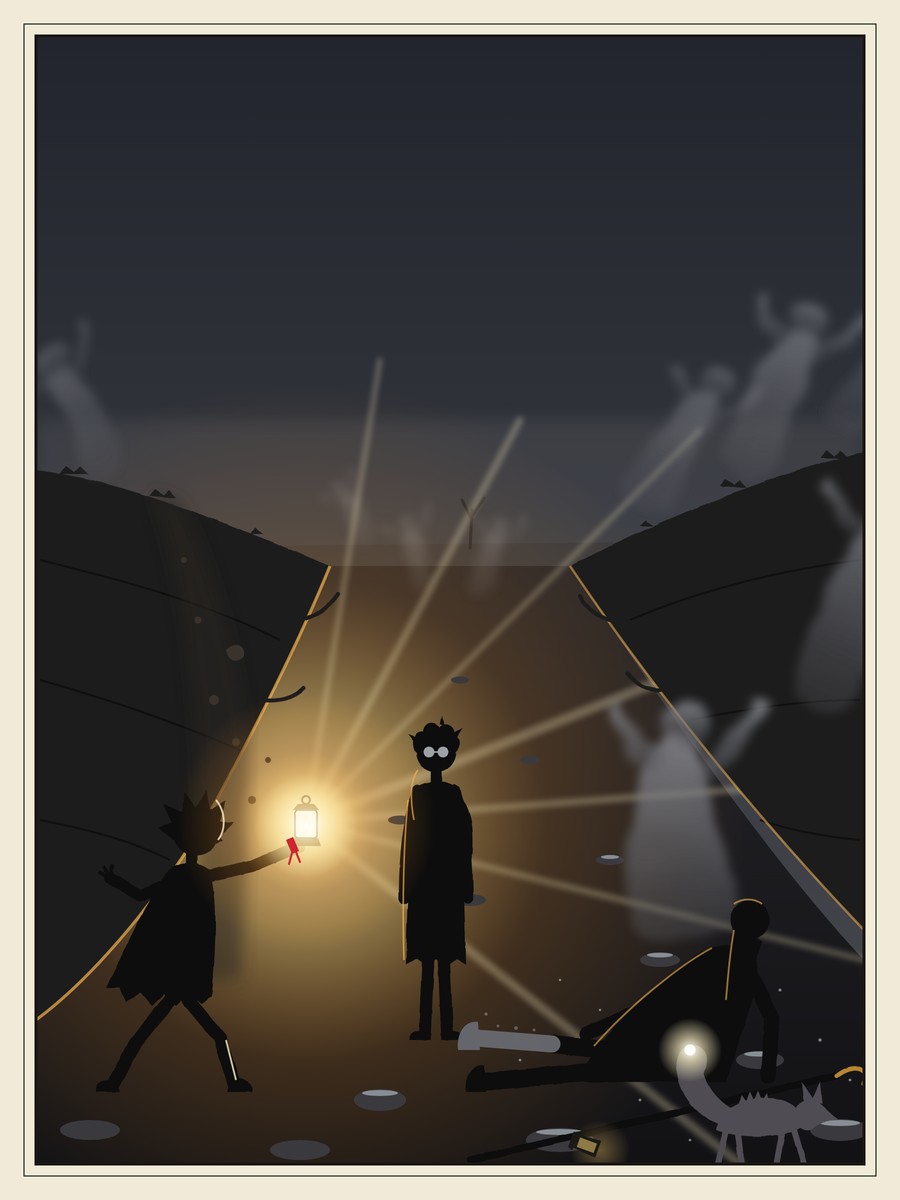
The Hollows shrieked.
It was the only sound they ever made: a high, thin, tearing scream, like wind through a broken window. The ones nearest the lamp twisted and shrank and fled, up the banks and over the top and away into the dusk, and the others went after them, from both ends of the gully at once, until there was nothing left but the frost melting on the stones and the smell of something burnt.
Wren stood there breathing hard. Then she saw Old Ash.
He had got himself up on one elbow. His face was grey too, now — not Hollow-grey, but the plain grey of pain — and his lips were pressed together so tight that they had gone white in his beard. The leg lay out on the stones in front of him, the colour of cold ashes.
Wren was on her knees beside him before she knew she had moved. She held out the lamp. She did not stop to remember the words, but they came anyway.
“Here,” she said. “It’s for you. You don’t have to do anything.”
The flame leaned out of the lamp towards the old man like a flower towards a window. The warmth went down over the grey leg, and the colour came back into it — slowly, from the knee down, the way a stain spreads through cloth, until his breeches were brown and his boot was brown and his skin above the boot was an old man’s skin again. Old Ash let out a long breath.
“Thank you, child,” he said.
“Can you get up?”
He tried. He got as far as one knee, and then his face went very still and white, and he sat down again rather suddenly.
“Hm,” he said. “No. Not just now.” The knee was already swelling under his breeches. “The colour’s come back, but that’s not the same as mending. The Hollow had the warmth out of it, and the stones did the rest. Twice in one week. I’m getting careless in my old age.”
“It wasn’t you that was careless,” said Wren.
She stood up and turned round. Tobin was standing exactly where he had been standing all along. He had not moved. His hands were still at his sides, and his spectacles were still fogged, and his face was the colour of the frost.
“You just stood there,” said Wren.
Tobin opened his mouth. Nothing came out of it this time either.
“He told you to shout for me. I heard him — I heard him, I was halfway back already — and you never shouted. You just stood there with your mouth open like a fish on a slab, and he had to get in front of you, with his leg, because you were too scared to—“
“You went off!” Tobin’s voice came back all at once, cracked and much too loud. “You took the lamp and went off! He told you to stay close and you said shouting distance and then you went off over the hill to look for — for him, for Varrick, and you left us down here with nothing but an oil-lantern, and you knew—“
“Don’t you dare—“
“—you knew we had nothing! It’s not even a proper light! It’s not ours, the proper light, it’s only ever yours, you never let it out of your hand—“
“Because I can’t trust anybody with it!” Wren was shouting now, and she did not care. “Look what happens! You can’t even shout! Some Lamplighter you’d make. You’re scared of your own shadow, Tobin Harrowgate. You’re scared of the dark. You’re nothing but a nob’s boy with a bag full of spanners who should’ve stopped at home with his father—“
She stopped.
She had not meant to say that last part. She had not even known it was in her until it was out. It hung in the cold air of the gully between them like something broken that cannot be put back.
Tobin did not say anything. He took off his spectacles and wiped them on his coat, slowly, though they were not foggy any more. He put them back on. Then he turned round and went to pick up Old Ash’s lantern from where it lay among the stones, and he did not look at Wren again.
Old Ash had watched all of it from the ground. He said nothing either. He only looked at Wren for a long moment, the way he had looked at her once in the Leaning Tower when she had said that nothing in the world was free; and Wren found that she would rather he had shouted.
They could not go on that night, and they could not go far the next. Tobin and Wren got Old Ash between them to a place where the bank had fallen in and made a hollow out of the wind, without speaking a word to each other, which is not easy when you are lifting a tall old man. Tobin built a fire. Wren set the lamp beside Ash’s leg, where its warmth could reach the knee. Nobody made tea, which shows you how bad things were.
Wren took the first watch. She sat on a stone with her arms round her knees and her back to the others and glared out into the dark, daring something to come. Nothing did. She thought about what she had said, over and over, and every time she thought about it, it was worse. She had never said sorry to anyone in her life, not and meant it. She did not know how you began; so she glared at the dark instead, because it was easier.
Tobin lay on his side with his back to the fire, and did not sleep.
He did not take out his mother’s night-lamp; he thought he did not deserve it. He lay with his eyes open in the dark and heard Wren’s voice again and again — you’re scared of the dark — and the worst of it was not that she had said it. The worst of it was that it was true. Old Ash had told him on the Beacon stair that courage was being frightened and standing anyway; and today he had been frightened, and he had stood, all right. He had stood like a post. And an old man had been hurt for it.
Long after Wren had woken Old Ash for the middle watch, and curled up with her hand on the lamp, and gone to sleep, a voice spoke softly out of the hollow in the bank.
“Lad. Come here a minute. I know you’re awake.”
Tobin went and sat down beside him. In the firelight the old man’s face looked very tired, and he held himself carefully, as people do when moving hurts.
“I’m sorry,” said Tobin. It came out in a whisper. “It’s my fault. Your leg. She’s right. I’m a coward.”
“Hm,” said Old Ash. “No. You’re not.”
“I froze. You told me to shout, and I couldn’t even—“
“I know. I was there.” Ash shifted his leg, and winced. “Listen to me, Tobin, because I’ll only say this once tonight, and I want you to keep it. Fear is not the same as cowardice. They’re not even cousins. Fear is a thing that happens to you, like cold, or hunger. It comes up out of your belly and takes hold of your legs, and you don’t get a say in it. A hare freezes in the grass when the hawk goes over. Nobody calls the hare a coward.”
“I’m not a hare.”
“No. You’re a boy who was frightened. That’s no shame.” Old Ash looked into the fire. “Cowardice is something else. Cowardice is what you choose afterwards, when you’ve had time to think, and you’ve seen what the fear cost, and you decide to let it have its way next time too. That’s the only kind there is. And you haven’t made that choice, lad. Not yet. You won’t have to make it for a while.”
Tobin was quiet for a long time.
“And when I do have to?”
“Then you’ll be frightened again,” said Old Ash. “I expect you’ll always be frightened of the dark. Some people are. I’m not asking you not to be. I’m asking you to remember there’s more than one way to stand in it.” He paused. “And I stepped in front of you today because I’m old, and that’s what old men are for. Don’t you take that away from me by calling it your fault.”
Tobin wiped his nose on his sleeve. “Sir. You knew. About the dark. Before she said it.”
“I’ve known since the gate.” Ash’s beard moved; it might have been a smile. “That little lamp in your pack, with the stars on it. Light it, if it helps. There’s no shame in a light, lad. There never was.”
Tobin went back to his place. He did not light the night-lamp. But he lay with his hand on his pack, where he could feel the shape of it through the canvas, and after a while, for the first time that night, he slept.
Old Ash sat up alone through the turning of the night, with his leg stretched out to the lamp. He did not wake Wren for the last watch. He kept it himself, and it was a long one, and he spent most of it looking at his knee, and then at the long way still to go to the mountain, and then at his knee again.
And when the morning came, it did not come grey and cold, as every morning on the Greywaste had come before it. The wind had dropped away to nothing in the night. The air hung over the plain thick and warm and perfectly still, like the air in a shut room, and not one blade of the grey grass was moving.
Old Ash looked up at the heavy sky, and sniffed it, and did not like it at all.
Chapter 2 complete
The Hollow Hunt