Chapter 1 · 17 min read · 21 min listen
The Pale Road
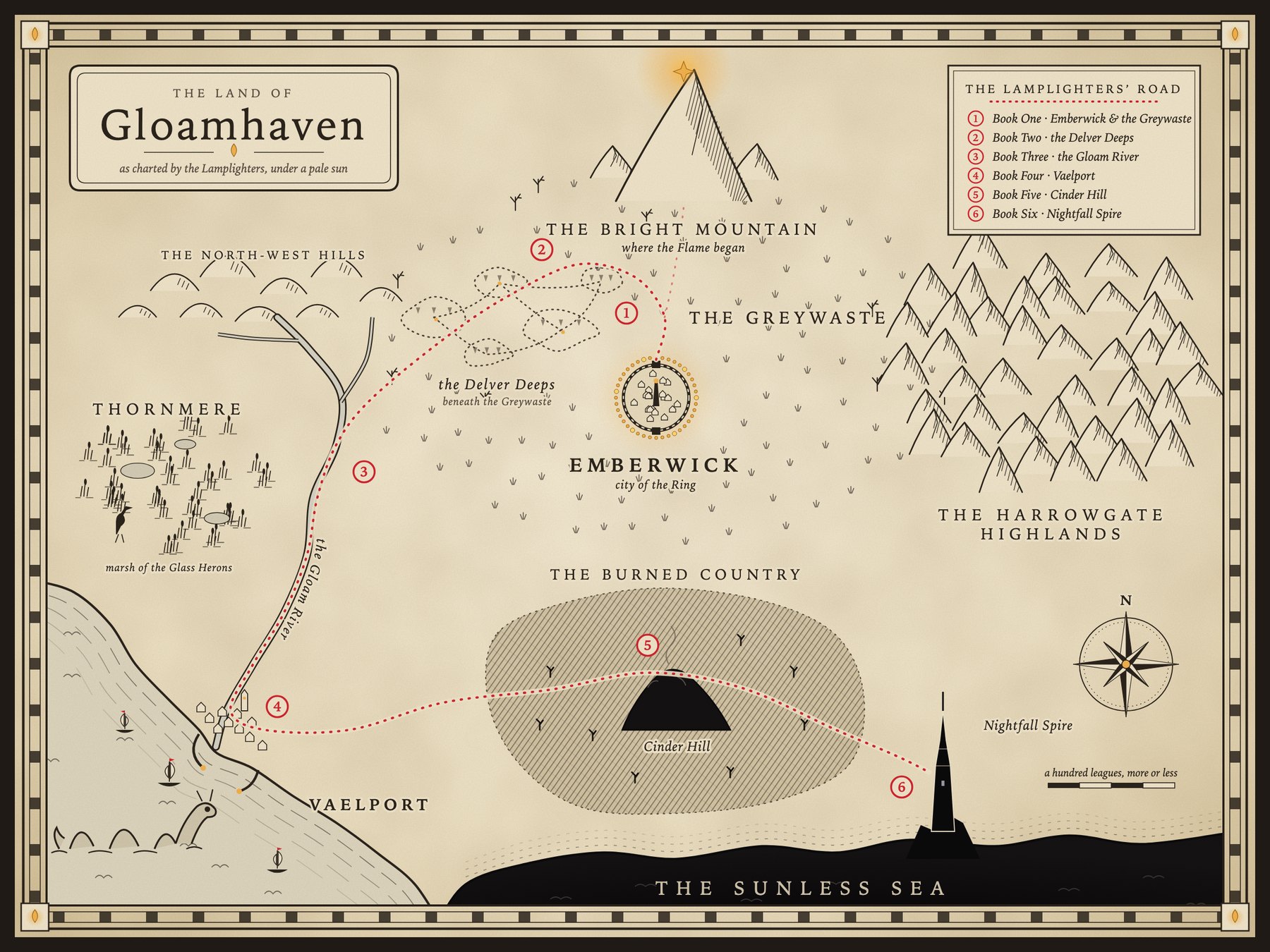
If you had been a bird — and there were not many birds left in Gloamhaven, so you would have been a lonely one — and if you had flown out over the Greywaste on the fourth morning after the Ring of Emberwick was lit, you would have seen a great deal of nothing.
You would have seen grey grass, mile after mile of it, bending in a thin cold wind. You would have seen dead trees standing about in ones and twos, black and bare, with their branches held up like people who have just been told something dreadful. You would have seen a road running away north and a little east until it was lost in the mist. And over it all you would have seen the sun, Solenne, hanging in the sky as pale as a coin seen through dirty water, and giving about as much warmth as a coin does.
But if you had flown a little lower, you would have seen one thing more. On that long grey road, very small, there was a spot of gold.
It was moving. It went at about the pace of four travellers walking, one of whom was limping; and that is exactly what it was.
At the front went a girl of twelve, or near enough, small and wiry and sharp in the chin, with black hair that stuck out in tufts because she cut it herself with a knife. Her name was Wren Ashby, and until a few days ago she had been a chimney-sweep in the Low Quarter of Emberwick, owing money to everybody and owning nothing at all. She still owned very little: a coat too big for her, boots too small, a heel of bread in her pocket that she had not eaten and did not mean to, and a ribbon tied round her left wrist. And she had the lamp.
It was not much to look at. It was small enough to sit in two hands, made of brass dented in three places, with a little hook on top and a glass chimney that had a crack in it as fine as a hair. It had no oil and no place to put any. But inside it burned a flame no bigger than the tip of a finger, golden and white at the heart; and in the light of it, Wren’s ribbon was red. It was the only red thing for a hundred miles. Wren had learned the word only days ago, and she still looked at the ribbon when she thought nobody was watching.
Behind her came a tall, gangly boy of thirteen who seemed to be made mostly of elbows. He had untidy fair hair, ink on his fingers, spectacles that kept sliding down his nose, and a pack so full of tools that he clanked when he walked. This was Tobin Harrowgate, the son of the Warden of Emberwick. He had a brass compass in his hand, and he was looking at it instead of at the road, which was why he had already fallen over twice that morning.
Behind Tobin, slowest of all, came an old man so tall and so stooped that he looked like a question mark in a coat. His beard was long and white and singed brown at the edges; his coat was patched all over and had once been blue. He leaned on a long pole with a brass hook at the top, from which a little oil-lantern swung, and every second step he took was a careful one, because his left leg had been hurt in the battle for Emberwick and had not yet forgiven him for it. His name was Old Ash, and he was the last true Lamplighter in Gloamhaven.
And round the three of them, ahead and behind and sideways and back again, ran a small fox the grey of old ashes, whose tail-tip glowed with a living spark like a coal. Her name was Cinder. She could not talk, but she understood everything, and she had already stolen two oatcakes from Tobin’s pack before breakfast.
Far behind them, a ring of gold fire burned on the walls of Emberwick. Wren had lit it herself, at the top of the Great Beacon, by giving the lamp’s flame away. It had cost her everything she had; and when it was done she had found, to her great astonishment, that she had lost nothing at all. But that is the story of another book. This is the story of what happened next.
“It’s still pointing the same way,” said Tobin. “I did think it might wander. Compasses do, technically speaking, when they’ve been tampered with. But it’s quite steady. North and a bit east.” He looked up at the edge of the sky, where a faint pale point stood above the mist like the tip of a tooth. “Straight at the Bright Mountain.”
“You said that yesterday,” said Wren.
“Well, it’s still true.”
“Facts don’t stop being true just because you’ve heard them, Wren.”
“No,” said Wren, “but people stop listening.”
Old Ash, behind them, said “Hm,” which might have meant anything, and stopped.
At the side of the road, half sunk in the grey grass, stood a post of stone about as tall as Wren. Near the top a small niche had been cut into it, like a cupboard with no door, and the niche was empty. Below that, worn almost smooth, someone long ago had carved the shape of a flame inside a ring.
Old Ash limped over and laid his long hand on the stone, very gently, as you might lay your hand on the neck of an old horse. “Waystones. The Lamplighters set them a league apart all along this road, from Emberwick to the mountain. There was a light in every one of them once. You could walk the whole road by night and never be in the dark for longer than an hour.” He looked along the road, grey and empty both ways. “They called it the Pale Road, because it showed up pale in the dark, between the lights. Hm. It’s only pale in the daytime now.”
“What happened to the lights?” said Wren.
“What happens to all of them. Somebody stopped tending them.” He looked down at her, and then at the lamp. “Would you, child?”
Wren held the lamp a little tighter. She did not mean to. Her hands did it on their own, the way your hand closes on a coin in your pocket when someone in a crowd brushes against you.
“Would I what?”
“Give it one.”
She looked at the niche. It was full of dust and dead grass and the dry husk of a beetle. In an hour it would be behind them, burning away for nobody at all. It seemed, to a girl from Soot Lane, a terrible waste.
Then she remembered the top of the Beacon, and the little flame sliding off the lip of the lamp like a drop of honey, and her certainty that it was gone — and what had happened after.
“It hasn’t got a wick,” she said. “Or oil. Or anything.”
“It never needed them,” said Old Ash. “Neither does the lamp.”
Wren brushed out the beetle with her sleeve. Then, a little awkwardly, because she was still not used to doing it, she tipped the lamp towards the niche and said, under her breath so the others should not hear, “Here. It’s for you.”
A bead of gold ran off the brass and dropped onto the bare stone.
And it stayed there. It stood up straight on the bottom of the niche, on nothing at all — and then it grew. It grew until it filled the niche and spilled warm light down the face of the old stone, and the carved flame in its ring seemed to leap; and the warmth came out across the road and touched their faces like the first fire of winter.
Tobin made a noise like a kettle.
“But what’s it burning?” he said. “It has to be burning something. Fire’s a process, it needs fuel, that’s the whole point of—“
“Look at the grass,” said Old Ash.
All round the foot of the waystone, in a circle about as wide as a cartwheel, the grey grass was changing. It was the faintest wash of colour, like a drop of ink in a bucket of water. But it was there: a fresh, cool, living colour that none of them had a name for, and that made Wren think of the smell after rain.
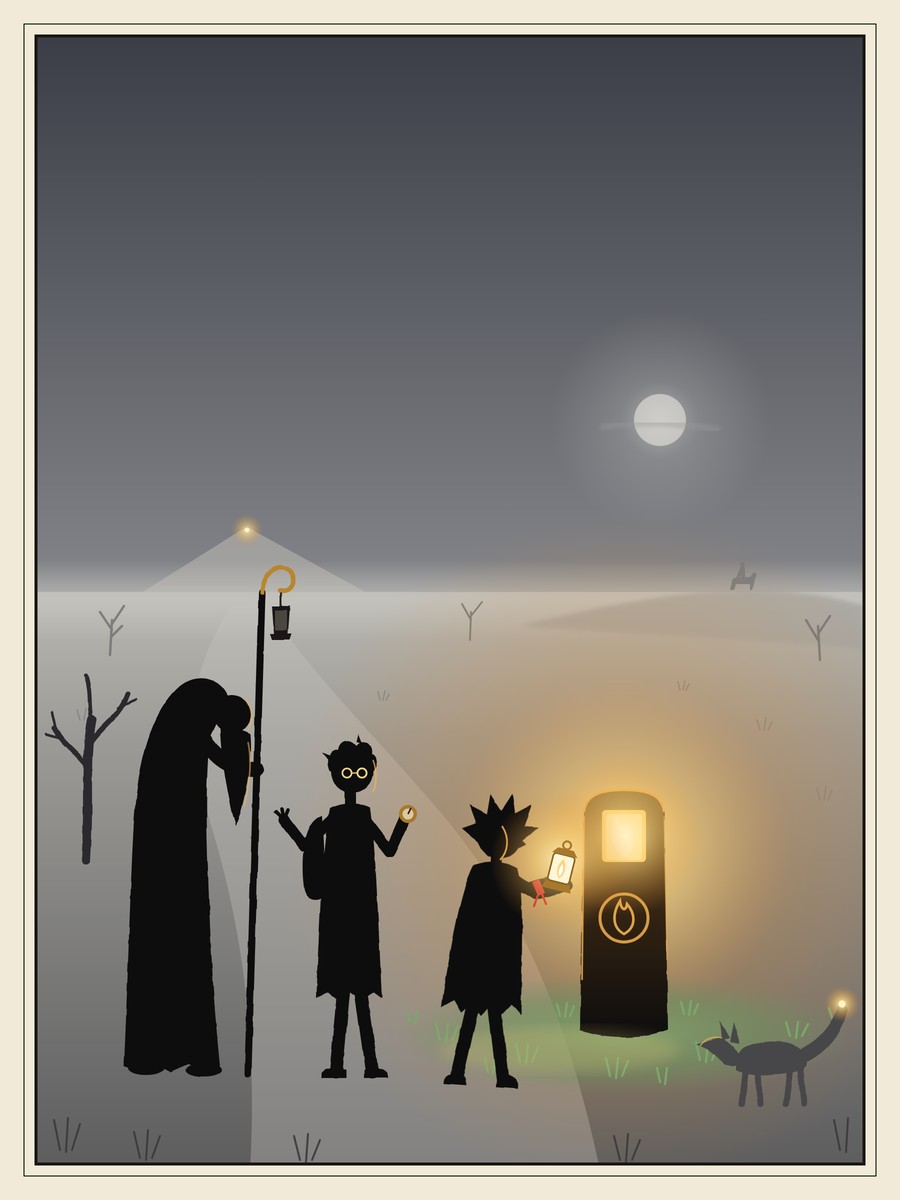
“Green,” said Old Ash softly. “That’s green, that is. I’d nearly forgotten.”
Wren looked down at the lamp. She knew already what she would see, but she looked anyway, because she was still not quite sure she believed it. The flame was not smaller. If anything, it was brighter than before.
“What is given, grows,” said Old Ash. He did not say it as if he were teaching her. He said it as if he were reminding himself.
They walked on. Wren did not look back for nearly a mile, because she did not want the others to see her do it. When she did, the waystone was a tiny point of gold far behind them on the grey plain; and she found that it did not look like a waste. It looked as if somebody had left a door open for whoever came next.
They camped that night in the lee of a dead tree, because it was the only thing for miles that kept off any wind.
Tobin built the fire, with a great deal of explanation about draughts and kindling and the proper ratio of small sticks to large ones. Wren, who had been lighting fires in other people’s grates since she was five, let him get on with it and did not say a word, which was very nearly the kindest thing she had ever done. The dead wood burned with a thin, sour flame and a lot of smoke. Beside it the lamp, sitting on a flat stone, looked like a gold sovereign next to a heap of pennies.
Old Ash made tea.
I have told you before about Old Ash’s tea, and I am sorry to say that the Greywaste did not improve it. The water came from a muddy pool in a stream-bed, and Ash boiled it with the tea and, for reasons he did not explain, with a handful of grey leaves off a bush. It came out the colour of a puddle and smelled of wet dog.
“It tastes like somebody washed their socks in it,” said Wren. “Somebody with feet.”
“Hm,” said Old Ash, pleased, and drank his down in one go. Cinder sniffed at Wren’s cup, sneezed a small shower of sparks into it, and went off to see whether Tobin’s pack had any oatcakes left. It had not, by the end.
Then Ash leaned back against the tree and stretched his bad leg towards the fire.
“Out here there’s no Ring,” he said. “No wall. Nothing between us and whatever’s walking about in the dark but this fire and that lamp and our own eyes. So we keep watch. The lad takes the first, I take the middle, and you take the last, child, till the light comes.”
“Why do you get the middle?” said Wren, suspiciously. In her experience, whoever chose the jobs kept the best one.
“Because the middle is the worst. It’s when the dark is thickest. On the wall at home we called it the turning of the night.” Tobin had gone a little pale behind his spectacles. He turned his face to the fire so that nobody could see, and nobody did. “There’s a thing we used to say on the wall at the turning of the night,” Ash went on, “when you couldn’t see your own hand. The Lamplighters’ Psalm. It’s older than the Guild, older than the wall. I’ll say it once, and you can learn it or not, as you please.”
He did not sing it. He said it, slowly, in his dry old voice, looking into the fire:
“Though I walk through the gloaming, I will fear no dark, for the Flame is with me. It goes before me on the road; it keeps the watch while I am sleeping. The night is long, but it is not for ever. My light was lit by another’s hand, and no dark can take it from me. So I will walk in the Flame’s keeping, all my days, until morning comes.”
The fire hissed. Out on the plain the wind moved through the grass like a long breath let out.
“Rot,” said Wren, but not loudly. She was lying with her chin on her arms, saying the words over in her head. Until morning comes. It was too like the scrap of song she had left from her mother — Morning comes, morning comes — and she did not know what to do with the feeling it gave her, so she put it away.
Tobin was staring at Old Ash.
“I know that,” he said. “Not all of it. The first bit. Though I walk through the gloaming.” He pushed his spectacles up his nose. “My mother used to say it, when I couldn’t sleep. I thought she’d made it up.”
Old Ash looked at him for a long moment across the fire.
“Hm,” he said. “No. She didn’t make it up. But I expect she meant every word, lad. That’s the next best thing.”
Wren went to sleep the way she had every night since they left the Grey Gate: curled on the hard ground with her coat over her and one hand stretched out to rest on the lamp.
She did not hold it, exactly. She only kept her fingers against the brass, so that she would know if it moved. But the plain truth, which she did not tell herself at all, was that she had never owned anything that someone had not taken off her sooner or later, and she was not about to start trusting the world now, just because it had been kind to her once or twice. Not even Old Ash. Not even Tobin. She liked them both a good deal more than she would ever have said. That was not the same thing.
Tobin sat up against the dead tree and kept the first watch.
I will tell you about that watch, because Tobin never told anybody.
Beyond the little ring of firelight the dark began — not the dark of a city at night, with a lit window here and there, but the old dark, the kind that goes on in every direction with nothing in it at all. It came right up to the edge of the light and stopped there, and it seemed to Tobin that it was waiting. Every time a stick cracked in the fire, his heart jumped so hard it hurt.
He had helped save a city. He had stood on a dark stair beside Old Ash and held it against the Hollows. And he was just as frightened now as he had been at five years old, in his bed in the Warden’s Hall, the night after his mother died, when somebody had taken the candle away.
His hands began to shake. He sat on them. It did not help.
At last, very quietly, he reached into his pack and took out a little lamp of his own. It was nothing like Wren’s: a plain Guild-oil night-lamp with a pewter base and a glass shade painted with tiny stars. It had been his mother’s. He had slept with it burning beside his bed every night of his life, and he had brought it across the Greywaste wrapped in a spare shirt, and told nobody.
He lit it with a twist of grass from the fire and held it cupped against his chest. Its light was thin and yellow. There was not much oil left in it. Three nights, perhaps. Four, if he was careful.
It was a silly thing to want, with a fire, and a lamp with the real Flame in it not six feet away. He knew that. But Wren’s lamp was Wren’s. This one had been his mother’s, and it was the only thing in the whole of the dark that he had brought from home.
Though I walk through the gloaming, he whispered to it, I will fear no dark—
He could not remember what came next. He said the first line again instead, and then again, and after a while his hands stopped shaking.
On the other side of the fire, Wren half woke, as people who have slept rough most of their lives often do. She saw Tobin through the smoke, bent over a little light, and thought sleepily that he was reading his map again, and that he was the most hopeless swot in Gloamhaven. Then she went back to sleep with her hand on the lamp, and did not think of it again for a long time.
They had walked for perhaps an hour the next morning when Cinder stopped dead in the middle of the road.
Her ears went flat. Her tail went low, and the spark in it burned smaller and fiercer, like a coal when you blow on it. She was not looking ahead, towards the mountain. She was looking back.
Wren turned.
The Pale Road ran away behind them, grey on grey, to the edge of the mist. Far back she could see the waystone they had lit, still burning, a pinprick of gold. And on a low rise beyond it, against the dull sky, there was a rider.
He was too far off to have a face. He was only a shape: a man on a horse, both of them grey, sitting quite still and looking — Wren was sure of it — straight at them.
“It’s him,” said Tobin. His voice went up at the end. “Isn’t it? It’s Varrick.”
Nobody needed to answer. They had all seen that grey cloak before, at the top of the Great Beacon, with the fire roaring behind it.
“He’s been there since the gate,” said Wren. “Hasn’t he? The whole way.”
“Hm,” said Old Ash. He leaned on his pole and looked back for a long while, and Wren could not read his face at all. “He’s keeping his distance. I used to know what that lad was thinking before he thought it. I don’t any more.”
As they watched, the grey rider came slowly down off the rise to the road. He did not come towards them. He rode as far as the waystone, burning gold in the grey morning, and there he stopped.
From that distance it was impossible to tell what he was doing. He might have been waiting for them to go on. He might, Wren thought, with a cold feeling in her stomach, be about to put it out.
But he did not put it out. They watched for a long time, and all that time the little gold light burned on, and the grey rider sat beside it, quite still, as if he had forgotten where he was going.
Then Old Ash turned his back on him, planted his pole on the Pale Road, and said, “Come along.”
They went on towards the mountain. And I may as well tell you, since you will want to know, that whatever Captain Varrick did beside that waystone, he did it for a long time — for when Wren looked back again at noon, he was still there.
Chapter 1 complete
The Pale Road