Chapter 14 · 16 min read · 21 min listen
A Letter Sealed in Grey
On the far side of the Gloam River the land began to change.
None of the changes were for the better, as far as Wren could see. The flat grey plain rose into long low hills of grey heather, which scratched your ankles, and dun bracken, which soaked your knees. The old Lamplighters’ road wound between them, very faint now, marked here and there by a waystone with its empty niche. Every time they came to one, Wren let the flame lean into the niche, and it caught and burned gold behind them as they walked on. By the fourth day there was a thin line of lit waystones running back across the hills, like the beads on a necklace.
Mira thought the hills were very fine. She thought most things were very fine. She had seen her first rain, and stood in it with her face turned up until she was soaked; she had seen her first rabbit, and chased it, and said that it was rude of things to be faster with their legs than she was with her eyes. She walked into things less each day, and in the evenings, when the light went and the others began to stumble, she clicked her way round the camp fetching sticks for the fire and laughed at them.
“How do you bear it?” she said, after Tobin had fallen over the same tree-root twice. “Your eyes stopping just because the sun has. It seems very badly made.”
“It’s worked well enough for most people,” said Tobin, from the ground.
“Most people,” said Mira, “have not met me.”
The food was running low. That was the real trouble. The Delvers had given them what they could spare: dried mushroom, and a hard grey biscuit that Ash said would keep for a hundred years and that Wren said tasted as if it already had. On the fourth day Ash opened the last packet and divided it by five, and then looked at it, and divided his own share again between Cinder and Mira, and said he was not hungry. Nobody believed him.
It was about the middle of that afternoon, on the long slope of a grey hill, that Wren’s pocket hummed.
She thought, at first, that it was her stomach. It had been making noises all day. She put her hand on her middle and frowned at it.
“Was that you?” said Tobin.
“Course it was me. I’m starving.”
“No,” said Mira. She had stopped dead in the road with her head on one side. “That was not a stomach. Stomachs do not hum in tune. Wren — your pocket.”
Wren put her hand in her coat pocket, and her fingers closed on the singing-stone.
It was cold — colder than the wind — and trembling faintly under her fingers, the way a glass trembles when someone sings near it. The hum was one long low note, so quiet that you felt it more in your teeth than heard it.
They all stood still.
Cinder’s ears went flat. A growl began somewhere deep in her chest, so low it was almost the same note as the stone. She was looking back down the road the way they had come.
“Something cold,” said Old Ash quietly. “Gorrim said so. Mira?”
Mira shut her eyes and clicked — three sharp clicks, tk-tk-tk — and listened, and clicked again.
“A horse,” she said. “Shod. Coming fast along the road behind us. One rider. He is—“ She frowned. “He is very quiet. He sits on the horse like a sack. And there is a bag on his back, full of something thin. Paper, I think.”
“Varrick?” said Tobin. His voice had gone high.
“No,” said Ash. “Varrick’s horse is heavier, and he doesn’t sit like a sack. Hm. A rider in a hurry, on the Queen’s business, with a bag of paper. I think, children, that we have met the post.”
The stone hummed louder in Wren’s hand.
There was not much time to argue, and so for once nobody did. At the foot of the slope, where the road ran between two banks of heather, stood a waystone they had passed an hour before. Ash sent them down off the road into the ditch beside it — Tobin and Mira on one side, Cinder flat in the bracken on the other — and he himself stood behind the waystone with his long brass-hooked pole held low along the ground, like a fisherman waiting for a pike.
“And me?” said Wren.
“You,” said Ash, “stand in the road. With the lamp. And don’t move.”
Wren looked at him. “You want me to stand in front of a galloping horse.”
“I want you to stand in front of a galloping horse,” said Ash, “holding the one thing in all Gloamhaven that horse has not seen for a very long time. Trust me, child. It will stop.”
I should tell you that Wren did not much like being told to trust people. But she had given the lamp to Tobin at the foot of the Black Stair and got it back again; and she had asked Mira for help in Deepholm and got that too. It is a strange thing about trust: the more you do it, the less it feels like falling. So she went and stood in the middle of the road with the lamp in both hands, and set her feet, and waited.
She heard the hooves before she saw them. Then the horse came round the bend at the bottom of the hill.
It was a grey horse — not grey the way a horse is born grey, but grey with all the colour wrung out of it — and it was thin, and its eyes rolled. On its back, swaying like a sack, sat a man in a grey cloak with a great leather satchel slung across him. His face was the colour of putty. His eyes were open and saw nothing, and the cold came off him ahead of the horse like a draught from an open door.
The horse saw the lamp.
It stopped so hard that its hooves skidded in the dirt. It stood with its legs braced and its nostrils wide, staring at the light, trembling all over. The rider swayed forward in the saddle. Without a word, without any change in his empty face, he kicked at the horse’s sides to make it go on.
The horse would not go.
And Old Ash stepped out from behind the waystone, swung his long pole, caught the rider neatly under the arm with the brass hook, and lifted him out of the saddle and into the heather as easily as you might lift a coat off a peg.
The rider did not fight. That was the worst of it. He only tried to get up, slowly, like a toy that has been wound and set going, and reach for the horse again. Cinder stood on his chest and growled, and he did not even seem to see her.
Wren knelt down beside him.
“Here,” she said. “It’s for you. You don’t have to do anything.”
She held out the lamp, and the flame leaned out towards him. Warmth spread over the heather. And the colour came back into the man the way it had come back into Mrs Fenn and Gristle Mott and Tavi — slowly at first, then all in a rush. His cheeks went brown and red with weather. His cloak turned out to be a faded green, with a little brass badge on the shoulder in the shape of a horn. He blinked. He took a great gasping breath, as if he had been under water for a long time, and burst into tears.
He was quite young, they found, when he had stopped crying — eighteen, perhaps, or nineteen. His name was Dunstan, and he had been a post-rider once, carrying letters between the Ring-towns. One night, he could not say how long ago, he had been caught on the open road after dark.
“It was cold,” he said. “That’s all I remember. Cold, and then a voice. Ever so kind, it was. It said I’d been riding so hard for so long, and wasn’t I tired, and why not let somebody else do the deciding.” He shuddered. “After that, nothing. Only riding. Somebody’d put a bag in my hands, and I’d ride till somebody took it off me, and then there’d be another.” He looked down at the satchel across his chest as if he had never seen it before. “Where am I? Whose is all this?”
“That,” said Ash, “is what we should like to know.”
He lifted the satchel off Dunstan’s shoulder and opened it.
It was full of letters. There were perhaps two dozen, every one sealed with a blob of grey wax. Wren touched one and snatched her finger back. The wax was cold — not cold like a stone in winter, but cold the way the stone in her pocket had been cold, the way a Hollow is cold. Most had no crest pressed into them; only a smooth grey thumbprint, like a fingertip dipped in ash.
“Reading other folk’s letters,” said Ash, taking out his knife, “is a poor habit. But these were going to a poorer place.”
He broke the seals one by one, and read, and his face grew longer and greyer with every letter. Wren read some over his elbow. They were from places she had never heard of: a guard-captain in some city by a lake, a lamp-keeper in a town in the hills, a man who signed himself only a friend. Some were grovelling and some were proud. But they were all, when you got to the bottom of them, the same kind of letter.
“They’re bargains,” said Wren slowly. “Every one of them. I’ll let your grey things in at the north gate, if you’ll leave my house alone. I’ll put out the lamps on the east wall, if you’ll make me rich.” She looked up. “They’re all selling something.”
“Hm,” said Ash heavily. “Yes. That’s how she does it, child. Not with armies, mostly. With a great many small, frightened people, each one asking her to make an exception for him.” He laid the letters down on the heather, one after another. “Varrick was the polite one. These are the people who answered him.”
Tobin had picked up the last letter in the bag.
He had not opened it. He was just holding it, turning it over in his ink-stained fingers, and he had gone very still.
This one was not like the others. The paper was thick and good, the kind you only find in grand houses. And pressed into the grey wax, quite clearly, was a seal: a tall tower with a little flame on top. Wren had seen that seal before. It was carved over the gate of the Warden’s Hall in Emberwick, and on the badges of the Warden’s guards, and on the buckle of Sergeant Bracken’s belt.
On the front, in a tall, careful, slanting hand, it said: To Her Majesty. By the Captain’s rider.
“That’s my father’s writing,” said Tobin.
Nobody said anything.
Tobin broke the seal himself. His hands were perfectly steady while he did it, which was somehow worse than if they had shaken. He unfolded the paper and pushed his spectacles up his nose and read it aloud, in a clear, flat, careful voice, as if it were a lesson he had been set.
Madam,
Your Captain once made me an offer, and I did not keep my part of it, and my city has turned its face from me for having made it at all. I write now to make another.
The lamp you seek has gone out of Emberwick. It is carried by a sweep-girl and the old madman Ash, and by my son. They go towards the Bright Mountain by the old Lamplighters’ road. I have this from my son’s own hand; he wrote to tell me so before he left. I can tell you more of their road, if you wish it. And the boy will come home, in time. When he does, the lamp will come with him. I will see that it is put into your hands.
In return I ask only what your Captain spoke of: that when the Rings fail, as they all will, I shall not fail with them. Give me a throne over all the Rings, and I will keep them in good order for you.
I ask one thing more. Let no harm come to the boy. He is foolish, but he is mine.
Edric Harrowgate, Warden of Emberwick.
Tobin stopped reading. He folded the letter up again, very neatly, along its old creases. Then he stood up and walked away down the road, and sat down on the waystone with his back to them all, and did not move.
It was getting dark. The waystone glowed gold behind him, and Tobin sat on it with his shoulders hunched, a long thin black shape against the light.
“His breathing has gone very small,” said Mira quietly. “I don’t like it.”
Ash was looking at Wren.
“No,” said Wren. “No. Not me. You go. You’re old. You’re good at — at saying things.”
“Hm,” said Ash. “I’m good at saying hm.” He did not move. “I think it had better be you, child.”
“I’ll only say the wrong thing.”
“Very likely,” said Ash. “Go and say it anyway.”
So Wren went, and stood beside the waystone with her hands in her pockets, and then sat down on the edge of it beside Tobin, not too close.
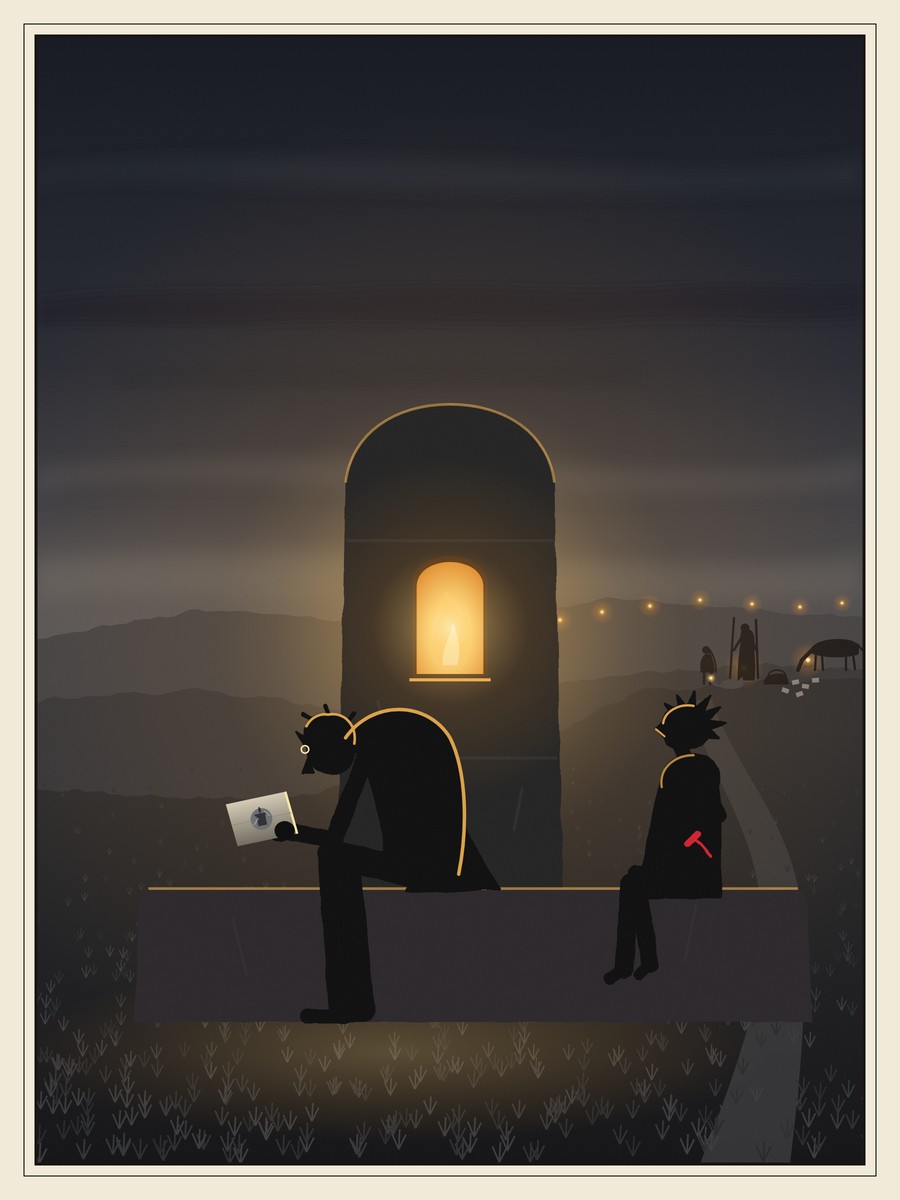
For a long time neither of them said anything. The wind went over the heather.
“Well,” said Wren at last. “At least you know now.”
Tobin made a small sound.
“That came out wrong,” said Wren.
“He used my letter,” said Tobin. He was not crying. His voice was quite flat and quiet, and he was looking straight ahead at nothing. “I wrote him that I loved him. I wrote him I wasn’t running away. I sat at Ash’s table and crossed things out for an hour, to get it right. And he read it and — and used it. Like a map.” He took his spectacles off and held them in his lap. “I thought he was frightened. I thought, he’s just frightened, the way I’m frightened, and he made a mistake, and he’s ashamed, and that’s why he wouldn’t look at me. I thought if I came back with a way to make the light last, he wouldn’t have to be frightened any more, and then—“ He stopped. “But he isn’t just frightened, is he. He’s chosen. He’s picked a side. And it isn’t ours.”
Wren did not say anything. She was trying very hard to think of something that was not wrong.
“Mott sold me,” she said at last. “You know that. For the reward. Stood at the bakery door and pointed at me, so he could have a purse of silver. And I thought — that was the worst thing anybody could ever do. Selling you. I thought I’d hate him till I was a hundred and four.” She picked at a thread on her coat. “Your dad’s a nob, so it’s a throne he wants, not a purse. That’s the only difference. It’s the same thing, only bigger.” She stopped. “That’s not helping, is it?”
“Not really,” said Tobin. But he had turned his head a little towards her.
Wren put her hand into the inside pocket of her coat, the one next to her heart, where she had kept it every day since they walked out of the Grey Gate. She took it out and looked at it. It was a heel of bread — or it had been, once, warm from Nettle’s hand. Now it was shrunken and as hard as a roof-slate, with a good deal of pocket-fluff on it.
“Here,” she said, and held it out.
Tobin stared at it. “Is that — that’s Nettle’s bread.”
“Last of it. I was saving it.”
“What for?”
Wren shrugged. “For when it was worst,” she said. “I reckon this is worst. Looks like it from here.”
Tobin took it. He turned it over in his hands. Then he tried to break it in half, and it would not break; and he tried harder, and it still would not; and in the end Wren took it back off him and cracked it on the corner of the waystone, like a nut, and it went in two with a noise like a dropped plate.
Tobin laughed. It was a wet, broken sort of laugh, and it was mostly not a laugh at all, and at the end of it he put his face in his hands and cried properly. Wren sat beside him and let him. She did not put her arm round him, because she would not have known how. But she shifted along the waystone until her shoulder was against his, and she stayed there; and after a while she found that this was a thing that she did know how to do after all.
They ate the bread. It was terrible. It was the best thing either of them had ever eaten.
“He’s still my father,” said Tobin at last, when it was dark, and the waystone was the only light on the hill.
“Yeah,” said Wren. “I know.”
“Is that stupid? To still — after that?”
Wren thought about Gristle Mott, sitting grey against the yard wall with the reward purse in his lap, and about kneeling down in front of him anyway. “No,” she said. “I don’t think so. I think that’s the bit that isn’t stupid.”
Later, when they had walked back to the others, Mira asked if she might hold the letter.
Tobin gave it to her without a word. She did not use her eyes. She shut them, and ran her fingertips over the paper slowly, the way she had read the Story-Wall in the Deeps.
“He pressed very hard,” she said. “Here, on the boy. And here, on mine. The pen went almost through.” She opened her eyes and handed it back. “He was afraid when he wrote it. Not only of her. I think he was afraid of you.”
Tobin looked at the letter for a long time. Then he folded it, and put it in his pocket.
Ash burned the other letters in the fire that night, one by one; they burned with a sulky, smoky light and smelt of wet ashes. In the morning Dunstan would ride away on his horse — which turned out, once the lamp had looked at it a while, to be a dappled brown — and tell them, before he went, of the nearest city on the coast, a day or two west and south: a place called Vaelport, where the post-riders said there was a light so bright that it never got dark at all.
But that was in the morning. Tonight Tobin lay awake beside the fire with one hand in his pocket. In that pocket were two things. One was a small brass compass with his mother’s words inside the lid: Home is where the light is. The other was a letter sealed in grey.
He held on to the compass. But all night long, he could feel the other one too.
Chapter 14 complete
A Letter Sealed in Grey