Chapter 13 · 17 min read · 22 min listen
Colours
Mira did not sleep that night. Nobody had really expected her to.
She sat on a flat rock at the edge of the Gloam River with the lamp on the stones in front of her, and she looked at it. She looked at it the way you might read a letter from someone you had given up hoping to hear from: over and over, from the beginning, in case you had missed a word. Now and then she put her face so close to the glass that her nose nearly touched it. Once she shut her eyes tight and clicked her tongue at it — tk, tk — and then opened them again, quickly, as if to check that it was still there.
It was still there. It always was.
Wren lay a little way off, pretending to be asleep, and watched her. Mira wore an expression Wren had never seen before. It was not quite happiness. It was bigger and quieter than that. It was the look of someone who has been told a story all their life, and has believed it, and has just found out that it was true.
“You can come and sit by me,” said Mira, without turning round. “I can hear you not sleeping. You do it very loudly.”
So Wren went and sat by her. Mira turned and looked at her, very seriously, for a long time. Being looked at is not a thing most of us notice much. But Wren had never been looked at like that, and she found she did not know where to put her hands.
“You are smaller than your voice,” said Mira at last.
“Thanks very much.”
“It was not a complaint. My clicks told me you were small. They did not tell me you would look it.” Mira reached out a finger and touched the tufts of Wren’s hair where they stuck out over her ears. “And this is how your hair looks. I knew how it felt. I did not know a thing could look the way it feels. Does everything?”
Wren thought about it. “Mostly,” she said. “Mott looked the way he felt. Like a sack of wet coal.”
Mira laughed, a short, delighted bark.
The sun came up over the Gloam River, and Mira saw her first morning.
It was not, I am sorry to say, much of a morning. The cursed sun rose through the mist like a coin seen through dirty water, and turned the black river grey, and that was more or less the end of what it could do.
Mira thought it was the most wonderful thing she had ever seen.
“It is coming in from everywhere at once,” she said, standing up on her rock. “Wren, there is no edge to it. Where is the lamp of it?”
“That’s the sun,” said Wren. “It’s not much of one.”
“It is enormous,” said Mira, and would not be told otherwise.
All that first morning she went about the river-bank like a bee in a garden, and everything astonished her. She picked up handfuls of shingle and said that she had always known stones were different, but not that they were different-looking, which seemed to her a great extravagance on the part of stones.
She was very bad at distances. Her echo-sense had not gone anywhere — the Ferryman had given her eyes, not taken her ears — and when she clicked she could still tell you to a finger’s breadth how far off the river was, or the tree, or Tobin. But her eyes did not yet know what her ears knew, and they kept telling her lies. She reached out to touch the far bank of the Gloam, a quarter of a mile away, and was very much put out when she couldn’t. She walked straight into Old Ash’s back because, she said, he had looked a long way off and then had suddenly not been.
“Shut your eyes and click, then,” said Wren, “if your eyes are no good.”
“My eyes are perfectly good,” said Mira with dignity. “They are only new. One does not blame a baby for falling over.” Then she shut them, clicked, walked neatly round Ash, and opened them on the other side. “There. They agree with each other now. That is a relief. I was not sure they could be trusted.”
Tobin, watching with great scientific interest, said that, technically speaking, it was a matter of the brain learning the signals, and had she noticed whether the lamp looked further away when she shut one eye—
“Tobin,” said Mira. “You have a very long nose.”
Tobin went pink. “I — have I?”
“It is a good nose,” said Mira kindly. “I heard that it was long. I did not know it would go on for quite so long as it does.” She tilted her head. “And there is colour on your face. That is new.”
“That,” said Wren, enjoying herself enormously, “is called going red.”
It was the colours that undid her in the end.
There were not many to see. Out here, far from any Ring, the world was the old Gloamhaven world: grey and brown and dun and that tired blue-ish that people called dull. But near the lamp, as you know, the colours came back; and so all morning Mira kept running back to it, the way you keep running back to the one warm room in a cold house.
Close to its light, the ribbon on Wren’s wrist was red — a true, glad, berry red. Mira held Wren’s wrist in both hands and looked at it for so long that Wren began to feel awkward and tried to take it back.
“What is its name?” said Mira. “Not ribbon. The — the loud part of it.”
“Red,” said Wren.
“Red,” said Mira softly, the way you would say the name of a friend. “It sounds like it looks. It sounds warm. And Tobin’s hair, near the lamp? And Cinder’s tail — that is something else again.”
Wren said Tobin’s hair was yellow, because Nettle had said so. About Cinder’s tail nobody could agree until Ash, sitting on a stone by the little fire he had built with his bad leg out in front of him, said “Hm,” and that it was gold at the tip and orange behind, and that it did not matter very much what you called a thing so long as you saw it. Cinder, who knew perfectly well she was being talked about, let the spark at the end of her tail brighten until it glowed like a coal in a breeze. She was, I am afraid, showing off.
Then Mira went and knelt by the fire.
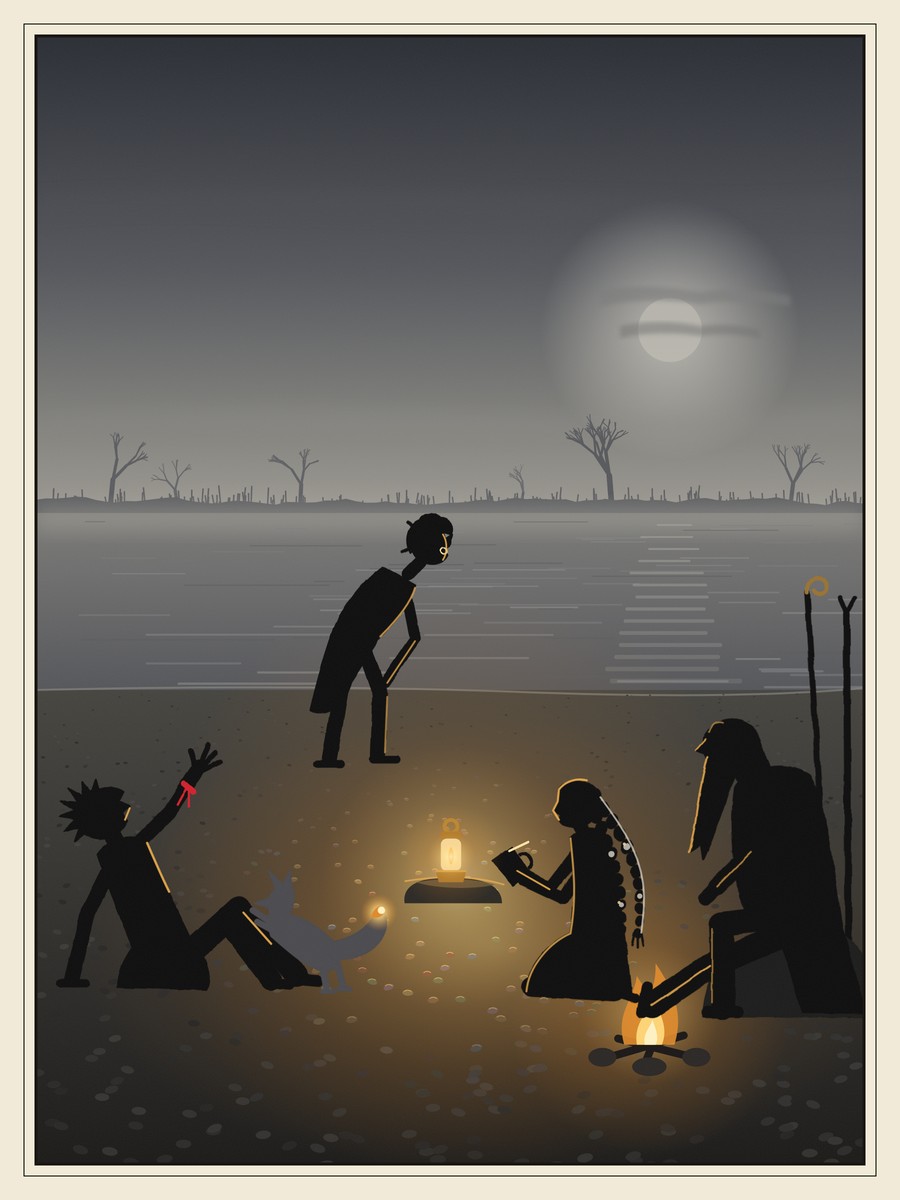
In the Deeps she had only ever felt fire, as a warmth with no shape to it. Now she saw the flames climbing over the sticks and falling back and climbing again, and she knelt there with her hands spread to it and her mouth a little open, and did not say anything at all.
“Tea,” said Old Ash, and handed her a tin cup.
Now, you will remember Old Ash’s tea. The Greywaste had not improved it. He made it from whatever leaves he could find, and on this particular morning, I am almost sure, he had forgotten it on the fire for a very long time indeed. Now she looked into the cup.
She tilted it towards the lamp. She looked at the grey-brown scum going round on the top, and at the bits of leaf, and at something small and dark at the bottom which might have been a leaf and might not. Then she looked up at Old Ash, her face perfectly serious and full of wonder.
“Oh,” she said. “It is the colour of what it tastes like.”
And Wren laughed.
I want to be careful how I tell this, because it matters. Wren had laughed before. She had laughed at Mott behind his back, and at Gutterlings, and at Tobin when he fell over. But all those laughs had been short and sharp — the kind you do with your mouth while the rest of you stays watchful, the way a sweep keeps one hand on the chimney-wall while she reaches with the other. Wren had never in her life laughed with all of herself at once. She had never had the time. There had always been a debt to pay or a meal to find or something coming up the lane behind her.
This was not that kind of laugh.
It came up from somewhere near her boots and took hold of her and would not let go. She laughed until she had to sit down on the shingle. She laughed until her eyes ran. She tried to stop, and looked at Mira’s grave face, and started again, worse. Cinder came and put her paws on her knee in some concern, and sneezed a spark, which set her off again.
Tobin stared. He had never heard Wren laugh like that. Nobody had. Then he began to laugh too, because it is very difficult not to; and then Mira, who did not quite understand what was funny but could see that it was something good, laughed as well, a bright, surprised sound that rang off the water.
Old Ash looked from one to the other of them.
“Hm,” he said. Then the corner of his beard twitched, and he took the cup back and tipped it, very slowly and with great dignity, into the Gloam River.
When it was over, and they lay back on the shingle with their stomachs aching, Wren felt lighter than she could remember — as if something tight inside her that she had not known was there had come undone.
The Delvers came down to the river that afternoon.
Mira heard them first, of course. She had been sent to listen to the river and come back, and she had not come back; so they had come to find her. Out of the mist on the far bank rose a sound like a hive: hundreds of voices, low and anxious, calling her name the long Delver way, Mi-i-ira, so that it rolled out over the water and came back off the reeds.
Mira cupped her hands and called back. A great rustling cheer went up on the other side. And within the hour, by the knock of stone on wood and the creak of good grey Delver rope, they had lashed a raft together from the dead black trees along the shore and were poling it across: two rafters, and Mother Hessa, and Tavi, and Speaker Gorrim.
Mira stood on the shingle and watched them come.
She had known them all her life by their voices and their footsteps. Now she saw them, which is a strange thing to do with people you love. “Ollan, your beard!” she cried, before the raft had even grounded. “Gran, you are so small!” And Mother Hessa, who was indeed very small, put both hands on Mira’s face and felt it all over, the old Delver way, and understood. Then she held Mira tight and hummed into her hair for a long time.
Tavi came off the raft at a run, found Cinder by the warmth of her tail, and picked her up. Cinder allowed it for exactly three seconds and then sneezed in his ear.
Last off the raft came Speaker Gorrim.
He was a great slow mountain of a man, with a white beard plaited past his belt, and he had sat in the Hall of Answers and condemned them all to the Silent Pit. Now he walked up the shingle towards the warmth of the lamp and stopped in front of Wren, and was silent for so long that she began to wonder whether he had come to condemn her all over again.
Then Speaker Gorrim knelt down on the stones.
He did it slowly, because he was not young and the stones were hard. Behind him the rafters went quiet. Even Tavi stopped fidgeting.
“I said there was no light,” said Gorrim, very low. “I said it was a story to frighten children, and I would have put you in the Pit for saying otherwise.” He turned his pale blind eyes towards the warmth. “And when the dark came for my boy, it was your light that went down after him. Not mine. Mine was never there. I was proud, and I was wrong, and I am sorry.”
Wren did not know what to do with a grown man kneeling in front of her. She looked at Ash, who only waited.
“Get up,” said Wren at last. “Please. It wasn’t mine anyway, the light. It was given me. Same as it was given Tavi.” She shifted her feet. “And I’d have thought I was a liar too, if I’d been you. I did think it was a trick, the first time I saw it.”
Something moved at the corner of Gorrim’s mouth — not quite a smile, but the place where a smile might one day go.
“Then we are a pair,” he said, and got up, and took something from inside his robe.
It was a stone, smooth and pale and the size of a hen’s egg, with a thin dark line running round its middle like a seam.
“A singing-stone,” said Gorrim. “Not one of the Hour-Stones. Older. Cut from the heart-wall of Deepholm, where the old songs were first sung, and cut to hear one thing only. It hears the cold.” He put it into Wren’s palm. It was cool and heavy, and it fitted her hand as if it had been made to. “When anything comes near that drinks songs — the grey things, the cold riders — it will hum. Low at first. Louder as they come. It was silent all my life, until the night Varrick came. Then it sang so that I could not sleep, and I did not listen.” He closed her fingers over it with his own. “Listen better than I did.”
Wren opened her mouth to say what she always said, which was what do you want for it?
She shut it again.
“Thank you,” she said instead. It was getting easier.
That night Gorrim and his party stayed on the near bank, round the company’s fire, and it was settled what the Delvers would do. They could not go home while the Hollows held the deep halls. But they had heard Wren and Tobin talk of Emberwick, away to the south, where the Ring burned white-gold along the wall, and they had made up their minds.
“We will go to your city,” said Gorrim. “We will learn to live where the warmth is. Slowly, perhaps. But we are stone-workers. We are patient.”
“Go to Soot Lane,” said Wren at once. “There’s a bakery. Mrs Fenn’s. Tell her Wren sent you. And tell Nettle—“ She stopped. She did not know what to tell Nettle. “Tell her I’ve still got the bread.”
Afterwards, when the fire had burned down to red, Wren lay with her head on her pack and the lamp in the crook of her arm, and without quite meaning to she began to hum.
It was the old tune. Morning comes, morning comes. The only part of her mother’s lullaby she had left.
Beside the fire, Mother Hessa sat up.
Then she began to hum too. Not a different song — the same one, note for note, rising and falling in the same places, only slower, the way Delvers did everything. Gorrim took it up, deep as a cellar. And then, from across the dark water, faint and far, the whole camp of the Delvers on the other bank took it up as well, hundreds of soft voices together, until the river itself seemed to be humming, low and warm, like a bell long after it has been struck.
Wren sat up. Her heart was going very fast.
“That’s mine,” she said. “That’s my mum’s song.” She had known since the Story-Wall that it was theirs too; but she had never heard it sung by so many.
“It is the Waking Song,” said Mira, beside her. “The oldest song in Deepholm. We sing it to babies, and when someone has been ill and gets better.” She hesitated. “Most of the words are gone. They wore away, Gran says, the way steps wear away when too many feet go up and down them. We only have the tune. And the one line on the Wall.”
“Sing it,” said Wren. She had hold of Mira’s sleeve, and had not noticed. “The line from the Wall. Sing it again.”
Mira took a breath and sang it. Her voice was small and clear and not very tuneful, and it went through Wren like warmth through a cold hand.
“…and the dark shall not keep us.”
That was all. The humming went on a while across the water, and faded, the way the fire was fading, and the river went on talking to itself in the dark.
Wren lay back down and held the line inside her carefully, like a full cup. Morning comes, morning comes … and the dark shall not keep us. There was still a great gap where the rest of it ought to be. But it was more than she had had a week ago, and she had not bought it, or stolen it, or earned it. It had simply been given to her: once by a blind girl in the dark, and now again by the same girl, who could see, beside a river at night.
She went to sleep with it.
In the morning, while the rafters were readying the raft to go back, Mira came and stood in front of Old Ash with her hands behind her back and her chin up. She looked, Wren thought, exactly the way Wren herself looked when she had made up her mind to ask for something and was ready to be told no.
“I wish to come with you,” said Mira. “To the Bright Mountain.”
“It’s a long road, child,” said Ash.
“I know. You say so often.”
“Hm. And a dangerous one. And dark, a good deal of it.”
“The dark,” said Mira, “is where I am best. In the light I am a baby who falls over things. But when the light goes, you will all be stumbling about like Delvers who have had too much mushroom-ale, and I will not. You need someone who can see in the dark. Now you have one who can see in both.” Her voice wobbled, very slightly, and steadied. “I have asked the Speaker. He has said yes. Gran cried, but she said yes. And I have never seen a mountain. I would like to see a great many things. I would like to see them with you.”
Ash looked at Wren.
It was her lamp; that was what the look meant. And Wren thought of the night in Deepholm when she had asked Mira for help — she, who never asked anybody for anything — and of how Mira had not asked for a single thing back.
“Course she’s coming,” said Wren. “Somebody’s got to tell me what colour things are.”
Mira’s face broke open like a morning.
So when the raft pushed off for the far bank, with Gorrim standing tall in the middle of it and Tavi waving and Mother Hessa calling back instructions about ointment, five travellers stood on the shingle and watched it go: a tall old man leaning on two poles, a gangly boy with a compass, a small grey fox with a tail like a coal, a sweep with a red ribbon and a lamp, and a pale girl who kept forgetting to wave because she was too busy looking at things.
In Wren’s pocket the singing-stone lay smooth and cool and silent.
It stayed silent for four days.
Chapter 13 complete
Colours