Chapter 15 · 16 min read · 20 min listen
The Lights of Vaelport
Mira heard the sea hours before anyone saw it.
They had turned west after Dunstan rode away, following the Gloam River down towards the sea, as he had told them to; and the compass in Tobin’s pocket did not like it at all. Every time he took it out, the needle swung round and pointed back over his right shoulder — north and a bit east, towards the Bright Mountain, which had sunk out of sight behind the hills — and Tobin would look at it and sigh and put it away again.
“It’s only a little way round,” said Wren. “Isn’t it?”
“Technically,” said Tobin, “it’s a great deal of the way round. About forty miles of the way round, and forty back, if my map’s right, which it may not be, since the man who drew it had obviously never been anywhere.”
“The Mountain will wait,” said Old Ash. “It has waited three hundred years. We need bread, and we need to tell the Rings what was in that bag. Both of those are at the coast.” He did not say what else they all knew: that his bad leg was getting worse, not better, and that he leaned harder on his two poles with every mile.
So they went west, beside the slow grey river, over the last of the grey hills; and on the second morning Mira stopped in the road and put her head on one side.
“There is something ahead,” she said. “Breathing. Like the river did, before we found it — only the river was asleep, and this is not.” She clicked, and listened, and frowned. “I can’t find the edge of it. It doesn’t send anything back. Wren, the river is going into it. There is something ahead of us that is breathing, and it is bigger than Deepholm.”
Wren went cold all over. Cinder, however, only sniffed the wind and sneezed, and trotted on with her tail up.
It was late afternoon before they came over the last rise and saw it.
If you have seen the sea, you will remember the first time. If you have not, I hope you will one day, and I hope that somebody you like is standing next to you when you do.
It lay below them at the foot of tall grey cliffs, and it went on for ever. It did not stop at the edge of the sky; it simply turned into the sky, grey into grey, so that you could not tell where one ended and the other began. It moved all over, all the time, in long slow ridges that came in from nowhere and broke white on the rocks below with a noise like a great slow breath going in and out. The wind off it was cold and wet and tasted of salt. Grey birds hung in it without moving their wings, crying in thin, complaining voices.
Wren had thought the Soot Canal was a lot of water. She stood on the clifftop with her mouth open and her hair blown flat and did not say anything at all, which was so unusual that Tobin looked at her twice.
“It’s the sea,” said Tobin, in a voice of great satisfaction, as if he had arranged it. “The Western Sea. It’s on all the old maps. I never thought I’d — well. There it is.” He pushed his spectacles up his nose and stared and stared.
Mira had gone very quiet. She stood right at the edge of the cliff with Ash’s hand on her shoulder in case she stepped off it, which she had nearly done twice, and she looked at the sea, and then shut her eyes and listened to it, and then opened them again.
“It is the shape of what it sounds like,” she said at last, softly. “I didn’t think anything could be.”
They went down a steep path to the shore and stood at the edge of the water. Wren held the lamp out over the place where the waves ran up the sand and spread out thin and foaming and slid back again. And in the lamp’s light, just for a moment, at the very edge of the foam, the grey water was not grey. It was a colour none of them had ever seen — not blue, not quite green, but something clear and deep and cold between the two, like the inside of a piece of glass.
“What’s that one?” said Mira at once. “Ash. What is that called?”
Old Ash looked at it for a long time.
“Sea-green,” he said at last, and his voice was rough. “My grandmother had a shawl that colour, when I was very small. She used to say that the sea had been that colour every day, once.” He cleared his throat. “Hm. Wind’s getting up. Come along.”
They saw Vaelport that evening.
They had walked south along the clifftops all afternoon, with the sea booming on their right hand, and as the dusk came down they rounded a great dark headland — and stopped, all five of them, as if they had walked into a wall.
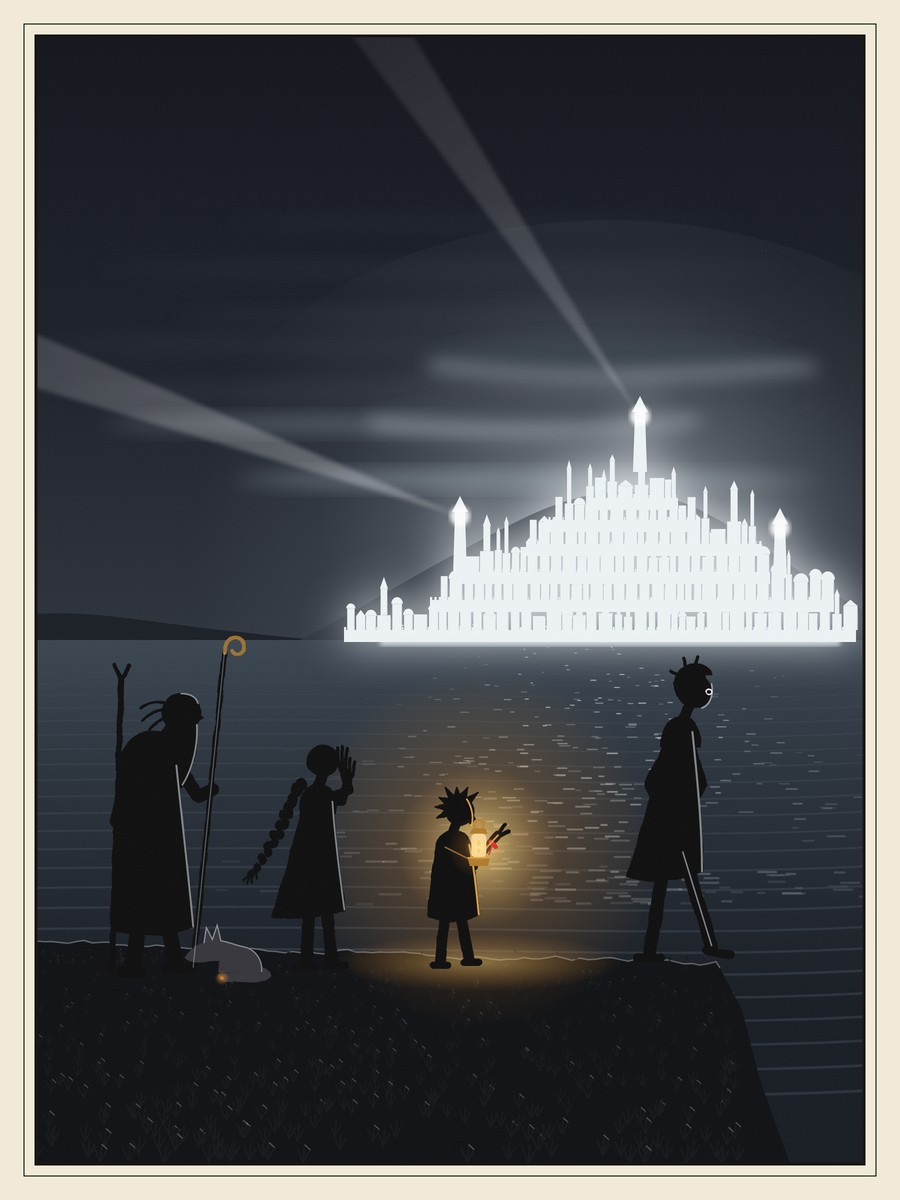
Across a wide bay, perhaps ten miles off, a city was burning with light.
I do not mean that it was on fire. I mean that it shone. It climbed up the hills above the far shore in tier after tier of towers and walls and domes, and every one of them was lit — not here and there, the way a town is lit at night, with a lamp in this window and that, but all over, all at once, as if the whole city had been carved out of light and set down on the hills. Long white beams swung out from its towers across the dark water. Its harbour glittered. Its walls glittered. Even the clouds above it were lit up from beneath, so that the sky over Vaelport was paler than the sky anywhere else, as if a white sun were about to rise there instead of in the east.
Emberwick’s Ring, at its very best, burning gold along the wall on the night they lit the Beacon, had been a beautiful thing. Beside this, it would have looked like a string of birthday candles.
For a while nobody said anything at all.
Mira was the first to move. She had put both hands up in front of her face, and she was looking through her fingers. “It is so loud,” she whispered. “It’s shouting. Everything in it is shouting at once.” She took her hands away, and squinted, and put them back again, laughing a little and gasping, the way you do when you jump into cold water. “Oh, but it’s — Wren, it’s beautiful. I didn’t know there could be so much light in the whole world. There must be a thousand lamps. There must be ten thousand. Where do they get them all?”
Wren did not answer. She was asking herself the same thing; only she was not asking it in the same way.
Tobin had taken a step forward, to the very edge of the headland, and his face in that far-off white light was eager and pale and hopeful all at once. Wren had seen him look like that before — over a broken clock, or a map, or a puzzle he thought he could solve.
“Look at it,” he said. “Just look at it. That’s not a Ring, that’s — that’s a whole city that doesn’t need a Ring. No Hollow could get within a mile of that. They wouldn’t need anybody’s oil. They wouldn’t need to bargain with anybody.” He swallowed. His hand had gone to his coat pocket, where the letter was. “If Emberwick had light like that, Father wouldn’t — he wouldn’t have needed to be so frightened. Would he? He wouldn’t have had to — to write to anyone.” He turned round to them, and his spectacles flashed white. “Perhaps they could help. Perhaps if we went to them and told them, they’d — they could send some of it back. To Emberwick. And then he wouldn’t need a throne, he’d only need—“
He stopped, because nobody was answering him.
Wren was looking at her wrist.
They were ten miles away; but the light of Vaelport was so strong that it reached them even here, faint and white, across the bay. It lay on the heather. It lay on Tobin’s face, and on Mira’s hands, and on Ash’s beard. And it lay on the ribbon round Wren’s wrist. In that light, her ribbon was not red. It was not even the faded grey-with-a-little-pink it had been in the old days in Soot Lane. It was white — a bleached, washed-out white, like a rag that has been left out in the frost for a winter.
She brought her wrist up close to the lamp. The ribbon went red again at once, deep and warm and glad.
She held it out again, into the white light. White.
“Nobody’s got that much light for nothing,” said Wren slowly. “Nobody. Somebody’s paying for that.” She looked across the water. “And I’d like to know who.”
Cinder was not looking at the city at all. She was sitting very upright at Ash’s feet with her back to it, and the spark at the end of her tail, which had glowed so bright beside the sea that afternoon, had gone down small and dim, like an ember left in yesterday’s hearth. When Mira bent to stroke her, she sneezed — not crossly, but in a small, unhappy sort of way — and pushed her nose into Ash’s boot.
Old Ash had not said a word. He stood leaning on his two poles with the wind tugging at his beard, and he looked at Vaelport for a long, long time, the way you look at the face of somebody you think you may have met before.
“That isn’t Flame,” he said.
He said it quietly. He did not say it like a man who is guessing.
“But—“ Tobin turned round. “How can you possibly tell? From all the way over here?”
“Look at it, lad.” Ash did not take his eyes off the city. “It doesn’t flicker. It doesn’t lean. Flame leans towards you; you’ve seen it. It gives.” He was silent a moment. “And it’s warm. Look at that light, all that light — and tell me. Does it look warm to you?”
Tobin looked. They all looked. And it is a strange thing, but once Ash had said it, none of them could see anything else. Vaelport blazed across the dark water, brighter than anything they had ever imagined; and it was cold. Cold the way frost is cold, and moonlight, and a knife left out on a step overnight. It was the coldest light Wren had ever seen.
“Then what is it?” said Mira, very small.
“Hm,” said Ash. And that, for that night, was all he would say.
They camped on the headland, out of the wind, in the lee of a fallen waystone that Wren lit before she slept. Nobody talked much. Tobin lay with his hand in his pocket and his eyes open. Mira lay with her back to the city, because she said it was too loud to sleep with, and then turned over three times to look at it again.
Once, very late, Wren saw Tobin sit up and take out his compass. He opened the lid and held it up to catch the far white glow, and she saw his face as he looked at it. The needle was not pointing at Vaelport. It had never once pointed at Vaelport. It pointed steadily the other way, back over the dark hills, north and a bit east, towards a mountain none of them could see. Tobin looked at it for a long time. Then he shut the lid, very gently, and lay down again with it in his fist.
Wren lay awake with the singing-stone in her hand.
It was silent. She had half expected it to hum, and it did not; it lay in her palm cool and smooth and still. She did not know whether that meant there was nothing in that city that drank songs — or only that the city was a long way off, across a great deal of water, and that some kinds of cold take longer to reach you than others.
She turned it over in her fingers for a long time. In the end she put it back in her pocket and curled up with her arm round the lamp, with her mother’s song going round and round in her head — Morning comes, morning comes … and the dark shall not keep us — until she slept.
In the morning they walked to Vaelport.
The sun came up over the grey hills to the east, exactly as pale as it always did; and ahead of them, all along the shore, the city still blazed. It had not dimmed for the morning. It did not seem to know that morning had come.
There was a road along the bay, and the nearer they came to the city the busier it grew. There were carts piled with fish and carts piled with furniture, and pedlars and pilgrims and whole families walking with their bundles on their backs. Some of them, Wren saw, had the tired, frightened look of people who have come a long way from a city whose Ring was failing, and have heard that somewhere, at the end of the road, there is a place where it never gets dark. They all walked faster as they went, and none of them looked back.
A woman walked beside them for a mile, with a baby on her hip and two small boys hanging on her skirt. She had come, she said, from a Ring-town in the hills where half the lamps on the wall had gone out last winter and the other half were going.
“They say nobody in Vaelport has ever been greyed,” she told them. Her face was thin and tired, and lit up as she talked. “Not one, not ever. They say it’s never dark there, not even at midnight. And they say the light’s free.” She hitched the baby higher. “Free to all who come in. Can you imagine?”
Wren could imagine a good many things. She had been imagining them all her life, mostly about what things cost. Once, not so very long ago, she would have said at once that nothing was free and there was always a catch. Now she knew better. She knew that some things really were given; she was carrying one of them. But that was exactly the trouble. She knew what a real gift felt like now. And she put her hand on the lamp, and looked at the white city blazing ahead, and did not feel it at all.
“Hm,” said Old Ash, beside her, and that was all he said; but he said it in the voice he kept for Varrick.
The road was paved, as they came closer, with a smooth white stone that glittered. The walls rose up ahead of them, white and smooth and very high. And in the middle of the walls, standing wide open, were the gates of Vaelport.
They were enormous. They were made of something that was not quite glass and not quite crystal, cut into a thousand faces that caught the white light and threw it back, so that the whole gateway blazed like a frozen waterfall. It was so bright that Mira had to walk the last half-mile with her hand over her eyes, holding on to Wren’s sleeve and clicking. Even Tobin, who loved anything that was cleverly made, went quiet when he looked at it.
“Wren,” said Mira, peering between her fingers. “What colour is that? The gate. You promised you would tell me what colour things are.”
Wren looked at the gate for a long moment. It was white, and it was bright, and it shone back every scrap of light that fell on it a hundred times over. There was not a single thing in it that was red, or gold, or sea-green, or any of the colours she had only just learned the names of.
“There isn’t one,” she said slowly. “That’s what’s wrong with it.”
A hundred yards from the gates, Old Ash stopped and leaned on his poles.
“Wren,” he said. “The lamp. Put it away, child. Inside your coat.”
Wren looked at him. She did not argue. She did not even ask why. She tucked the little battered brass lamp inside her coat, against her ribs, and did up the coat over it, the way she had done on the very first day, in the chimneys of Thornbury House, when she had not known what it was or what it would cost her or who had put it in the wall.
It lay there warm and steady, like a hand.
“Stay close,” said Ash, to all of them. “Keep your eyes open. And whatever they offer you in there—“ He paused, and looked up at the blazing gates, and his face under his singed beard was very old and very stern. “Remember what’s in Wren’s coat. And remember how it came to her.”
Then he straightened his back as well as he could, and set his two poles on the shining road, and walked on.
So they went up to the gates of Vaelport together: a tall, stooped old man in a coat that had once been Lamplighter blue; a gangly boy with a compass in one pocket and a grey-sealed letter in the other; a pale girl with her hand over her new eyes; a small grey fox whose tail had gone almost dark; and a sweep with cropped black hair and a ribbon on her wrist that had turned, in all that dazzle, as white as frost.
The light of Vaelport poured over them, cold and white and endless, and made them very small.
But under Wren’s coat, so small that nobody in all that shining city could have seen it, a flame that had been given away and was not one bit the less for it went on burning, warm and gold and patient, the way it always had — as if it knew something about the brightest city in Gloamhaven that the city did not yet know about itself.
Chapter 15 complete
The Lights of Vaelport