Chapter 12 · 16 min read · 21 min listen
The Ferryman of the Gloam River
The Delvers did not like the morning.
It came up grey and pale over the Greywaste, the way mornings always did in Gloamhaven, and the wind came with it, and four hundred people who had lived their whole lives under a roof of stone sat huddled among the tumbled rocks at the top of the Black Stair and held on to the grass. They could feel the open all around them. It frightened them, Mira said, the way a cliff-edge frightens you even when you are standing well back from it.
“They will get used to it,” she said. “I am getting used to it. Listen.” She clicked, upwards, and nothing came back, and she laughed out loud, the way a small child laughs at a game it does not want to stop. “Nothing! Nothing at all! Wren, it is the best thing I ever heard.”
Wren was sitting on a stone with the lamp in her lap, eating a cold Delver cake that tasted mostly of mushrooms. She did not say anything. But she had been watching Mira click at the sky for some time, and she was smiling.
Old Ash was not smiling. Mother Hessa was re-binding his leg, and she was humming as she did it, and pulling the bandages tight in a way that made him say “Hm,” every few seconds in a rising note, like a cart-wheel wanting grease.
“You will not walk on it for a week,” said Hessa briskly. “You will not walk far on it for a month. You will not climb any more stairs at all, ever, if you have any sense, which I am beginning to doubt.”
“Madam,” said Ash, “I have been climbing stairs for seventy years.”
“Then you have had a good long go,” said Hessa, “and can stop.”
In the end he walked with the Delver bridge-pole that Wren had carried up the Black Stair, its bronze hook worn smooth, and his own brass-hooked lamplighter’s pole in his other hand, so that he went along between them like a very tall, very cross insect. Tobin, who had been looking at his compass, said that this was actually a very sound arrangement from the point of view of weight distribution. Ash told him to hush.
The compass still pointed north and a bit east. But between the hilltop and the pale tooth of the Bright Mountain, Ash said, lay the Gloam River, and the Gloam River had no bridge.
“There used to be a ferry,” he said. “In my master’s day. A Lamplighter’s ferry. It went over twice a day, morning and evening, and charged nothing.” He shook his head slowly. “Hm. That was a long time ago.”
Speaker Gorrim came to see them off. He had Tavi on his hip, though Tavi was far too big to be carried and kept trying to get down, and Tavi was asking questions so fast that his father could not answer any of them. What is the wind for? Where does it go? Why is the warm thing warm? Is the sky very high? Higher than the Great Hall? Higher than the Pit is deep?
“My people will rest here,” said Gorrim. “A day. Perhaps two. We cannot go back, and we do not yet know how to go forward.” He was quiet for a moment, as if the words cost him something. “I would know what lies across that river. Whether there is a road for us there. Will you let one of my people walk with you to the water, and listen to it, and come back and tell me?”
“I’ll go,” said Mira at once.
Gorrim turned his face towards her. Only the day before, in the Hall of Answers, he had silenced her before everyone. Wren remembered it, and Mira certainly did. But he did not silence her now.
“Yes,” he said slowly. “You will. You have the best ears in Deepholm, and you have been right about more than I have.” He bowed his great head to her — a small bow, but a real one. “Go, Mira. Listen well.”
It took them until the middle of the afternoon to reach the Gloam River, and they heard it long before they saw it.
At least, Mira heard it. “There is something ahead,” she said, an hour out from the hilltop, “breathing. Something very big and very slow, breathing in its sleep.” Wren could hear nothing but the wind in the grass. Another hour, and she could hear it too — a deep soft sound like wind in a chimney. And then the grey grass sloped down, and the ground grew damp and soft, and there was the river.
It was the widest thing Wren had ever seen. It was wider than the Soot Canal, wider than Beacon Square, wider than the whole of Soot Lane laid end to end. It went slowly past them, grey as pewter, with a cold white mist lying on it so that they could not see the far side at all. There were reeds along the edge, dry and rattling. There was no bridge. There was no boat. There was nothing on the bank but a single old post, leaning, with an iron ring rusted to it and an empty lamp-niche in its top, like the waystones on the Greywaste road.
“The ferry-post,” said Ash quietly. “Hm. So it was here.”
Tobin stood at the water’s edge and looked at the river with his head on one side, and Wren could see him working out sums.
“Allowing for the current,” he said, “and assuming the far bank is roughly as far off as the near one — which it would be, of course, by definition — and allowing for Ash’s leg, and the fact that I can’t swim very well, and Wren can’t swim at all—“
“I can so swim.”
“You can drown in an energetic manner,” said Tobin. “I’ve seen you in the canal. It isn’t the same thing.”
“Hush,” said Mira suddenly.
They hushed.
She was standing very still, with her face turned towards the mist. She clicked once, out over the water. Then again.
“There is a boat,” she said. “Out there. Someone is rowing. Slowly. One of the oars creaks.” She listened. “He is coming this way.”
Wren could see nothing but white. But after a moment she heard it too: a soft creak and splash, creak and splash, getting nearer. Cinder, at her feet, sat up very straight with her ears pricked — but she did not growl. Her tail-spark, Wren noticed, had begun to glow.
Then out of the mist came the prow of a boat.
It was a long flat ferry-boat, old and grey and weathered, with a bench across the middle and a lantern-hook at the bow with no lantern on it. Standing in the stern, rowing with one long oar, was an old man. He was tall, and he wore a hooded coat the colour of the river, and his beard was short and grey, and when the boat bumped gently against the bank among the reeds, he shipped the oar and looked up at them.
He had kind eyes. That was the first thing Wren thought, and afterwards it was the thing she remembered best. Not the colour of them. Only that they were kind, the way a fire is warm — not because it is trying to be, but because that is what it is.
“Going over?” he said.
“Yes, please,” said Tobin, before anyone else could speak. “That is — if it isn’t too much trouble. There are five of us. Four and a fox. And one of us has a bad leg, so we would need to — and, I’m sorry, but what do you charge? Because we haven’t very much. Actually we haven’t anything. I’ve a penknife, and a notebook, and—“
“No charge,” said the ferryman.
Wren went very still.
She did not know why. It was only two words. People said them sometimes. But something about the way he said them went into her like a splinter of warmth, and stuck, and she found that she was holding the lamp very tightly.
“Nothing’s free,” she heard herself say. It came out sharper than she meant. “Everything costs. There’s always a catch.”
The old man looked at her. He did not seem offended. If anything, he looked as if she had said something he had heard before, a long time ago, and was glad to hear again.
“Not this,” he said. “This is given.” He held out his hand to help her into the boat. “Come along, child. The mist won’t wait for ever.”
She took his hand. It was warm — as warm as the lamp — and rough with old work, and across the palm of it ran a scar, white and old, the kind of scar you get from holding something very hot for a very long time.
Wren looked at it. Something tugged in her memory — a market, a smell of new bread, a warm loaf put into her hands. But before she could catch hold of it she was in the boat, and Tobin was helping Ash down, and Ash was saying Hm in a strange, soft voice, and the moment went by.
Last of all, Mira stood on the bank alone.
“And me?” she said, a little uncertainly. “I am only meant to listen to the river. I am meant to go back.”
“There’s room for you,” said the ferryman. “There is always room.” And he held out his hand to her too, and she took it, and stepped down into the boat as lightly as if she had been doing it all her life.
The ferryman pushed off, and the bank slid away behind them, and in a dozen strokes it was gone in the mist.
I do not know if you have ever been out on wide water in a fog. It is a very quiet thing. There is no up and down, no near and far; there is only the boat, and the people in it, and the creak of the oar, and white on every side. Even Tobin stopped talking. Cinder lay curled in the bottom of the boat with her chin on Wren’s boot. Ash sat in the bow with his bad leg stretched out and his eyes on the ferryman, and his face was very strange — not grieved, the way it went when he spoke of Varrick, but the opposite of grieved, if there is such a thing. As if he were holding something in, very carefully, so that it would not spill.
Mira sat on the bench beside Wren, trailing one hand in the river.
“It is cold,” she said. “And soft. And it goes all the way, doesn’t it? Over to the other side, and down to the sea, and nobody ever has to carry it.” She tipped her head. “Ferryman. Your oar creaks on the left.”
“So it does,” said the ferryman. “It always has.”
“I can hear the other bank,” said Mira. “A long way off. Reeds, like these. And a bird.” She smiled. “I have never heard a bird before. Not a real one. Only singing-stones made to sound like them.”
The ferryman rested on his oar. The boat drifted, turning a little on the slow grey water, in the middle of the mist, in the middle of the river.
“You were born in the dark,” he said. It was not a question.
“Yes,” said Mira. And then, quickly, with her chin up, in the way she had: “But I am not broken. I want you to know that. People from up here always think we must be broken, and we’re not. I hear the whole world. I hear more than Wren does, and Wren hears more than anyone.” She paused. “Wren could not see on the bridge. I could. I held the bridge. Us. We held it.”
“I know,” said the ferryman gently. “I heard.”
Wren looked up sharply. But the old man’s face was only kind.
“No,” he said to Mira, “you are not broken, child. You never were. This is not a mending.” He shipped the oar, and leaned forward on the bench, and his voice was very quiet. “It is a gift. That is all. You may have it, if you like. You do not have to do anything.”
Mira was silent for a long moment. Her face had gone very still, the way it did when she was listening hard.
“What gift?” she whispered.
The ferryman did not answer. He dipped his two thumbs in the grey water of the Gloam River. Then he reached out, slowly, so that she could hear him coming, and laid them very lightly on her closed eyes.
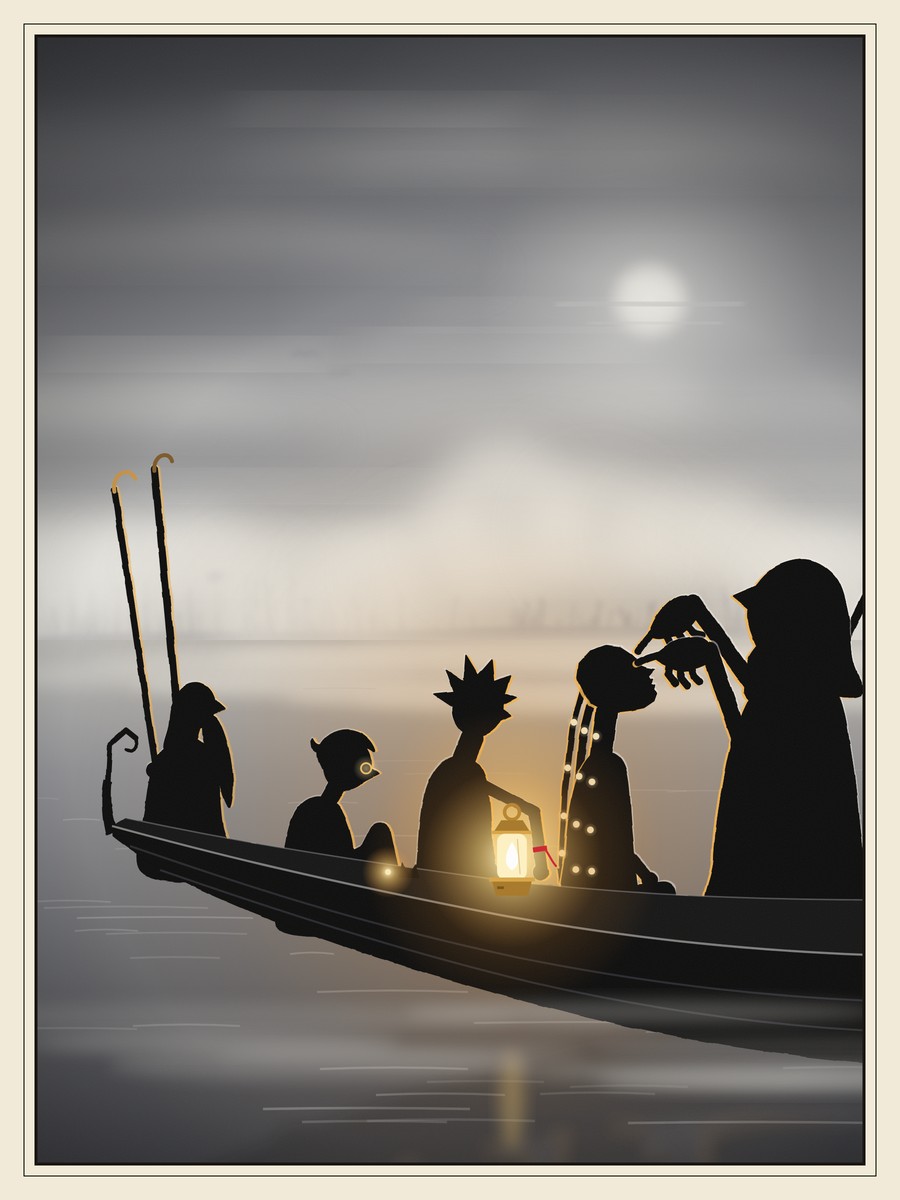
Nobody in the boat breathed.
Wren could not have said how long it lasted. A heartbeat. A minute. The mist stood round them. The water lapped at the boat. And the warmth — she felt it, sitting beside Mira; she felt it the way she had felt the lamp blaze up in Tobin’s hands at the foot of the Black Stair — the warmth came out of the old man’s hands like the first warmth of the sun on your face, if you can imagine such a thing, in a land where the sun had not been warm for three hundred years.
“Your hands are warm,” whispered Mira. “Like Wren’s lamp. Exactly like it.”
He took his hands away.
“Open your eyes, child,” he said.
This is the part of the story that Mira always told best, and she told it all her life, so I will let you hear it, as nearly as I can, the way she told it.
She said that at first there was nothing. Then there was a greyness, which she did not know was greyness, because she had no name for it. It was not a sound and not a touch and not a smell, and it was everywhere at once, and it frightened her. She said it was like being shouted at by the whole world without anyone making a noise.
And then, in the middle of the greyness, there was something else.
It was small. It was close to her. It was in Wren’s lap. It was golden-white, and it moved — it danced — and it was the same as the warmth. That was how she knew. It was the warmth, made into something she could — she did not have the word yet. See. It was the warmth, and the warmth had a shape, and the shape was beautiful, and it was the first thing that Mira of Deepholm ever saw in her life.
“Wren,” she whispered. She was shaking. “Wren. What is that?”
Wren’s throat was so tight she could hardly get the words out.
“That’s the lamp,” she said. “That’s — that’s the light, Mira. That’s what light is.”
Mira stared at it. She did not blink. Tears were running down her face and she did not seem to notice them.
“It’s true,” she said. “It’s true. The Warm Man said. On the Wall. He said one day we would see, and I never — I believed it, but I never—“ She put out one shaking hand towards the flame, not touching, the way you would reach towards something very precious. “Oh, it’s beautiful. Oh, Wren. Nobody ever told me it would be beautiful. They only ever said it was bright.”
And then she laughed, and clicked her tongue — out of sheer habit, at the flame, as if to make sure of it — and the click came back to her off Wren and Tobin and the boat and the water, exactly as it always had.
“I can still hear,” she said, astonished. “I can hear and see. Both at once. Is that allowed?”
“I think,” said the ferryman, and there was a smile in his voice, “you will find it is.”
Wren looked down at her wrist. Her ribbon was red. It was the reddest she had ever seen it, as red as it had been at the top of the Beacon. And she turned to look at the old man in the stern — to say something, she did not know what; she thought, perhaps, thank you, which was not a thing she was good at saying — and he had already taken up his oar, and was rowing, slow and steady, creak and splash, as if nothing at all had happened.
The boat bumped against the far bank among the reeds.
They climbed out. Tobin helped Ash, who leaned on both his poles and said nothing at all. Cinder jumped ashore and shook herself. Wren gave Mira her hand, and Mira stepped onto the bank and stood there in the grey grass, turning her head this way and that, looking at everything — at the reeds and the mist and her own hands, which she held up in front of her face and turned over, and over, and over again.
Then Wren turned back to the boat to say thank you.
The boat was not there.
The mist lay on the river, thick and white and still. There was no ferry. There was no old man. There was no creak of an oar going away, no splash, no ripple spreading on the grey water where a boat had been pushed off. There was only the river, going slowly past, breathing in its sleep, as it had been when they came.
“But—“ said Tobin. He stared at the mist. “But he can’t have — he’d have had to turn the boat, and that takes at least — and we’d have heard — the left oar creaked, Mira heard it, so we’d have—“ He stopped. He pushed his spectacles up his nose. He opened his mouth again, and shut it, and for once in his life, Tobin Harrowgate had nothing whatever to say.
“He didn’t charge,” said Wren, to nobody. She was holding the lamp against her chest. “He didn’t charge us anything.”
She looked round at Old Ash.
The old man was standing on the bank, leaning on his two poles, looking out at the mist where the boat had been. He did not say Hm. He did not say anything at all. But his old face, under the singed white beard, was full of light — and he was smiling, the way Wren had never once seen him smile, as if he had been waiting a very long time for something, and it had come.
Nobody asked him what he knew. Somehow, none of them wanted to.
And Mira, who had been looking at everything, stopped looking at everything. She turned round in the grey grass and looked, very carefully, at Wren — at her face, for a long, long moment, the way you might look at a map of a country you had only ever heard described.
“So that,” she said softly, “is what you look like.”
Chapter 12 complete
The Ferryman of the Gloam River