Chapter 11 · 16 min read · 21 min listen
Light in the Low Places
In all the world there was only one light left at the bottom of the Black Stair, and it was on the end of a fox’s tail.
Cinder stood in the doorway with her legs braced and her ears flat, and the spark at the tip of her tail burned so fiercely that it lit her own grey muzzle and her bared white teeth and nothing else at all. Beyond her, out in the cavern, the cold was gathering. Wren could not see the Hollows. She did not need to. She could feel them the way you feel the sea when you stand at the edge of it at night — a great grey weight of nothing, leaning in.
They did not come past the fox. Not yet.
“The last of my people have gone up,” said Mira, close beside her. “I counted their feet. There were four hundred and twelve, and old Bettle with his stick, which I counted as one and a half.” Then her voice changed. “And now there are others on the bridge.”
Wren gripped the pole in her hands. It was a Delver bridge-pole, long and smooth, with a hook of worn bronze on the end for catching loose ropes, and it was not so very different from a sweep’s brush. She had been poking things with long sticks since she was five years old.
“Where?” she whispered.
Mira clicked. It was a tiny sound, no louder than a fingernail on a cup, and it went out across the chasm and came back to her changed.
“Two men in iron. The first is eleven slats out, coming slowly, holding both hand-ropes. The second is four behind him. They cannot see either, Wren. They are feeling their way, like you.”
“Not like me,” said Wren. “I’m a sweep.”
She crept out onto the first slat of the bridge and crouched there. The whole thing swayed under her like a hammock. Below was a black so deep it had a smell. She heard it now herself — the creak of the ropes, the slow chink of armour, the scrape of an iron boot on stone.
“Seven slats,” breathed Mira. “Five. He is reaching forward with his right hand. Now, Wren — low, by the left rope—“
Wren swung.
The bronze hook struck something that rang like a pot-lid, and a hand let go of a rope. The bridge lurched wildly. In the dark a man grunted — the first sound she had ever heard a Hollow Knight make — and there was a long scrabbling as he caught hold again.
“Back three slats,” said Mira. “He is holding on with both hands now, and not moving. He does not like this bridge.”
“Nobody likes this bridge,” said Wren. Her heart was hammering. She was grinning in the dark like a lunatic.
I should say here, in case you are worried, that nobody fell into the chasm that night. Wren saw to that. She had made up her mind about it before the first Knight ever set foot on the slats, and I think it was one of the best things she ever decided.
What followed was the strangest fight she was ever in. She never once saw her enemy. She crouched on the swaying slats with her pole, and Mira knelt at the bridge-post behind her with one hand on Wren’s ankle, clicking, and told her everything. Left rope. Low. He is lifting his foot. Two of them now, close together. Leave the first; the second is the one reaching. And Wren poked, and hooked, and rapped iron knuckles, and set the bridge swinging under them until the Knights clung to the ropes and could not go forward. And behind her in the doorway Cinder blazed and snarled, and the great grey cold leaned in and leaned in, and did not come past.
They could not have held it alone, any of them. Wren could not see. Mira could not fight. Cinder could not do both. But all three together, in the dark, at the bottom of the world, they held the bridge.
Then, across the chasm, someone began clapping. Slowly.
“Very good,” said a voice. Smooth as oiled iron. “Very good indeed, Wren Ashby.”
Wren’s mouth went dry.
“You gave it away,” said Captain Varrick. He was on the far lip, she thought, by the sound. He was not shouting. He had no need to; the cavern carried his voice to her as if he were standing at her shoulder. “I felt it go up the stair. Do you know, I almost did not believe it. The only thing you ever had. Given to a boy who freezes. And here you are, in the pitch dark, with a blind girl and a fox, holding a bridge for people who were going to throw you into a pit.” He paused. “I wonder what you think you will get for it.”
“Nothing,” said Wren. “That’s the point, you great lump.”
“Hm,” said Varrick — and for one horrible instant he sounded exactly like Old Ash, as if he had caught the habit long ago and never quite shaken it. “My men do not tire, child. You do. In an hour, or two, your arms will give out. And then I will come across, and you will be very cold, and very far down, and nobody will be coming back for you. They never do. You know that better than anyone.”
Wren said nothing. Her arms were already aching. She hated that he knew it.
Mira’s fingers tightened on her ankle. Then Mira leaned close, and her breath was warm on Wren’s ear.
“Every Delver bridge,” she whispered, “has a warden’s knot. On this side. On the post by my hand. It is for floods — if the river comes down the cleft, the wardens pull the pin and let the bridge go, so it does not pull the posts out of the rock. My grandmother showed me when I was little. I can feel it now. One pull, Wren. And then there is no bridge.”
Wren’s heart jumped. “And no way back,” she whispered.
“There is no back,” said Mira simply. “There is only up.”
“There’s Knights on it.”
“Yes.”
“Then we don’t pull it.” Wren set her jaw. “Not with anyone on it. I don’t care who they are. I’m not doing that.”
Mira was quiet for a heartbeat. Then her hand found Wren’s in the dark and squeezed it, very hard, and Wren understood that she had said the right thing.
“Then we must make them go back,” said Mira. “All of them. And I will listen for the last foot.”
Wren looked at the only light there was. “Cinder,” she said. “Can you run a rope?”
The ember-fox looked round at her, and the spark on her tail flared like a coal under a bellows.
She went out along the hand-rope like a squirrel along a washing line, and as she ran her spark blazed brighter and brighter, until for a moment Wren could actually see: the long bridge sagging across the black, the pale stone slats, and three grey figures in grey armour clinging to the ropes with grey, empty faces turned towards a little burning fox. Cinder sneezed. A shower of sparks went over the first Knight’s helmet.
The Hollow Knights could stand the dark. They could stand the cold. I do not think, in all the years since they had been hollowed, that any of them had had a fox sneeze fire on them. They went backwards along the bridge in a clattering hurry, all three of them, and Cinder came trotting back along the rope with her tail held high, looking very pleased with herself.
“Listening,” whispered Mira. Her head was tipped to one side. “Three on the slats. Two. One. He is stepping off. He is off.” Her voice went tight. “The bridge is empty, Wren.”
Wren put both hands round the pin. It was cold bronze, as long as her forearm.
“Varrick!” she shouted. “Keep your men back! I’m letting it go!”
There was a silence on the far side of the chasm. Then, very quietly, Varrick said, “Stand back from the ropes.” And iron feet shuffled away from the edge.
Wren pulled.
The pin came out with a squeal. Something went crack inside the post, and the hand-ropes leapt out of her reach like living things, and the whole bridge — every rope and every pale stone slat — swung away from her into the dark. She heard it go. It hissed down the face of the far cliff, a long, long whispering, and then the whispering went on, fainter and fainter, and then there was nothing. No crash. No splash. Only the cold breath coming up, the same as before.
Nobody said anything for a long time.
“Well,” said Varrick at last, from the far side. His voice had changed. It sounded, for the first time, a little tired. “There is more than one road to the top of the world, Wren Ashby. I will finish this somewhere else.”
His footsteps went away, back into the silent tunnels of Deepholm. And as they went, the great grey cold went with them, slowly, like a tide going out, until the air at the bottom of the Black Stair was only the ordinary cold of stone.
Wren sat down on the floor, very suddenly, because her legs had stopped working.
Up above, the lamp was getting brighter.
Tobin noticed it first at about the four-hundredth step, and thought he was imagining it. By the five-hundredth he was sure. It was no longer a little golden room around him, six steps up and six steps down. It was ten steps. Then twelve. By the six-hundredth he could see the curve of the wall going up ahead of him, and the curve going down behind, and Gorrim’s face — wet with sweat, set like stone — and the grey head on his shoulder.
He did not know why. He was only holding it. He had not done anything. He had climbed, that was all, one step and then the next, holding it up so that four hundred people could feel it on their faces. He had held it low over every gap. He had held it out to an old Delver woman who had sat down on the four hundred and twentieth step and said she could go no further, and she had felt the warm on her cheeks and got up again.
What is given, grows. He had written that in his notebook too. He had thought he understood it.
At some point, the cold draught from below stopped. It did not fade; it simply was not there, as if a door had been shut far underneath them. Tobin did not know what it meant. He hoped very much that he knew.
“Nine hundred and ninety-eight,” he croaked. “Nine hundred and ninety-nine.”
There was no thousandth step. There was a slab of stone overhead, flat and heavy, with a crack round its edge, and through the crack came a breath of air so different from the air of the stair that Tobin nearly sat down. It was cold — but it was a clean cold, a moving cold. It smelled of grass.
It took Gorrim and two of the stone-carriers, braced on the top steps with their shoulders under the slab, to move it. It went over with a great grinding thud. And above them there was no roof at all.
Tobin climbed out onto a rough hilltop among tumbled stones, with the grey grass of the Greywaste hissing all around, and he looked up.
There was a moon. It was pale, as the moon in Gloamhaven always was — a thin white coin behind thin cloud. But after a thousand steps in the dark, it was the most beautiful thing he had ever seen in his life. He stared at it while the Delvers came up out of the ground behind him, still holding the rope.
They did not look at the moon. They could not. But as each one came out into the open, they stopped, and lifted their faces, and clicked — and nothing came back. No roof. No walls. Only the wind, going on and on for ever. Some of them sat down and held on to the grass. One small girl began to cry, and her mother picked her up, and then began to cry as well, and then — this was the odd part — began to laugh.
Speaker Gorrim did not lift his face to the sky at all. He knelt down on the grass and untied the blanket from his shoulders, and laid his son in it, very gently, as if he were made of glass.
Tavi lay there, grey and still, staring at nothing.
Tobin knelt down on the other side of him. And then he did not know what to do.
He had seen Wren do this. He had seen her kneel on a bakery step in Soot Lane, and outside the sweep yard, and in a hundred doorways. But that had been Wren, with Wren’s lamp. He looked down at the little dented brass thing in his hands, burning white-gold, brighter now than he had ever seen it, and he heard her voice in his head: It’s yours. Not lent. Yours.
It was his. So it was his to give.
“Here,” said Tobin. His voice shook, so he started again. “Here. It’s for you, Tavi. You don’t have to do anything.”
He held out the lamp.
The flame leaned out of it towards the grey boy, the way a flower leans towards a window, and warmth spread over the grass. And the colour came back into Tavi as the dawn comes up over a hill — slowly, then all at once: the pale pink in his cheeks, the soft brown of his hair, a flush along his ears. He blinked. His hand moved on the blanket. His head turned — towards the warmth, not towards any light, for he had never seen a light in his life — and his face screwed up in deep puzzlement.
“Father?” he said. “Why is it warm? Where is the roof?”
Speaker Gorrim made a sound that Tobin had never heard a grown man make.
He gathered his son up off the grass, blanket and all, and held him against his chest and bowed his great grey head over him. His shoulders shook. He did not make any more sound, and he did not need to. The proud Speaker of the Delvers, who had called the lamp a lie and sent strangers to the Silent Pit, knelt on the hilltop under the pale moon with his boy in his arms and wept, and did not care who heard.
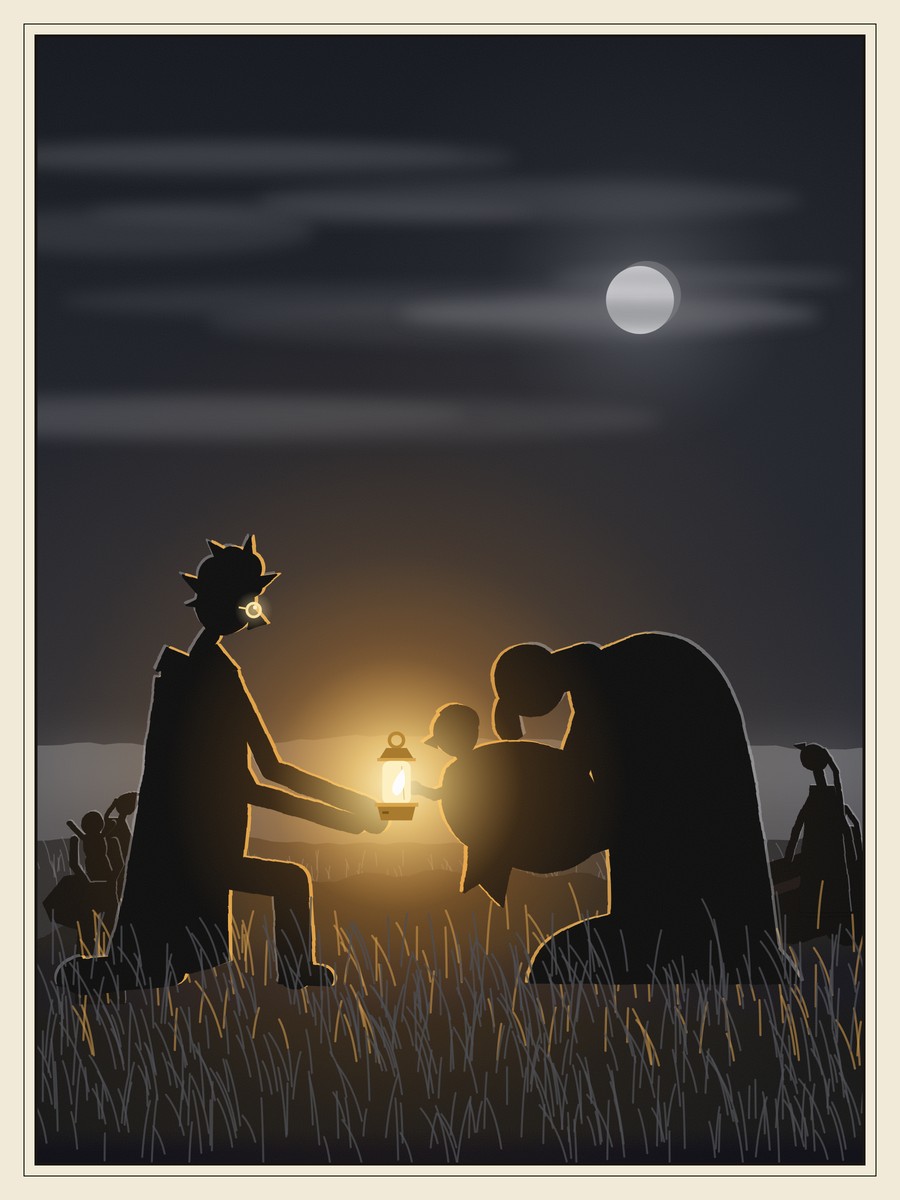
When at last he lifted his head, his wet face was turned towards Tobin — or towards the warmth in Tobin’s hands.
“The Delvers have a word for everything,” he said, in his deep slow voice, and it broke. “Nine words for the sound of water. Four for the quiet before a song. And I have no word for this.” He bent his head over his son again. “None at all.”
Tobin had no idea what to say to that, so he pushed his spectacles up his nose, and said, “There are some more. Greyed ones. Further down the line. I’d better—“ and went, before anyone could see that he was crying too.
Wren and Mira climbed the Black Stair together in the dark, and Cinder went in front.
With four hundred Delvers clicking, Mira had said, the stair was a din. With one, it was a map. Mira went first, with Wren’s hand on her shoulder, and every few steps she clicked once, softly, and listened, and said, “Gap. Long step. Wall side,” or “Loose stone. Step over,” exactly as if she could see it. Behind them, Cinder’s little spark bobbed, lighting nothing but itself.
“You’re showing off,” said Wren, at about the two-hundredth step.
“A little,” said Mira. She clicked. “Step.”
Somewhere about the six-hundredth step, Mira stopped.
“Wren,” she said. “May I ask you something?”
“You’re going to anyway.”
“Are you afraid he will keep it?”
Wren opened her mouth to say no, quickly, the way she said most things. Then she shut it again, and thought, because Mira would hear if she lied. She thought of Tobin in the stream-bed, frozen like a hat-stand. She thought of Tobin on the thirtieth step under his father’s Hall, all alone in the dark, saying It’s not mine. I’m taking it back to her. She thought of a compass needle in a cell lock, and a letter left for a father who could not look at him.
“No,” she said at last, and was surprised to find it was true. “He won’t keep it. He’s not the keeping sort. He’s a great swot and he talks too much and he’s frightened of his own shadow. But he’s not the keeping sort.”
“Good,” said Mira. She clicked. “Step.”
They climbed on. And Wren found that the dark of the Black Stair, which should have been the worst dark she had ever been in, with no lamp and no ribbon and no end to it, was not so very bad after all. It was only dark. She had a hand on a friend’s shoulder, and a fox at her heels, and somewhere up above her, in the hands of someone she trusted, the light was going on ahead.
At the top of the Black Stair there was light.
Wren saw it from far below, a faint gold glow on the curve of the wall, and she began to climb faster and faster until Mira said, “Wren, I can hear you not looking where you’re going.” And then they came up the last steps and out through the hole into the wind, and there was the pale moon, and the grey grass, and four hundred Delvers sitting about on a hilltop with their faces turned to the sky. And there was Tobin, sitting on a stone by the hole, waiting, with the lamp in his lap.
He stood up when he saw her. He looked dreadful. His spectacles were cracked across one lens, his knees were through his trousers, and his face was streaked with soot and something else. He was smiling.
He held out the lamp.
“Here,” he said. “It’s yours. Not lent. I’m not asking for it back.” He pushed his spectacles up his nose. “You don’t have to do anything.”
Wren looked at it for a moment.
Then she took it. And the lamp did not dip, or flicker, or go small. It blazed up in her hands exactly as bright as it had blazed in his — brighter, if anything — and the ribbon on her wrist flushed red as a rose in the moonlight, and it was not one bit the less for having been given away.
“You didn’t drop it,” she said.
“I very nearly did,” said Tobin. “Twice.”
“Yes, well,” said Wren. “I very nearly didn’t give it you.” And she shoved him, quite gently, with her shoulder, which was the nearest she had ever come to a hug.
Behind them, Mira came up out of the hole into the open air. She stood quite still. She lifted her face, and clicked once, upwards, at the sky — and waited — and nothing came back.
“Oh,” said Mira, very quietly. “Oh. It goes on for ever.”
Chapter 11 complete
Light in the Low Places