Book
The Holy Spirit, or Power from on High
Part II: The New Testament
Book 2 of 2 in The Holy Spirit, or Power from on High
A. B. Simpson · 1843–1919
- 29 chapters
- 7 hr 25 min read
- Moderate Reading difficulty
Free to read·No account needed
Preface to Volume II
Taking books where there’s no signal? See Ochorus for missionaries or chaplains
About this book
The second volume of Simpson's great study of the Holy Spirit, tracing the Spirit through the New Testament from the Gospels to the last message of Revelation. Chapter by chapter he shows the Spirit in the life of Jesus, the promise of the Comforter, the waiting and the outpouring at Pentecost, and the Spirit's work in every epistle — calling the reader past doctrine to be filled with the Spirit for holiness and service. First given as Sunday messages at the Gospel Tabernacle in New York.
These words from the lips of the forerunner intimate that there was to be a great distinction between the old dispensation which he was closing, and the new, which Jesus Christ was about to usher
Contents
- 1 Preface to Volume II 2 min
- 2 The Holy Spirit in the Life of the Lord Jesus Christ 16 min
- 3 The Baptism with the Holy Ghost 14 min
- 4 The Wise and Foolish Virgins 12 min
- 5 The Parable of the Pounds, or Power for Service 20 min
- 6 The Holy Ghost in the Gospel of John 15 min
- 7 The Comforter 14 min
- 8 Waiting for the Spirit 16 min
- 9 Power from on High 21 min
- 10 Filled with the Spirit 15 min
- 11 The Holy Spirit in the Epistle to the Romans 16 min
- 12 The Holy Spirit in the First Epistle to the Corinthians 17 min
- 13 The Holy Spirit in the Body of Christ 11 min
- 14 The Holy Spirit in Second Corinthians 13 min
- 15 The Holy Spirit in Galatians 15 min
- 16 All the Blessings of the Spirit 21 min
- 17 The Holy Spirit in Philippians 15 min
- 18 The Spirit of Love 14 min
- 19 The Holy Spirit in Thessalonians 15 min
- 20 The Holy Spirit in the Epistles of Paul to Timothy 18 min
- 21 Regeneration and Renewal 14 min
- 22 The Holy Spirit in the Epistle to the Hebrews 16 min
- 23 God's Jealous Love 18 min
- 24 The Holy Spirit in the Epistles of Peter 14 min
- 25 The Holy Spirit in the First Epistle of John 20 min
- 26 The Holy Spirit in Jude 17 min
- 27 The Sevenfold Holy Ghost 11 min
- 28 The Spirit's Message to the Churches 20 min
- 29 The Holy Spirit's Last Message 15 min
Questions and Answers
What is The Holy Spirit; or, Power from on High, Part II about?
It is the second volume of A. B. Simpson's survey of the Holy Spirit through the Bible, tracing His person and work across the New Testament. The chapters began as weekly sermons printed in the Christian Alliance, and Simpson says he writes not for "the wise, the scholarly and the critical" but to give "simple and satisfying bread for the King's children."
How is the book organised?
Simpson moves book by book through the New Testament. He begins with the Spirit in the life of Christ, the baptism with the Holy Ghost and two parables, turns to John's teaching on the Comforter and the Pentecost chapters of Acts, then takes the epistles from Romans to Jude one at a time, and closes with Revelation and the Spirit's "last message" to the Church.
How does Simpson contrast the Spirit's work in the Old and New Testaments?
Simpson argues that in the Old Testament the Spirit came upon special individuals for special service, visiting the earth as occasion required, while in the New He is poured out on all believers and makes His home in them. Once He was with and upon people; now He dwells in them as the Spirit of the Son, so that what believers receive is "not the influence" of the Spirit but His Person.
What does Simpson mean by the baptism with the Holy Ghost?
Simpson teaches that Christ is the Baptizer and the Spirit Himself is the baptism, a union with a living Person rather than a feeling or power. As Jesus was born of the Spirit and later anointed at the Jordan, so the believer comes to a "crisis hour" of self-surrender, dying to self and rising to receive the Spirit, whose fire then searches, purifies and refines the soul.
Is there a difference between having the Spirit and being filled with the Spirit?
Yes. Simpson argues that the disciples, and the sealed believers of Ephesians, already had the Spirit in some measure yet still needed to be filled. He compares a shallow stream with an overflowing river, and calls being baptized into the one body an act but drinking into the Spirit a habit. Being filled, he says, brings the fullness of Christ, holiness, joy and the fruit of the Spirit.
How does Simpson say a believer is filled with the Spirit?
Simpson stresses waiting "on the Lord" rather than for Him: time to cease from self, feel one's need, listen and keep receiving, as the disciples waited before Pentecost. He then gives simple conditions: be empty, be hungry, be open, receive by faith as well as ask, wait upon the Lord, and give the blessing away to others, since the Spirit "is given for service."
What does Simpson teach about the Comforter?
Simpson explains that "Paraclete" means One at our side, "God at hand," so the main idea is practical sufficiency for every need rather than mere comfort. The Comforter does not take Christ's place but makes Him nearer; His great business is "to stand behind the scenes and make Jesus real." He also teaches, brings truth to remembrance and convicts the world of sin.
How does the book connect the Spirit with holiness, service and Christ's return?
Simpson argues that power from on high is first the power of holy character, "power to be, rather than to say and to do," and then power to witness to "the uttermost part of the earth." The Spirit loves believers "to jealousy," separating them from the world, and the closing chapter presents Him preparing the Bride and sending out witnesses for the Lord's coming.
About the author
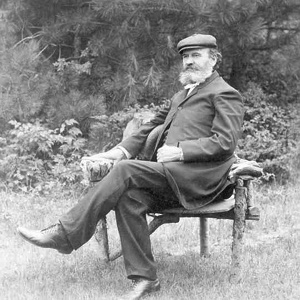
A. B. Simpson
The Holy Spirit, or Power from on High · 1896
More like this


Public domain. Source text from the original edition.
Elihu Vedder, “Storm in Umbria” (1875). The Art Institute of Chicago, CC0.
Cite this book
Copy a citation in the style you need.
- MLA
- Simpson, A. B. The Holy Spirit, or Power from on High. 1896. Ochorus, https://ochorus.com/books/power-from-on-high-new-testament/.
- Chicago
- Simpson, A. B. The Holy Spirit, or Power from on High. 1896. Reprint, Ochorus. https://ochorus.com/books/power-from-on-high-new-testament/.
- Chicago footnote
- A. B. Simpson, The Holy Spirit, or Power from on High (1896; repr., Ochorus), https://ochorus.com/books/power-from-on-high-new-testament/.
- BibTeX
- @book{simpson1896holy, author = {Simpson, A. B.}, title = {{The Holy Spirit, or Power from on High}}, year = {1896}, publisher = {Ochorus}, url = {https://ochorus.com/books/power-from-on-high-new-testament/} }