Chapter 9 · 17 min read · 21 min listen
The Captain in Grey
“I have to go home,” said Tobin.
He said it at breakfast, which was porridge the colour and texture of wet cement. Wren put her spoon down.
“Course you do,” she said.
“Not like that. Not for good.” Tobin pushed his spectacles up his nose. “Look. If I’m missing for a third night, my father will turn the whole city upside down, and the first place anyone sensible looks for a missing boy is wherever the missing girl is. But if I’m at supper, and I’m sulky, and I’ve been out ‘sketching the canal locks’, then I’m just being peculiar again, and nobody will think twice. And if I’m in the Hall, I can find out what he’s planning.”
“Nobs always go home,” said Wren. “That’s what home’s for.”
Tobin went red, and opened his mouth, and shut it again. Old Ash, behind his teacup, said, “Hm,” which might have meant anything.
“I’ll be back by dark,” said Tobin. “I promise.”
Wren shrugged, and picked up her spoon, and did not look at him. But when he was halfway down the wall-stair, she called after him — “Mind the guard on Tallow Bridge, he looks under everyone’s hat” — and Tobin, who did not own a hat, found that he was smiling all the way to the bottom.
He was not smiling an hour later.
He had come up through the Low Quarter and over the canal, and was climbing the long cobbled street to the Hill, when he found that everybody else was going the other way. Apprentices, washerwomen, clerks with ink on their cuffs, all hurrying north, all talking in low voices. Tobin turned and went with them, and that is how he came to be standing on the steps of a chandler’s shop in Gate Street, craning over the heads of the crowd, when the Grey Gate opened.
It had not opened in Tobin’s lifetime. But now its great iron leaves swung inward, groaning, and the cold came in with them — not wind, but cold, the way cold comes off a block of ice — and the crowd went quiet as a cellar.
A rider came through.
He was tall and pale, and he sat his horse as if he had been born on it. His armour was grey, and his long cloak was grey, and his horse was grey, and when he turned his head to look along the street Tobin saw that his eyes were grey too, a light, clear, polished grey, like water in a pewter jug. He was rather handsome. He did not look cruel. He looked, Tobin thought, like a man who had never once in his life been in a hurry.
Behind him, on foot, came six more.
They were men, or they had been. They wore grey armour like their captain, but their faces were not like his. Their faces were the colour of ash, and smooth, and empty, and their eyes did not look at anything. They walked in step, like clockwork. And as they passed, the paint on the chandler’s sign above Tobin’s head — it had been a sort of brownish not-quite-red — faded, very slowly, to the colour of dust.
A herald in the Warden’s livery, white-faced, stepped out from the gatehouse and cried in a voice that wobbled: “Make way! Make way for Captain Varrick, envoy of the Queen’s peace, who comes to treat with the Lord Warden of Emberwick!”
The Queen’s peace. Tobin heard the words go through the crowd like a draught going through a house. The Queen. The Queen’s peace. Peace, he said. Some people sounded frightened. Some — and this made Tobin’s stomach turn over — sounded hopeful.
The grey rider rode up Gate Street at a walk, nodding pleasantly to the people on either side, and the crowd parted in front of him like a field of barley parting for the wind. As he passed the chandler’s steps his eyes moved, without any hurry, over the faces there, and for one half of a second they rested on Tobin’s.
Then they moved on.
Tobin found that he had stopped breathing. He started again. Then he jumped off the steps and ran by the back lanes, all elbows and knees, towards the Warden’s Hall.
There was a way into the Hall that nobody knew about except Tobin, the coal-man and possibly the cat: through the coal-cellar and up the servants’ back stair. Tobin went up it three steps at a time. He came out into his workshop, where the Orrery of the Ring stood on its round table with its hundred and forty-four glass beads glowing faintly, and he did not even stop to look at it.
He went instead to the corner, where a wooden panel was screwed to the wall, took out the four screws with the little screwdriver he kept in his top pocket, and lifted the panel away.
Behind it was dark.
Tobin had found the crawlway when he was eight years old, hiding from his fencing master. It ran between the attic floor and the ceilings of the rooms below, a long low gap full of dust and old beams and the bones of mice, and if you crawled along the third beam on the left for forty-one lengths of your own body, you came out above his father’s study, where a crack beside the plaster rose in the ceiling let you look straight down onto the desk. He had spent a great many afternoons there when he was small, watching his father write, wishing he would look up.
He had forgotten how dark it was.
He knelt at the opening with his heart going like a hammer, and thought about going back for his night-lamp, and knew that he could not: a light in the crawlway would show through every crack in every ceiling between here and the study. He thought about Wren in the flue at Thornbury House, not minding the dark at all. He thought: she’d laugh at me. And then, oddly: no. She wouldn’t. Not about this.
He took a breath of dust and crawled in.
The dark closed over him like water. He could not see his hands. He could feel the beam under his knees and the cobwebs on his face, and every few lengths something small scuffled away from him. He counted lengths out loud, under his breath, the way his mother had taught him to count stairs when he was frightened of the cellar — “fourteen, fifteen, sixteen” — and his voice shook, and he kept counting. At thirty he heard voices. At forty-one he lay flat along the beam, put his eye to the crack beside the plaster rose, and looked down.
His father was standing by the window.
Lord Edric Harrowgate stood with his hands behind his back and his chin up, as he always did when there were visitors, and the grey light from the window made the silver at his temples shine like frost. He looked very calm. Only Tobin, who had spent his whole life watching that back, could see that the hands behind it were holding each other far too tightly.
The door opened. The steward announced, in a voice that was trying hard not to squeak, “Captain Varrick, my lord.”
And the captain in grey came in, and took off his gloves, and bowed.
“Lord Warden,” he said.
His voice was the most pleasant voice Tobin had ever heard. It was low, and smooth, and unhurried, and it went into your ears as easily as oil goes into a lock.
“You keep a fine city,” said Captain Varrick, “in very poor light. It cannot be easy, with the lamps as they are, and the Guild as it is.” He smiled a little. “I have met Master Prowle.”
“You did not come here to discuss Master Prowle,” said Lord Edric.
“No.” Varrick sat down, uninvited, in the chair before the desk, and crossed one long grey leg over the other. “I came to make you an offer. My mistress has no quarrel with Emberwick. None at all. The Hollows that came over your wall the other day — that was a misunderstanding. They were drawn by something. A light that did not belong in your city.” He turned his gloves over in his hands. “Give me that light, Lord Warden, and they will go away. Your Ring will hold. Your people will sleep. You will have peace, for as long as you like.”
“What light?” said Lord Edric, though Tobin could tell from his voice that he knew.
“A certain lamp. A small thing. Brass, rather battered. Not worth a great deal to look at.” Varrick’s grey eyes rested on the Warden’s face. “It is a dangerous object in the hands of a child. And it does, if I may say so, belong to my mistress. It was taken from her a long time ago.”
Up on the beam, Tobin’s fingers dug into the wood. That’s a lie, he thought. That’s a lie, that’s a lie. Tell him it’s a lie.
“The Guild calls it witch-light,” said his father slowly.
“The Guild,” said Varrick, “is wiser than it knows.”
There was a silence. Lord Edric turned from the window and walked to his desk, and stood there, looking down at nothing. On the wall behind the desk hung a portrait of a woman with fair hair and a laughing mouth. Tobin saw his father’s eyes go to it, and stay there for a moment, and then come away, as if it had been too hot to touch.
“And the girl?” said Lord Edric. “The sweep who carries it?”
“Children are no concern of mine,” said Varrick lightly. “Do as you please with her.”
“And if I refuse?”
Varrick looked almost sorry. “Then I am afraid your lamps will go on being — unreliable. And the misunderstandings will go on happening. And one night there may be a misunderstanding that does not stop at the Low Quarter.” He leaned forward a little. “But I do not think you will refuse. You are a sensible man, Lord Warden. You have a great deal to keep. And for a man of your quality — perhaps there could be more. My mistress is generous to her friends. A seat at a larger table than this one.”
He said it as gently as if he were offering a cup of tea.
And as he said it, Tobin saw him do a strange thing. He laid his gloves on his knee, and with the thumb of his left hand he began to rub the palm of his right, slowly, round and round, the way you might rub a sore place without knowing you were doing it. From up in the ceiling Tobin could see the palm quite clearly. There was a scar across it: a long, pale, shiny scar, puckered at the edges, like an old burn.
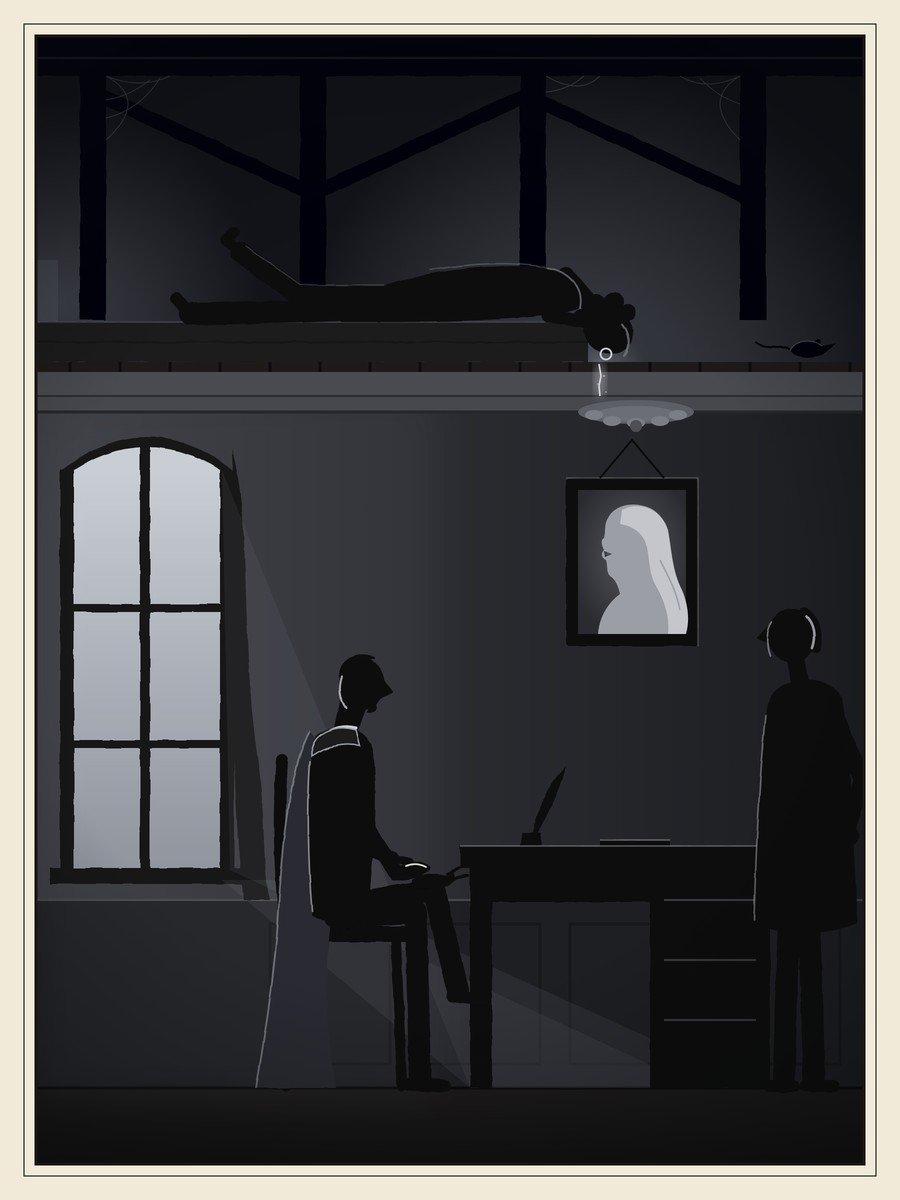
His father was quiet for a long time. Tobin, lying on the beam in the dark, wished with his whole body, as hard as he had ever wished anything: Say no. Please. Say no. Be the man she married. Say no.
“Very well,” said Lord Edric Harrowgate. “You shall have it.”
Varrick stood up and bowed. “I knew we would understand each other.”
He drew on his gloves and went to the door. And at the door he stopped, and turned his head, and looked up — not quickly, not as if he had heard anything, but quite slowly and pleasantly — at the ceiling. At the plaster rose. At the crack beside it.
Tobin lay without breathing, his eye an inch from the gap, a single thread of dust drifting down from the beam beneath his chin.
“You have mice, my lord,” said Captain Varrick.
Then he went out.
Tobin did not remember crawling back. He remembered only that he was suddenly kneeling on his own workshop floor in the grey afternoon light, with cobwebs in his hair, and that he was shaking so hard he could not fit the screws back into the panel. He gave up and sat with his back against the bench.
Above him, on the Orrery, the glass beads along the north stretch of the wall flickered, faint and tired.
His father had said yes.
He had always known, in the way you know a thing without letting yourself look at it, that his father was afraid. Afraid of the dark beyond the wall, and of losing his place. But he had never thought — he had never once in his life thought — that his father would look at a lie, and know it was a lie, and say very well.
And now he had to go back to the Leaning Tower, and look at Wren, and decide.
Everyone wants something, she had said, in this very attic, with her chin up. She would think he had known all along. She would think he had been sent. And why should she trust the Warden’s son, when the Warden had just sold her?
He could say nothing. He could say his father was making plans, and leave it there. It would not even be a lie. Not exactly.
Tobin sat on the floor until the light at the window began to go. Then he got up, left the panel lying where it was, and ran.
The lamp in the round window was lit when he came up the wall-stair, and the door opened before he could knock. But it was Wren who opened it this time, not Old Ash.
“You came back,” she said. Just for a moment she sounded surprised. “You look like something the cat sicked up. What happened?”
Tobin opened his mouth. But before he could say anything, Old Ash, who was standing at the round window with his pole in his hand, said in a voice none of them had heard him use before:
“Come here. Both of you. Quietly.”
They went to the window.
Below the North Wall, on the inside, there ran a road, and along the road, in the last of the gloaming, a grey horse was walking. The rider on its back rode easily, looking up at the Ring-lamps as he passed them, one after another, the way a man might look at the locks on a house he meant to buy. Six grey shapes walked behind him. As they went by, each Ring-lamp dimmed a little, and did not quite come back.
Under the Leaning Tower, the rider stopped. He lifted his pale face, and looked up at the round window, and smiled.
Old Ash did not move. But Tobin, standing beside him, saw his face, and never forgot it. It was not angry. It was not afraid. It was the face of a man who has been told, all at once, that someone he loved has died — except that the someone was alive, and sitting on a grey horse below the window, smiling at him.
“Hm,” said Old Ash, very low. “So it’s you they sent, lad.”
Down on the road, the rider touched two fingers to his brow, like a salute, and rode on into the dusk.
“You know him,” said Wren.
“I taught him.” The old man let the curtain fall. His hands were not quite steady. “He was a Lamplighter once. The best I ever had. Quick and brave and clever, and kind — oh, he was kind, then. He could light a Ring-lamp in a gale at the full stretch of his pole. He took the oath at the Beacon with his hand held over the oath-flame, the way we all did, and it marked him, the way it marked us all.” He turned his own right hand over, and on the palm, faint and old, there was a pale mark across it, like a burn.
Tobin felt cold all over. “He’s got a scar,” he said. “There. Just like that. He rubs it. I saw him.”
Old Ash closed his eyes. “Does he,” he said. “Does he, now.”
“What happened to him?” said Wren.
“He fell,” said Old Ash. “Bargains will do that.” And he went out of the door onto the wall, into the dark, with his pole on his shoulder, and did not say anything more.
So then there was nobody in the tower but Tobin and Wren and the fox.
Tobin sat down on the bench. He took off his spectacles, and put them on again. And then, because he found that he could not bear to sit there for one more minute with the thing inside him, he told her. All of it. The gate, the beam, the dark, the voice like oil, the portrait on the wall. And very well. You shall have it.
Wren did not interrupt him once. When he had finished she was standing quite still in the middle of the room with her arms folded, and her face had gone the way he had known it would: closed, like a shop with the shutters down.
“So,” she said. “Your dad’s going to sell me.”
“Yes.”
“And you’ve come to tell me.” Her voice was very flat. “Why? So I’ll run, and you can tell him which way? Or so I’ll hand it over nicely, so nobody gets hurt? Go on. Which one is it? Everybody wants something.”
“Neither,” said Tobin. His voice came out wobbly, and he made it steady. “I came to tell you because it’s true. And because he’s wrong. And because Captain Varrick is a liar, and I heard him lie, and my father heard it too, and said yes anyway.” He swallowed. “He’s my father. I’m not going to pretend he isn’t. But I’m not on his side. Not about this.”
Wren looked at him for a long time. In her lap — she had sat down without noticing — Cinder’s spark was burning brighter than it had all day.
“You’d pick a sweep,” she said slowly, “over the Warden.”
“I’d pick—“ Tobin stopped. He did not know how to say it without sounding like a book. “I’d pick you not being sold,” he said at last. “That’s all.”
Wren turned her face away, very quickly, and looked hard at the stuffed owl.
“That night-lamp of yours,” she said, after a while, to the owl. “The little one. You sleep with it.”
Tobin’s ears went hot. “How did you—“
“I’m not blind.” She still did not look at him. “I won’t tell. That’s all. I won’t tell anyone.”
It was not much. It was, Tobin thought afterwards, perhaps the most anyone in Soot Lane had ever given anyone for nothing. His throat was too tight to say thank you, so he just nodded, and Wren nodded at the owl, and that was that.
The door opened, and Old Ash came in with the cold on his coat.
“Well,” he said, looking from one to the other. “Hm. Good.” He hung up his pole. “We can’t stay. Not now. There’s only one place in Gloamhaven where that lamp will be safe, and only one place where whatever’s broken might be mended, and that’s the Bright Mountain, where the Flame began. But it’s a long way, and the road isn’t on any map you can buy. I’ll need my charter, and my old map, the one the Lamplighters kept. The Guild took both when they turned me out.” He sat down heavily. “They’re in the vault under the Guild Hall.”
Wren’s head came up. For the first time since Tobin had walked through the door, something lit in her eyes.
“A vault,” she said. “Now that’s something I know about.”
Chapter 9 complete
The Captain in Grey