Chapter 10 · 16 min read · 21 min listen
Gutterlings and Glass
The roof of the Guild Hall was the richest roof in Emberwick, and Wren hated it on sight.
It was covered all over in gold leaf — not much gold, she guessed, but enough to catch what little light the night had and throw it about in a showing-off sort of way. There were gilded gutters and gilded weathercocks, and in the very middle, rising out of the roof like a great glass bubble, was the dome. By day it let the pale sun down into the Guild’s great hall. By night it was a vast dark eye with a faint glow somewhere deep inside it.
“Honestly,” whispered Wren, crouching behind a chimney stack. “Who puts gold on a roof? Who’s going to see it? Pigeons?”
“It’s meant to be seen from the Hill,” whispered Tobin, who was lying flat on the leads with his arms wrapped round the chimney as though it were his last friend in the world. “Technically speaking, it catches the light from the Beacon and gives an impression of—“
“Of nobs with more money than sense.”
“I was going to say prosperity.”
“Same thing.”
Between them Cinder lay with her chin on her paws. The spark in the tip of her tail was banked down to a dull red glow, the way a fire is banked for the night, as if she knew perfectly well that this was not a time for being noticed.
It was past midnight. The plan had been written out by Tobin on the back of one of Old Ash’s maps, in very small, very neat handwriting, with numbered steps and a diagram. Ash could not come himself. “Hm. A man my height on a roof is not a burglar, child,” he had said. “He’s a weathervane.” So it was the two of them and the fox. Wren would get them in, because getting into places she was not wanted was the one thing in the world she was truly good at. Tobin would get them into the vault, because the vault had a lock no one in Emberwick had ever opened without the key. And Cinder would get them out again, if it came to that, because Cinder could smell a watchman through three floors and a door.
“Step one,” breathed Tobin, reading his paper by the red glow of Cinder’s tail. “Enter by the north flue of the great hall fireplace, which, according to the builder’s drawings—“
“I know what a flue is.” Wren was already prising the iron cap off the nearest chimney. A breath of cold, sooty air rose out of the dark. “Not lit. They never light this one. Too mean to buy the coal. Feet against one side, back against the other, and if you get stuck, don’t shout.”
Tobin looked into the black hole and swallowed so loudly that she heard it. Then he lit his mother’s little night-lamp with fingers that shook only slightly, hooked it to his collar, and followed her down.
If you have never been down a chimney, I can tell you that it is worse than going up one. You cannot see your feet. Soot gets into your ears and up your nose and somehow, mysteriously, into your socks. Wren went down that flue the way other girls go down a staircase. Tobin went down it the way a sack of potatoes goes down a well, with a great deal of bumping and one long, muffled squeak, and came out at the bottom in such a cloud of soot that for a moment he looked like a chimney himself.
They stood in a fireplace big enough to park a cart in. Before them lay the great hall of the Lamp Guild: gilded pillars marching away into the gloom, portraits of past Guild Masters frowning down from the walls, each one rounder and glossier than the last. The air smelled of lavender and floor polish.
Cinder dropped out of the chimney behind them, shook herself, and sneezed. A little spray of sparks danced across the polished floor.
“Shh!” said both children at once.
Cinder gave them a look that said she would sneeze when she pleased, thank you, and trotted off between the pillars with her nose down.
The vault lay at the bottom of a short stone stair behind a door marked GUILD OFFICERS ONLY in gold letters. The door was not even locked. (“Why would it be?” said Wren. “Everyone’s too frightened of the Guild to try it.”) But the vault door itself was another matter.
It was iron, painted dark green, with brass hinges as thick as Wren’s arm. In the middle was a round brass plate set with five little dials, each marked round its edge with tiny numbers. Behind the plate, if you put your ear to it, you could hear a faint, steady ticking, like a clock in another room.
Tobin put his ear to it, and his whole face changed. Wren had seen that look before, in his attic, when he showed her the Orrery. It was the look of a boy who has forgotten to be afraid because something more interesting has come along.
“Oh,” he breathed. “It’s a Pellingham. A Pellingham Patent Five-Tumbler. I’ve only ever seen the drawings. Listen — every time a dial passes the right number, a tumbler drops, but the clock keeps turning, so if you don’t set the next dial before the tick comes round again, it resets all of them, which means—“
“Which means can you open it or not?”
“Which means you have to listen for the drop between the ticks. It’s actually rather beautiful. Mister Pellingham was a—“
“Tobin.”
“Yes. Sorry. Hold the lamp closer.”
He laid his long ink-stained fingers on the first dial and turned it, very slowly, with his ear pressed flat to the brass. Tick, went the lock. Tick. Tick. And then, so small that Wren almost missed it, a tiny tock, like a pebble dropping into a cup.
“One,” whispered Tobin.
On the fourth dial he went wrong, and the lock gave a soft, disappointed whirr, and all the tumblers clicked back up again. Wren said “Rot!” under her breath, and he said “Sorry, sorry,” and his fingers began to tremble. She did not say anything else. She only held the lamp steadier. The second time, he got all five. The last tumbler dropped with a heavy, satisfied clunk, and the great green door swung inward an inch on its own weight.
Tobin sat back on his heels, grinning all over his sooty face.
“Not bad,” said Wren, “for a nob.”
It was the nicest thing she had ever said to him, and they both knew it.
The vault was a long low room lined with shelves of strongboxes, tin tubes and leather ledgers with the years stamped on their spines in gold. Wren slipped the lamp from her coat, just enough to see by, and its warm golden glow ran along the shelves like honey.
She found Ash’s things almost at once, because they were the only things there that did not look as if they belonged. They had been shoved on a bottom shelf behind a crate: a tin tube with a cracked blue seal, and a bundle in oilcloth, with a label in the Guild’s spiky handwriting — CONFISCATED. PROPERTY OF THE EXPELLED MASTER LAMPLIGHTER. NOT TO BE RETURNED. The tube held a sheet of thick creamy paper with a little painted lamp at the top and a great many signatures at the bottom. The oilcloth held a map, folded so many times that it had gone soft as cloth.
“Got them,” said Wren. “Come on.”
But Tobin had taken a ledger off the shelf, because Tobin could never walk past a book without opening it, and his mouth was slowly coming open.
“Wren. Listen to this. Ring oil, purchased, four thousand gallons. Canal water added, one thousand two hundred gallons. Sold to the Ring account at full price, five thousand two hundred gallons.” He turned the page. “They’re watering the oil. They’ve been doing it for years. And here — Flame tokens, struck, twenty thousand, at one farthing each. Sold in the Low Quarter at tuppence, blessed at the Beacon. Blessed! They’re bits of tin, Wren! They sell bits of tin to people who can’t afford bread and tell them it’ll keep the Hollows off, and all the while they’re watering the oil that actually does keep the Hollows off, and that’s why the Ring’s failing, it’s not the dark times at all, it’s — it’s them!”
His voice had climbed higher and higher. Cinder flattened her ears at him.
Wren only shrugged. She had a Flame token herself, somewhere in the bottom of her coat. Mott had sold it to her for a week of her bread money.
“Course it’s them,” she said. “It’s always them. What did you think it was?”
“But it’s wrong.”
“Lots of things are wrong. Doesn’t stop them. Put it in my bag, if you want it. Ash’ll like it.”
He was still putting it in her bag when the first Gutterling dropped out of the ceiling.
High in the vault wall was a small round grating, where an air-flue came in from above. Something was squeezing out between its bars — something about the size of a cat, black as the inside of a chimney, with long spidery fingers and two enormous round white eyes. It dropped onto the top shelf with a soft plop, sat up, and stared at the gilt lettering on the ledgers.
“Shiny,” it whispered, in a voice like a squeaky hinge.
A second one squeezed through behind it. Then a dozen more, in a sort of black trickle.
“Gold on the books and gold on the box!”
“Gilt on the lid and gilt on the locks!”
“Oh, rot,” said Wren.
The Gutterlings poured down the shelves like spilled ink. They scratched at the gilded corners of the strongboxes. They pulled the ledgers half out to lick the gold letters on the spines. One of them found a crate of Flame tokens, and the lid came off, and a great shining avalanche of tin went jingling and clattering across the stone floor, rolling into every corner, ringing like a hundred tiny bells.
Far above them, up the stair, a voice said, “Eh? What was that?”
“Out,” hissed Wren. “Out, out, out—“
But one Gutterling had dropped right in front of her, and it was not looking at the ledgers. It was looking at the front of her coat, where three brass buttons gleamed in the lamplight. It had a bent ear, a nose like a candle-snuffer and a sly, crooked face, and Wren knew it at once. It was the very Gutterling that had stolen her brush in the flues of Thornbury House, the day all this began.
“Sweepy-girl!” it squeaked, delighted. “Sweepy-girl’s come again! Sweepy-girl’s got the shiny-shine!”
“Snib,” said Wren grimly.
“Shiny-shiny, mine-mine!” sang Snib, and reached for her buttons with both hands.
She slapped his fingers away. He hopped back, offended, and opened his mouth very wide, and Wren had the horrible certainty that he was going to set up such a squealing that every watchman in the building would come running. So she did the only thing she could think of. She twisted the top button off her coat, thread and all, and held it up.
Snib’s mouth shut with a snap.
“Yours,” said Wren, “if you’re quiet.”
“Quiet-quiet,” whispered Snib. “Quiet as mice.” He snatched the button, bit it, and hugged it to his narrow black chest. Then his bent ear twitched, and his eyes went wide in a new way. “Boots on the stair! Boots on the stair! Two big men with a lantern there!”
Cinder was already growling. Wren heard it too — heavy boots, a jingle of keys, a man saying “Probably rats, Dobbs,” and another answering “Rats don’t jingle, Hobb.”
Wren stuffed the lamp into her coat.
“That’s the only stair!” squeaked Tobin.
“Snib knows a way,” said Snib unexpectedly. “Up the flue and over the top, round the glass and never stop!” And he was off up the shelves like a spider, and through the grating, and gone.
The grating was far too small for a person. But beside it Wren saw now a wider square of darkness — an old coal-chute, the kind of thing no grown-up ever noticed and every sweep knew. She shoved Tobin at the shelves. “Climb!”
He climbed faster than she would have believed possible. Cinder went up past them both in two bounds. Wren went last, and as she pulled her feet into the chute, the two watchmen arrived at the bottom of the stair and stopped, and stared at the open vault, the floor shining with a thousand tin tokens, and a dozen Gutterlings sitting on the shelves licking the gilt off the ledgers.
“Gutterlings!” roared one. “Get out of it, you thieving little smuts!”
I am sorry to say that the Gutterlings did not get out of it. They threw tokens at him instead. It made a very great deal of noise, and it was the best thing that could have happened, because nobody thought to look up the coal-chute at all.
The chute came out on a ledge just under the rim of the dome, where a small iron hatch stood open to the night. They squeezed out onto the roof — and stopped. The way to the drainpipe at the far corner was blocked by a gilded parapet too high to climb, and the only way round it was across the dome.
Not over the top. Across its lower slope, along one of the iron ribs that held the glass in place — a narrow black rail running round the great curve like a line on a map. On either side of it was glass. And under the glass, a long, long way down, was the floor of the great hall, where lanterns were now bobbing about and voices were shouting, because the watchmen had woken the whole building.
“No,” said Tobin. “Wren, I can’t. The thing is, technically, I’m not very good with heights either. I didn’t put that in the plan. I should have put that in the plan.”
His face, in the glow of Cinder’s tail, had gone the colour of old porridge. He was clinging to the hatch-frame with both hands, and the night-lamp at his collar was shaking so hard its little flame danced.
Wren thought of all the things she could say — you great lump, and get on with it, and we haven’t got time. And then, without quite knowing why, she said none of them.
“Look at me,” she said instead. “Not down. Me. You put your foot where mine was. That’s all. That’s all a roof is.”
“That’s not all a roof is.”
“It is tonight.”
She stepped out onto the rib. Under her feet the glass creaked — a long, thin, terrible sound, like ice on a pond.
“Now you.”
Tobin let go of the frame. He put one foot on the rib, and then the other. The glass creaked again, and he made a noise like a kettle just before it boils.
“Me,” said Wren. “Look at me.”
He looked at her. He put his foot where hers had been, and then the next, and the next. Cinder came behind him, light as a leaf, and once, when he wobbled, she pressed her small warm body against the backs of his legs and held him there. Halfway across, a man below lifted his lantern and looked straight up, and for one dreadful heartbeat Wren was certain he had seen them — but the dome was dark, and they were dark, and all he saw was the night.
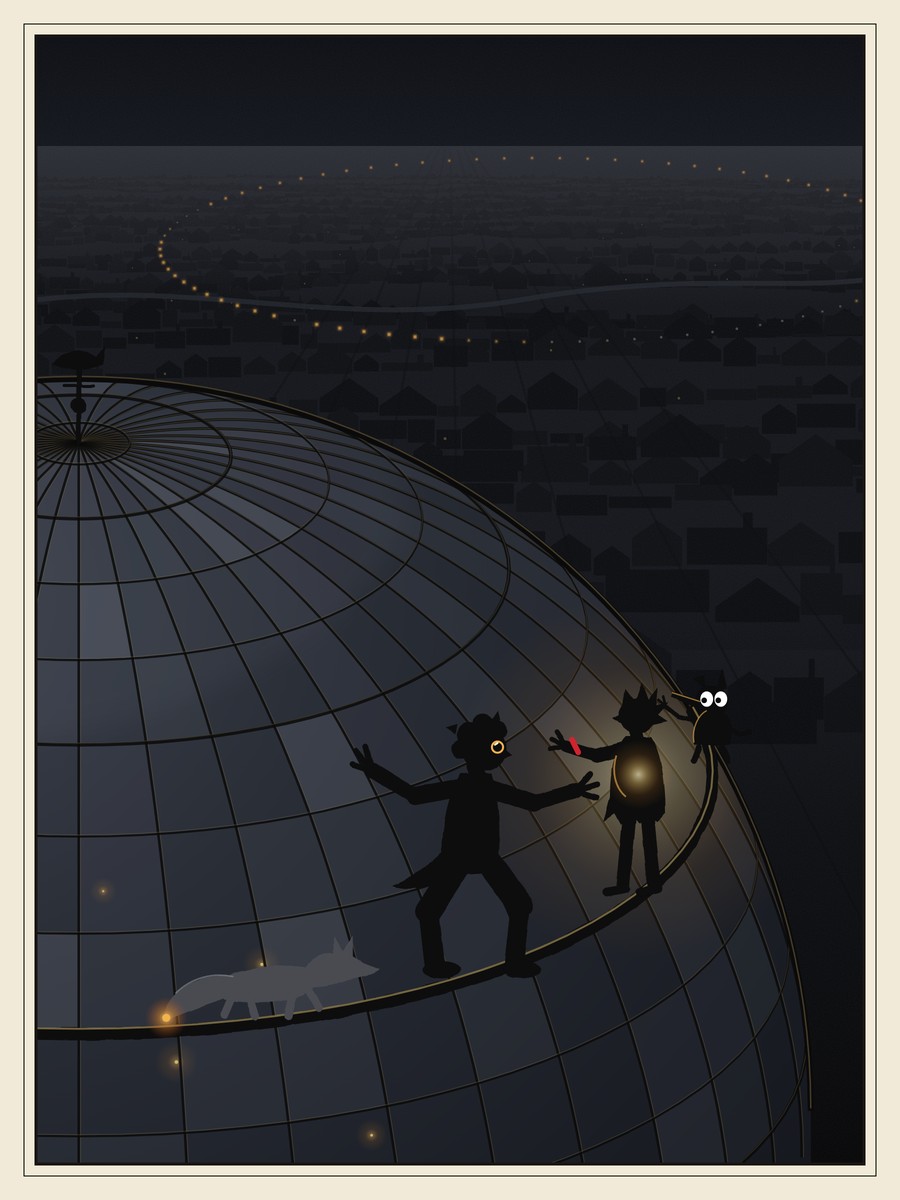
Three more steps. Two. One. Wren seized Tobin’s wrist and pulled him onto the solid leads, and they both sat down very suddenly with their backs against a chimney.
“I,” said Tobin, and breathed for a while. “I did that.”
“You did,” said Wren. And then, because she did not want him getting ideas: “Slowest I ever saw, mind.”
On the parapet above them, something small and black sat admiring a brass button in the gloom.
“Sweepy-girl owes Snib,” it remarked. “Button for quiet. Not for the way.”
“Sweepy-girl’s out of buttons she can spare,” said Wren.
Snib considered this, his big white eyes blinking slowly, as though some strange new thought had wandered into his head and he did not know what to do with it. Then he shook himself, squeaked “Buttons later! Buttons later!” and dropped away into a chimney-pot.
It was nearly three in the morning when they came up the last crooked step of the Leaning Tower, black from head to foot, with soot in their hair and soot in their eyebrows and soot, Tobin discovered, in places he did not wish to discuss. Old Ash was waiting in his armchair by the round window, the stuffed owl watching over his shoulder. He did not say anything. He only held out his hands.
Wren gave him the tin tube. He drew out the charter and spread it on his knees and touched the little painted lamp at the top with one long finger, very gently, the way you might touch the face of someone you had not seen in thirty years. Then he unwrapped the map, and something in his face that had been tight for a long time seemed to loosen.
“Hm,” he said roughly. “Well. Well, well.”
“And this,” said Tobin, and laid the ledger on top, open at the page about the canal water. Old Ash read it in silence. Cinder, who had already found the biscuit tin, crunched loudly in the corner.
“Proof,” said Ash at last. “Hm. Proof of what every poor soul in the Low Quarter has known in their bones for twenty years.” He looked at the two black-faced children over the top of the ledger, and there was something in his eyes that might have been pride and might have been worry and was probably both. “The Guild will hate you now, you know. Not just the witch-girl and the Warden’s boy. The ones who know.”
“They hated me already,” said Wren.
“They didn’t know my name,” said Tobin, a little faintly.
“They will.” Ash heaved himself up and reached for the teapot. “Tea. You’ve earned it. No — forgive me — you’ve had it coming, which is quite a different thing.”
Wren, who had tasted Ash’s tea before, opened her mouth to say she was not thirsty, thank you, not in the least. But she never said it. Cinder had stopped crunching. The fox had gone stiff all over, her nose to the round window, her tail-spark flaring white, and a low growl was rolling in her throat like distant thunder.
Wren turned to the window.
Out across the dark city, the long curve of the Ring-lamps stood along the wall like a string of dim yellow beads. As she watched, the one nearest the tanneries flickered — and went out.
Then the one beside it.
Then the next, and the next, one after another, quite steadily, the way you might pinch out candles at the end of a long evening — marching along the wall towards Soot Lane, and the canal, and the bakery, and the loft over Mott’s yard where Nettle slept.
And behind each one, where the light had been, the dark came over the wall like a tide.
Chapter 10 complete
Gutterlings and Glass