Chapter 8 · 17 min read · 21 min listen
The Tale of the Lampwright
Wren came down the crooked stair next morning with her boots in her hand and a question in her mouth, and she did not wait to put either of them on.
Old Ash was at the table, trimming wicks with a pair of tiny scissors. Cinder was under the table, watching the scissors in case they turned out to be edible.
“That song,” said Wren. “Last night. On the wall.”
Ash did not look up. Snip. “Good morning, child.”
“You were humming it. Morning comes. Where did you get it?”
Snip. Snip. He set down the scissors and looked at her then, and Wren had the feeling, which she did not like, that he had been waiting for her to ask.
“It’s an old Lamplighter song,” he said. “Very old. We used to sing it on the wall at the turning of the night, when the dark is thickest and the lamps want minding. It was sung by a good many people, once.” He paused. “And by more than one mother.”
Wren’s hand went to the ribbon on her wrist. She did not know she had done it until she saw him look at it.
“Then you know the words,” she said. “All of them. The rest of it.”
“I know the words I was taught.”
“Then tell me.”
Old Ash was quiet for so long that Tobin, coming down the stair behind her with his hair standing up like a hayrick, stopped on the bottom step and did not dare come further.
“No,” said the old man at last, quite gently. “Not yet. I think somebody sang those words to you first, child, and they were hers to give, and I won’t take them out of her mouth. Not this morning.”
“That’s rot,” said Wren. “She’s not here. She’s not anywhere. You can’t take anything from somebody who’s not anywhere.”
“Hm,” said Old Ash, and picked up his scissors again. “You’d be surprised.”
Wren sat in the round window with her back to him and her arms folded, and stayed there most of the morning. This lasted until Cinder brought her a biscuit, put it down on the bench beside her, looked at it, looked at Wren, and then — because she was a fox, and had her limits — picked it up again and ate it herself. Wren laughed in spite of herself, and after that it was hard to go on sulking.
It was a long, grey, waiting sort of day. Old Ash slept most of it in his armchair with his mouth open, because, he said, a man who walks the wall all night must sleep somewhere, and the bed was too far up. Tobin took apart three broken lamps and put two of them back together. Wren kept watch from the window. Twice she saw guardsmen tramping below the wall, look up at the Leaning Tower, mutter to each other, and walk the other way.
When the gloaming came down and the Ring-lamps along the wall coughed into their poor yellow life, Old Ash woke, stretched, made a pot of tea which nobody drank, and said:
“Now. I promised you the beginning.”
He went to a chest under the stair and came back with a bedsheet. It was patched in the middle with a darn shaped, Tobin said, almost exactly like a duck. He strung a cord from the banister to a nail in the wall, hung the sheet over it, and set a three-legged stool behind it. Then he held out his hand.
“The lamp, child. I’ll not touch it. Put it on the stool yourself.”
Wren did. The light came through the sheet warm and gold, and the whole sheet glowed like a page held up to a window, and the duck-shaped darn showed dark in the middle of it.
Old Ash fetched the biscuit tin with the lighthouse on the lid, emptied the last three biscuits onto the table (Cinder had two of them before they stopped rolling), and tipped out of it a heap of shapes cut from stiff black paper: a mountain, some rooftops, a crown, a long thin hand with too many fingers, a little figure of a man holding up a lamp.
Wren looked at them, and at the sheet, and at the old man kneeling behind it with his white beard full of light.
“Shadow puppets,” she said. “I’m twelve.”
“Then you’re old enough to sit still,” said Old Ash. “Sit.”
He began with his bare hands. He laid them together behind the sheet, and on the bright cloth a mountain rose, steep and black, and on its peak — he did something quick with his thumb — a tiny point of brightness that was the gap between two knuckles.
“After the king’s bargain,” he said, “the world went grey. Not all at once. Colours went the way names go when you are old: one, and then another, and then you can’t remember what you’ve lost. Cities built walls. People forgot what warm meant. And then, one evening, a shepherd on the lower slopes of the Bright Mountain looked up and saw a light coming down.”
The point of brightness began to move down the mountain’s side, slowly, as his knuckles slid apart.
“Excuse me,” said Tobin. “Sorry. But actually, if your hands are that close to the source, the shadow ought to be enormous, and if they’re further away—“
“Thank you,” said Old Ash, without stopping. “The light came down the mountain, and it was a man. And he was carrying—“
Cinder strolled out from behind the stool, and her shadow fell across the sheet: a fox the size of a carthorse, with a brush like a bonfire, padding across the mountain and sitting down on top of it.
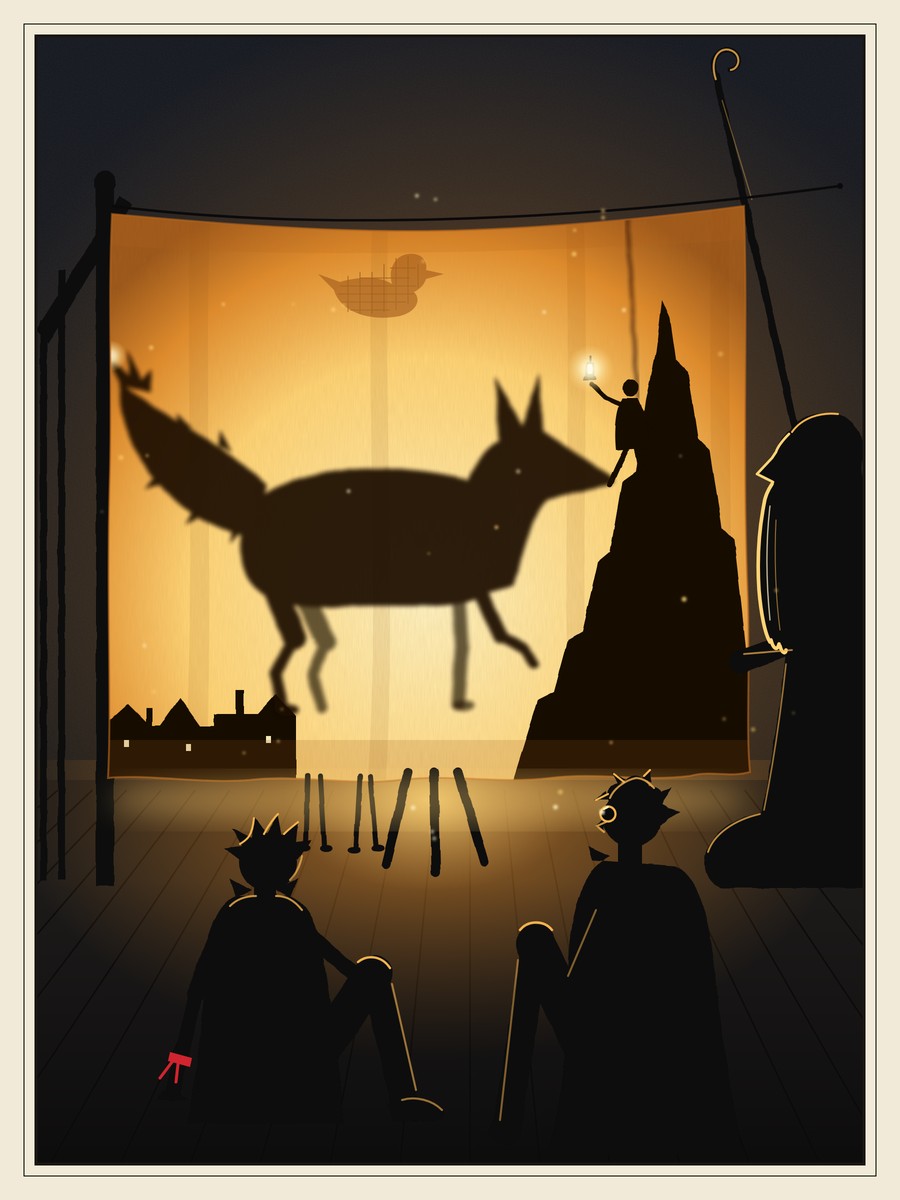
“—and in those days,” said Old Ash, perfectly calmly, “there were very large foxes. Cinder, get out of it.”
Cinder yawned, and her shadow yawned, a great black cave of a mouth with teeth like fence-posts. Wren snorted so hard she had to put her face in her knees.
Old Ash took the little paper figure of the man with the lamp, and held it up to the light, and on the sheet the stranger walked down out of the mountains and into a town of black rooftops.
“He was quite ordinary to look at,” he said. “That was the first surprise. No crown. No sword. A traveller’s coat, and boots that had been mended, and in his hand a small brass lamp with a flame in it that was not yellow, and not grey, but gold. And he went to the first door he came to, and knocked, and when they opened it he said, Your lamp’s gone out. May I light it?”
“And then he charged them,” said Wren.
“No.”
“Then he charged them later. That’s how it goes. They give you a bit for nothing, and then when you’re used to it they want it back with something on top. Everyone knows that.”
“He lit it,” said Old Ash, “and went to the next door, and lit that. He went down the whole street, and the next street, and through the whole town, and on to the next one. Anyone who asked. Rich and poor. Kind and unkind. The ones who thanked him and the ones who slammed the door afterwards. He never asked a penny, and he never once asked anyone whether they deserved it. In the end people stopped asking his name, and simply called him the Lampwright.”
“He’d have been robbed in Soot Lane in a minute,” said Wren.
“Oh, he was robbed,” said Old Ash. “Often. People tried to take the lamp from him in every city in Gloamhaven.” He paused. “They found they couldn’t keep it.”
Wren opened her mouth and shut it again. She was thinking of Grubb’s long nose, and Grubb shaking his burned fingers, and the way he had howled.
“How did one lamp light all of them?” said Tobin. He had stopped fidgeting. “If he lit a thousand lamps from one flame, it would have to — I mean, by the end there’d be nothing left. That’s just arithmetic.”
“Is it?” said Old Ash. “Hm. Hold that question, lad. Keep it in your pocket. It’s a good one.”
Now the paper man came to a house where a figure sat in a doorway, bent and still. Ash’s fingers made it: a head bowed, hands in the lap.
“There were people,” he said, “whom the Hollows had touched. You’ve seen them now. You know.” Wren thought of Mrs Fenn on her step, and her stomach went cold. “Grey all through. Forgetting their own children. And there were people who were blind, who had never seen even the grey. And he came to them, and he did not light a lamp. He knelt down, and put his hand on them, and held the Flame near.”
The bowed figure on the sheet lifted its head.
That was all. It was only a shadow lifting its head. But something about the way Ash did it — slowly, as if waking, as if surprised — made the hair stand up along Wren’s arms. And at that same moment, as though it had been listening, the lamp on the stool flared a little brighter, and the sheet turned from gold to a colour that was almost the colour of a sunrise, and on Wren’s wrist the ribbon blazed red.
“The grey went out of their faces,” said Old Ash softly. “Their cheeks came back pink. The blind ones looked up and saw the light, and the light was the first thing they ever saw, and they wept. And they remembered names they had forgotten for twenty years.”
Nobody said anything. Even Tobin.
Then Cinder got up again, trotted to the table, stood on her hind legs, and took the little paper man out of the old man’s fingers with her teeth — very delicately, as if she had done it before. Then she walked across in front of the lamp with him, and on the sheet the stranger with his lamp went walking on through the towns, from one side to the other, bobbing a little, with a large fox’s head attached to the back of him.
“Yes,” said Old Ash, a little hoarsely. “Thank you, Cinder. That’s exactly right. He went on.”
“Some of the people he lit lamps for followed him,” Ash went on, when Cinder had been persuaded to give the paper man back. “He taught them to carry the Flame and to tend the lamps of every city, and they made a promise, and the promise was this: to give light freely, to all who ask, and to take nothing for it. They called themselves Lamplighters. They wore blue, because blue was the colour of the sky when the sun was gold.”
Tobin looked at the old man’s patched coat, and said nothing.
“And the Queen,” said Old Ash, and he picked up the long-fingered paper hand, “hated him.”
The hand came onto the sheet from the edge, enormous, reaching. It was only black paper. But it was cut so that the fingers were a little too long and a little too thin, and they did not grab. They hovered. They seemed to wait.
“She did not shout,” said Old Ash. “She never does. First she offered him things. She offered him a crown, like Ardric’s, and a city of his own, and a sun that would shine on him alone. And he said no. Then she offered to leave the cities in peace, every one, if he would only put out his lamp and go home. And he said no to that too, because he knew what her peace is worth. So she sent her darkness after him. And his friends, the Lamplighters, who had promised so much — hm. Most of them ran.”
The paper hand closed slowly round the little man with the lamp.
“There is a hill,” said Old Ash, “a long way from here, called Cinder Hill. Nothing grows on it now. They say the ground there is still warm. And on that hill the Queen’s darkness came up round him like a tide coming in over the sand, and it was cold, and it was all the cold there has ever been, and it covered him. And it put out his light.”
He reached for the tea-cosy, lifted it off the pot, and set it over the lamp.
The room went dark.
It was not the ordinary dark of a room at night, with grey at the window and shapes you can half see. It was black, black as the inside of a sealed flue, so black that Wren could not see her own hand. Somewhere to her left she heard Tobin’s breath catch and go quick and shallow, the way a small animal breathes when it is caught. Without quite deciding to, she reached out in the dark and found his sleeve, and took hold of it. His arm was shaking.
“Rot,” she whispered. “It’s only a tea-cosy.”
“I know,” whispered Tobin. “I know it’s only a tea-cosy.”
But neither of them let go.
“His friends wept,” said Old Ash’s voice out of the blackness. It sounded very old now, and very tired, and very near. “They said: it’s over. They said: we were fools to hope. They said: she was right, the grey is easier. They went home and shut their doors. And it was dark on the first day.”
Silence. Cinder, invisible, gave a small whine.
“And it was dark on the second day.”
Wren found that she was holding her breath. She was twelve, and it was a story, and it was only a tea-cosy. She knew all that perfectly well. She held her breath anyway.
“And on the third day,” said Old Ash—
“Get on with it,” whispered Wren, and her voice cracked in the middle.
“—on the third morning, very early, before even the pale sun was up, a shepherd on the slopes of the Bright Mountain looked up. And on the top of the mountain, where nobody had climbed, there was a fire burning.”
He lifted the tea-cosy.
The light came back into the room all at once, the way a wave comes over a rock — gold and warm and smelling of bread — and the sheet blazed with it, so bright after the dark that Wren had to screw her eyes shut, and when she opened them they were wet, and she told herself it was the brightness. Cinder’s spark was burning like a star. The patches on Old Ash’s coat were blue, blue, blue. Tobin’s face beside her was pink and astonished and had a tear running down it behind his spectacles, which he did not wipe away.
“They ran up the mountain,” said Old Ash quietly. “His friends. All the ones who had gone home. They ran all the way up. And when they got there, there was the Flame, burning on the bare rock, burning without oil and without wick, warmer than anything they had ever felt. And he was gone.”
“Gone?” said Tobin. “Gone where?”
“Hm,” said Old Ash.
“That’s not an answer,” said Wren. “That’s a noise.”
“It is the answer I have,” said the old man.
He took down the sheet and folded it, and while he did it he told them the rest, plainly, without any shadows at all. How the Lamplighters had carried the Flame from the mountain to every city in Gloamhaven, and lit the great Rings from it, and the Rings had held back the Hollows for three hundred years. How, little by little, the Lamplighters had grown fewer and the Guild had grown larger. How someone had first said, Surely it is only fair to charge a little, for the oil. How the oil had been easier than the Flame, because oil could be weighed and counted and sold. How the lamps had grown dimmer every year, and the Guild had grown richer, and the price had gone up, and up.
“And the Flame,” said Tobin. “The real one. From the mountain.”
Old Ash sat down in his armchair. He looked at the little brass lamp on the stool, dented and cracked and burning, and the gold light lay on his face.
“You’re looking at it,” he said.
Nobody moved.
“That is his lamp,” said Old Ash. “His own. The one he carried down the mountain. When he was gone, his friends kept it, and passed it from hand to hand, from one Lamplighter to the next, for three hundred years. The last who kept it were the Thornburys, up on the Hill. And when the last of the Thornburys died, fifty years ago, the lamp could not be found. We searched that house from cellar to roof. I searched it myself, when I was a young man.” He shook his head. “And all the while it was sitting in a sealed flue behind a row of bricks, waiting for a sweep.”
Wren looked at the lamp, and then at her own hands, black under the nails with soot that never quite came out.
“Why me?” she said. “I’m nobody. I’m a thief. I’d have sold it the first morning if Grubb hadn’t—“ She stopped.
“I know,” said Old Ash.
“So why didn’t it burn me? It burned him.”
“Because Grubb tried to buy it,” said Old Ash, “and you were given it. That’s its law, child, and it’s the oldest law there is. It cannot be bought, stolen or earned. Only given.”
Wren felt something go cold and then hot at the back of her neck. She was in the market again, with her stomach aching, and a warm loaf being put into her hands by an old man with kind eyes. No charge. It’s given. She had meant to say something cheeky. And when she turned round, he had not been there.
She pushed the thought away hard, the way you push a door shut on a draught.
“Well, that’s rot,” she said, louder than she needed to. “That’s just rot. Nothing in the world is free. Everything costs. If it doesn’t cost you now, it’ll cost you later. I’ve known that since I was four.”
Old Ash looked at her for a long moment. He did not look cross. He looked, if anything, as though he were sorry for her, and also as though he knew something that would one day make her very glad.
“Then you’ve never met him,” he said.
The silence after that was so complete that they could hear the Ring-lamps hissing on the wall outside.
“There is a second half to the law,” said Old Ash at last. “What is given, grows. Remember that, both of you, though you won’t understand it yet. I didn’t, for years.” He laced his long fingers together. “And there’s more to the story than I’ve told you tonight. A good deal more. But it is not mine to tell. Not yet.”
Tobin had taken his spectacles off again. He held them in his lap and looked at the lamp without them, so that it must have been only a gold blur to him.
“Mr Ash,” he said. “Sir. The Lampwright. The man in the story.” He swallowed. “Could he come back?”
Old Ash did not answer. He said, “Hm,” very quietly, the way you might say it to yourself in an empty room.
Then he sat in his armchair, with Cinder’s chin on his boot, and looked at the little brass lamp for a long, long time, and did not say anything else at all.
Chapter 8 complete
The Tale of the Lampwright