Chapter 7 · 17 min read · 21 min listen
Old Ash
The Leaning Tower did not so much stand on the North Wall as lounge against it, like a tired old man resting his shoulder on a friend. It was built of grey stone furred with moss, and it tipped so far towards the city that Tobin, looking up at it in the last of the gloaming, worked out the angle in his head and did not like the answer.
“Eleven degrees,” he whispered. “At least. Technically speaking, it ought to have fallen down a century ago.”
“Then it’s had a good run,” said Wren. “Stop measuring it and climb.”
On one side lay Emberwick, chimneys and lamp-towers smudged together in the smoke, with the Ring of great lamps along the wall burning their tired yellow. On the other side there was nothing at all but the Greywaste going away into the dusk, flat and still.
Only one window in the tower was lit: a round one, high up, like an eye.
Wren had her hand inside her coat, round the lamp. Everyone in Soot Lane knew about mad old Ash. He kept a demon that looked like a fox. He boiled cats in his kettle, or, according to Nettle, who had it from a boy who had it from his cousin, he boiled boys, which was worse. Wren did not believe a word of it. But she was not sorry to have Tobin, with all his elbows, standing between her and the door.
The door was low and round-topped and studded with black nails. Tobin lifted his hand to knock.
Before his knuckles touched the wood, it swung open.
“Hm,” said a voice from inside. “You took your time.”
The man in the doorway was so tall that he had to stoop under his own lintel, and so old that Wren could not have guessed his age if you had paid her. His beard was long and white, except on the left side, where it was singed a toasty brown, as if he had once leaned too close to something hot and had not bothered to mind. He wore a coat so patched that it was more patch than coat, all of it the dull blue-grey of a puddle under a cloudy sky, and he held a long pole with a brass hook at the top.
He looked at them, slowly, from under eyebrows like two white hedges.
“You’ll be the sweep,” he said to Wren. “And you’ll be the Warden’s boy. Come in before you let the cold in. Mind the owl.”
“How did you know we—“ Tobin began.
“I have a window,” said Old Ash, and went inside, and that seemed to be all the answer anyone was getting.
The room at the bottom of the tower was round, and every inch of it was full. There were maps on the walls and maps used as tablecloths, and lamp-parts everywhere: glass chimneys, brass collars, coils of wick. A staircase wound up round the wall and vanished into the ceiling, and on every step of it sat something: a teacup, a candle-end, a boot, another teacup. By the door stood a stuffed owl with one glass eye missing, which gave it a look of permanent disapproval.
A fire burned in a small iron stove, and beside it, in a basket, something lifted its head.
It was a fox, smaller than a dog, with a coat the grey of old ashes in a cold grate. But at the very tip of its brush there was a spark — a real spark, a little live coal of light — that winked and wavered like a candle in a draught. When it saw the children, the spark brightened.
“That’s the demon,” whispered Wren.
“That,” said Old Ash, “is Cinder. She is not a demon. She is a great deal worse. She is a fox with opinions.”
Cinder trotted across to inspect the visitors. She sniffed Wren’s boots, which smelled of soot, and seemed to approve. Then she sniffed Tobin’s shoes, which were polished, and the hem of his good wool coat, which smelled of the Warden’s Hall.
Her nose wrinkled.
“Hello,” said Tobin politely, bending down. “I’ve read that foxes are actually more closely related to—“
Cinder sneezed. A little burst of sparks flew out of her nose like sparks from a blacksmith’s hammer, and three of them landed on Tobin’s coat and made three tiny smoking holes.
“She doesn’t care what you’ve read,” said Old Ash. “Sit down.”
Wren laughed so suddenly that she had to pretend it was a cough. Tobin patted out his coat with an injured air while Old Ash lifted a kettle off the stove.
“Tea,” he announced.
If you have ever been given a cup of something by a person who is very proud of it, you will know there is only one thing to do, and that is to drink it and say it is lovely. Tobin, who had been brought up properly, knew this. Wren knew that you never turn down anything hot. So they both took the chipped cups, and said thank you, and drank.
Tobin’s face did something complicated. Wren’s did not; she had swallowed worse. But afterwards, telling the story to Nettle, she said it had tasted like a boot that had been boiled in a puddle, and then she said that this was unfair to boots.
“It’s very —“ Tobin swallowed. “It’s very distinctive.”
“My own blend,” said Old Ash, settling into an armchair that sighed under him. “Nettle leaves. Pine bark. A little dried mushroom. Smoke.”
“Smoke?” said Wren.
“It gets in,” said Old Ash. “I’ve stopped arguing with it. Have a biscuit.”
The biscuits lived in a tin with a lighthouse on the lid. They were square and grey and so hard that when Wren knocked one on the table it sounded like a door-knocker. She was working out how to get her teeth into it when a grey shape poured over the arm of the bench like water, a mouth closed on the biscuit, and the biscuit was gone.
Cinder lay down by the stove with it, her spark glowing with triumph, and began to crunch.
“Oi!” said Wren. “That was mine, you thieving—“
“Yes,” said Old Ash, “she does that. She has never paid for a biscuit in her life. I find it best to regard every biscuit in this tower as being on loan from Cinder.”
Wren glared. The fox looked back with its mouth full, quite unashamed, and Wren, who had stolen a great many things herself, found she could not stay cross with anything that thieved so well. When the biscuit was finished, Cinder climbed onto the bench, turned round three times, and lay down in Wren’s lap as though she had been doing it for years. She smelled of woodsmoke.
Nobody had ever lain down on Wren before, except Nettle on cold nights. After a while, very carefully, she put one hand on the fox’s back.
Old Ash watched this. He said nothing, but he said “Hm,” and drank his tea as though it were delicious.
“Well,” he said at last, putting down his cup. “I know why the Warden’s boy is here. He hasn’t anywhere else to go, which is the best reason there is. And I know why the city is shouting your name, child, because they’ve been shouting it under my window all day. Witch-light, they call it. Show me.”
Wren’s hand went to her coat, and stopped.
All her life she had kept her few good things hidden. You did not show a coin in Soot Lane, or a warm scarf, or a whole loaf, because the moment you showed it someone wanted it, and the moment someone wanted it, you had lost it. Half Emberwick wanted the lamp. And this old man had a room full of lamps.
“Why?” she said. “What’ll you give me for a look?”
Old Ash did not seem offended. If anything, he seemed a little sad.
“Nothing,” he said. “I haven’t anything you want. I won’t touch it; you have my word. I only want to see it, child. I have been waiting a long time to see it.”
There was something in the way he said it — not greedy, the way Grubb had said twenty silver crowns, but quiet and tired and hungry in a different way, like a man in a desert talking about rain — that made Wren take the lamp out before she had quite decided to.
She set it on the table among the teacups: a little brass lamp, dented on one side, with a hook on top and a crack in its chimney fine as a hair. And in the middle of it burned a small flame, golden-white, steady as a held breath, that smelled faintly of new bread and of something Wren had no name for, because she had never in her life smelled a summer.
The room changed.
The stove-light seemed to step back, the way a servant steps back when the master comes in. The shadows went soft and far off, as if they were listening. And the colours came.
Tobin saw it first in the old man’s coat. The patches that had been the colour of a puddle were not the colour of a puddle any longer. They were blue: not grey-blue, not dun-blue, but a deep clear blue that Tobin had never seen anywhere except, perhaps, in a dream. The maps woke up, and their forests were a colour Tobin did not know the name of. On Wren’s wrist the faded ribbon glowed red, red as a robin’s breast in a picture-book, and Wren looked down at it and did not even pretend not to.
Cinder’s spark blazed up like a little star.
And Old Ash went very still.
He kept his word and did not reach for the lamp. But Tobin, sitting nearest, saw the old man’s great knotted hands begin to shake on his knees: first a little, then so much that he pressed them flat to keep them quiet. His eyes, which had been sharp and dry and amused all evening, were not dry now.
For a long moment the only sounds were Cinder’s breathing and the small tick-tick of the stove.
“Where,” said Old Ash, and his voice came out rough, and he cleared it and tried again. “Where did you find this?”
“Thornbury House,” said Wren. “In a sealed flue.”
“Thornbury House.” He shut his eyes. “Hm. Of course it was. Fifty years I’ve walked past that chimney.” He opened them again and looked at the lamp as if it were a face he had not seen since he was a boy. “And it waited for a sweep.”
“Do you know what it is?” said Tobin, his spectacles sliding down his nose. “Because there’s no reservoir, and no wick I can see, and—“
“I know what it is,” said Old Ash. “And I’ll tell you. But not all at once, and not tonight. A thing like this has to be told in the right order, or it comes out wrong, like a clock put together backwards. Do you know why the sun is pale?”
“It just is,” said Wren. “It’s the sun.”
“It’s the dark times,” said Tobin uncertainly. “That’s what Master Prowle says.”
“Master Prowle,” said Old Ash, “would call a hole in his own boat the wet times. No. The sun is pale because a man made it so. Listen.”
He told it simply, the way you would tell a thing that had happened in your own street, and the lamp burned on the table, and the colours stayed.
Three hundred years ago, he said, there was a king in Gloamhaven called Ardric, who was clever and handsome and brave and afraid of exactly one thing, which was dying. Far in the north rose the Bright Mountain, where, it was said, the sun’s own fire came to rest in the evenings like a bird coming home to its nest.
Ardric climbed the Bright Mountain. It took him a year. And at the top, in a cleft in the rock where the light did not reach, he found someone waiting for him.
“Morvaine,” said Old Ash, and the stove-fire ducked for a moment as if a door had opened. “The Umbral Queen. She is very old, and very cold, and she never shouts. She does not need to. She asked Ardric what he wanted, and he told her: a crown he would never have to take off. A life that would never end. And she smiled and said, Easily done. I ask only one small thing in return. I ask for the sun’s fire.”
“What did she want it for?” whispered Tobin.
“Not to use,” said Old Ash. “To put out. She hates light the way you hate a stone in your shoe. So Ardric reached up — oh, he was brave, I’ll give him that, though bravery isn’t worth much when it’s going the wrong way — Ardric reached into the sun’s fire with his two bare hands and took it. He put it into his crown, and gave the rest to her, and she folded it up in the dark and kept it. And from that day to this the sun has risen pale, and the colours have gone out of the world one by one, and the Hollows have come out of the Greywaste, and every city has had to build a wall and a ring of lamps to keep the cold away.”
“And Ardric?” said Wren. Her voice came out smaller than she meant.
“Some say he wears his crown still,” said Old Ash, “somewhere in her grey halls, and cannot take it off, and cannot die. Hm. That is what undying means, child, when it is the Queen who gives it.”
Nobody said anything for a while.
Wren looked at the round window. In the morning the sky over the Greywaste would be grey, and at noon, as on every noon of her life, the sun would hang in it like a coin seen through dirty water. You did not think about the sun, any more than you thought about the cobbles.
“What colour was it?” she said. “Before.”
Old Ash looked at the lamp, and its light lay on his face, and Wren saw that his face was not grey but brown and pink and weathered, like a face in a story.
“Gold,” he said. “Like that.”
Wren stared at the little flame. It was not the yellow of the Guild’s oil, and not the dull brass of a coin. It was something warm and alive and glad, something that made you want to hold out your hands to it. And she thought: the whole sky. Every morning. The whole sky, that colour. And somebody took it.
She found she was angry, and could not have said why, and it was a much bigger anger than she was used to.
Tobin had taken off his spectacles and was polishing them on his shirt, which was what he did when he did not want anyone to see his face.
“My mother used to sing about it,” he said. “A song about the gold morning, and the green hills, and the blue water. I asked my father once what green was, and he said it was a word in old songs, and I should stop asking about Lamplighter nonsense.” He put his spectacles back on. “I thought she’d made them up. The colours. I thought they were just pretty words.”
“They are pretty words,” said Old Ash gently. “But they were not made up. Your mother knew that, lad. A good many mothers used to.”
Then he got up, with a creak of knees, and went to the window.
The children could see what he saw over his shoulder. Out on the Greywaste, beyond the reach of the Ring-lamps, shapes were moving, only a little paler than the dark. They did not walk. They drifted, the way smoke drifts on a still day, slowly and all together, towards the wall. Tobin stopped counting at forty.
Cinder, in Wren’s lap, lifted her head and growled, a low steady sound like a kettle beginning to think about boiling.
“Hm,” said Old Ash. “Yes. I see them.” He turned round. “You’ll stay here, both of you. The guard won’t come near this tower; they think I’m mad, and they’re quite right, and it’s very convenient. There’s a room at the top with two beds and a good deal of dust. The fox will want to sleep with one of you. I advise you to let her.”
“We can’t pay,” said Wren at once.
Old Ash looked at her for a moment, the way he had looked at the lamp.
“No,” he said. “I know. Go to bed, child.”
The beds in the top room sloped, so that Wren had to sleep with one foot braced against the wall to keep from rolling out. Tobin was asleep almost at once, with his mother’s little night-lamp burning low on the floor beside him. Wren noticed that he checked it twice before he shut his eyes, and noticed that he did not know she had noticed. She decided not to say anything. You never spent a secret before you needed to.
The lamp she kept under her blanket, against her ribs. Cinder lay across her feet like a warm stole.
She could not sleep. She lay thinking about a gold sky, and a king reaching into the sun with his bare hands, and a smiling queen in a crack of rock. She thought about Mrs Fenn sitting grey on her doorstep, and Nettle, back in Soot Lane, alone.
Somewhere outside there was a sound: a scrape, a step, a soft metal click.
Wren slid out from under the blanket, Cinder grumbling, and went to the little window under the eaves.
Below her the North Wall ran away east and west, a broad stone walk with a parapet on the Greywaste side, and every forty paces one of the great Ring-lamps stood on its iron post like a sentry. One of them, a little way along, had guttered nearly out; it was only a smudge of brown light, and the dark was leaning in around it.
And beneath it stood Old Ash.
He reached up with his long pole, the brass hook glinting, and opened the lamp’s little door, and trimmed the wick, and touched it with a taper. The Ring-lamp coughed and caught and burned up again, brighter than its neighbours.
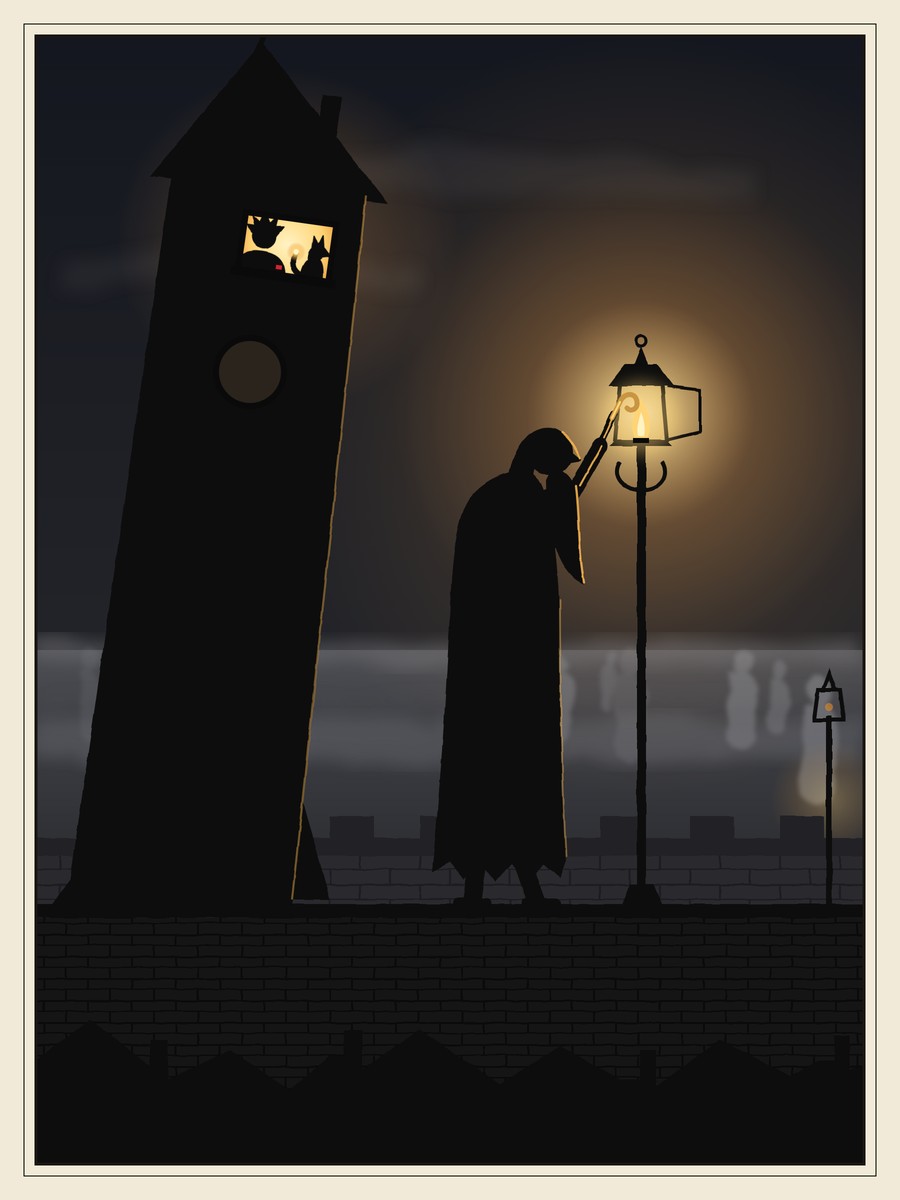
Old Ash lowered his pole and stood with his white head bowed, looking out at the dark. And then, so softly that if the night had not been so still she would never have heard it, he began to hum.
It was only a few notes. They rose, and fell, and rose again, gentle as a hand on a sleeping child’s hair.
Morning comes, morning comes…
Wren’s fingers closed on the window-ledge so hard that the stone bit into them.
She knew that tune. She had known it longer than she had known her own name. It was the only thing she had left that had never been sold or lost or stolen: a woman’s voice, very close, very warm, singing in the dark, and two words, and then nothing. She had never heard anyone else in the whole of Emberwick sing it.
The old man on the wall hummed on, and the tune went past the place where Wren’s memory always broke off, and kept going, into the part she did not have.
She stood frozen at the window, the cold creeping up through her bare feet, and did not breathe, and listened.
Chapter 7 complete
Old Ash