Chapter 6 · 17 min read · 21 min listen
The Guild’s Verdict
The Guild Hall of Emberwick had been built by people who wanted you to know they had money. It had a gilded door and gilded window-frames and a gilded weathercock on its gilded dome, and all that gilding gleamed faintly through the gloom like the inside of an old purse. Wide stone steps ran down from the door to the square. It was on these steps, early the next morning, that the Guild delivered its verdict.
Tobin stood at the bottom of them beside his father, and wished he were anywhere else.
He had not slept. He had followed Wren across three roofs the evening before, until she had turned on him on a slippery ridge and hissed, “Go home, nob, before you fall off and they blame me for that too,” and vanished into the dark as if she had been rubbed out. He had walked home with his night-lamp held out in front of him, flinching at every shadow. And all night, lying in bed with the little flame burning beside him, he had seen Mrs Fenn’s face. I think I had some children. I can’t think what I called them.
Now a crowd filled the square, rich folk at the front and poor folk at the back, and a crier in a Guild tabard rang a bell for silence.
“Hear ye! Hear ye! Pray silence for the Master of the Worshipful Guild of the Lamp, Cuthbert Prowle!”
Guild Master Prowle came out through the gilded door as though he were coming on to a stage. He was a round, glossy man in a round, glossy coat, and round his neck hung a gold chain of office so heavy that Tobin had always wondered how he kept his chin up. Even from the bottom of the steps you could smell him: lavender oil, a great deal of it.
“Citizens of Emberwick,” said Prowle, spreading his soft white hands. “We live in dark times. Dark and perilous times. Yesterday, for the first time in a hundred years, the creatures of the Greywaste breached our blessed Ring. And why?” He paused. He liked pausing. “I shall tell you why. Because a pernicious, malignant and wholly unsanctioned witch-light has been carried into our city, and has poisoned the Ring-lamps of the Low Quarter, and drawn the Hollows down upon us like moths to a — like flies to a — like moths.”
A murmur went through the crowd.
“The Guild has deliberated,” Prowle went on. “The Guild has consulted the most ancient authorities. And the Guild’s verdict is this: the said witch-light is to be seized and surrendered to the Guild, that it may be safely extinguished. And the creature who carries it” — he unrolled a paper with a flourish — “a sweep-girl of the Low Quarter, small, dark-haired, about twelve years of age, answering to the name of Wren — is to be arrested and held. A reward of fifty silver crowns is offered for her capture.”
Tobin heard the back of the crowd draw in its breath. In the Low Quarter, fifty crowns was a whole life.
“The order,” said Prowle, “awaits only the Warden’s seal.”
Lord Edric Harrowgate went up the steps. He did not hurry and he did not hesitate. A little table had been set out with a quill and a stick of grey sealing-wax, and he signed the paper in his neat, tall hand, and pressed his ring into the wax. His face showed nothing at all. It never did.
Tobin watched his father’s hand, and wanted to shout. She saved them. The lamps were going out before she ever touched that lamp. But the words stuck in his throat, the way they always did when his father was near, and he said nothing. I am sorry to say that is very often what happens to the things we most ought to say.
They walked back up to the Warden’s Hall together, in silence. At the door, his father stopped.
“Sergeant Bracken tells me you were seen in Soot Lane yesterday,” he said. He did not raise his voice. He never raised his voice. “In the middle of the disturbance. With a lamp.”
Tobin’s mouth went dry. “I — yes, Father. I was — conducting an experiment.”
“An experiment.” Lord Edric looked at him for a long moment, the way he might have looked at a clock that kept bad time. “Well. It seems that you know the Low Quarter, which is more than can be said for most of my guard. You will make yourself useful for once. You will go with Bracken’s men this morning and show them the girl’s haunts.”
“But Father, she isn’t —“
“That will be all, Tobin.”
So Tobin went down the Hill again with six of the Warden’s guardsmen, and Sergeant Bracken walking beside him. Bracken was a grizzled, heavy-footed man with a grey moustache and tired eyes, and he did not seem to be enjoying himself either.
“Just point, lad,” he said quietly, as they came into the Low Quarter. “Point and keep your head down. Nobody’s asking you to like it.”
Soot Lane was very quiet that morning. Up on the wall two Guild workmen on ladders were poking at the dead Ring-lamps and shaking their heads. People watched the guardsmen go by with hard faces. Mrs Fenn’s door was shut, and there was no smell of bread.
Tobin pointed at things. He pointed at the rope-maker’s roof, and the wash-house, and the tannery, all of which were quite truthfully places he had seen Wren, and none of which, he was fairly sure, she would be anywhere near. While the guards were poking with their halberds under the tannery steps, something tugged at his sleeve.
He looked down. A freckled face looked up at him. It had two teeth missing.
“You’re the thauthage boy,” said Nettle.
“Shh!” Tobin glanced at the guards. Nobody was looking. “Nettle. Where is she? Is she all right?”
Nettle considered him very seriously for a moment, with her head on one side, the way a bird considers a worm.
“Wren thayth you’re a great lump,” she said at last. “But you thtood in front of Molly. I thaw.” She took hold of two of his fingers in her small cold hand. “Come on.”
Wren was in a dead chimney behind the old glue-works, folded up in the dark of the flue like a bat. She came down when Nettle whistled, and when she saw Tobin behind Nettle her face went hard as a stone.
“You brought him?”
“He’th all right,” said Nettle. “He’th nithe.”
“He’s the Warden’s son. His dad just signed a paper saying I’m to be locked up. I heard the crier. Half of Soot Lane heard the crier.” Wren glared at Tobin. “Go on, then. Shout for your soldiers. Fifty crowns. Your dad’ll be proud of you.”
“I’m not going to shout for anybody,” said Tobin. “I came to help.”
“Rot. Nobody helps. Not for nothing.”
“I can hide you.”
“Where? Under your hat?”
Tobin took a breath. “In the Warden’s Hall,” he said. “In my workshop. It’s right at the top, under the roof, and nobody ever comes up there, not even the maids, because they say it ticks. Nobody will search the Warden’s own house for a girl the Warden wants arrested. It’s the last place in the city anyone would look. Statistically speaking,” he added, “it’s the safest room in Emberwick.”
Wren stared at him as if he had gone mad. Then, slowly, a very small and wicked grin spread across her sooty face.
“Under your dad’s nose,” she said. “In his own house. Oh, that’s good. That’s rotten. I like it.”
They sent Nettle to the Fenns’. “Go and help Pip with the little ones,” Wren told her, crouching down. “Nobody’s after you. Keep your head down and your mouth shut, and if anybody asks, you haven’t seen me for a week.” Nettle hugged her hard round the neck, and then, after a moment’s thought, hugged Tobin round the knees, and ran.
Wren did not walk up the Hill. She went over it, by chimneys and garden walls, while Tobin walked up the street below like a respectable person. Once she dropped a pebble on his head to show him where she was. When he reached the Hall, he went in through the kitchens and up the back stairs, five flights, to his attic, and opened the skylight, and there she was, sitting on the roof-leads outside with her chin on her knees.
“Took your time,” she said, and dropped in.
Tobin’s workshop ran the whole length of the roof. It was full of benches, and the benches were full of cogs and springs and lenses, coils of copper wire, a half-built clock with its insides showing, and in the far corner, propped against the wall, a tall tin figure shaped like a man, with a round head and two round glass eyes and a door in its chest.
“What,” said Wren, “is that?”
“The Mechanical Footman. It’s going to carry trays. Eventually. At the moment it mostly falls over.” Tobin pushed his spectacles up. “Don’t touch the left arm, it’s sprung.”
Wren walked round the room slowly, touching everything but the left arm, and Tobin, who had never let anybody into his workshop, found he did not mind.
Then she stopped in front of the Orrery.
It stood in the middle of the room on its own round table: a great circle of brass, the city wall in miniature, with a hundred and forty-four little glass beads set along it, all joined by threads of copper wire. Most of the beads glowed a dim, sleepy yellow. But along one side, the Low Quarter side, a long run of them had gone quite dark, like a gap in a smile.
“That’s where they came in,” said Wren quietly.
“Yes.”
She was silent for a moment. Then she saw it. Not on the wall of the Orrery at all, but here, in the room, in the middle of the circle, where nothing should have been: one tiny spark of light on the brass map of the Hill, burning brighter than all the others put together.
“That’s me,” she said. “That’s — that’s here. That’s this room.”
“That’s the lamp,” said Tobin. “Yes.”
Wren looked at the Orrery for a long time. Then, as if it cost her something, she said, “It’s dead clever. I’ll give you that.” And at once, as if to pay herself back, she put her hand in her coat and pulled out the compass and held it out to him.
“Here. Have it. It’s not even gold.”
Tobin took it. He turned it over in his hands. It was warm from her pocket.
“Why?” he said.
“Because you didn’t shout for the soldiers.” She shrugged, and looked away. “Don’t make a thing of it.”
“I’m not making a thing of it. I only want to know why. I want to know why about everything. Why does the lamp burn without oil? Why does it make the colours come back? Why did the Ring-lamp flare when you walked past it? Why did the Hollows run?” He spread his ink-stained hands. “That’s all I want. I just want to understand it.”
“Everyone wants something,” said Wren. “That’s what I’m saying. You want to understand it. Grubb wanted to sell it. The Guild wants to put it out. Everyone wants something, and in the end they’ll all take it, one way or another. That’s how it goes. Nothing’s free.”
“That isn’t true.”
“Isn’t it? What do you want, then? Really?”
Tobin opened his mouth, and then shut it again, because the honest answer was I want not to be frightened of the dark, and he could not possibly say that.
“I don’t want to take it off you,” he said at last. “That’s all I know.”
Wren looked at him narrowly. Then she sat down on the floor with her back against the Orrery’s table and pulled the lamp out of her coat and set it beside her, and its small golden light filled the long dim room, and all the brass in it — every cog and spring and wheel — began to shine a colour Tobin did not know the name of.
“I didn’t help her,” Wren said, very low. She was looking at the flame. “Mrs Fenn. I had it right there in my hand, and I didn’t even think. I just ran.”
Tobin did not know what to say to that. So he sat down on the floor beside her, not too close, and the two of them looked at the little flame together, and for a while neither of them said anything at all.
It was the middle of the afternoon when Tobin, looking out of the little round window at the end of the attic, saw a large red-knuckled man wheezing up the Hill road between two guardsmen.
“Wren,” he said. “Who’s that?”
Wren came to look, and went white under her soot. “Mott,” she said. “Gristle Mott. My sweep-master. Oh, rot. Oh, blast. He sent me up these chimneys last winter. Every flue in this house — he knows I know them. He’ll have told them. Fifty crowns, he’d sell his own mother for five.”
Below them the front door boomed. Boots came pounding up the stairs.
“The skylight —“ said Tobin.
“They’ll have someone on the roof, if Mott’s told them anything. That’s where I’d go.” Wren’s eyes darted round the room. “There’s nowhere. There’s nowhere to —“
They both looked at the Mechanical Footman at the same moment.
The door in its chest was just big enough. Wren folded herself up inside like a pocketknife, knees to chin, and Tobin pushed the door to, and it stuck, and he thumped it, and it shut. Then he dived for his bench and snatched up a screwdriver and bent over the half-built clock as the attic door burst open.
It was Mr Quill, his father’s steward, long and grey-whiskered and anxious, with a face like a disappointed horse. Behind him came two guardsmen, and behind them, breathing heavily, Sergeant Bracken.
“Master Tobin!” said Mr Quill. “Your father was given to understand that you were with the Sergeant this morning.”
“I was,” said Tobin. “Then I felt unwell. I came home. I’ve been here ever since.” He was astonished to hear how steady his voice was. “On my own.”
“The sweep-master says the girl knows the flues of this house. We are to search every room.”
“Of course,” said Tobin. “Search away. Mind the left arm of the Footman, it’s sprung.”
The guardsmen searched under the benches and behind the shelves. One stuck his head out of the skylight and said, “Nothing up here, Sarge.” The other peered into a crate of copper wire as if a girl might be hiding at the bottom of it. Bracken stood in the doorway with his thumbs in his belt, looking round the attic with his tired eyes.
Then the younger guardsman stopped in front of the Mechanical Footman.
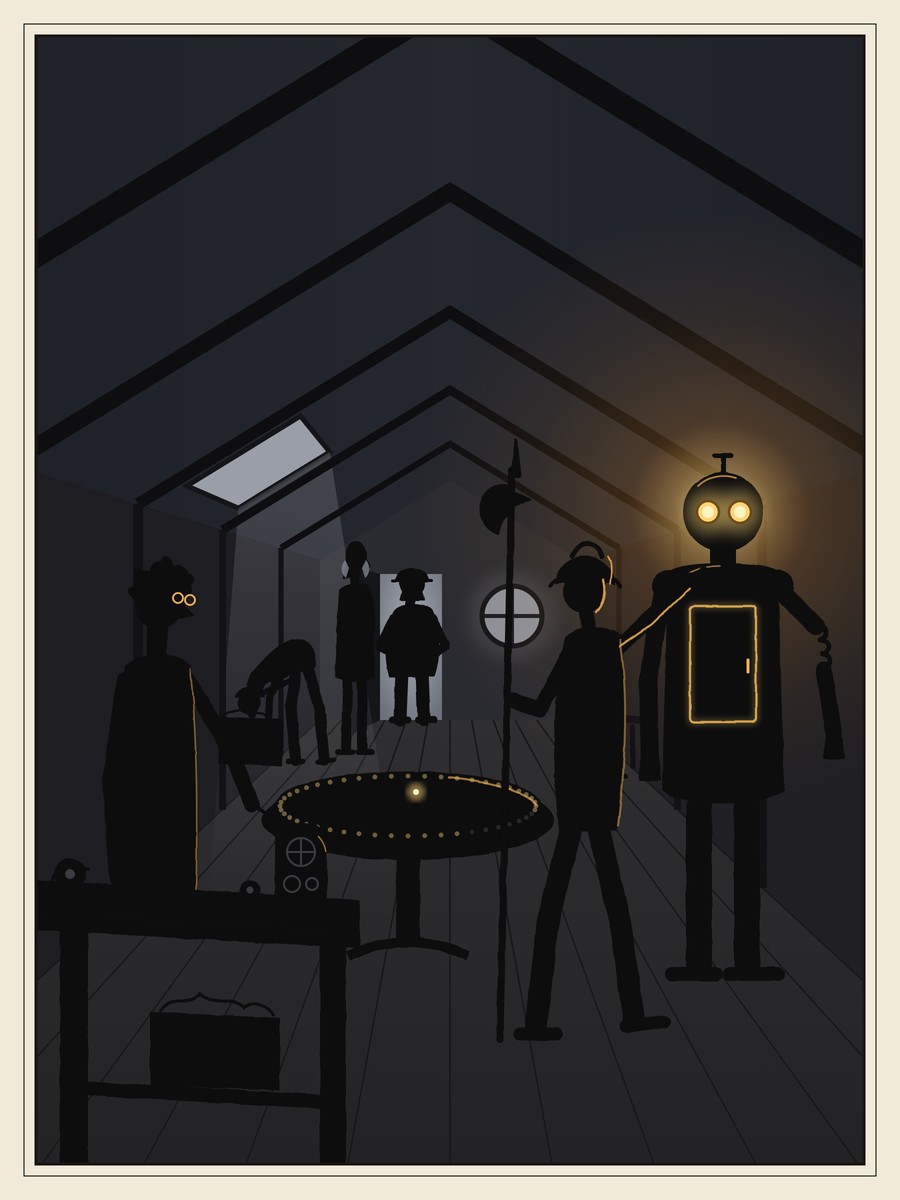
“Sarge,” he said uneasily. “Sarge, its eyes are lit.”
Tobin’s heart stopped. Through the two round glass eyes of the Footman’s tin head shone a soft golden glow. Of course it did. The lamp was inside with Wren, and the lamp did not know how to hide.
“Phosphorescence,” said Tobin.
Everybody looked at him.
“Phosphorescent eye-lamps,” he said. “Experimental. They absorb ambient light during the day and re-emit it gradually, on a principle of — well, it’s very technical. It’s so the Footman can find its way along the corridors at night without bumping into the furniture. With the trays. It’s for the trays.” He made himself smile. “I could explain the chemistry, if you like? It takes about an hour.”
The young guardsman backed away hastily. “No, you’re all right, sir.”
Sergeant Bracken looked at the Footman for rather a long time. Then he looked at Tobin. Tobin made himself look back, and did not blink, and did not push his spectacles up his nose, though they were slipping badly.
“Right,” said Bracken at last. “Nothing here. Sorry to have troubled you, Master Tobin.” He turned to go, and paused, and added, without looking round, “Clever thing, that Footman. You want to keep it out of sight, though. Folk might take it for witch-light.”
Then they were gone, and their boots went thumping off down the stairs, and Tobin sat down very suddenly on the floor because his legs had stopped working.
He had looked a grown man in the face and lied, three times, for someone else. He had never done that in his life. He waited to feel wicked. Instead he mostly felt as though he might be sick.
The Footman’s chest-door creaked open, and Wren unfolded herself out of it, stiff and dusty and staring at him with an expression he could not read.
“Phosphorescence,” she said.
“It’s a real word.”
“I know it’s a real word. I don’t know what it means.” She shook her head slowly. “You lied to your own dad’s man. For me.”
“Yes. Well.” Tobin stood up, wobbling. “They’ll be back. That sergeant knew, I think. We can’t stay here.”
They went out through the skylight as the light was failing.
Wren went first, quick and sure on the leads, and Tobin went after her with his night-lamp in his pocket and his stomach somewhere around his boots. He had never been on a roof this high. The whole city lay below them, grey and smoky and huge, ringed by the dark wall with its long dead gap on the Low Quarter side.
“Where are we going?” he said. “Where can we possibly go? The guard will be everywhere. They’ll search every flue in the Low Quarter. Mott knows them all.”
Wren was quiet for a moment, crouched on the ridge with the wind in her ragged hair. Then she pointed. Far away to the north, at the very edge of the city, where the wall bent round towards the Grey Gate, a single crooked tower leaned out over the battlements as if it were trying to see over them.
“Nobody looks for anyone at the Leaning Tower,” said Wren. “Not even the guard goes near mad old Ash.”
“Old Ash? The madman who walks the wall at night talking to the lamps? They say he was thrown out of the Guild for —“
“Have you got a better idea?”
Tobin had not. So they went. They went across the roofs and down through the dark alleys, flattening themselves into doorways whenever a guardsman’s lantern came bobbing by. Once, on a high ridge with nothing to hold, Tobin froze, and could not go on, and Wren came back without a word and took his hand, and led him across as if he were Nettle. Neither of them ever mentioned it afterwards.
By the time they reached the foot of the North Wall, the gloaming was nearly gone. They climbed the worn stone steps to the top, and stood on the walkway in the wind, and looked along it.
There was the Leaning Tower, black against the last grey of the sky. Every window in it was dark, all but one: a round window near the top, where a single lamp was burning. It did not gutter or smoke like the Guild’s lamps. It burned steady and clear, like someone keeping watch.
Wren’s hand went to the lamp inside her coat, the way another girl might have reached for her mother’s hand.
“Well,” she said, and her voice was not quite as steady as she wanted it to be. “Somebody’s in.”
Chapter 6 complete
The Guild’s Verdict