Chapter 5 · 17 min read · 21 min listen
Over the Wall
Market day in Soot Lane happened every Thursday, and it was the only day of the week when the Low Quarter was loud for a good reason.
By the middle of the morning the lane was packed from wall to wall. There were barrows of small hard apples, a man selling second-hand boots that were really only one boot, and a woman with a cage of hens who all looked as if they had been told bad news. There was a knife-grinder whose wheel threw out sparks, a fiddler with three strings, and a Guild oil-cart with a little painted sign on the side that said GUILD OIL — ONE PENNY THE MEASURE — FLAME TOKENS TWO A PENNY, BLESSED AT THE BEACON. The oil-man, whose name was Tallis, had a voice like a rusty gate and sold a great many tokens, for people in the Low Quarter were frightened of the dark and two a penny is cheap for courage.
And in the middle of it all, with its door propped open and its window steamed up, stood Mrs Fenn’s bakery.
You could smell Mrs Fenn’s bakery from the canal. It was the only good smell in Soot Lane, and people walking past would stop and close their eyes and breathe it in, as if it were a sort of breakfast. For most of them it was the only kind they got.
Wren and Nettle were sitting on the step, which was where they always sat on market days, because Mrs Fenn always came out sooner or later.
“Now then,” said Mrs Fenn, coming out. She was a wide, soft, floury woman with arms like bread rolls and a face as round and kind as a loaf. There was flour in her hair and flour on her apron and, somehow, flour on the tip of her nose. “Now then, you two sparrows. I’ve some crusts here going begging. Burnt, mind. Can’t sell ‘em. You’d be doing me a favour.”
They were not burnt. They were never burnt. Wren knew that, and Mrs Fenn knew that Wren knew it, and neither of them ever said so.
“Ta, Mrs Fenn,” said Wren, and took them.
“Thank you, Mithith Fenn,” said Nettle.
“Bless you, duck.” Mrs Fenn turned to shout into the shop. “Pip! Hettie! Mind that oven! Sam, put your sister down, she’s not a sack of flour — Molly, where’s your brother? Where’s the baby? Who’s got Jem?”
“I’ve got Jem, Mum!”
“Well, don’t drop him!”
There were five Fenn children, always everywhere at once. Pip was ten and very serious about bread. Hettie was eight and sang all day. Sam was six and liked to carry things that did not want to be carried, such as his sisters. Molly was four, and Jem was a baby, and Wren sometimes thought the bakery must be the warmest place in Emberwick.
Wren was halfway through her second crust when a shadow fell across the step, and she looked up, and groaned.
“Good morning,” said Tobin Harrowgate.
He had clearly tried to make his hair untidy and had only managed to comb it in a slightly different direction. He was holding something wrapped in a white linen napkin. People were staring at the napkin. Nobody in Soot Lane had ever owned a napkin.
“You again,” said Wren. “Haven’t you got a Hall to go and sit in?”
“I’ve brought the sausages,” said Tobin.
He unfolded the napkin. There lay two fat brown sausages, still faintly warm, smelling of pepper and onions and a great deal of meat. Nettle made a small noise like a kettle starting to boil.
Wren looked at the sausages for a long moment. Then she looked at Tobin.
“You actually brought them.”
“You said to. A proper one, a Hill one, with meat in it, and one for Nettle. I took them off the breakfast sideboard. I hope that’s all right. It isn’t stealing, technically, because they’re my father’s sausages, and I’m his son, so in a sense they’re partly mine, and anyway I didn’t eat my own breakfast, so the household is exactly level—“
“Give,” said Wren.
He gave. She handed one to Nettle and bit into the other, and for a moment the whole world was sausage. It was the best thing she had ever tasted. She would never have said so.
“So,” said Tobin hopefully. “My compass?”
Wren swallowed. “That,” she said, “was the down payment.”
“The what?”
“The first bit. Sausages, that’s the first bit. Now we talk about the rest.”
“You said bring sausages and then maybe we’ll talk. This is talking!”
“Then we’re getting on lovely,” said Wren, and licked her fingers.
Tobin opened his mouth. Then he did something she had not expected. He laughed. It was a short, surprised laugh, as if it had come out without asking, and he looked rather startled by it himself.
“You are,” he said, “the most unreasonable person I have ever met.”
“You should get out more,” said Wren. But she found, a little to her annoyance, that she was almost smiling.
He stayed. He followed her up and down the market asking questions — where had she found it, did it ever go out, what did it burn, had she weighed it — and at last, in the alley behind the bakery, mostly to make him stop talking, she opened her coat for half a second and let him look.
The lamp lay against her ribs, small and dented, its glass chimney cracked, its golden flame no bigger than a fingernail. And in its light the grey alley changed. The bricks were not grey. They were a deep dusty colour, warm as a fox. The moss between them was not grey either. And Tobin’s own hands, held up in front of him, were pink.
Wren shut her coat. The alley went grey again.
Tobin did not say anything at all. It was the first time she had known him not to.
It happened in the late afternoon, when the market was packing up.
The first thing Wren noticed was the dogs. All at once every dog in Soot Lane stopped nosing for scraps and stood stiff, staring at the wall. Then one by one they put their tails between their legs and slunk away under the carts.
The second thing she noticed was the lamps.
Along the stretch of city wall that ran behind Soot Lane stood five of the old Ring-lamps, the same tired iron cages she had seen from the Nest the night before. As she watched, the nearest one dipped. Its flame shrank down to a blue bead, then rose again, smoky and thin. Then the next lamp did the same, and the next. It looked as if something were blowing on them, very softly, from the other side. But there was no wind at all.
“Wren,” said Tobin, behind her. His voice had gone high. “Wren, the lamps.”
“I see them.”
Then came the cold.
It came over the wall as it had the evening before, only this time it poured down. It rolled over the battlements in a long white-grey wave, like fog off the canal on a winter morning, but heavier and slower than any fog, and it slid down the stones and spread along the ground and came creeping in between the market stalls. Where it touched, frost bloomed on the cobbles. A puddle went white with a small, hard crack. The fiddler’s last note died away in the middle, and he did not start another.
And then everything was quiet.
If you have ever been in a crowded place that has suddenly gone silent — a schoolroom when the master walks in, or a kitchen when somebody has dropped the best dish — you will know that kind of quiet, the kind where everybody is holding their breath at the same moment. This was like that, except that it went on and on. Nobody moved. Nobody spoke. A whole street full of people stood in the cold fog with their breath smoking, and looked up at the wall.
The Hollows came over it.
They did not climb. They poured over the top like smoke poured into a jug, ran down the stones, and at the bottom gathered themselves up into shapes. Tall shapes, grey shapes, shaped like men and women and yet not like them, because where their faces should have been there was nothing at all, only a dim smooth greyness, like the inside of a cloud. They made no sound. Their feet, if they had feet, did not touch the ground. They drifted forward into the market, one and then three and then a dozen, and the cold came with them, so bitter that Wren’s eyes watered and the water froze on her lashes.
Then somebody screamed, and everybody ran.
This is the part of the story that Wren never liked to tell. She told it once, years later, and stopped halfway, and would not go on. So I shall tell it for her, as gently as I can.
Barrows went over. Apples bounced across the frosted cobbles. The hen-woman’s cage burst open and hens went flapping in every direction. Mothers snatched up children, and doors slammed all along Soot Lane.
And through it all the Hollows drifted, slowly, never hurrying, as if they had all the time in the world.
Wren saw the knife-grinder, who had stayed too long by his wheel, turn round and find one standing right behind him. It did not strike him. It only reached out one long grey hand and laid it on his shoulder, almost kindly, the way a friend might. And the colour went out of him. There had not been much colour in the knife-grinder to begin with — a little brown in his coat, a little ruddiness in his cheeks — but what there was drained out of him the way water drains out of a basin, and he went grey all over, grey face, grey hands, grey hair. He did not cry out. He sat down, quite slowly, on his own upturned wheel, and folded his hands in his lap, and looked at nothing.
Everywhere the Hollows passed, the colour went. The faded awnings went grey. The few small apples went grey. The bread in the bakery window, which had been the brown of good crust, went the colour of old stone.
“Inside!” Mrs Fenn was in her doorway, shooing children like hens. “Pip, inside! Hettie, Sam, in, in, in! Molly — Jem — where’s —“
“I’ve got Jem, Mum!”
“Then get him in!”
Wren had Nettle by the hand. She was dragging her towards the bakery, because the bakery was close and the bakery had a door, and Tobin was stumbling along beside them with his little night-lamp held out in front of him in both hands. He had lit it. Wren did not know when. Its small yellow flame shook as if it were as frightened as he was.
A Hollow drifted out of the fog to their left. It turned its blank face towards them.
Tobin stopped. Wren saw his knees shake. She saw his teeth chattering, and his spectacles misting over with cold. And she saw him step sideways, not away from the Hollow but towards it, so that he was standing between it and little Molly Fenn, who had tripped on the step and was sitting there in the frost, too frightened to cry.
“G-go away,” said Tobin. “P-please. G-g-go away.”
He held up the night-lamp. The Hollow paused. The oil-light did not hurt it; Wren could see that. But it did not like the light. It hung there in the fog, swaying, and did not come closer, and Pip darted out, scooped up his little sister and bolted inside with her.
Mrs Fenn was still in the doorway, counting. Wren could see her lips moving. One, two, three, four —
She did not see the Hollow come up behind her out of the alley.
“Mrs Fenn!” Wren shouted. “Behind you —“
Mrs Fenn turned round. And the Hollow put out its long grey hand and touched her, very gently, on the cheek.
That was all. It was such a small thing. And then the Hollow drifted on past, as if it had done nothing much, and was gone into the fog.
Mrs Fenn stood quite still in her doorway. The flour on her apron, which had been white, went grey. Her round pink face went grey. Even her eyes, which had been a soft kind brown, faded until they were the colour of rain on a window. Then she sat down on her own step, quite slowly, the way the knife-grinder had, and put her grey hands in her grey lap.
“Mum?” Pip had come back to the door. He had Jem in his arms. “Mum, come inside. Mum?”
Mrs Fenn looked up at him. Her face was not frightened. That was the worst of it. It was polite and puzzled and gentle, the face of someone who has been asked the way by a stranger and does not know the town.
“Hello, dear,” she said. “Are you lost?”
Pip stared at her.
“It’s me,” he said. “Mum. It’s me. It’s Pip.”
“Pip,” said Mrs Fenn. She said it carefully, as though it were a word in a foreign language, and she was not sure she had it right. “Pip. That’s a nice name.” She frowned a little, and looked down at her hands. “I think I had some children. Didn’t I? I’m sure I had some children. I can’t think what I called them.”
Behind Pip, in the doorway, Hettie began to cry. Mrs Fenn did not turn round. She only sat on her step, in the cold, looking at nothing, and smiled a small, faint, faraway smile.
Wren had seen a great many bad things in her twelve years. She had never seen anything like this. It went into her like a nail.
And while she was standing there, a cold breath touched the back of her neck.
She turned. Nettle had let go of her hand. Nettle had run to Mrs Fenn — of course she had, Nettle always ran to anybody who was sad — and was patting her grey arm and saying, “Mithith Fenn? Mithith Fenn, it’th all right,” in her small lisping voice. And behind Nettle, rising up out of the fog, taller than the bakery door, was a Hollow.
It bent over her. It reached out one long grey hand towards the top of her freckled head.
Wren did not think. Afterwards, she could never remember deciding anything at all. She only knew that her hand was inside her coat, and then her hand was out of her coat, and there was the lamp in it, held out at arm’s length, and she was shouting something — she never knew what — at the top of her voice.
The lamp flared.
It was not the small warm glow she knew. It was white. It was white-gold, blazing, as if somebody had opened the door of a great furnace in the middle of Soot Lane, and it threw her shadow and Nettle’s and Mrs Fenn’s far down the street behind them. The fog went up in a great rushing billow like steam off a kettle. The frost on the cobbles ran to water. And for one long moment, in a circle all round her, the colour came back into the world: the bricks warm as a fox, the spilled apples suddenly, impossibly, red as her ribbon, and Nettle’s freckles a bright and glorious gold.
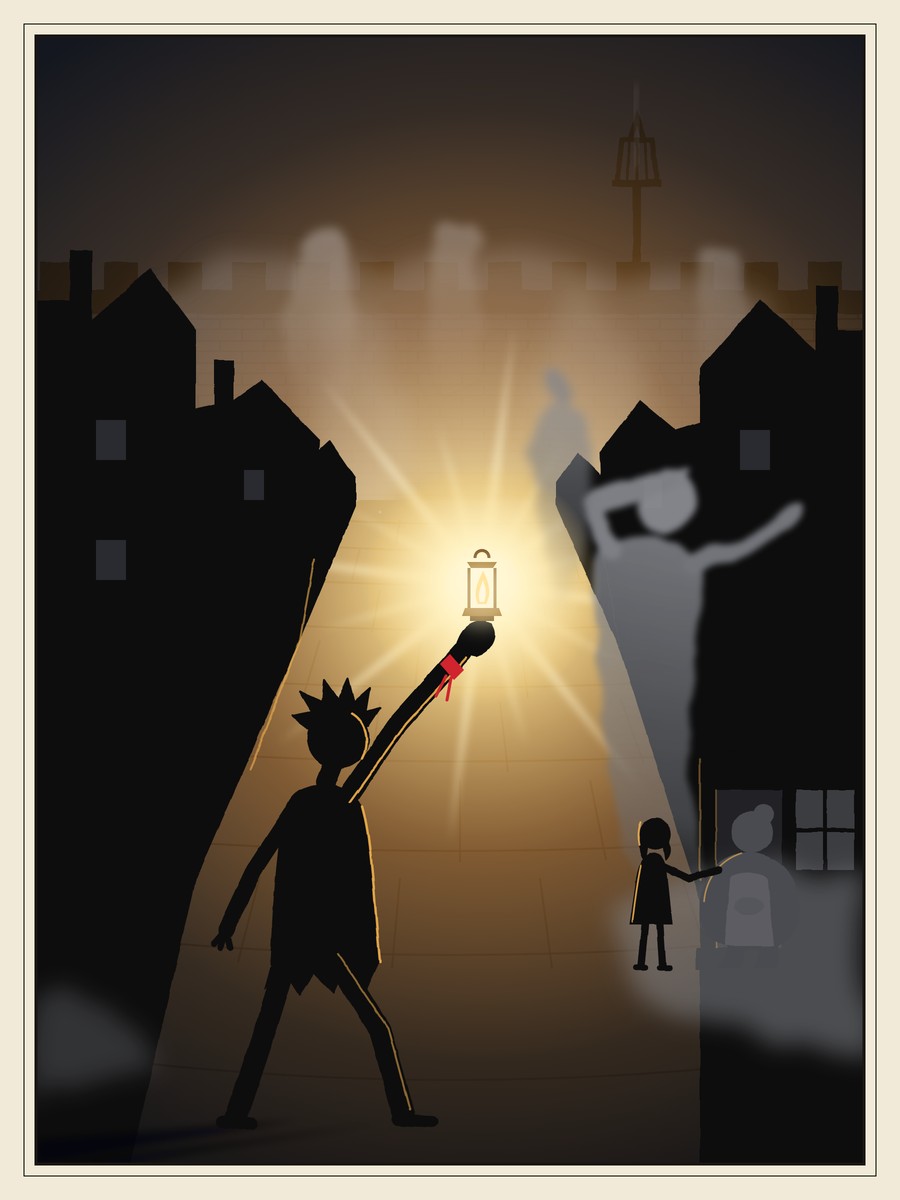
The Hollow screamed.
It was the only sound Wren ever heard a Hollow make, and she never forgot it: a high, thin, tearing shriek, like wind through a broken window, that came out of no mouth at all. It reeled back from the light with its grey hands thrown up over its blank face. And all down Soot Lane, the other Hollows shrieked too, every one of them, a dreadful rising chorus, and they turned and fled. They fled back the way they had come, pouring up the wall like smoke going backwards up a chimney, and over the top, and away into the Greywaste.
All but one.
The last of them stopped at the top of the wall. It turned. It did not have eyes, so it could not look at her. But Wren knew, the way you know when somebody behind you in a crowd is staring, that it was looking at her. At the lamp. It held there, a grey shape against the grey sky, for one long, cold moment.
Then it was gone.
Slowly the lamp sank back to its small golden glow. Slowly the colour went out of the apples again, and the bricks went grey. The fog was gone. The cold was going. Wren’s arm was shaking so much she could hardly hold the lamp up.
It was very quiet again in Soot Lane. But it was a different quiet now.
Wren looked up at the wall. Behind Soot Lane the five old Ring-lamps had all gone out. And not only those five. Along the wall in both directions, as far as she could see, the Ring was dark: a long black gap in the circle of lights, like a missing row of teeth.
Then she looked round, and saw the people.
They were coming out of doorways and from under carts, and standing in a wide, ragged ring all round her, at a careful distance, staring. Not at the dark wall. Not at the greyed knife-grinder, or at Mrs Fenn on her step. At her. At the girl with soot on her face and a blazing lamp in her hand.
Nobody said thank you.
“I saw it,” somebody said. “I saw it flare up. Like a furnace.”
“What’s she got there?”
“That’s no Guild lamp. Where’s the oil? There’s no oil in it.”
“The Ring went out when she lit it. Did you see? The whole Ring went dark.”
“That’s not true!” said Tobin. “That’s — the Ring went out before — it’s a question of sequence, you see, the lamps were already guttering when —“
Nobody was listening to him. Tallis the oil-man had climbed up onto the step of his cart. His face was grey with fright, not with Hollows, and he was pointing at Wren with a shaking finger.
“Witch-light,” he said, in his voice like a rusty gate. “That’s what that is. That’s no true flame. True flame comes from the Beacon, true flame comes from the Guild. That’s witch-light. She brought them. She called them over the wall with it, and then she sent them off again to make herself look grand.”
“Witch-light,” somebody else said. And then somebody else, and somebody else, and the word went round the ring of people like a cold wind. Witch-light. Witch-light. Somebody picked up a frozen turnip from the gutter.
Wren did not wait to see where it would go.
She shoved the lamp back into her coat, grabbed Nettle by the wrist, and ran. She ran down Soot Lane with the word chasing after her, and dived into the alley behind the tannery, and through the hole in the fence, and up the drainpipe onto the roofs, hauling Nettle behind her. The roofs were hers. The roofs had always been hers.
But when she looked back from the first ridge, she saw that she was not alone. Somebody was coming up the drainpipe after her, badly, with a noise like a cutlery drawer going downstairs on its own, and a little yellow night-lamp swinging from one hand.
Chapter 5 complete
Over the Wall