Chapter 4 · 17 min read · 22 min listen
Flicker
Some people look as if they could belong anywhere. Others look as if they belong in exactly one place and nowhere else at all. Tobin Harrowgate was the second sort, and if you had seen him that evening, picking his way down off the Hill and into the Low Quarter, you would have known at once that he had come from somewhere with carpets.
It was not his clothes. He had put on his oldest coat, the brown one with the darned elbow, and had even rubbed a smear of soot onto one cheek, because he had read that this was what one did to pass unnoticed. It was everything else. It was the way he walked, as if the cobbles might be counted later and he wanted to be sure of the number. It was his spectacles, which flashed at every lit window. It was the way he said “I beg your pardon” to a dog.
And it was the thing in his hand.
It was a pocket-watch case with the watch taken out of it. Where the hands and numbers should have been, a single copper needle balanced on a pin, and on the tip of the needle sat a glass bead no bigger than a lentil, taken from the box of spares he kept under the Orrery. He had spent a feverish quarter of an hour making it before he left, and the whole of the back stairs trying to think of a name for it, and in the end he had scratched FLICKER on the lid, because PORTABLE THERMO-SYMPATHETIC LOCATING INDICATOR would not fit.
The principle, as Tobin would have been very glad to tell you, was simple. The beads on the Orrery warmed in sympathy with the Ring-lamps they stood for. A bead cut loose and set on a pivot ought, therefore, to swing towards whatever burned brightest nearby, the way a sunflower was said to turn towards the sun. Nobody in Emberwick had seen a sunflower for a very long time. But the theory was sound.
The theory had felt a great deal sounder in his warm attic than it did now.
In Gloamhaven, of course, the whole day is a kind of evening. But there is a time, after the pale sun has given up altogether and before the real dark comes, when the light goes thin and blue and everything looks as though it is standing a long way off. The old word for it is the gloaming. It was the gloaming now, and in the gloaming the Low Quarter looked very low indeed.
The houses leaned towards each other over the crooked lanes like old women sharing a secret. Washing lines zigzagged overhead, hung with shirts the colour of dishwater. The air smelled of tanneries and cabbage and soot. Two girls on a doorstep stopped their clapping game to stare. A woman with a basket of turnips looked him up and down, slowly, from his clean boots to his combed hair.
“Lost, are we, your lordship?” she said.
“Oh, no,” said Tobin. “Well, yes, in a geographical sense, but not in the sense you mean. And technically I’m not a lordship. My father is the Warden, which is an appointed office, not a hereditary—“
The two girls on the doorstep burst out laughing. Tobin went red to the tips of his ears and hurried on.
In his other coat pocket, the one that did not hold his mother’s compass, was his mother’s little night-lamp. He had blown it out at the foot of the Hill, so as not to be stared at, and promised himself that he would only light it again if it became truly dark. It was not truly dark yet. He kept one hand on it all the same, and felt the cool glass under his fingers, and told himself firmly that he was not frightened, he was merely gathering data.
Flicker’s needle trembled. Then it swung, slowly but quite definitely, down a lane to his left. A crooked sign on the corner said SOOT LANE.
“There you are,” Tobin whispered. The bead at the needle’s tip had begun, very faintly, to glow.
He was so busy staring at it that he did not see the small figure coming the other way until it bumped hard into his elbow.
“Oi! Mind yourself, mister!”
It was a girl, a sweep by the look of her, small and thin and black with soot from head to heel. Her hair was cut short and ragged, as if somebody had done it with a knife in the dark. She had a sharp chin and quick eyes, and for half a moment those eyes looked straight into his. Then she was gone round the corner.
“I do beg your pardon,” Tobin called after her, because he had been brought up properly.
Then he put his hand in his pocket, and the compass was not there.
Now, I would like to tell you that Wren Ashby had not meant to rob him. But this is a true story, and so I had better tell you instead that she had meant it very much indeed.
She had seen him coming: a proper Hill nob, with clean ears and a shiny thing in his hand. She had wanted the shiny thing. But the shiny thing was in his hand, and his other pocket was hanging open like a mouth, and inside it something gleamed gold. Wren had not stopped to think. She never did. Thinking was for people who could afford to wait.
It was a fine piece, heavy and smooth and round. Gold, maybe. Grubb would give her five crowns for it, or he would have, if he had not thrown her out of his shop, the old weasel. Somebody else would, then. A week of suppers, for her and Nettle both. Two weeks if she was clever.
“Stop! Thief! Stop!”
Wren grinned. Nobs always shouted “Stop!”, as though anybody ever had.
She went up a water-butt, over a lean-to, and onto the long slate roof of the rope-maker’s, and there she slowed, because there was no need to hurry now. No nob alive could follow her across the roofs of Soot Lane. These were her roads. She knew every loose slate and rotten gutter, every chimney-stack you could hide behind and every gap you could jump. She turned at the ridge to have a last look at him, and her mouth fell open.
He was coming up the water-butt.
He did it badly, with a sound like a sack of pans falling down a stair, and he very nearly fell off twice. But he did it. He hauled himself onto the lean-to and stood there wobbling with his arms out, and then he looked straight up at her and pointed.
“That,” he called, “is mine. And it is not gold, if that’s what you’re thinking. It’s brass. Gilded brass. It would barely fetch—“
“Rot!” shouted Wren, and ran.
She leapt the gap to the cooper’s roof, slid down his slates, dropped onto the flat top of the old wash-house and ran again. Behind her she heard a clatter and a yelp. She went up a drainpipe and round two chimney-stacks, and only then did she stop and listen.
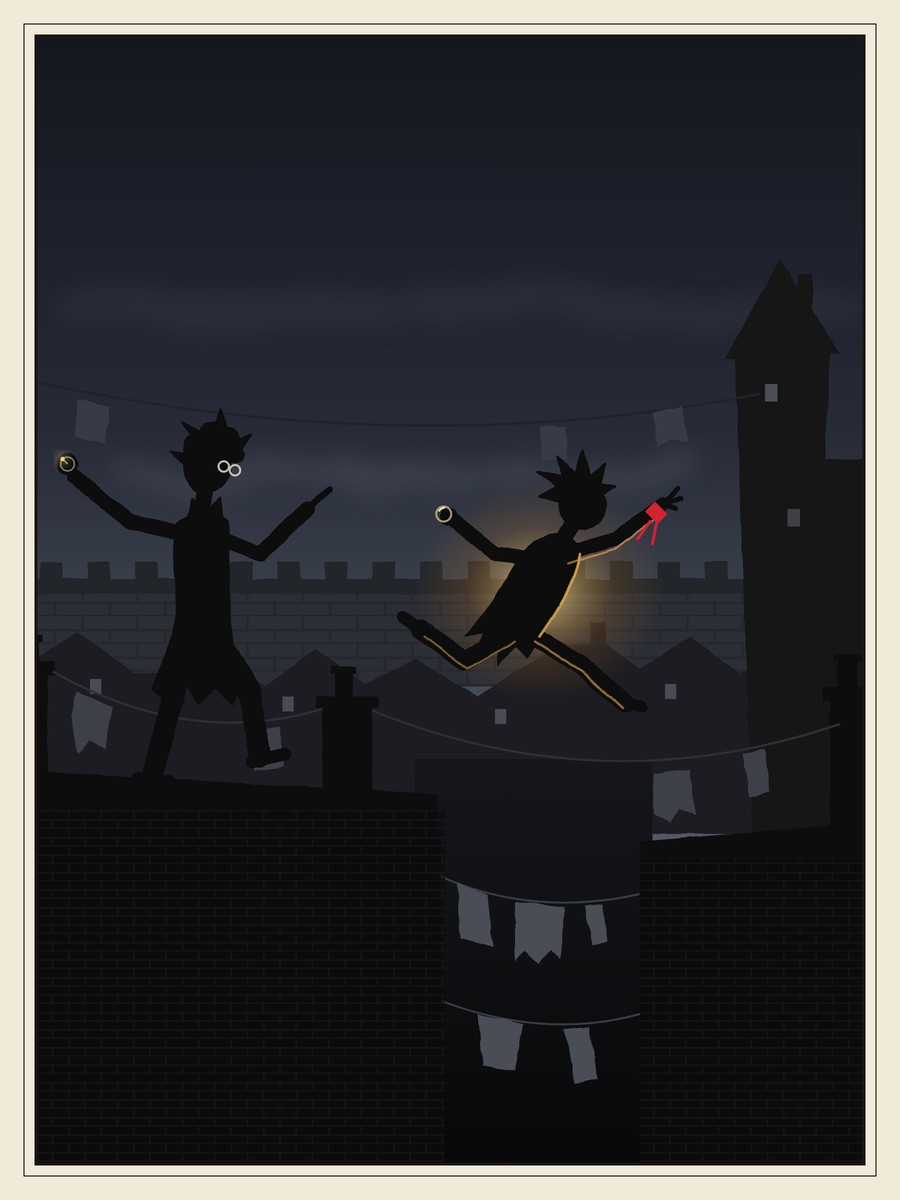
Nothing. Only the wind in the flues, and somebody’s baby crying in a room below.
“Great lump,” she said, pleased with herself, and went on more slowly towards the Nest.
What Wren did not know, and what Tobin himself only half believed, was that she had a light in her coat that could be followed through the dark like a bonfire on a hill.
Tobin had fallen off the rope-maker’s roof into a cart of wet sacking. He lay there a moment, thinking that his father would certainly have something to say about this. Then he remembered Flicker, and found it still in his fist, its glass unbroken.
The needle was pointing up and to the left. Not along the lane, where any sensible person would run. Up. Over the roofs. And the little bead was brighter than before.
“Oh,” said Tobin slowly. “Oh. That’s interesting.”
He did not go back up the water-butt; he had learned that he was not much good at water-butts. Instead he looked about him, the way he looked at a broken clock before he opened it, and he saw what Wren had never had to notice, because she had always had her own feet to trust: the washing lines. They ran across the lane from window to window and roof to roof, dozens of them, tied off to iron hooks and chimney-pots, sagging under their loads of shirts.
“Tension,” murmured Tobin, “and the coefficient of — no. No, don’t think about it. Just do it.”
He found an outside stair, climbed it to a first-floor landing, took hold of the stoutest line he could see, and swung himself out over the lane hand over hand. The line dipped alarmingly. A wet stocking slapped him in the face. A shirt wrapped itself lovingly round his head, so that for several terrible seconds he was hanging in mid-air in the dark with no idea which way was up. Then his boots struck slate, and he let go, and sat down very hard on the far roof in a heap of somebody’s sheets.
He was not hurt. He was, he realised, almost laughing. He checked Flicker again, and went on.
The Nest was a hollow between two chimney-stacks on the oldest house in Soot Lane. The stacks kept it a little warm, and from it you could see the whole Low Quarter while nobody in the Low Quarter could see you. Nettle was waiting there, as she always was at this hour, curled up like a cat in a nest of old sacks.
“Wren!” Nettle sat up. She was seven, and small for seven, with a face so freckled it looked as if somebody had flicked a paintbrush at it, and two gaps where her front teeth had been. “You’re late. I’ve been waiting ageth.”
“Ages,” said Wren. “Budge up.”
She sat down, and pulled from inside her coat a heel of bread, which was all the supper there was going to be tonight. It was not a large heel. Wren looked at it. Then she broke it in two, very carefully, and gave Nettle the bigger half.
“Ith that the betht bit?”
“It’s the bit you’re getting. Eat it before I change my mind.”
Nettle ate it. Wren ate the smaller half, slowly, to make it last. She had just put the last crumb into her mouth when a voice behind her said, rather breathlessly, “Excuse me.”
Wren went up like a scalded cat. She was on her feet in an instant with her back to the chimney-stack and Nettle pushed behind her, and there was the nob, standing on the ridge-tiles not three yards away. He had a sheet over one shoulder and a stocking caught on one ear. His spectacles were crooked. In one hand he held his shiny watch-thing, and its little glass eye was glowing like a coal.
“How?” said Wren. “How did you — nobody follows me. Nobody can.”
“I wasn’t following you, exactly,” said the nob. “Well. I was. But I couldn’t have, actually, if you’d kept running. You’d have lost me in another two roofs. I only caught up because you stopped.” He looked at Nettle, and then at the empty place in Wren’s hand where the bread had been, and something in his face changed. “You stopped to give her your supper.”
Wren felt her face go hot under the soot, which made her angrier than anything.
“Mind your own business,” she said.
“I’m sorry. I didn’t mean — it’s only that you gave her the bigger piece. I saw you.” He pushed his spectacles up his nose. “My name is Tobin Harrowgate. I would like my compass back, please.”
“What compass?”
“The one in your pocket, Wren,” said Nettle helpfully, from behind her.
Wren closed her eyes. “Thank you, Nettle.”
“You’re welcome.”
“Harrowgate,” said Wren, opening them again. “Harrowgate like the Warden?”
“He’s my father.”
“Then you can buy yourself another one, can’t you? Your dad’s got a whole Hall full of gold. I’ve seen it. Well. I’ve seen the outside of it.”
“It’s not about the gold.” The boy’s voice wobbled, very slightly, and he steadied it. “It was my mother’s. She gave it to me. It has words inside the lid. Look, if you like. It says Home is where the light is.”
Wren did not look. Words like that got inside you, and then you could not sell a thing at all. She kept her hand clamped round the compass and said nothing, and the wind came round the stack and made them both shiver.
Then the boy took out a second thing from his coat, a small glass night-lamp with a little painted border, and lit it with a match. His hands were shaking so badly that it took him three matches. The flame that came up was small and yellowish and smelled of Guild oil.
“Scared of the dark, are you?” said Wren. “A big lump like you?”
“I am not scared,” said Tobin. “I’m being practical. It’s getting dark. Light is practical.” Then, because he was an honest boy even when it was inconvenient: “Also, yes. A bit.”
And that was when he saw it.
Next to his night-lamp, something else was shining. It came through the girl’s coat, through the rough cloth over her ribs, a soft golden glow that made his own little flame look grey and sickly beside it. In that glow, he saw that she had a ribbon tied round her left wrist. And the ribbon was not grey. It was not brown. It was a colour Tobin had seen in only one place in his whole life: in a single faded picture in his mother’s old songbook, a picture of a rose.
“What,” he said, “have you got in your coat?”
“Nothing.”
“You have. It’s glowing. I can see it glowing.” He held up Flicker. The needle was no longer trembling. It pointed at her, steady as a finger, and the bead at its tip blazed. “That’s it. That’s what I followed. Not you. That.”
“There’s nothing in my coat but me,” said Wren, and stepped back, and her heel came up against the low brick lip at the edge of the Nest.
Beyond the Nest, past the last roofs of Soot Lane, rose the great dark line of the city wall. And on the wall, perhaps a hundred yards away, stood one of the old Ring-lamps of the Low Quarter. It was an iron cage on a stone post, and inside it, for as long as Wren could remember, a smoky little flame had burned, dimmer every winter. Nobody ever looked at it. It was just there, like the canal and the cold.
As Wren stepped to the edge, it flared.
It was only the sort of brightening a candle gives when you open a door. But Tobin saw it, and Wren saw it too. The old lamp jumped up bright and yellow, brighter than it had been in years, and stayed bright as long as she stood there. When she stepped back, uneasily, into the shelter of the stack, it sank down again.
Tobin’s mouth was open.
“It’s you,” he said. “The bright bead. It’s you.”
“What bead? What are you on about?”
“I’ve got a — well, it’s a sort of model. Of the Ring. Of the whole wall, all hundred and forty-four lamps, in brass, with a bead for each one, joined by copper wires, and the beads warm up when the lamps burn, it’s a matter of sympathetic resonance, I’ll explain it properly another time — and then there was a new bead. A bright one. Brighter than any of the others. Only there isn’t a Ring-lamp in Soot Lane. And it was moving.” He was talking faster and faster. “I watched it wander about the Low Quarter. I watched it go down to the canal and back. And I thought it must be a fault in the wiring, but it isn’t, is it? It’s whatever you’ve got in your coat. And whatever it is, it makes the Ring burn brighter.”
Wren stared at him. “Do you always talk like a book falling down the stairs?”
“Mostly,” Tobin admitted. “Especially when I’m nervous. Can I see it?”
“No.”
“Please?”
“No. And you’re not having your compass back neither.”
“Neither — well, technically, that’s a double negative, which means I am —“
“Rot!” said Wren. “Look. Things cost. Everything costs. You want your compass, what’s it worth to you?”
Tobin felt in his pockets. He had a pencil, a screwdriver, two matches and half a page of calculations. It had never once occurred to him that he might need money.
“I haven’t got anything,” he said.
“Then you haven’t got a compass.” Wren folded her arms. “Bring me a sausage. A proper one, a Hill one, with meat in it. Bring one for Nettle and all. Then maybe we’ll talk.”
“That’s extortion.”
“I don’t know what that is, so I can’t be doing it. Finders keepers.”
“You didn’t find it! You took it out of my pocket!”
“Took it, found it.” Wren shrugged. “Same thing in Soot Lane.”
Tobin opened his mouth to argue, and closed it again, and opened it, and then he stopped, because Nettle had stood up in her nest of sacks and was looking past both of them, out over the wall.
“Wren,” she said, in a very small voice. “Wren, look.”
The wind had dropped. That was the first thing Wren noticed: the wind had dropped, all at once, as if a door had been shut somewhere. And in its place came a cold. Not the ordinary cold of a Soot Lane evening, which she had known all her life and could put up with. This was a different cold. It came over the top of the wall the way water comes over the lip of a basin, slow and heavy, and it made her teeth ache.
From the Nest you could just see over the wall to a grey strip of the Greywaste, with its dead grass and black trees. There was never anything there.
There was something there now.
There were shapes out on the plain. Grey shapes, a little paler than the grey dark around them, so that at first you could not be sure you were seeing them at all. They were shaped something like people. But they did not walk like people. They drifted, the way smoke drifts when there is no wind to push it, and they had no faces that Wren could see — only a smoothness where faces ought to be. There were five. No, there were more than five. There were twenty. There were more than she could count, and they were all moving the same way, slowly, silently, across the dead grass.
Towards the wall. Towards the Ring.
Towards the Low Quarter.
On the wall, the old Ring-lamp shuddered in its iron cage, though there was no wind to shake it.
Tobin’s night-lamp rattled in his hand. He did not even notice. Inside Wren’s coat, against her ribs, the brass lamp she had found in the flue grew warm, and then warmer, as though it, too, had seen.
Nobody spoke. Every child in Emberwick had heard the stories grown-ups told to make you come home before dark — and had been told, in the same breath, that nothing had come over the Ring for a hundred years.
It was Nettle who said it in the end. She said it in a whisper, with her cold little hand wrapped tight round Wren’s.
“Hollowth.”
Chapter 4 complete
Flicker