Chapter 3 · 16 min read · 21 min listen
The Warden’s Son
At the very top of the Warden’s Hall, which stood at the very top of the Hill, which was the highest part of Emberwick, there was an attic that nobody but Tobin Harrowgate ever went into if they could help it.
It was a long, low room under the slates, with beams you hit your head on and two round windows at either end, like the eyes of an owl. It was full of things. There were clocks in it, and parts of clocks; springs and cogs and coils of copper wire; jars of screws sorted by size and jars of screws not sorted at all; a telescope that had been taken to pieces and put back together with one piece left over; three half-built mechanical birds, none of which could fly; and maps. Maps were pinned to the beams and stacked on the floor and rolled up in umbrella-stands — maps of the city, maps of the canals, maps of the wall, and one very old map of the whole land of Gloamhaven, with a mountain drawn at the top of it in faded ink and the words Here the Light Began written underneath in a tiny, careful hand.
And in the middle of the room, on a round table all to itself, was the thing Tobin was proudest of in all the world.
“It’s called the Orrery of the Ring,” he was saying. “Well — I call it that. Technically speaking an orrery is a model of the sky, the sun and moons and so on, so it isn’t strictly an orrery at all. But it goes round, you see, in a way, and I couldn’t think of a better word, and Brass Model of the City Wall with Glass Beads didn’t sound nearly so—“
“Quite so, Master Tobin,” said Mr Quill.
Mr Quill was the Warden’s steward. He was a dry, upright, grey-whiskered man who had served the Harrowgates for thirty years, and he had come up the attic stairs to say that supper was served. He had been standing in the doorway for six minutes and had not yet managed to say it.
Tobin did not notice. Tobin was thirteen, and tall for it, and made almost entirely of elbows and knees; he had untidy fair hair that would not lie down, ink on every one of his fingers, and a pair of round spectacles which slid down his nose whenever he got excited, which was often. They were sliding now. He pushed them up and went on.
“It’s the whole of the city wall, you see, all the way round. Every Ring-lamp is one of these glass beads. A hundred and forty-four of them. I counted. Well — obviously I counted, I made them. And these—“ he touched a fine copper thread that ran from bead to bead, and another that ran inward from the ring across the table to a little brass cup at the very centre — “these are the flame-wires. They follow the flame-pipes exactly. The real ones, I mean. Under the city. From the Great Beacon out to every lamp on the wall. I copied the pattern from an old Lamplighter plan I found in—“ He stopped, and went a little pink, and said instead, “—in a book. And then I ran a wire all the way down the back stairs and into the cellar, where the Hall’s own old pipe comes up out of the ground, and joined it on. And the thing is, Mr Quill — the really remarkable thing is—“
“Supper, Master Tobin,” said Mr Quill.
“—that it works. When the Ring-lamps burn, the copper in the pipes gets warm, and the warmth comes up my wire, and the beads glow. Just faintly. Look.” He bent over the table. “There’s the North Wall. There’s the Grey Gate. You can see which lamps are burning well and which aren’t. That one’s nearly out — that’s the one over the tanneries — and those three there by the canal-mouth are very poor. You could stand here and see the whole Ring at once, Mr Quill, without ever going out in the—“
He stopped again.
“In the cold,” he finished.
“Indeed,” said Mr Quill. “His lordship is waiting.”
I should tell you now, before we go down to supper, the thing about Tobin that nobody in the Warden’s Hall knew — not Mr Quill, not the maids, and certainly not his father. It was this. Tobin Harrowgate was frightened of the dark.
I do not mean that he was a little nervous of it, the way most people are when they go down to the cellar for coal. I mean that when the lamps went out at night his hands began to shake, and his breath went short, and his heart thumped so hard in his ears that he could not hear anything else. It had been that way as long as he could remember. And so every night, when he went to bed in the little room off the attic, he lit a lamp beside his pillow and left it burning till morning.
It was a small lamp, made of pale glass with a little painted border, and it burned Guild oil like any other. It had been his mother’s.
Lady Elinor Harrowgate had died when Tobin was five. He did not remember very much of her, and what he remembered came in pieces, like light through leaves: her hands, which were always cool; her laugh, which was quick and surprised, as though the world kept doing funny things she had not expected; and her songs. She had known all the old Lamplighter songs, the ones nobody sang any more — songs about lamps lit on high towers, and fire carried down from mountains, and a morning that would come. She used to sing them to him at night with that little glass lamp burning beside the bed, and when he was frightened she would say, “There. You see? The dark is only the place where the light hasn’t got to yet.”
He had a thing of hers that he kept always in his waistcoat pocket: a brass compass, plain and a little worn, with a lid that snapped shut. Inside the lid, in letters so small you had to tilt them to the light, was written: Home is where the light is. He did not know what it meant, but he read it most days anyway.
His father did not like the songs. After Lady Elinor died, Lord Edric had the books of old stories taken out of the library and put away, and when Tobin, aged six, had asked to hear about the Lamplighters, his father had said in his quiet, level voice that he would not have Lamplighter nonsense spoken of in his house, and that was the end of it. Tobin had found the book with the old plan in it at the back of a cupboard, years later, with his mother’s name written in the front. He had not told anyone.
Supper in the Warden’s Hall was served in the Long Room, at a table so long that there could have been twenty people at it. There were two. Lord Edric sat at one end and Tobin sat at the other, and in between them stretched a great expanse of polished wood with a single candlestick in the middle and a great deal of silence.
The Long Room was always cold. Most of the Warden’s Hall was cold; it was built of grey stone, and it was very grand, and very old, and grand old stone houses do not warm up easily. The fire in the grate was small, because oil and coal were dear and the Warden did not believe in waste. The portraits of dead Harrowgates looked down from the walls, all in grey, all looking as if they disapproved of soup.
“Quill tells me,” said Lord Edric, “that you were not at your fencing lesson this afternoon.”
Tobin’s father was a tall man — Tobin had got his height from him, though not, it seemed, anything else — with a long stern face and hair that was going silver at the temples. He never shouted. Tobin could not remember ever hearing him shout. He did not need to. His voice had a way of going quieter and quieter until you would almost rather he did.
“No, Father. I’m sorry. I was finishing something. In the attic.”
“In the attic.” Lord Edric laid down his spoon. “Master Ravell tells me you have not held a sword properly in a month. Your riding master says you fall off. You are thirteen years old, Tobin. In five years you will be expected to take your place in this city. People will look at you, and they will see the Warden’s son. What would you have them see? A boy who plays with clockwork?”
“It isn’t playing, actually,” said Tobin. “It’s — well, technically it’s a sort of instrument. I’ve built a model of the Ring, Father, the whole wall, and it shows you which lamps are burning, from right here in the Hall, and I thought — I thought it might actually be useful, to you, I mean, with the lamps going dim, because you could see at once which ones were failing and send the Guild to—“
“Tobin.”
“—to fix them before they—“
“Tobin.”
Tobin stopped.
“The Ring,” said his father quietly, “is the business of the Guild and the Warden. Not of children. Not of toys. Eat your supper. And you will dress properly afterwards. Guild Master Prowle is coming to council this evening, and you will attend.”
Tobin looked up, startled. He had never been allowed into a council before.
“It is time,” said Lord Edric, “that you learned something of what it means to keep a city safe.” And he took up his spoon again, and said nothing more for the rest of the meal.
The council was held in the Warden’s study, which was a little warmer than the Long Room because it was smaller, and which smelled, by the time Guild Master Cuthbert Prowle had been in it for five minutes, overwhelmingly of lavender.
Prowle was a round man. He was round in the face and round in the middle and round in the voice, and he had a way of shining, as if somebody polished him every morning. Across his front, from shoulder to shoulder, hung a heavy gold chain of office, which clinked whenever he moved, and he moved a great deal. He smelled of lavender oil so strongly that Tobin’s eyes watered. And he loved long words the way some people love sweets: he could not get through a sentence without one.
“My lord Warden,” he said, bowing so low the chain swung. “I come, alas, as the bearer of regrettable — I may say lamentable — tidings.”
Besides Prowle and the Warden and Tobin, who had been put on a hard chair in a corner and told to listen, there was one other person in the room: a grizzled, tired-looking man in the grey coat of the city guard, with his helmet under his arm and mud on his boots. His name was Sergeant Bracken. He had come straight from the North Wall and had not been offered a seat.
“The Ring,” said Prowle, “is diminishing. Its luminosity is declining at an unprecedented rate. Eleven lamps on the eastern stretch have been reduced to a mere — ahem — glimmer. Four more by the tanneries. The Guild labours night and day, my lord. Night and day! But these are dark times. Dark times. The very oil seems wearied.” He spread his plump hands. “The Guild therefore most respectfully requests a further allocation of funds. For oil. A modest augmentation. Let us say — double.”
“Double,” said Lord Edric.
“These are, as I say, dark times.”
Lord Edric was silent for a while. Tobin watched him. His father’s face did not change, but his long fingers had begun, very slowly, to tap the edge of the desk.
“Sergeant,” said the Warden at last. “Your report.”
Sergeant Bracken shifted his feet. “The Greywaste watch, my lord. Last three nights.” He spoke slowly, like a man who did not want to say what he had to say. “There’s shapes out there. Past the Grey Gate. In the gloaming, mostly. Grey shapes, my lord, on the grey grass. Hard to see. You look, and you think it’s mist, and then it moves.” He paused. “There’s more of them each night. And they’re closer.”
The study seemed to get colder. Tobin found that his hands had closed tight on the edge of his chair.
“Hollows?” said Lord Edric. His voice was very quiet.
“Couldn’t swear to it, my lord. But I’ve not seen anything else move like that.”
“Nonsense,” said Guild Master Prowle, rather too loudly, and his chain clinked. “Mist and imagination, Sergeant. Mist and imagination. No Hollow has crossed the Ring of Emberwick in a hundred years. The Ring holds. The Ring will always hold — provided, of course,” he added, turning his shining face back to the Warden, “that it is properly funded.”
Lord Edric looked at the Guild Master for a long time. Then he took up his pen.
“Double,” he said, and signed.
Prowle bowed so deeply that his chain nearly touched the floor, and said a great many words of gratitude, a good number of which Tobin had never heard before, and swept out in a cloud of lavender. Sergeant Bracken put on his helmet and followed, more slowly. At the door he glanced back, and his eyes met Tobin’s in the corner, and Tobin had the odd feeling that the tired old soldier was sorry for him, though he could not think why.
His father did not look at him at all. He sat at his desk with the pen still in his hand, staring at the darkening window, and his fingers had stopped tapping.
“Go to bed, Tobin,” he said.
Tobin went up to the attic. He did not go to bed.
He lit his mother’s little glass lamp first, as he always did, and set it on the corner of the round table where its light fell on the Orrery. His hands were not quite steady. He kept thinking of the Sergeant’s voice: You look, and you think it’s mist, and then it moves.
“Mist and imagination,” he said aloud, to the empty attic, in a fair imitation of Prowle’s round voice. It did not make him feel any better.
He bent over the Orrery and looked at the Ring.
It was worse than it had been at supper. He could see that at once. All round the brass circle the little glass beads were glowing faintly — but faintly was the word, faint and dull and tired, like embers at the end of a long night. The eastern stretch was barely lit at all. The bead over the tanneries had gone quite dark. He counted the dim ones, and then counted again, and got a number he did not like.
And then he saw it.
It was not on the Ring at all. It was inside it — on one of the fine copper flame-wires that ran across the table beneath the city, through the tangle of lanes and canals of the Low Quarter. There, on the wire, where no Ring-lamp was and no bead had ever been, was a point of light.
It was very small. It was smaller than the smallest bead. But it was bright — brighter than any bead on the whole Orrery, brighter than the whole Ring put together — and it was not dull and it was not tired. It was a clear, steady, golden-white, like nothing Tobin had ever seen in his life. The copper wire around it had begun to glow too, a warm reddish shimmer he had no name for, as though the light were too strong to stay in one place and was spilling over into everything near it.
Tobin took off his spectacles, wiped them on his shirt, and put them on again. It was still there.
He had seen something like it before. Two days ago — just a flicker, high up at the edge of the Hill, near the old Thornbury place — and then last night, a little spark in the Low Quarter that came and went. He had thought it was a fault. A loose wire. A bit of dust. He had meant to take that section to pieces and find out.
This was not dust.
As he watched, the point of light moved.
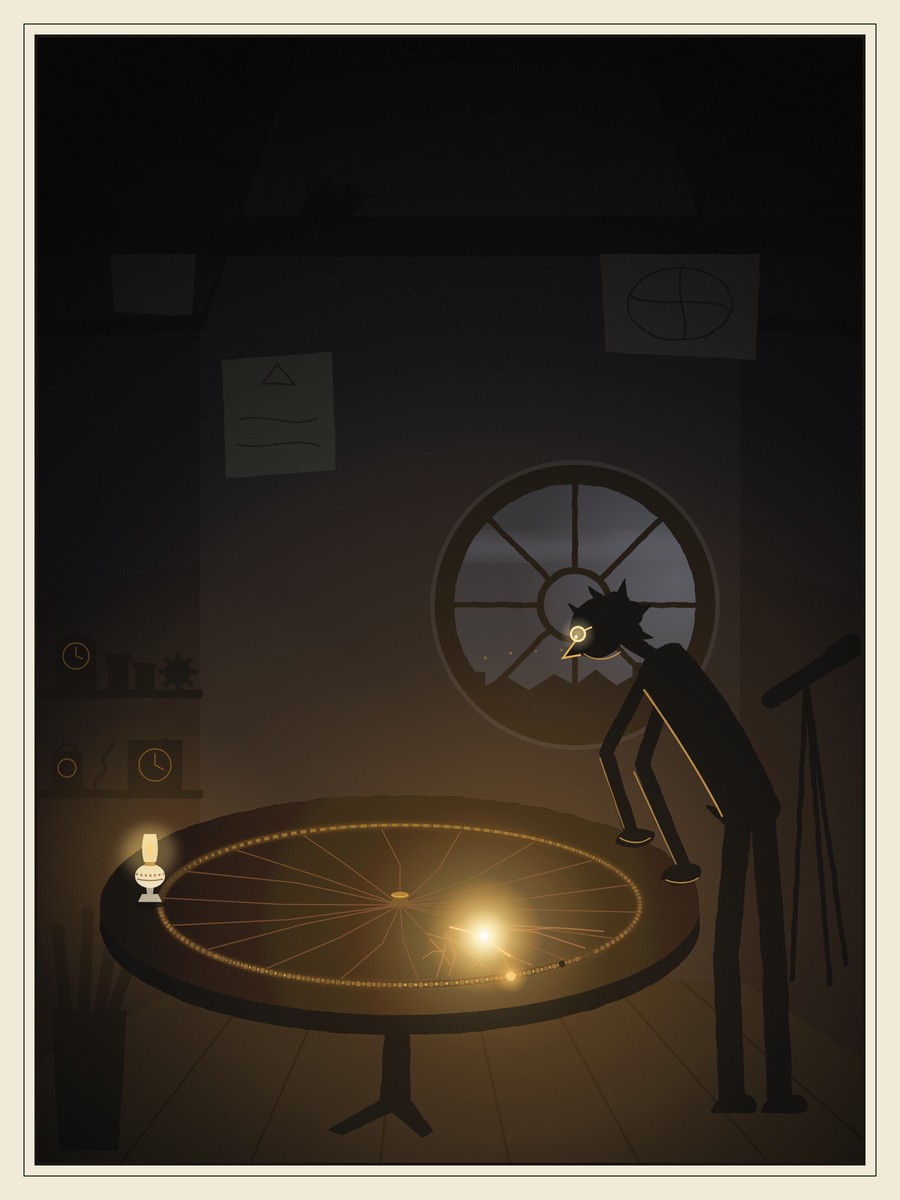
It slid along the copper wire, slowly, steadily — the pace, Tobin thought with a strange prickle at the back of his neck, of somebody walking. It went down past the tanneries. It went along beside the canal. It turned a corner — a real corner, the wire bending where the real pipe bent under the real street — and Tobin ran his inky finger along his big map of the city on the beam above until he found the place, and read the name, and said it under his breath.
“Soot Lane.”
The light went on down Soot Lane. And as it went, a strange thing happened. At the end of the lane, where it met the city wall, there was a single old Ring-lamp — Tobin knew it, a poor dim one, he had been watching it fade for weeks — and as the golden point drew near it, that little bead on the Orrery flickered, and brightened, and for a moment glowed as warm and clear as if it had been lit that very hour.
Then the point of light turned again, into a tangle of houses, and stopped, and stayed where it was, burning.
Tobin stood back from the table.
There was no lamp in Soot Lane but that one old Ring-lamp on the wall. There was nothing in the Low Quarter that could burn like that. There was nothing in the whole of Emberwick — he was quite, quite sure of it — that could burn like that. Not the Ring. Not the Beacon, even, not any more. And yet there it was, a little golden point on a copper wire, as plain as print.
He thought of his father, saying not of children, not of toys. He thought of the Guild Master, shining and smelling of lavender and saying double.
He thought of the Low Quarter. In the dark.
Tobin had never been to the Low Quarter in his life. He had never been anywhere after nightfall in his life, except from one lit room to another. The thought of going out — down the Hill, through the gates, into streets with no lamps, where Hollows might be moving like mist on the grey grass — made his stomach turn over and his hands begin, quite helplessly, to shake.
He looked at the golden point on the Orrery for a long time.
Then he went and got his coat.
He put it on with trembling fingers, and did up the buttons wrong, and did them up again. He put his mother’s compass in his waistcoat pocket and laid his hand flat over it for a moment, the way some people say a word before they jump. Then he picked up the little glass night-lamp from the table — it shook in his grip, and the flame shook with it — and he went, very quietly, down the attic stairs.
Chapter 3 complete
The Warden’s Son