Chapter 2 · 17 min read · 21 min listen
The Lamp That Would Not Stay Lost
Crookback Market was the noisiest place in Emberwick, and the smelliest, and Wren loved it.
It sprawled along the bank of the Soot Canal where the water bent round in a crooked elbow, and it was all stalls and barrows and awnings jammed so close together that you could walk from one end to the other across the tops of them, if you were small and quick and didn’t mind being shouted at. A woman sold eels out of a bucket; a man sold second-hand boots, every one of them odd. There were pots and pans, and rope, and rags, and tin Flame tokens on strings that the Guild said would keep your house safe from the dark, and onions that were small and grey and sour, because everything that grew in Emberwick was small and grey and sour. Over it all hung the smell of fish and smoke and canal-water, and the pale sun peering down through the haze like a sick man through a window.
Wren slipped through the crowd with her coat done up to the chin and both arms folded tight across her chest. She had left the garret before Mott was up — which was not difficult; Mott was never up before noon — and she had not stopped to look at the lamp since she woke. She had woken warm, and that was enough.
At the far end of the market, where the stalls gave way to proper shops with proper doors, there was a narrow building with a window so dirty you could not see through it, and over the door a sign that read:
GRUBB — LOANS — NO QUESTIONS
A bell jangled as Wren went in. The shop was dim and crammed to the ceiling with other people’s things: clocks that did not tick, coats that did not fit, a stuffed badger, a box of spoons, three violins with no strings. Behind the counter, on a high stool, sat Silas Grubb.
He was a thin man, so thin that he looked as if he had been folded up and put away somewhere and only lately taken out again. He had a long nose that went down and then, at the very end, went down a little further, as if it were trying to see what was in your pocket. When he saw Wren, he rubbed his hands together. He always rubbed his hands together.
“Ah,” said Silas Grubb. “The Ashby girl. Mott’s sweep. What have you brought me this time? A spoon? A very small boot? I can give you a farthing for a very small boot.”
“Not a boot,” said Wren.
She looked behind her, to make sure the door was shut. Then she unbuttoned her coat, and took out the lamp, and set it on the counter between them.
I wish you could have seen Grubb’s face. It went still all over, the way a cat goes still at a mousehole. The golden light fell on his long nose and his thin fingers and the dusty clutter all about, and wherever it fell the dust looked like something better than dust — a soft brown on the boxes, a warm glint on the brass of the dead clocks. Grubb’s eyes went small and shiny.
“Hm,” he said, very carefully, in the voice of a man trying not to sound interested. “An old lamp. Dented. Glass cracked. Not worth much. Twopence.”
“It hasn’t got any oil in it,” said Wren.
Grubb’s eyes flickered down to the base of the lamp, and then back up to the flame, and then to the base again. His hands stopped rubbing.
“It’s been burning since yesterday,” said Wren. “It doesn’t go out. I blew it out and it lit itself again.”
“Sixpence,” said Grubb, rather quickly.
“Rot.”
“A shilling. Two shillings. Two shillings and a ha’penny, and you’ll not get a better price in—“
“I’ll take it somewhere else, then,” said Wren, and she reached for the lamp.
“Wait.” Grubb leaned so far over the counter that his nose nearly went into the flame. His voice had gone high and thin. “Wait, wait, wait. A lamp that needs no oil. A lamp that burns without the Guild. Do you know what the nobs on the Hill would— never mind. Never mind. Ten shillings. A crown! Five crowns!” His fingers were twitching. “Twenty,” he said. “Twenty silver crowns. There. Twenty silver crowns, girl, and that’s robbing myself blind.”
Twenty silver crowns.
Wren had never in her life held more than four pennies at once. Twenty silver crowns was a sum so large that she could not even picture it. She tried to picture it in pies, and it was a lifetime of pies. It was — she did the sum again — enough to walk out of Mott’s yard and never come back.
“Done,” she said.
“Done!” cried Grubb, and he reached out with both hands and snatched up the lamp.
And then he screamed.
It was not a large scream, because Grubb was not a large man, but it was a very sincere one. He flung the lamp away from him as if it were a live coal. It bounced off a box of spoons, rolled along the counter, and stopped in front of Wren, still upright, still burning, as though nothing in particular had happened. Grubb was hopping round behind the counter with his hands tucked under his armpits, howling. When at last he pulled them out to look at them, Wren saw that both palms had gone an angry, blistered pink, as if he had grabbed the handle of a pan that had been sitting on the fire all day.
“It burned me!” he shrieked. “It burned me!”
Wren looked at the lamp. She looked at her own hands. Then, slowly, she picked the lamp up.
It was warm. Pleasantly warm, the way it had been all night. It did not hurt her in the least. She turned her palms over afterwards and there was not a mark on them; only the soot, and a little of yesterday’s brick-dust under her nails.
Grubb saw this, and his face, which had been pink with pain, went the colour of old paste.
“Cursed,” he whispered. He backed away from her until he hit the shelves and a violin fell off. “That thing’s cursed. That’s witch-work, that is. Burning a man for an honest bargain—“
“You were going to cheat me,” said Wren. “You’d have sold it for a hundred.”
“Get out!” Grubb grabbed a broom and flapped it at her, keeping well out of reach of the lamp. “Out! Out of my shop, you and your witch-light! Don’t you come back here! Don’t you ever come back here!”
Wren went out. The bell jangled behind her, and the door slammed, and a moment later she heard the bolt go across.
She stood for a while in the street with the lamp tucked back into her coat, feeling it warm against her ribs, and feeling extremely sorry for herself.
It was cursed. It must be. Why else would it burn Grubb and not her? And if it was cursed, then nobody would buy it — or if they did, they would burn their hands and start screaming about witches, and the next thing she knew, the guard would be knocking on the garret door. There would be no silver crowns. There would be no pies on Tallow Bridge. There would be no leaving Mott’s yard and never coming back. There would be soot, and board money, and being hungry, as always.
And she was hungry. She had not eaten since yesterday’s crust, and her stomach had begun making a noise like a cart going over cobbles. She had promised Nettle breakfast, too. “Maybe,” she had said — and Nettle, who was seven, would have heard yes.
“Everything costs,” Wren muttered. “Told you so.” She was not sure whom she was telling.
She was walking back along the edge of the market, past the eel-woman and the odd boots, wondering whether she could lift an onion without being seen, when she smelled bread.
It was not the smell of the market bread, which was grey and hard and tasted of the bottom of the bin. It was warm and rich and golden — if a smell can be golden — and it stopped her in her tracks as if she had walked into a wall. She turned round.
An old man was sitting on an upturned crate by the canal wall, with a wide basket on his knees. The basket was covered with a cloth, and from under the cloth came that smell, and a little drift of steam. He wore a long coat that had seen a good deal of weather, and he was not calling out, as the stall-holders did. He was simply sitting there, as though he had all the time in the world, watching the people go by.
As Wren stared, he looked up, and his eyes met hers.
They were kind eyes. That was the first thing she noticed, and it made her wary at once, because in Wren’s experience kind eyes generally meant somebody wanted something from you. They were deep-set, with lines at the corners from smiling, and they looked at her — at her tufty hair and her bare black feet and her sharp, suspicious chin — as if she were somebody worth looking at.
“Hungry?” he said.
“No,” said Wren.
The old man smiled, as if that were a very good joke, and lifted a corner of the cloth. He took out a loaf — a round brown loaf, with a crust that cracked when he held it — and held it out to her.
Wren did not move. “How much?”
“No charge.”
“Everything’s got a charge.”
“Not this,” said the old man. “It’s given.”
Wren looked at the loaf, and at the old man’s hand holding it out. It was a working hand, brown and broad, and across the palm there ran an old pale scar, as if long ago something had gone right through it. She only half noticed this. She was mostly noticing the loaf. Then, before he could tell her what she owed him for it, she snatched it out of his hand and stuffed it under her arm and backed away.
It was warm. It was so warm she could feel it through her sleeve.
She had gone three steps before she thought of something to say: something sharp, to show she was nobody’s fool, and that if he thought he could come asking favours later on account of one loaf of bread, he had another think coming. She turned round with her mouth already open.
The crate was there, by the canal wall. The old man was not. Nor was his basket. Wren looked up the street and down it, and along the canal both ways, and he was nowhere in sight — though there was nowhere he could have gone, not in the time it had taken her to walk three steps.
She stood with her mouth open a while longer. Then she shut it, and held the loaf a little tighter, and went to find Nettle.
She found her on the back step of the sweep-house, shivering, with her knees pulled up inside her shirt.
“You got breakfatht!” said Nettle, and her whole freckled face lit up, gap and all.
They sat on the step and ate it together. Wren tore it in half, and then, after a moment’s thought, tore a bit more off her own half and put it on Nettle’s. The inside of the loaf was soft and white and steaming, and it tasted the way it had smelled, warm and rich and somehow golden, and it went down into Wren’s empty stomach like a fire being lit in a cold grate.
“Where’d you get it?” said Nettle, with her mouth full.
“Man gave it me.”
Nettle stopped chewing. “Gave it? For nothing?”
“That’s what he said.”
Nettle thought about this very seriously. “Nobody giveth anything for nothing,” she said at last. “You thaid.”
“I know I said,” said Wren crossly. “Eat your bread.”
But all that afternoon the bread sat in her stomach, warm and puzzling, and the lamp sat against her ribs, warm and puzzling, and the two of them together made her more uncomfortable than she had been in her life. And the longer she thought about it, the more certain she became that the lamp was nothing but trouble: a cursed, burning, unsellable, witch-light sort of trouble that would bring the guard down on her head as sure as eggs. Grubb would talk. Grubb always talked. The best thing — the only thing — was to be rid of it before anybody came asking.
So she went down to the Soot Canal, to the quiet stretch behind the tanneries where nobody went if they could help it, and she took out the lamp, and she threw it in.
It went in with a dull plop. The black water closed over it. Wren stood on the edge and watched — and the lamp did not go out. It sank slowly down into the dark, turning a little, and it shone. It shone all the way down. Even when it came to rest on the bottom, among the mud and the old bottles and goodness knows what else, it lay there glowing up through the black water like a star that had fallen out of the sky and gone to sleep. Wren had never seen a star; nobody in Emberwick had, for three hundred years. But if she had, she would have thought of one then.
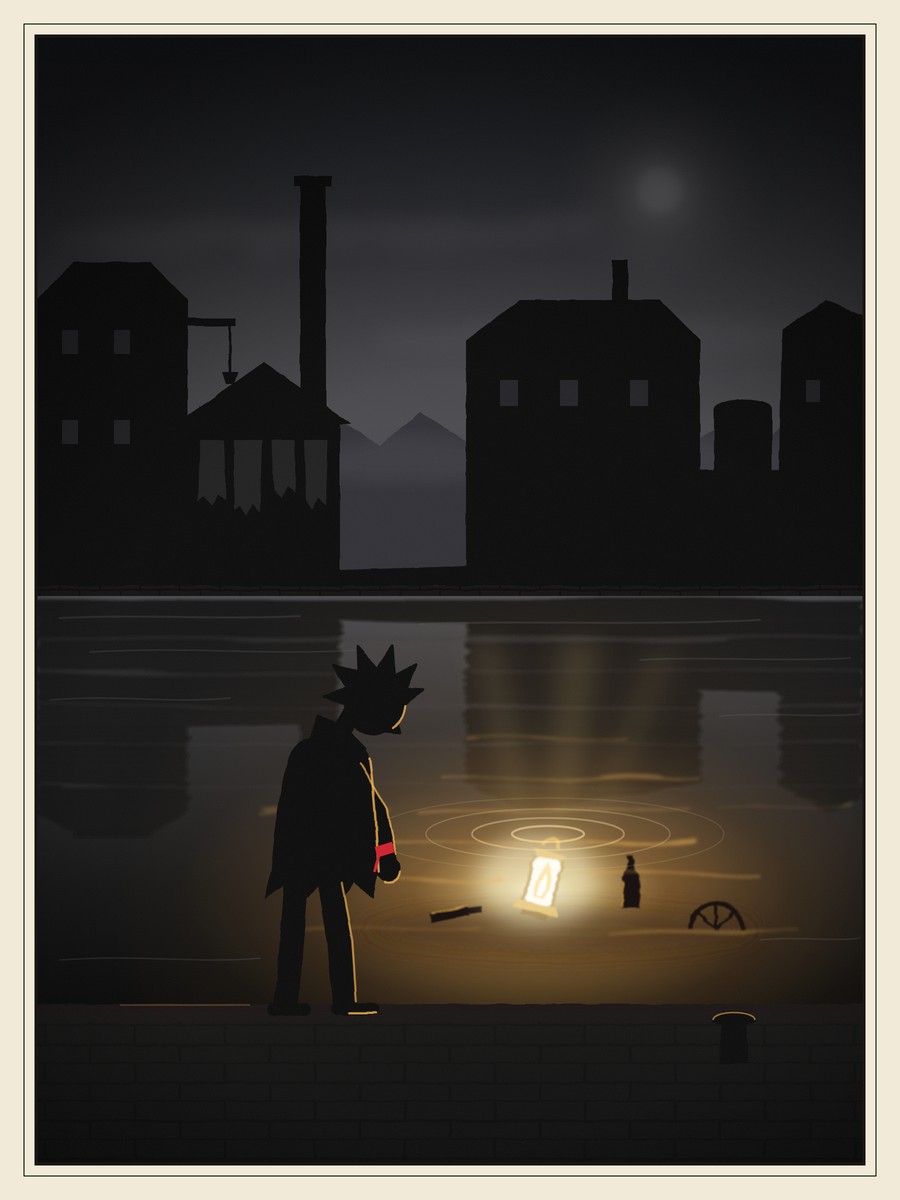
“Good riddance,” she said, rather loudly, and walked away without looking back.
That afternoon she swept two chimneys on Fuller Street with a borrowed brush. When she climbed up to her garret in the gloaming, the lamp was sitting on the windowsill.
It was perfectly dry. There was not a speck of canal-mud on it. It was burning away calmly in the little window as though it had been there all day, and the garret was warm.
Wren looked at it for a long time. Then she picked it up, put it under her coat, went straight back downstairs and out through the back of Mott’s yard to the tannery yard behind it. The tannery yard was a dreadful place that smelled of things you would rather not think about, and the ground there was soft and black. She dug a hole with her scraper as deep as her arm, and put the lamp at the bottom of it, and filled the hole in, and stamped on it, and put a broken barrel on top for good measure.
When she climbed back up to the garret, the lamp was sitting on the windowsill.
“Right,” said Wren, between her teeth.
This time she took it all the way to Tallow Bridge, which was a good half-mile off, in the middle of the city, where the pie stall stood. She set it down very carefully on the parapet of the bridge, in plain view, where anyone at all might pick it up and take it home — let them have the trouble of it, she thought, let them burn their fingers — and she walked away without looking round, past the pie stall, and home in the dark.
You will already have guessed where it was when she got there. Wren had guessed too. She was not surprised when she opened the door of her garret and saw the little golden flame on the sill. She was only very tired, and very cross, and — though she would not have admitted it to anybody — a little bit frightened.
She sat down on her mattress and glared at it.
“What do you want?” she said. “Eh? What do you want with me?”
The lamp burned.
“I never asked for you,” said Wren. “I never. You were stuck in a wall. I let you out, didn’t I? That’s all. That’s all I did. And I can’t sell you, and I can’t eat you, and I can’t get rid of you, and Grubb thinks I’m a witch, and he’ll tell everyone, and they’ll come for me, and it’s all your fault.” She found that her voice had gone wobbly, and she stopped, and swallowed, and went on more fiercely. “Everything costs. Everything. So what do you cost? Eh? What’s the catch? There’s always a catch. You tell me what I owe and I’ll—“
“It was given, child.”
Wren went absolutely still.
The voice had come from the chimney-breast. It was not loud. It was low and quiet and very close, as if someone were sitting just on the other side of the bricks, in the warm dark of the flue, speaking to her the way you might speak to someone you had known for a long time. It was not Mott’s voice, or any voice she knew. It was the kindest voice she had ever heard.
“Not lost,” it said. “Given.”
Then there was nothing. Only the canal, far below, sighing against its walls.
Wren did not move for a long time. Her heart was going like a hammer. She had been in a thousand dark chimneys alone and never once been frightened. She was frightened now. She could feel the fear in her fingers and the backs of her knees. And yet — this was the strange part, the part she could not make sense of afterwards — underneath the fear there was something else. Something that felt very like the warmth of the lamp, or the warmth of the bread in her stomach. As though the voice, whoever it belonged to, had not been angry with her at all. As though it had only wanted her to know.
“Who’s there?” she whispered at last.
Nobody answered. She had not really expected anybody to.
After a while she lay down on the straw, and pulled the blanket with the hole in it up to her chin, and turned on her side so that she could see the little flame on the windowsill. She did not want to look away from it. Without quite knowing why, she found that she had begun to hum.
It was a tune she did not often let herself remember. It came from a long way back, from before Mott’s yard, from before the soot — from a time she could not see at all, only feel, like a room you have been in once in the dark. Someone had sung it to her. Someone with soft arms and a voice that went up at the end of the lines. Morning comes, the song went. Morning comes, morning comes...
And then it stopped. It always stopped there. There were more words after that, she knew there were; she could feel the shape of them, the way you can feel the shape of a word on the tip of your tongue. But she had never been able to find them. She hummed the first line over again, and then again, more softly, and each time the tune ran out and left her listening to nothing.
“Morning comes,” Wren whispered to the lamp. “That’s all I’ve got.”
The lamp burned on, steady and golden. Her ribbon lay red across her wrist in its light. The garret was warm, and the bricks of the chimney-breast were warm, and the bread was still warm inside her; and somewhere in the middle of the third morning comes, without meaning to, Wren fell asleep.
Chapter 2 complete
The Lamp That Would Not Stay Lost