Chapter 1 · 17 min read · 21 min listen
A Lamp in the Flue
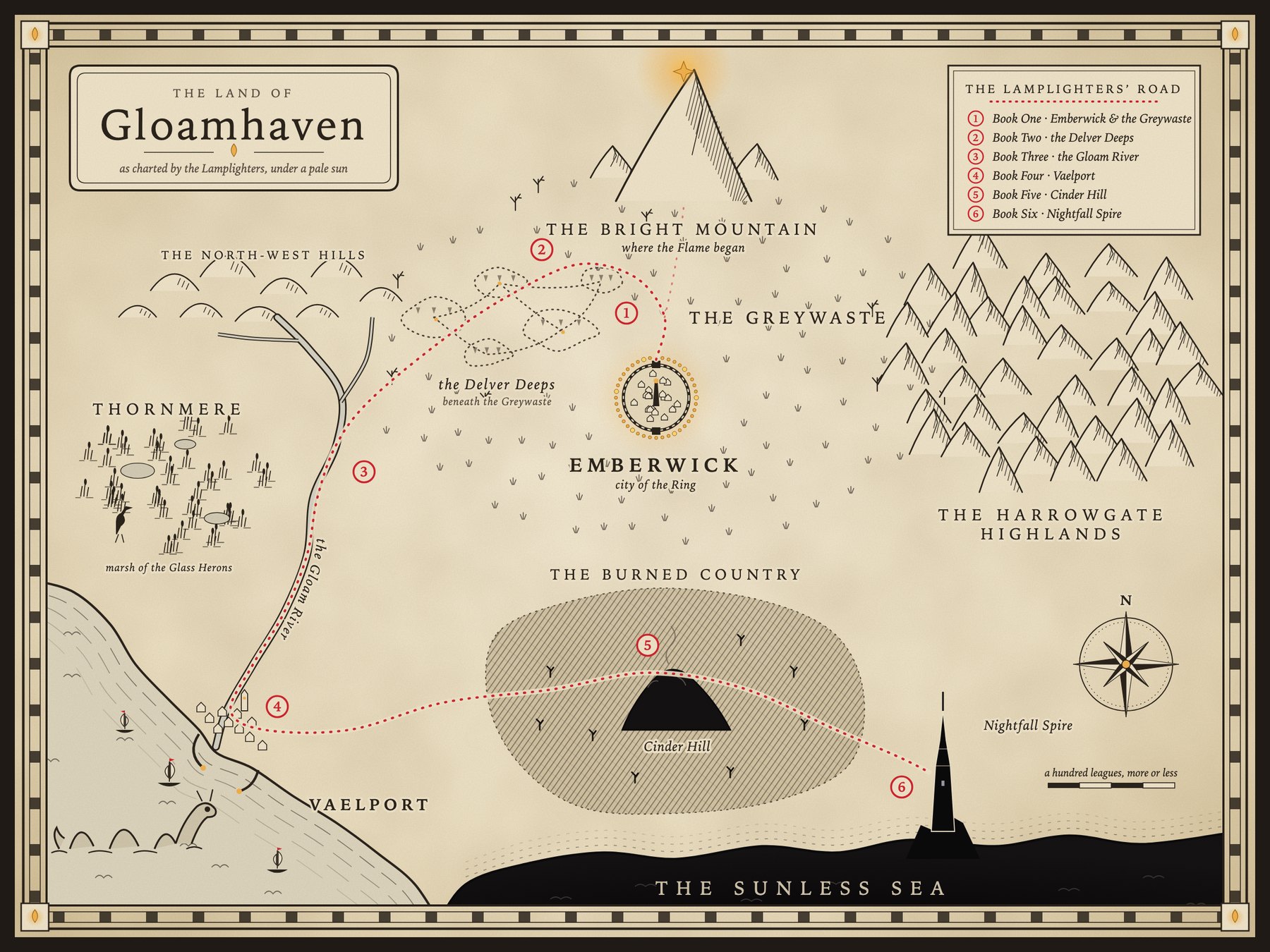
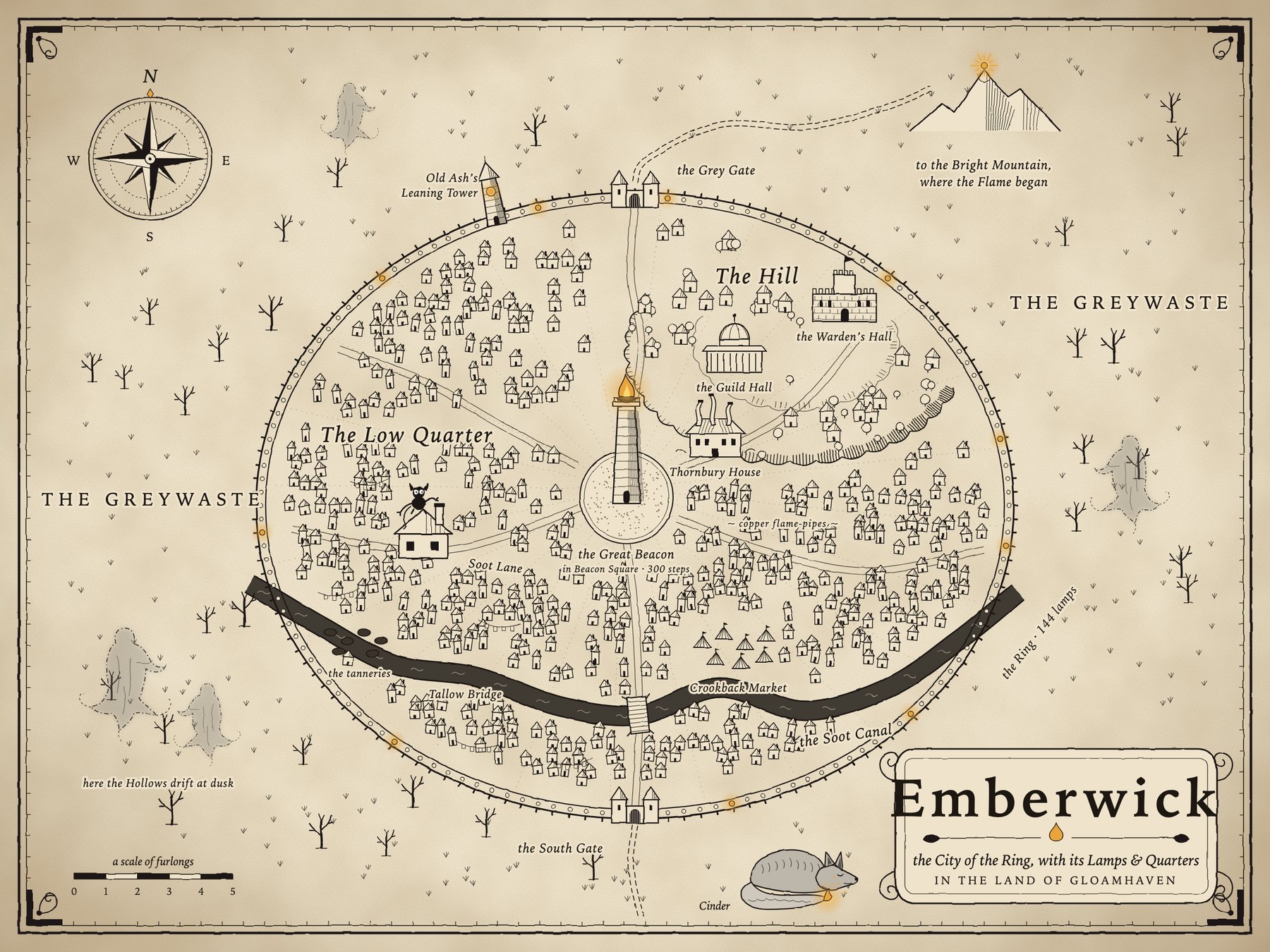
In the city of Emberwick it was noon, and you would never have known it. The sun was up — it was always up at noon, as it had been every day for three hundred years — but it hung above the chimneys as pale as a coin seen through dirty water, and it gave about as much warmth as a coin does. Its light was thin and grey. It lay on the rooftops like dust. It turned the canals into strips of slate and the people into something very like their own shadows.
Nobody in Emberwick thought this was strange. That is the trouble with a curse that lasts long enough: people stop calling it a curse and start calling it the weather. If you had asked anyone in the city what colour the sky used to be, they would have scratched their heads and said, “Well — sky-coloured, I suppose,” and gone back to work. The names of most colours had dropped out of the world, the way the names of very old kings drop out of it, and only a handful were left: grey, which was everywhere, and brown, and dun, and a tired, washed-out blue-ish that people called “dull” when they bothered to call it anything.
On this particular grey noon, high on the roof of Thornbury House, a girl sat astride a chimney-pot, eating the last crust of her breakfast and glaring at the sun as if it owed her money.
Her name was Wren Ashby. She was twelve, or near enough — nobody had ever told her the exact day — and she was small and wiry and sharp in the chin, with black hair she cut herself with a knife whenever it got into her eyes, so that it stuck out in tufts like the feathers of the little brown bird she was named after. She was a chimney-sweep, which meant she was black from her cap to her bare heels, and did not mind. Soot is a kind of coat, when you have no other. The only thing about her that was not black was a ribbon tied round her left wrist: a narrow, frayed, faded thing, the colour of a grey dawn with a little pink in it. It had been her mother’s. It was the only thing she owned that nobody had sold her or let her have on account, and she never took it off.
Thornbury House stood at the edge of the Hill, where the tall houses of the rich gave way to the crooked roofs of everyone else, and it had been shut up for fifty years. Its chimneys rose from the roof in tall twisting stacks, some spiralled like barley-sugar and some leaning together like old men telling secrets. People in Soot Lane said it had belonged to the last family of Lamplighters, back before the Guild, and that it was haunted, and that anyone who went inside came out with white hair. Wren had been inside all morning. Her hair was as black as ever.
She was there because of Gristle Mott, her sweep-master. And Mott was not there — he was in the back room of the Three Wicks with a mug of something — because of a gentleman.
“Gentleman come by the yard,” Mott had wheezed that morning, rubbing his great red knuckles. “Good coat. Clean boots. Agent for some buyer what wants the old Thornbury place. Wants to know if the chimneys is sound. Paid in advance.” He had patted his pocket, which clinked. “So down every flue in the place, Ashby, and if there’s one brick loose I want to know it.”
“Do I get any of what he paid?” said Wren.
Mott had laughed — a dreadful noise, like a bellows full of gravel — and told her she could have the honour of working off another day of her board money, and wasn’t she lucky to have a roof over her head at all. Wren owed Mott board money. She had owed it for as long as she could remember, and however many chimneys she swept, the sum never got any smaller. She had worked out long ago that it was not meant to.
“Everything costs,” she told the sun now, round her crust. “And if it doesn’t cost you, it’ll cost you later.” She had never yet known it to be wrong.
She licked her thumb, took up her brush and scraper, and dropped into the chimney like a stone into a well.
If you have never been inside a chimney, you may imagine it is a dreadful place, close and black and choking. And so it is. But Wren had been going up and down chimneys since she was five, and she knew them the way you know the inside of your own pocket. She knew how to brace her back on one wall and her knees on the other and wriggle down like a caterpillar. And she knew the dark. The dark did not frighten her in the least. The dark was simply where the work was; and in the dark, nobody could see that you were small.
The chimneys of Thornbury were the strangest she had ever been in. They twisted and doubled and joined and parted again, so that she would go down one flue and come out in another, three rooms away. It was like climbing about inside a knot. She tapped the bricks with her scraper as she went and found, rather to her annoyance, hardly a loose one anywhere.
It was somewhere in the middle of the afternoon that she first heard the scritching. It came from above her, and then below, and then from somewhere off to one side where there should not have been room for anything. It was a small, busy sound, like mice wearing boots.
“Gutterlings,” said Wren, wedged in the dark with her elbows out. “Course there are. Fifty years of nobody.”
Two white eyes opened above her head, round and enormous and colourless, like two peeled eggs. More opened beside them, until the chimney seemed full of eyes.
“Sweepy-girl, sweepy-girl!” squeaked a voice, thin as a whistle. “Come to call, come to call!”
“Brushy-brushy, give-give!”
“Shiny-shiny, mine-mine!”
Gutterlings, I should explain, are not wicked — not exactly. They are knee-high soot-imps who live in chimneys and flues, black as the soot itself, with long thin fingers and big white eyes. They speak in rhymes because they think rhymes are clever, and they steal anything that glints because they think glinting things are cleverer still. They are a nuisance rather than a danger.
“Clear off,” said Wren. “I’m working.”
“Working, working, never shirking!” squeaked the eyes by her knee, and something tugged at her brush.
Wren kicked. There was a scuffle, a great deal of squeaking and a shower of soot down the back of her neck, and when it was over she had her scraper and the Gutterlings had her brush, and they were carrying it away up the flue, singing.
“Brushy-brushy, ours-ours! Sweepy-girl for hours-hours!”
“That’s Mott’s brush!” Wren shouted. “He’ll have it out of my hide!”
She went up after them, very cross, round a bend and down into a place where three flues met in a brick chamber no bigger than a cupboard. The Gutterlings were there, crowded into one corner — and they were not looking at her at all. They had dropped the brush. They were scratching at the wall.
The largest of them, who had a bent ear and a long nose like a candle-snuffer, had his face pressed flat to the bricks. “Warm-warm,” he was squeaking softly. “Shiny-warm. Snib wants. Snib wants.”
Wren had felt it too, the moment she dropped into the chamber: the air was warm. Not the stuffy, coal-smelling warmth of a chimney with a fire below; this was soft and clean and steady, like a loaf just out of the oven, or a cat that has been sitting in the one patch of sun on a windowsill. And there had been no fire in Thornbury House for fifty years.
“Shift,” said Wren, and pushed in among them, and laid her hand where Snib’s nose had been.
The bricks were warm. And they were loose. Somebody, long ago, had bricked up a gap here in a hurry, and the bricks moved under her palm like bad teeth.
I do not know what you would have done in Wren’s place. Perhaps you would have reported a loose patch in the third-floor flues and gone home. But Wren had been hungry nearly every day of her life, and when you are hungry every day you learn one thing above all: if something is hidden, somebody thought it was worth hiding.
She worked her scraper into the crumbling mortar while the Gutterlings hopped round her ankles squeaking advice. One brick came out, and warm air breathed through the hole onto her face. Then a whole section fell inward with a soft rattle, and she was looking into a sealed-off flue no wider than her shoulders, running up into the dark.
Only it was not quite dark. Halfway up, in a little niche cut into the brick, something was shining.
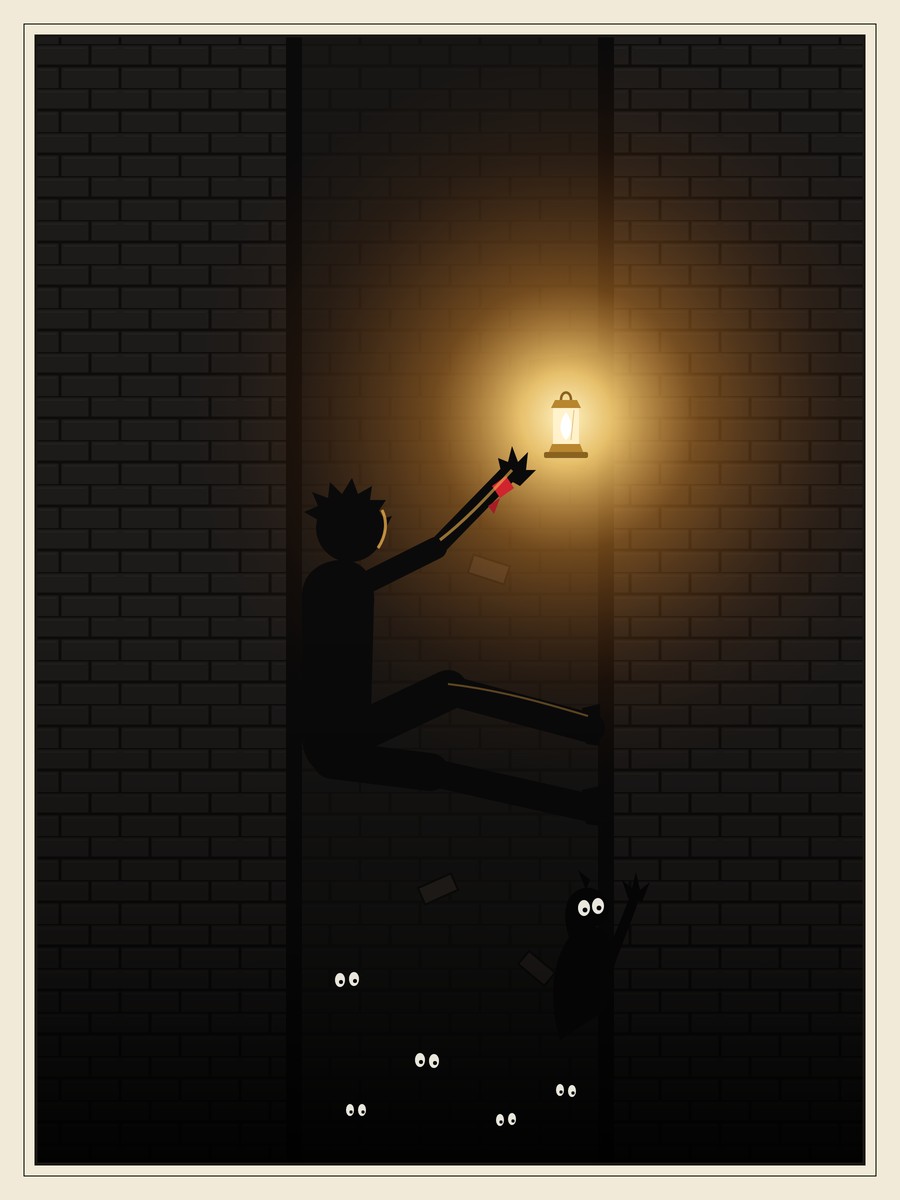
Wren pulled herself through and up, ahead of the Gutterlings, and got there first. She hung in the narrow flue with her knees braced and looked, and for a long moment she did not do anything at all.
It was a lamp. A small one, small enough to sit in her two hands, made of brass that had been knocked about a good deal; it was dented in three places and scuffed all over. It had a little hook on top for hanging, and a glass chimney with a fine crack running up one side, thin as a hair. It was the kind of thing you might find at the bottom of a box in Crookback Market and never look at twice.
Except that it was alight.
Inside the cracked glass burned a flame no bigger than the tip of Wren’s little finger. It did not flicker. It did not smoke. It stood up straight and clear, and it was not grey, and it was not brown, and it was not dun or dull. It was a colour Wren had never seen and had no word for. If you and I had been there, we should have said at once that it was golden — golden and white at the heart, like the best sort of morning. Wren could only stare.
All the warmth had come from it — through the bricks and into the chamber — from this one tiny flame. She held her fingers near it the way you do near a fire, and the warmth went into them and up her arms, and she noticed, far off, that it smelled faintly of new bread, and of something else she could not name.
She picked it up. It was warm in her hands but not hot. She tipped it to see how much oil was left — and then turned it right over. The lamp had no oil. It had no place for oil: no reservoir, no cap to unscrew. Only the flame, standing in the brass on nothing at all, as if it had every right to.
“That’s not possible,” Wren whispered.
“Shiny-shiny!” squealed Snib, right behind her. “Shiny-shiny, mine-mine!”
The Gutterlings had crowded into the flue below her, white eyes fixed on the lamp, long fingers reaching. Snib had scrambled up the wall beside her like a spider, his nose nearly touching the glass.
“Snib found! Snib found first!”
“You found a wall,” said Wren. “I found this.”
She did the only thing she could think of. She put her face to the glass and blew the flame out.
Darkness dropped on the flue like a sack. The Gutterlings wailed. Wren clutched the lamp to her chest and held her breath, waiting for them to lose interest, as Gutterlings do when the shiny thing is gone.
She counted one. She counted two.
On three, the lamp lit itself again.
It did not sputter back. It needed no spark. One moment there was nothing, and the next the little flame was simply there, upright and golden and calm, as though it had only blinked. And Wren, holding the lamp against her chest, looked down and saw her ribbon.
It lay round her wrist, just beside the glass. And in that light it was not faded, and it was not grey with a little pink in it. It was a colour so deep and warm and alive that she felt it more than saw it, the way you feel a kind word. You and I would have called it red — a true, glad, berry red. Wren had no word for it. Nobody had used that word in her hearing in her whole life. She only knew that her mother’s ribbon was suddenly the most beautiful thing she had ever seen, and that she had worn it for eight years without once seeing it at all.
“Rot,” she whispered. It was all she could manage.
Then she shoved the lamp inside her coat, did up every button over it, and went down that flue faster than any sweep in Emberwick has ever gone down anything.
The Gutterlings chased her for a while, but with the lamp hidden they could not see it, and Gutterlings have short memories for what they cannot see. In the end they went back to squabbling over Mott’s brush. The last thing Wren heard as she dropped out of the great kitchen fireplace into the grey afternoon was Snib, small and far away up the chimney, squeaking sadly: “Shiny-shiny. Snib’s shiny. Snib remembers.”
She went home the long way, over the roofs. All the way she could feel the lamp against her ribs, warm and steady like a hand resting there, and the warmth seemed to spread until even her bare toes on the cold slates did not feel quite so cold.
And she planned. A brass lamp that burned without oil! There was not a pawnbroker in the city who would not give his eyeteeth for it. She would take it to Silas Grubb at Crookback Market first thing in the morning, and she would not let Grubb cheat her, not this time. She would sell it for silver. She would eat for a month. She would buy hot pies from the stall on Tallow Bridge, the ones with gravy in them, and eat them one after the other until she burst. She would buy Nettle a pair of stockings.
By the time she climbed down into Mott’s yard at the bottom of Soot Lane, the gloaming had come — the grey of the day deepening into the grey of evening, which in Emberwick was all the difference there was — and she was very nearly smiling.
“Where,” roared Gristle Mott, “is my brush?”
He filled the doorway of the sweep-house: a huge man, wide and wheezing, with a face like a boiled ham, smelling as always of gin and soot.
“Gutterlings had it,” said Wren. “Dozens of them.”
“Gutterlings!” Mott spat. “Two shillings, that brush. That’s two shillings on your board, Ashby. And sixpence for the trouble of listening to you.”
Wren did a quick sum. She would now owe Mott money until she was roughly a hundred and four. She opened her mouth to say so — and shut it again. Under her coat the lamp was warm, and Mott had a nose for anything worth money the way a dog has a nose for a bone.
“Get to bed,” said Mott. “And no supper, not with two-and-six on your slate.”
Wren said nothing about the lamp. She walked past him with her hands in her pockets and her chin up, which is the best way of walking past people when you want them to think you have nothing worth taking.
Someone was waiting by the water-butt. It was Nettle, the smallest sweep in the yard — seven years old, so freckled you could hardly see her face for them, with two front teeth missing and arms like sticks. Nettle followed Wren everywhere. Wren pretended to mind.
“You were gone ageth,” said Nettle, who could not say her s’s for the gap in her teeth. “Mott thaid you’d fallen down a chimney and he’d thell your thpare thocks.”
“I haven’t got spare socks.”
“That’th what I told him.” Nettle slipped her little hand into Wren’s — and looked up, surprised. “Wren. Your handth are warm.”
“Must be the running,” said Wren. Nettle’s fingers were like ice, as they always were. Nettle was always cold. “Go on. Bed. I’ll see you in the morning.”
“Will you have anything for breakfatht?”
“Maybe,” said Wren, thinking of silver. “Maybe I will.”
Wren’s room was a garret at the top of the leaning house beside Mott’s yard. It had a roof so steep you could only stand straight in the middle, a window the size of a book, a straw mattress, and one thin blanket with a hole in it. Along one side ran the chimney-breast from the rooms below; but Mott never bought coal for anybody but himself, so the bricks were always cold. If you have ever tried to sleep in a room where the fire has gone out, you will know the kind of cold I mean. It is a slow, patient cold that gets in under your blanket and sits on your chest and waits for you to give up.
Wren shut the door, pushed the broken chair against it, and listened. Below, Mott was singing in the Three Wicks — badly. Then, slowly, she took out the lamp.
The flame was still burning, as straight and calm as in the hidden flue. Its light filled the little garret. It was not much light, but it was golden, and Wren had never had golden light in that room before. And her ribbon — she held her wrist up close — was red again, so red that she sat down on the mattress quite suddenly and simply looked at it.
“Where did you come from?” she whispered. “Who put you in that wall?”
The lamp said nothing. It only burned.
She wrapped it in her coat and pushed the bundle into the corner under the slope of the roof, where it glowed through the cloth like a coal through ash. Then she lay down under her blanket and waited for the cold to come and sit on her chest, the way it always did.
It did not come.
She noticed that her feet were warm. Then her hands, and the tip of her nose, which was always the last thing to be warm. The air in the garret was soft and still and kind; and when she reached out in the dark and touched the chimney-breast, the bricks were warm too, as though someone had lit a fire in the grate below for the first time in years. Nobody had. She knew perfectly well that nobody had.
“Rot,” said Wren softly into the dark. But she did not say it as if she meant it.
She meant to lie awake and plan — Grubb, and silver, and how to slip out before Mott was up. Instead, without in the least intending to, she curled up on the straw with her ribboned wrist under her cheek and the golden glow in the corner of her eye, and fell asleep.
That was the first night in Wren’s life that she was warm all the way through. It was not, I am glad to say, the last.
Chapter 1 complete
A Lamp in the Flue