Chapter 14 · 16 min read · 21 min listen
Given Away
The stair of the Great Beacon was black stone, worn into a dip in every step by three hundred years of Lamplighters’ boots. It went round and round, and it never seemed to go anywhere except further into the dark.
Wren counted. It was Tobin’s habit, not hers, but when you are climbing in the dark and cannot see the top or the bottom, numbers are something to hold on to. Twenty-one. Twenty-two. Twenty-three.
Tobin climbed behind her, breathing hard. Cinder ran ahead and then back, ahead and then back, her spark bobbing like a firefly.
At fifty-eight, the voice found them.
“Such a long way up,” it said, sweetly, out of the stones. “And what will you find at the top? An empty bowl. Nothing, little sweep. There is never anything at the top. Sit down and rest.”
“Don’t,” said Wren, through her teeth, before Tobin could say a word. “Don’t answer it. Just count.”
Fifty-nine. Sixty.
Far below them, iron clanged on stone.
They both stopped. Then, curling up the stairwell, came a breath of air so bitter that Wren’s fingers went numb round the lamp.
“The coal-door,” whispered Tobin. “They’ve found the coal-door.”
Down where the lamplight did not reach, something grey was moving up the stair. Not climbing. Drifting. And another behind it.
“Run,” said Wren.
They ran. Seventy, eighty, ninety. Her legs burned. The cold came after them faster than they could climb. At a hundred and twelve there was a little landing, where a narrow slit of a window let in a smear of grey night, and there Tobin stopped.
“Go on,” he said.
“What? Don’t be daft. Come on—“
“No.” His face was as white as his knuckles. “They’ll catch us both before we’re halfway. Hollows don’t get tired. It’s simple arithmetic. Somebody has to hold the stair, and it can’t be you, because you’ve got the lamp, so it has to be—“ His voice cracked in the middle. “It has to be me.”
“You haven’t even got a light!”
“I’ve got Cinder.” The ember-fox stood beside him, ears flat, spark blazing, growling so low that Wren felt it more than heard it. “And technically speaking, a narrow stair is the best place there is to hold anything. That’s why castles have them—“
“Tobin, you’re scared of the dark.”
“Yes,” said Tobin. “I know. I’m aware.” He pushed his spectacles up his nose, and his hand was shaking so badly that he nearly poked himself in the eye. “I’m going to be scared of it anyway. I’d rather be scared here than scared somewhere else.”
Wren opened her mouth to argue. But the first Hollow came round the curve of the wall, grey and faceless, and Cinder flew at it in a burst of sparks, and it drew back — only a little — and stopped.
And then, from somewhere below the Hollows, came a sound that Wren knew.
Tap. Pause. Tap. Pause. Tap.
It was a brass-hooked pole striking stone, the way it had struck the North Wall every night for thirty years. The grey shapes below shrank against the wall, and up through them came a little swinging lantern on the hook of a lamplighter’s pole. And behind it came Old Ash.
He looked dreadful. His coat was torn half off one shoulder, his beard was singed on both sides now instead of one, and he was limping. But he came up through the Hollows as if they were a draught, and they drew back from his little oil-light the way cats draw back from water. He reached the landing and looked at the two of them over his beard.
“Hm,” said Old Ash. “Good. You didn’t wait for me.”
“Ash! They said you were in a cage—“
“I was. It was a poor sort of cage.” He turned to face down the stair beside Tobin, old man and boy, with Cinder between their feet. Below them the Hollows were gathering again, a thick grey tide, and Ash’s lantern looked very small. “Hm. Up you go, child.”
“But—“
“Up,” said Ash. “You know what to do. The lad and I will hold the stair.”
Tobin’s teeth were chattering. “I don’t think I’m much good at holding stairs,” he said. “I should tell you, sir, I’m frightened of the dark. Quite badly, actually.”
“So was I, at your age,” said Old Ash. “So am I now, as it happens. Stand here anyway.” He glanced sideways at the boy, and something in his face softened. “That’s all courage is, lad. Being frightened, and standing here anyway.”
Tobin swallowed. Then he set his feet, and stood.
Wren looked at them both for one more moment — the tall bent old man with his pole, the gangly boy with his spectacles, the small grey fox with her tail on fire — and she found there was a lump in her throat that she did not know what to do with. So she did the only thing she could. She turned, and she climbed.
A hundred and fifty. A hundred and sixty.
She was alone now, with the lamp, and the dark, and the voice.
“Poor little sweep,” it murmured, so gently. “They’ve left you to do it all by yourself. That is what people do, you know. They always leave you. You learned that a long time ago.”
Two hundred. Two hundred and ten.
Below her, very faint, she heard Cinder snarl, and once Tobin’s voice, high and shaking, shouting “Get back!” She did not stop. If she stopped she would go back down.
Two hundred and ninety-eight. Two hundred and ninety-nine.
Three hundred.
The stair ended at a small iron door. Wren pushed it, and it swung open, and the wind hit her in the face.
She was at the top of the whole city. There were no stars, only a low, heavy sky. Far below, Emberwick lay in the dark like something drowned, and the wall round it was a black ring with not one light on it.
In front of her was the Beacon-bowl.
It was as big as a pond, a vast round dish of black iron on three great legs, its rim at the height of her chest. Inside lay the wick-bed: a matted floor of old wick like a field of dead grass, grey with dust and dry as bone. Round its edges gaped the dark mouths of the copper flame-pipes, going down.
It was the coldest, emptiest thing she had ever seen. It did not look like something that had ever been on fire. It looked like something that had forgotten fire was possible.
And standing beside it, his grey cloak stirring in the wind, was Captain Varrick.
“You’re quick,” he said. He nodded at the top of an iron stair that came spiralling up the outside of the tower. “The Lamplighters built that for carrying oil. I used to know a great many things like that.” He rubbed his right palm with his thumb. “Good evening, Wren Ashby.”
“I’m not going to take it from you,” said Varrick, spreading his empty hands. “I can’t. It must be given. I know that better than you might think. I’m here to make you an offer.”
“Don’t want it,” said Wren.
“You haven’t heard it yet.” He smiled. It was not an unkind smile, and that was the worst of it. “Here is my offer. Keep the lamp. Keep it, and walk away. Go down my stair, and through the Grey Gate, tonight. No Knight will stop you. No Hollow will touch you. You will never be cold again, or hungry, or anyone’s sweep, or in anyone’s debt. You keep everything. You lose nothing.”
The wind blew. The ribbon on Wren’s wrist fluttered red in the lamplight.
“And why not?” said Varrick softly. “Think about it. Why should you give anything to them?” He nodded down at the drowned city. “They called you a witch. Your own master sold you for a handful of silver. The Warden locked you in a cell. What has that city ever given you? Cold, and soot, and debt. You said it yourself, didn’t you? Everything costs. You were right. You have always been right. So why should you be the only one who pays?”
And Wren, standing at the top of the Beacon in the wind, found that she could not think of an answer.
Because he was right. She had known it since she was four years old and alone. Nobody gives you anything. If it doesn’t cost you now, it’ll cost you later. That rule had kept her alive. And here was a grown man in armour telling her she had been right all along — and offering her, at last, a way out.
Then the other voice came, from just behind her ear, so close she could almost feel its breath; and it was not speaking.
It was humming.
Wren went cold all over, colder than any Hollow had ever made her.
It was the tune. Her tune. The one with no words, the one she hummed to herself in the garret when she could not sleep. Morning comes, morning comes — and then, where Wren’s memory always stopped, where there was only a blank and an ache, the humming went on. It went on into the part she had lost. And there were words in it — she could hear that there were words, just on the other side of the humming, the way you can hear that someone is talking in the next room.
It was her mother’s voice. Or it was so like her mother’s voice that Wren could not tell the difference, and did not want to.
“I know the rest of it,” said the sweet voice, very softly. “I know all of it, every word. She sang it to you every night, did you know that? You used to fall asleep before the end. Come with me, little one. Come with me, and I will sing you the rest.”
Wren’s eyes stung. She held the lamp so tightly that the brass bit into her palms.
I will tell you now what she was really afraid of, because it was not Varrick, and it was not even the voice. She was afraid of the bowl.
She looked at that vast cold dish with its field of dead wick, and then at the little flame in her lamp, no bigger than her thumb. And she knew what would happen if she gave it. The bowl would swallow it, like one cup of water poured into the Soot Canal. It would be gone.
And then she would have nothing.
No warmth in the garret at night. No red ribbon. She would be what she had always been: a hungry nobody in a cold city, owing money she could never pay. The lamp was the only thing that had ever been hers.
Everything costs. And this would cost her everything.
“Well?” said Varrick, gently.
Wren shut her eyes.
And behind her eyes, without her asking, she saw Nettle. Not Nettle laughing, with her missing teeth and her freckles, but Nettle as she had been in Soot Lane, sitting on the cold step — grey, and quiet, and not knowing Wren’s name. She saw Mrs Fenn on the bakery step, with flour on her grey hands, trying to remember what her children were called. She saw, all over the dark city below, hundreds of people sitting down in the streets because a sweet voice had told them it was easier.
And she remembered kneeling beside Nettle with the lamp held out, saying here, it’s for you, you don’t have to do anything — and how it had blazed.
It cannot be bought, stolen or earned, said Old Ash, in her memory, in his slow dry voice. Only given.
Wren opened her eyes.
“I don’t want the rest of the song,” she said. Her voice came out small and wobbly, and she hated it, and she kept going anyway. “Not from you. It’s not yours to give me. And I don’t want your road, either.” She swallowed hard. “You’re right. Everything costs. But I reckon — I reckon some things are worth what they cost.”
She turned her back on Varrick. She climbed up onto the iron rim of the Beacon-bowl, knelt there with the wind tugging at her hair, and held the lamp out over the dead grey field of the wick-bed.
Her hands were shaking. She could not make them stop.
And then, quite clearly, she felt a hand on her shoulder.
It was a warm hand. Large, and steady, and kind, and very warm, as if it had been held near a fire for a long time. It did not push her, or pull her. It only rested there, the way a hand rests on the shoulder of someone who is about to do something hard, to say I am here. And her hands stopped shaking.
Wren did not turn round. She knew, somehow, that if she turned round there would be no one there. She was right about that. But she was not, she found, alone.
“Here,” she whispered, to the city, to the dark, to all the grey people sitting in the streets. “It’s for you. You don’t have to do anything.”
And she tipped the lamp, and gave the Flame away.
For one dreadful heartbeat, nothing happened. The little golden flame slid off the lip of the lamp like a drop of honey and fell into the grey wick, and Wren saw it there, tiny, a single spark in a field of dust, and she thought: it’s gone. I knew it. It’s gone.
Then the wick-bed caught.
It did not catch slowly, with smoke and crackling. It caught the way the sun comes up over the edge of the sea, if you have ever seen that — all at once, a great silent bloom of gold. The flame ran across the bowl in a ring, and the ring became a sheet, and the sheet became a roar, and a pillar of white-gold fire went up out of the Great Beacon into the night, so tall and bright that Wren had to throw up her arm across her eyes.
She heard the fire go down into the pipes — whoom, like a great wind through a hundred and forty-four throats — and the tower shuddered beneath her. She scrambled to the edge to see. The fire was running under the city, glowing up through the grates and gutters, racing along the buried copper like gold poured into a mould, under the Hill and the canals and Crookback Market and Soot Lane. It reached the wall.
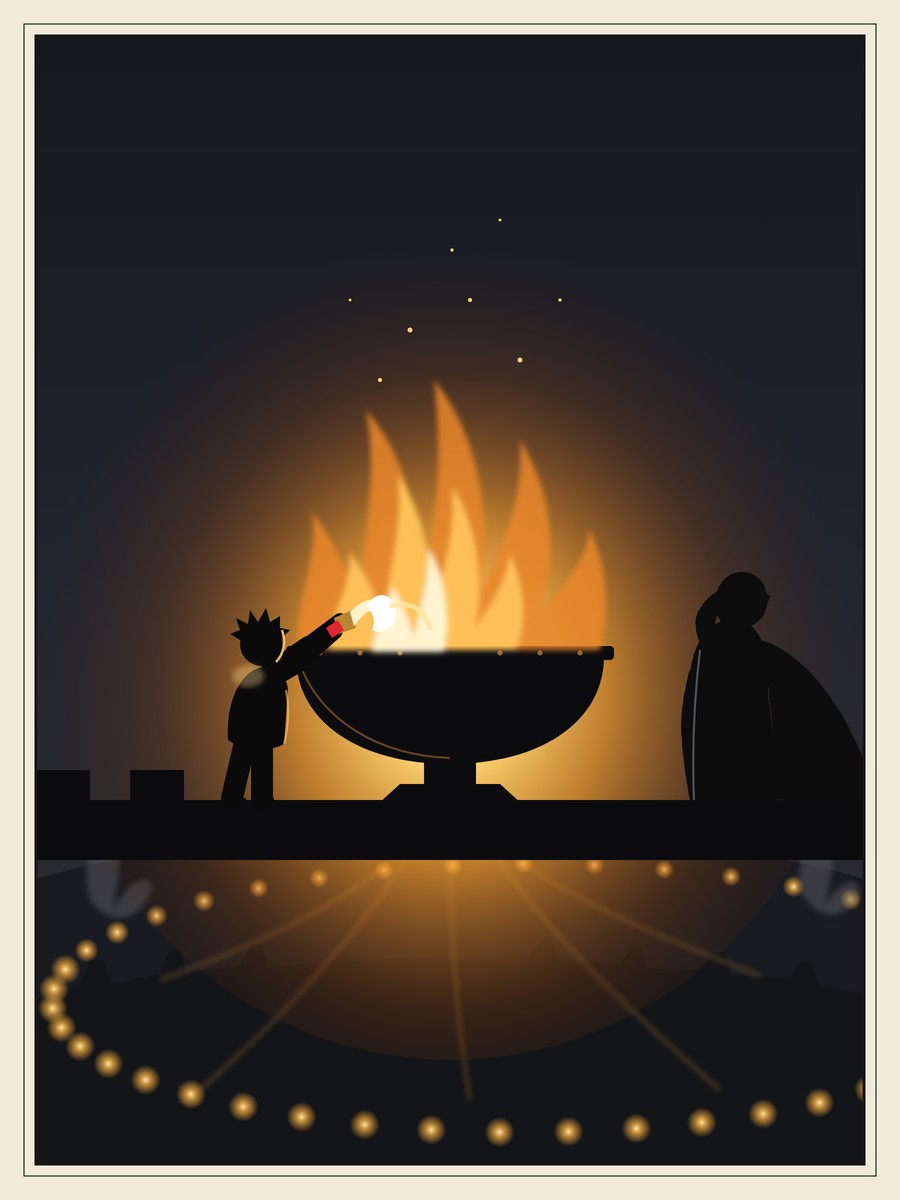
And the first Ring-lamp lit.
Then the next. Then the next and the next and the next, running round the city wall in both directions at once, faster than a horse could gallop, faster than Wren could turn her head to follow. Pop, pop, pop — like a string of beads catching the light — until the two runs of fire met on the far side of the city, and Emberwick lay inside a circle of flame.
Not the dim Guild-oil yellow Wren had always known. These burned white-gold, the colour of the little flame in the lamp, all hundred and forty-four at once.
Down in the streets, the Hollows screamed.
A high thin shriek rose from every lane and alley. They poured back towards the wall like smoke before a gale, and fled over it into the Greywaste, and were gone.
And the colour came back.
It came running into the city like the tide over sand. The roofs below, which had always been grey, turned a deep warm colour she had no word for, the colour of a fox’s back. Somewhere a door that had been grey all her life was suddenly a bright, ridiculous colour that made her want to laugh. The city was waking up in colours, and she did not know the names of any of them, and she did not care.
Then she looked down at the lamp in her hands.
It was not empty. The little flame was still there — the very same flame, smelling of bread and summer — and it was not weaker, not one bit. It was brighter than it had ever been. It filled her cupped hands with light until her fingers glowed pink, and for a moment Wren forgot to breathe.
What is given, grows, she thought. Old Ash had said that too, and she had not understood it. She understood it now. She had given it all away, every bit — and she had not lost anything at all.
The iron door behind her banged open. Tobin fell through it, his spectacles crooked and his face blazing with light, and Cinder shot past him with her tail-spark burning like a small sun. Behind them, leaning on his pole, came Old Ash.
“It worked,” said Tobin. “It worked. The whole network, all at once, I told you it was a network—“ And then he saw the city, and stopped talking, which was the most remarkable thing Wren saw all night.
Captain Varrick stood on the far side of the platform with one arm thrown across his eyes against the blaze. For the first time, he did not look smooth. He looked like a man who had been standing out in the cold for a very long time and had forgotten what a fire was for.
Old Ash looked at him across the Beacon. The old man’s face, in the gold light, was full of a grief so deep that Wren had to look away from it.
“Lad,” said Old Ash quietly. “You used to love this.”
Varrick lowered his arm.
For one heartbeat — Wren saw it; she was always sure afterwards that she had seen it — he did not move. His left hand had gone to his right palm, to the old scar there, and was resting on it. His grey eyes were on the fire. And there was something in his face, just for that one heartbeat, that was not grey at all.
Then it was gone. Captain Varrick turned without a word and went down the outer stair into the dark, his footsteps ringing on the iron, round and down, until they could not hear them any more.
Nobody said anything for a while.
Wren sat down on the warm stones at the top of the Great Beacon, with the lamp in her lap and Cinder curled against her side, and Tobin flopped down on her other side, and Old Ash leaned on his pole and looked at the city. The fire roared gently above them. All round Emberwick, the Ring burned gold.
On her wrist, her mother’s ribbon was blazing red — redder than it had ever been, redder than anything — the first colour she had ever known the name of.
Chapter 14 complete
Given Away