Chapter 13 · 17 min read · 21 min listen
The Last Lamps of Emberwick
The bells of Emberwick had not all rung together for a hundred years, and they had forgotten how. The Guild Hall bell clanged, the cracked canal-watch bell clattered, a little tin bell in the Low Quarter went tink-tink-tink like a spoon in a cup, and none of them kept time. It was the most frightened sound Wren had ever heard a city make.
“That’s not the hour,” said Tobin, holding the cell door open. His hands were still shaking from the stair. “That’s the alarm. That’s every alarm. Technically speaking, they only do that if—“
“If what?”
Tobin did not answer. He was already running, and Wren, with the lamp warm against her chest and her ribbon glowing red as a robin on her wrist, ran after him.
They did not go down, towards the boots and shouts at the great doors. They went up, through a door that looked like a cupboard and a staircase that looked like a ladder, into the long, slanting workshop under the roof. Clocks ticked on every shelf. And on its round table sat the Orrery of the Ring.
It was a brass model of Emberwick’s wall, as wide as a cartwheel, set all round with a hundred and forty-four tiny glass beads, one for each Ring-lamp. Thin copper wires ran from every bead inwards, under a little brass city, to meet in the very middle at a single larger bead on a tall brass spire. On any ordinary night the beads glowed a weak, tired yellow, like the real lamps they copied.
As Wren and Tobin watched, the beads began to go out.
There was a sound, very small, like a breath let go, and a shiver ran round the whole brass ring. Every bead flickered and held, the way a candle holds when you have nearly blown it out. Then all hundred and forty-four went grey at once.
Tobin made a noise in his throat. “No. They can’t all go. Not at once. Some of them are Ash’s, he relit them only tonight—“
“Tobin.” Wren had gone to the little round window under the eaves. “Come and look.”
From the top of the Hill you could see the whole of Emberwick spread out like a map, and all the way round it, like a necklace on a dark neck, the wall with its Ring-lamps. Wren had never once thought it beautiful. It had only been there, the way the sky was there.
Now it was gone. The wall was a black line against a blacker sky. There was not one lamp burning on it anywhere.
And over the wall, everywhere at once, came the Hollows.
They came the way fog comes off a river: not climbing, not hurrying, only arriving, like grey water sliding over a weir. Wherever they went, the lit windows went dull, and the painted signs went dull, and the faces of the people running went dull, and a cold rose up the Hill that Wren could feel through the glass.
Then the voice began.
If you have ever been very tired, and somebody has tucked a blanket round you and told you that you need not get up after all, you will know a little of what that voice was like. It came out of the dark itself, from the gutters and chimneys and the black spaces under the eaves, and it was the sweetest voice Wren had ever heard. It was like warm milk. But it was like warm milk that has been left standing, and is going cold, and has a skin on it.
“Hush now,” said the voice, softly, all over the city at once. “Hush, little city. Where would you run to? You have been fighting the dark so long. Aren’t you tired? Lie down. It is easier in the grey.”
Down in the streets, Wren saw people stop running. Some of them sat down, right where they were, in the middle of the road.
“There is a child among you,” said the voice, and it grew warmer still, and somehow it seemed to be speaking straight into Wren’s ear. “A little sweep, with a little lamp. Give me the lamp, child, and I will let them all sleep. Give it to me, and no one need be cold any more.”
Wren’s hand had closed tight round the lamp under her coat. “Rot,” she said, but it came out as a whisper.
Tobin’s face had gone the colour of candle-wax. “It’s her,” he said. “Isn’t it? The Queen. The one in Ash’s story.”
“Don’t listen to it,” said Wren. She did not know how she knew this, but she knew it. “Whatever you do, don’t listen.”
They went out of the window and onto the roof, because there was nowhere else to go. Tobin was bad at roofs. He went along the lead gutter on his hands and knees, saying “Oh dear, oh dear” under his breath like a little old lady crossing an icy road. But he did not stop, and Wren, who had once laughed at him for exactly this, did not laugh now.
Halfway along the east side of the Hall, the gutter ran past a tall lit window, and Tobin stopped so suddenly that Wren nearly walked into him.
It was his father’s study.
Lord Edric Harrowgate stood in the middle of the room in his long dark coat. In the doorway, with his helmet in his hands and mud on his boots, stood Sergeant Bracken.
The window was shut, but the glass was thin and old, and Bracken was not a quiet man when he was upset.
“—never meant to keep it, my lord,” he was saying. “Never meant to. He’s opened the Grey Gate himself. The Hollows aren’t going round the city, they’re coming into it. He’s not after any peace. He’s after the girl, and he’ll have every street greyed to get her.”
Lord Edric said something too low to hear.
“Her cell’s empty, my lord.” Bracken turned his helmet in his hands. “What are your orders? The men are asking. The people are asking. They want the Warden.”
For a long moment Lord Edric said nothing. Then he went to the door, and Wren thought he was going to go down the Hill to stand in the streets with his people.
He did not. He shut the door in Bracken’s face. He turned the key. He went to his big desk and sat down behind it, and put his face in his hands.
Tobin made no sound at all. Wren was never sure, afterwards, whether that was worse than if he had cried out.
Then Lord Edric lifted his head, and his eyes went to the window, and he saw his son.
I am sorry to tell you that this is how it was. Father and son looked at one another through the old glass for perhaps two seconds: the boy out on the roof in the dark with his elbows scraped and his fair hair blowing, and the man in his warm room with the door locked. Wren saw something move in Lord Edric’s face. It might have been shame. It might have been fear. It might, just a little, have been love.
Then the Warden of Emberwick stood up, and crossed to the window, and drew the heavy curtain across it, and the light went out of the glass.
Tobin stayed where he was, on his hands and knees in the gutter.
“Tobin,” said Wren.
“He knew,” said Tobin, in a flat, careful voice, the voice of someone carrying something heavy and trying not to drop it. “He knew Varrick was lying and he— He’s just going to sit there. He’s going to sit there while—“ He stopped.
Wren did not know what to say. In Soot Lane nobody’s father drew curtains on them, because nobody in Soot Lane had a father, or curtains. In the end she reached out and took hold of his sleeve, the way Nettle sometimes took hold of hers, and gave it a small tug.
“Come on, you great lump,” she said, as kindly as she knew how. “He’s drawn his curtain. That doesn’t mean you have to draw yours.”
Tobin looked at her. He pushed his spectacles up his nose with a finger that was still shaking. Then he nodded, once, and kept going.
They had got as far as the corner of the roof, where the gutter met a forest of chimney-pots, when something small and grey shot out from behind the nearest chimney and hit Wren in the middle of the chest.
She very nearly fell off the Warden’s Hall. Then she saw the tail-tip, glowing like a coal that had just been blown on, and she sat down hard on the leads and threw both arms round it.
“Cinder! Oh, you daft thing, you daft thing—“
The ember-fox wriggled and licked her chin and then sneezed a little shower of sparks all over Tobin, which seemed to make her feel better. Her coat was singed and one ear had a new notch in it. But her spark was burning brighter than Wren had ever seen it, because she was near the Flame again and because she was glad.
And she was not alone.
Behind her, peering round the chimney-pot with two enormous white eyes, was a knee-high creature as black as the inside of a flue, looking at Wren’s coat-buttons the way a hungry dog looks at a sausage.
“Snib,” said Wren.
“Sweepy-girl!” squeaked the Gutterling, and bobbed. “Sweepy-girl, shiny-boy, fox-with-fire, all in a row! Snib knows roofs. Snib knows ways. Fox says come, so Snib says go!”
“Cinder brought you?” said Tobin. “But how could she— she can’t talk—“
“Fox bites,” said Snib, with feeling, and rubbed his bottom. “Fox bites, Snib comes. Old man says.” He hopped from one long foot to the other. “Old man broke the grey-cage! Old man’s out and in a rage! Old man’s coming to the square, old man says meet him there!”
Wren and Tobin looked at one another.
“Ash,” said Wren. “He’s escaped. They had him in a cage? At the Grey Gate?”
“Grey-cage, grey-cage,” agreed Snib. “Bent the bars with his long stick. Knights all fell down, very quick. Now old man’s fighting, street by street. Beacon Square is where we meet.”
“Beacon Square,” said Tobin slowly. “Why would he want us to go to—“ And then he stopped, and his eyes went wide behind his spectacles, and he said, “Oh.”
“What?”
“Oh.” He grabbed Wren’s arm so hard that she yelped. “The Orrery! The wires! I copied it from the old Lamplighter plan and I knew the wires all ran to the middle, but I never once asked why, I thought it was just plumbing, and they go to the middle because that’s where the fire comes from—“
“Tobin. Slower. Words.”
“The Beacon!” He was almost dancing on the gutter, which was not a safe thing to do. “The Great Beacon isn’t just a tower. It’s the source. Copper flame-pipes run from it under the whole city to every Ring-lamp on the wall. It’s a network! The Guild stopped lighting the Beacon years ago because it cost too much oil, and they’ve filled each lamp by hand ever since, which is why they keep failing, but the pipes are still there. If the source burns, the whole Ring burns. If you could light the Beacon—“
He looked at the lamp in Wren’s hands. Wren looked at it too. Its little flame burned golden-white and steady, no bigger than her thumb, and smelled of bread and summer.
“With this?” she said. “Tobin, it’s tiny.”
“Yes,” said Tobin, and swallowed. “Technically speaking, that is the part I haven’t worked out.”
“Buttons later?” said Snib hopefully, from behind the chimney. “Buttons later? Buttons later?”
“Buttons later,” said Wren. “Lots. Now get us to Beacon Square.”
I do not think anyone but a Gutterling could have done it. The roofs of Emberwick are like a sea frozen in the middle of a storm, all peaks and troughs and sudden drops, and the Gutterlings have their own paths across it: a plank between two gables, a rope of knotted rags over an alley, a gap between chimneys exactly wide enough for someone small. Snib scampered ahead, his white eyes shining back at them, squeaking “This way, this way, mind the slate, this way, quick, or we’ll be late!”
Below them, the streets were full of Hollows.
Wren could not help looking. On the steps of a big house, a lady in a fine coat sat quite still, staring at nothing. Her coat had been green, perhaps, or blue. It was grey now. On a bridge, a man turned slowly round and round, as if he had forgotten which way his house was.
“Lie down,” sang the sweet voice, out of the dark. “Lie down, lie down. It is so much easier.”
At the bottom of the Hill they crossed above the Guild Hall, and there they saw something that made Wren stop, crouching on a ridge-tile, with her mouth open.
The gilded doors of the Guild Hall stood wide. Guild clerks were staggering out under heavy iron strongboxes and heaving them into a covered wagon, and at the front of the wagon, his gold chain of office glinting, sat Guild Master Cuthbert Prowle.
“Faster, you snails, you sluggards!” he hissed. “Leave the candlesticks, there’s no time—“
A Hollow came drifting round the corner of the square.
Prowle shrieked like a trodden cat and flung a handful of little stamped tin discs at it. They bounced off the grey shape and lay in the road, and the Hollow did not even slow down.
“Flame tokens,” said Tobin, in great disgust. “He knows they don’t work. It’s in his own ledger—“
The wagon lurched off with a crack of the whip, the clerks clinging to the back. The tin tokens lay where they had fallen.
Wren was not even angry. She had always known people like Prowle would run. She had not known how small they would look doing it.
Twice they had to lie flat while a Hollow passed so close beneath them that the cold came up through the slates into Wren’s bones. The second time, she felt her own thoughts beginning to go grey and slow at the edges, as if someone were rubbing them out with a damp thumb, and she held the lamp tighter, and the warmth of it pushed the grey back. Cinder growled, very low. Tobin had his eyes shut tight and his lips were moving. He might be counting. Or he might be doing the other thing — the thing he had done on the dark stair, that he had told her about in a small embarrassed voice, as if it were silly. Wren did not think it was silly. She did not say so. But she did not think it.
At last Snib stopped at the edge of a high roof and pointed with one long finger.
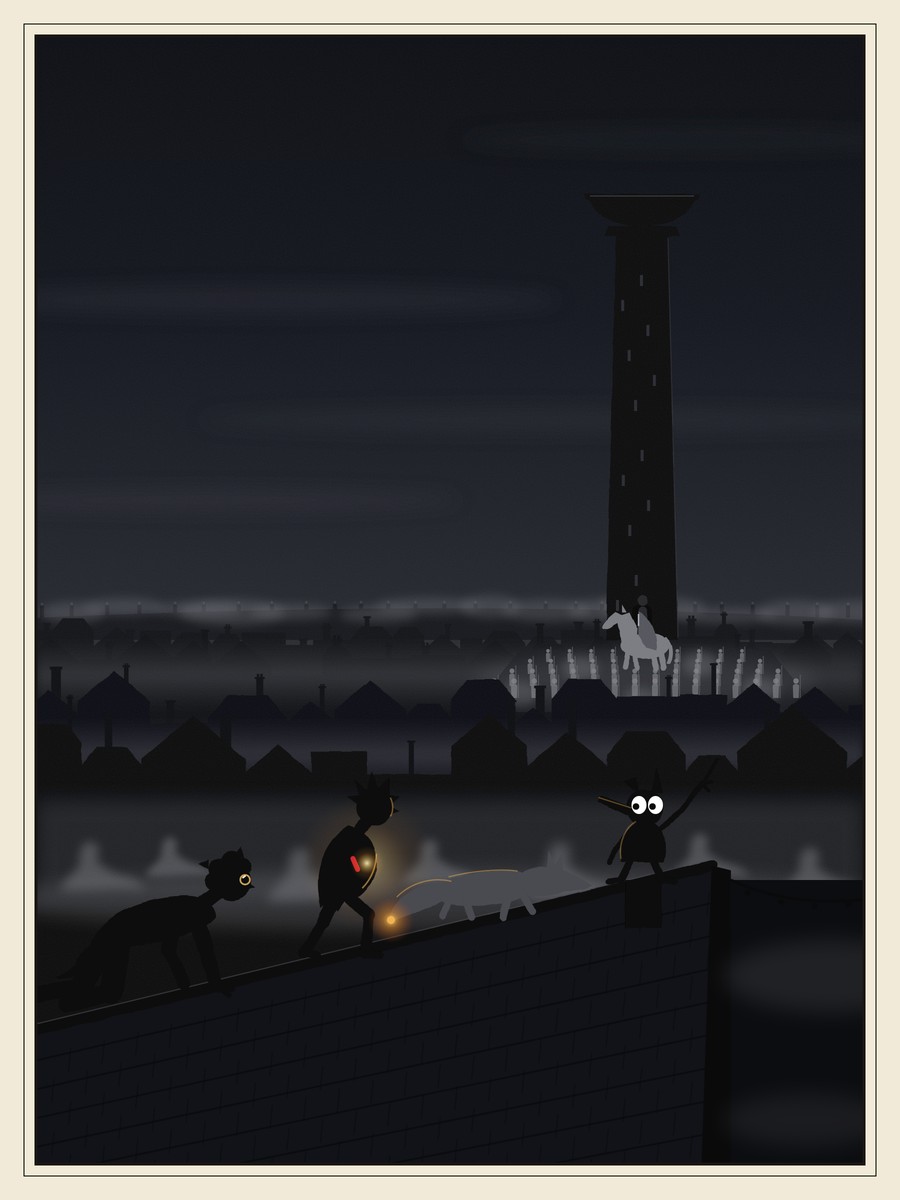
“Beacon Square,” he whispered. “Big tower. Big trouble.”
Wren had crossed Beacon Square a thousand times, carrying brushes, and never once looked up. She looked up now. The Great Beacon rose out of the middle of it like a dark finger pointing at the sky, black stone, with narrow windows spiralling up where the stair climbed round and round. At the very top was the shape of the great iron bowl where the Beacon-fire should have burned. It had been empty since before either of them was born.
“Three hundred steps,” said Tobin. “I counted them once. My tutor said it was a pointless thing to count.”
At the foot of the Beacon, the square was full of Hollow Knights.
They stood in rows, perfectly still, grey faces turned outwards, empty eyes watching every street, and Hollows drifted between them like mist between trees. And in front of the great door of the tower, sitting on a grey horse as still as a statue, was Captain Varrick.
He was not looking at the streets. He was looking, Wren realised with a horrible lurch, almost exactly at the roof where they lay.
“Good evening,” he called. His voice was smooth as oiled iron, and it carried easily across the square. “You’ve worked it out — the boy has, I expect. The Beacon. Very good.” He sounded pleased, like a teacher with a promising pupil. As he spoke, he rubbed his right palm slowly with his left thumb, the way someone rubs an old ache. “But you see, little sweep, I worked it out too. There is no way into that tower that does not go past me.”
Varrick’s gaze moved, and settled on Snib.
“You,” he said pleasantly. “Gutterling. Yes, you. I know your kind. You like shiny things, don’t you?” He drew from his saddlebag a glass jar as big as a man’s head, full to the brim with buttons — brass, silver, mother-of-pearl. Even in that grey light, they glittered.
Snib made a small, longing squeak.
“All of these are yours,” said Varrick, “and all you have to do is nothing at all. Go back to your chimney. Isn’t that easy?”
Snib’s long fingers twisted together. He looked at the jar. He looked at Wren. Wren thought: that’s it, then. She did not even blame him. Everyone has their price, and a jar of buttons was a better price than she could ever pay.
Snib looked at the jar for a long, long time.
Then he turned his back on it.
“Snib knows a way,” he whispered to Wren. “Little way. Coal-door. Round the back.” He was trembling all over, from his ears to his long black toes. “Snib shows you.”
Wren stared at him. “But the buttons. I haven’t got any to give you, not like that—“
“Not for buttons,” squeaked Snib, crossly, as if she were being very stupid. “Not for. Snib gives.” He looked surprised at himself, and then rather pleased, and he said it again, louder, trying it out. “Snib gives! Snib gives!”
Before Varrick could say another word, the Gutterling had dropped onto a drainpipe and gone sliding down into the shadows, and Cinder after him, and Wren and Tobin after Cinder.
They ran through an alley so narrow that Tobin’s elbows scraped both walls, and came out behind the Beacon. There, half-hidden by broken barrels, was a small square iron hatch black with coal-dust, the kind of door that nobody ever thinks about. Snib hauled at it with all his long fingers, and it creaked open, and a breath of cold, stale, sooty air came out.
“In, in, in,” squeaked Snib. “Quick, quick, quick.”
Wren went first, because coal-holes were her trade. She slid down a slope of old cinders onto stone, and Tobin landed on top of her, and Cinder on top of Tobin. Then Wren drew out the lamp.
Its light filled the little cellar, gold and warm. Through an archway, rising round and round into a darkness so deep the lamplight could not find the end of it, was a stair.
Wren looked back up the chute to thank Snib, but the hatch was already swinging shut. The last she saw of him was two white eyes, very bright, and a long thin hand lifted in something that might almost have been a wave.
Outside, in the square, she heard Varrick’s voice, no longer pleasant at all, giving orders.
Wren turned to the stair. Three hundred steps, Tobin had said. Three hundred steps, in the dark, with the Queen’s voice in the walls and the Knights behind them.
She put her foot on the first one.
Chapter 13 complete
The Last Lamps of Emberwick