Chapter 15 · 16 min read · 21 min listen
Into the Greywaste
The sun came up the next morning exactly as pale as it always had.
I would like to tell you otherwise. I would like to tell you that Solenne rose gold and blazing over Emberwick, and that everyone who saw it wept for joy. But it was not so. The Beacon could light the Ring, and the Ring could keep out the dark; but the sun had been cursed three hundred years ago by a bargain on a far-off mountain, and no lamp in a single city could mend that. It crept up over the Greywaste like a coin seen through dirty water, the same as ever.
And yet, for the first time in anyone’s memory, nobody in Emberwick was looking at the sun. They were looking at the wall, where a hundred and forty-four lamps still burned white-gold in the morning, as if they had no intention of ever going out again. And they were looking at their own streets, which had colours in them.
Wren walked down from Beacon Square with the lamp in her hands and Nettle at her elbow, and she did not know where to look first.
“That door’th blue,” said Nettle, pointing. Nettle had been restored a whole night longer than anybody else, and so she considered herself an expert. “Mithter Ath told me. Blue. And that one’th green, and that’th yellow, and your ribbon’th red, and Tobin’th hair ith yellow too, only a different yellow, and—“
“How d’you know all that?”
“I athked,” said Nettle simply.
Wren had never thought of asking. It had never occurred to her that colours were something you could have names for, like people.
They came down into Soot Lane. And there, all along the crooked little street, in the doorways and on the steps and sitting on the cold cobbles where the Hollows had left them, were the greyed.
The light of the Ring had driven the Hollows out. But it had not brought back what they had taken. There were people still sitting quite still in the morning air, grey from their hair to their boots, staring at nothing: old men and young mothers, a boy from the tannery, the woman who sold eels in Crookback Market. Their families stood round them, holding their hands, saying their names, getting no answer.
On the step of the bakery, with flour still on her grey hands, sat Mrs Dolly Fenn. Her five children were huddled round her like chicks. The smallest was patting her cheek.
Wren stopped.
You might think, after all that had happened at the top of the Beacon, that it would be easy now. It was not. It is one thing to give something away once, on a mountain-top, with a great roaring fire and the whole city watching. It is quite another to do it again on an ordinary morning in your own street, with nobody watching but a lot of tired, frightened neighbours, some of whom had shouted “witch-light” at you only days before.
Wren knelt down on the bakery step anyway. She held out the lamp.
“Here,” she said, a bit gruffly. “It’s for you, Mrs Fenn. You don’t have to do anything.”
The flame leaned out of the lamp towards Mrs Fenn, the way a flower leans towards a window. Warmth spread over the step. And the colour came back into Mrs Fenn the way it had come back into Nettle — slowly at first, then all in a rush: the pink in her cheeks, the brown of her hair, the faded red of her apron. She blinked. She looked down at the children round her knees, and her face crumpled up.
“Pip,” she said. “Hettie. Sam. Molly. And — and my little Jem.” She seized them, all five of them at once, in a hug so enormous that flour went everywhere. “Pip, Hettie, Sam, Molly and Jem! I know you! I know every one of you, my lambs—“
Wren stood up quickly and turned away, because her eyes had gone hot and she did not want anyone to see.
When she looked down at the lamp, it was brighter.
She went down Soot Lane door by door, all that morning.
Word spread ahead of her faster than she could walk. By the time she reached the third house, people were coming out to meet her. By the tenth, they were carrying their greyed ones out into the street on chairs and in barrows, and laying them in a row on the cobbles for her, which made her feel like a doctor and also slightly like a fishmonger.
At every one she knelt down and held out the lamp and said, “Here. It’s for you.” And every time, the flame leaned out, and the colour came back, and names came back, and somebody started crying, usually the person who had been doing the holding.
And every time, the lamp burned a little brighter.
Some of the people tried to pay her. A man pushed a copper penny into her hand, and when she gave it back he looked frightened, as if she had refused him on purpose. A woman tried to give her a ring. The eel-seller offered her a whole eel, which Nettle said was the worst present she had ever heard of.
“It’s not for sale,” Wren kept saying. “It’s given. You can’t pay for it. It doesn’t work like that.”
She heard herself saying it, over and over, and every time it sounded a little stranger, and a little less strange. She had spent her whole life saying everything costs. She was not sure when she had stopped believing it. She thought it might have been at the top of the Beacon, with a warm hand on her shoulder. Or it might have been earlier, in the market, with a warm loaf in her hands and an old man saying no charge. Or it might only be happening now, door by door, the way a frozen pond thaws — not all at once, but from the edges in.
Near the bottom of Soot Lane, by the gate of the sweep yard, she stopped.
Sitting against the yard wall, grey as a sack of ashes, with his big red knuckles gone the colour of putty and the reward purse still in his lap, was Gristle Mott. He had gone home through Soot Lane just before the whole Ring went dark, and the Hollows had found him at his own gate.
Nettle took hold of Wren’s sleeve. “Wren,” she whispered. “That’th him. He thold you. For the reward.”
“I know,” said Wren.
She stood and looked at him for a long time. She thought of all the cold nights in the garret with no coal, and the board money that went up every week however hard she worked, and the shouting, and the docked pay. She thought of him in the lantern-light at the bakery door, pointing at her.
Then she thought about the warm hand on her shoulder, and about who it had been given to. Not to the deserving. Not to the ones who had earned it. To her — Wren Ashby, liar and pickpocket, who had thrown it down at a Warden’s feet.
She knelt down in front of Gristle Mott and held out the lamp.
“Here,” she said. “It’s for you. You don’t have to do anything.”
The colour came back into Mott like wine into a glass. He wheezed, and blinked, and his little eyes focused on Wren, and he looked — for the first time in all the years she had known him — afraid of her. Not because she was dangerous. Because he did not understand what she had just done.
“Board money,” he croaked at last, from habit, the way some people say good morning. Then he stopped. He looked at the lamp. He looked at the ground. He licked his lips. “Board money,” he said again, quite differently. “You — forget it. You hear me? Forget the board money. All of it.”
And he got up, and shuffled into his yard, and shut the gate, and Wren did not see him again.
“Well,” said Nettle, after a while. “I’d have let him thtay grey.”
“Yes,” said Wren. “So would I, yesterday.”
At noon, if you could call it noon, Tobin found them in Beacon Square.
He looked as if he had not slept, which he hadn’t, and he had a large leather-bound book under his arm, which he had carried all the way from the Leaning Tower. Sergeant Bracken was there with a dozen guardsmen, looking exhausted and puzzled and rather pleased, and Tobin marched straight up to him and held out the book with both hands.
“The ledger of the Lamp Guild, Sergeant,” he said. “From the vault. It shows that the oil’s been watered for years, and the money’s gone into Guild Master Prowle’s own accounts, and the Flame tokens are just tin. Technically speaking, I stole it. I thought you ought to have it anyway.”
Bracken took the ledger and opened it. He read for a while, his grizzled eyebrows going up and up.
“Well,” he said at last. “That’ll be why Master Prowle left town in such a hurry.” The Guild Master’s wagon, it turned out, had gone out through the South Gate in the night, strongboxes and all, and not stopped. Nobody knew where he had gone. I am afraid that we have not seen the last of Cuthbert Prowle; men like him have a way of turning up again, smelling of lavender. But that is another story.
Then Bracken turned to Wren. He looked at her for a long moment: at her cropped black hair, and her sharp chin, and the lamp burning in her hands.
“I arrested you,” he said. “I’m sorry for it.”
Wren did not know what to say to that. No grown-up had ever said sorry to her before. So she said, “You weren’t rough,” which was true.
Sergeant Bracken held out his big hand. After a moment, Wren took it, and he shook it firmly, the way you shake hands with someone you respect.
Tobin went up the Hill alone that afternoon. He was gone an hour. When he came back to the Leaning Tower he was very quiet, and he sat down on the step and polished his spectacles for a long time, though they were perfectly clean.
“He was in his study,” he said at last, when Wren sat down beside him. “He’d heard. Everyone’s heard. I told him it was over and the Ring was lit and Varrick had gone.” He held his spectacles up to the light. “He didn’t say anything. He just stood at the window. I waited and waited, and he never turned round. He couldn’t look at me.”
“Maybe he couldn’t look at himself,” said Wren.
Tobin thought about that. “Maybe,” he said. He put his spectacles back on. “That’s worse, though, isn’t it? In a way.”
Wren didn’t answer. She just sat beside him on the step until the light went.
That evening, in the Leaning Tower, Old Ash made tea.
It was, if possible, worse than ever. It tasted, Tobin said afterwards, like a garden shed that had been left out in the rain. Cinder took one sniff at Wren’s cup, sneezed sparks all over the stuffed owl, and went to steal a biscuit off the shelf instead.
Old Ash sat in his big chair by the round window with his bandaged leg up on a stool. Out beyond the wall, the Greywaste stretched away into the dusk, flat and colourless and endless. And beyond the Greywaste, so far off that it might have been only a cloud, there was something on the edge of the sky that Wren had never noticed before: a faint, pale point, like the tip of a tooth.
“She’ll come back,” said Ash.
He did not say who. He did not need to.
“The Beacon will hold Emberwick,” he went on slowly. “For a while. Longer than the Guild’s oil ever would. But there are other cities, child, and other Rings, and every one of them is failing. And the sun is still cursed, and the Queen is still out there in the dark, and she has more than one captain.” He rubbed his singed beard. “She’ll come back with more. And next time she’ll know what she’s looking for.”
“So what do we do?” said Tobin.
Ash nodded at the round window, at the pale point on the edge of the sky. “The Bright Mountain,” he said. “Where the Flame began. Where he came from. If there is an answer anywhere in Gloamhaven, it’s there.” He was quiet for a moment. “I mean to go. I should have gone years ago. I was waiting.” He looked at the lamp burning on the table among the teacups. “Hm. I think I was waiting for that.”
“We’re coming,” said Wren at once.
Ash raised one shaggy eyebrow. “It’s a long road, child. Across the Greywaste, and beyond. I can’t promise there’ll be bread at the end of it. I can’t promise there’ll be an end of it at all.”
“Somebody’s got to come,” said Wren, “or you’ll poison yourself with that tea before you’re past the Grey Gate.” She lifted her chin. “Anyway, it’s my lamp. It was given to me. I’m not letting it go off without me.”
Ash looked at Tobin.
Tobin had gone pale. He was thinking — Wren could see it — of the dark, and of the long nights out on the Greywaste with no Ring round them at all, and of his father standing at the window and not turning round. He pushed his spectacles up his nose.
“I’ll need to bring some tools,” he said. “And a better map. And I should write a letter.”
He wrote it that night, by the light of the lamp, at Ash’s cluttered table. It took him a long time, and a great many crossings-out, and in the end it was very short. Wren did not read it, but Tobin told her what it said, years later:
Father, I have gone with the Lamplighter to the Bright Mountain. I am not running away. I am going to find out how to make the light last. I know you were frightened. I was too. I love you. Tobin.
He folded it and sealed it, and Sergeant Bracken promised to take it up the Hill in the morning.
Then, just as they were going to bed, Old Ash held out one long hand to Tobin.
“Your compass, lad,” he said. “Lend it me. Just for tonight.”
Tobin hesitated. Then he took the little brass compass from his pocket, the one with his mother’s words inside the lid, and put it in the old man’s palm. Ash closed his fingers round it and said “Hm,” and went up the crooked stair to the top of the tower, and they heard his footsteps moving about up there long after the candles were out.
Wren woke before dawn, warm all the way through.
She lay for a moment listening to Cinder snoring and Tobin muttering in his sleep about gear-ratios. Then she got up and went down to the door of the tower. Someone was sitting on the step outside.
It was Nettle, wrapped in a shawl of Mrs Fenn’s that was six sizes too big for her. She had walked all the way up to the North Wall in the dark to be there in time. She was not going to the Bright Mountain. She was going to live at the bakery, with Pip and Hettie and Sam and Molly and Jem — “Five or six, what’s the difference?” Mrs Fenn had said, and hugged her till she squeaked — and she knew it, and she had come anyway.
“For the road,” said Nettle, and held out her hand.
In it was a heel of bread. A heel of yesterday’s loaf, a bit squashed, a bit warm from being held.
Wren looked at it.
A month ago — a week ago — she would have looked for the catch. She would have asked what Nettle wanted for it, and what it would cost her later, and she would have taken it with a joke so that nobody could see that she minded. She stood on the step of the Leaning Tower and waited for that old feeling to come.
It did not come.
So she took the bread in both hands, the way you take something precious. “Thank you,” she said. And then, because it did not seem enough: “Thank you, Nettle.”
Nettle beamed so hard that the gap where her front teeth should have been showed all the way across.
When Old Ash came down, the others were ready. He handed Tobin his compass. Tobin opened the lid and looked inside, and frowned, and looked again.
“It’s — the needle’s straight again. And it’s moved,” he said. “Technically speaking, that isn’t north. That’s — well, it’s nearly north. North and a bit east. It’s pointing at—“ He looked up, out over the wall, at the faint pale tooth on the edge of the sky.
“Tuned,” said Old Ash. “A compass ought to know the way home.”
Tobin read the words inside the lid again — Home is where the light is — and shut it very carefully, and put it in his pocket, and kept his hand on it.
Sergeant Bracken himself unbarred the Grey Gate for them, as the pale sun came up.
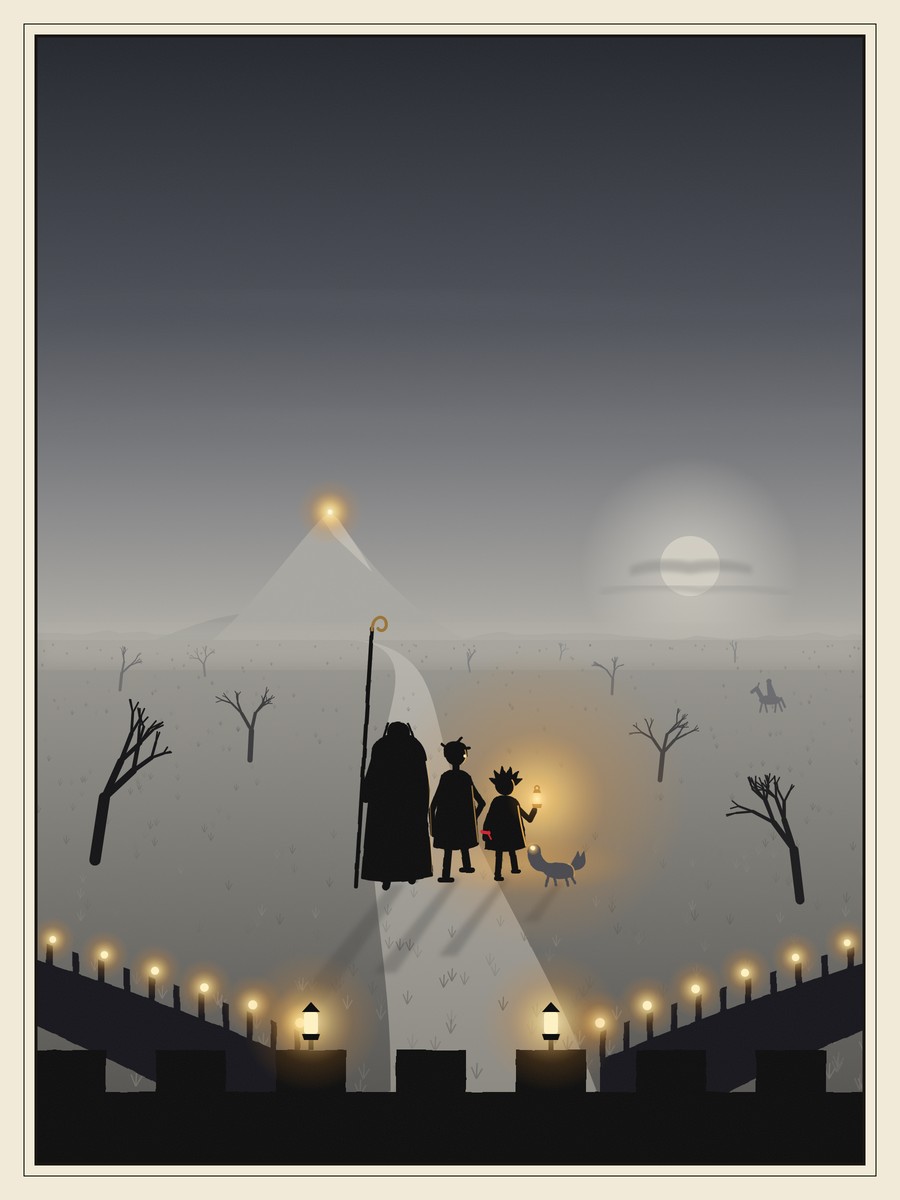
The Greywaste lay beyond it, wide and flat and silent, the colour of old porridge, all grey grass and dead trees and a road that went away into the mist. Behind them the Ring burned gold along the wall. Ahead there was nothing at all but grey.
They walked out together: a tall old man with a brass-hooked pole, a gangly boy with spectacles and a compass, a small grey fox with a tail like a coal, and a sweep with cropped black hair, a heel of bread in her pocket, a red ribbon on her wrist, and a battered brass lamp burning in her hands.
After a mile or so, Wren found that she was humming.
It was the old tune. Morning comes, morning comes. She still did not know the rest of the words. Perhaps, she thought, she would find them one day, somewhere along the road; but if she did, it would not be because anyone had sold them to her. And for the first time in her life, it did not sound like a song about something that would never happen. It sounded like a song about something that was on its way.
Cinder stopped. Her ears went flat, and she looked back.
Far behind them, on the long grey road from Emberwick, so far off that it was hardly more than a smudge against the mist, a single rider in grey was following.
Wren saw it. She looked down at the lamp, burning warm and steady in her hands. Then she turned her face towards the Bright Mountain, and kept walking, and kept humming; and the little flame she carried, which had been given away and was not one bit the less for it, lit the grey road in front of them, step by step, all the way to the edge of the world.
Chapter 15 complete
Into the Greywaste