Chapter 12 · 16 min read · 21 min listen
Taken
There was no back door to Mrs Fenn’s bakery. Wren knew that before she looked, because she had known every door in Soot Lane since she was four years old, but she looked anyway. Then she looked at the chimney, which was far too narrow, and at the window, which had a guard outside it, and at last she stopped looking and stood in the middle of the shop with the lamp in her hand and Nettle clinging to her coat.
“Wren,” said Tobin quickly. “Listen. If you go out the front with the lamp held up, they won’t dare—“
“They’ll dare,” said Wren. “There’s a reward.”
Someone knocked on the door. It was not a loud knock. It was a tired one.
“Open up, lass,” said a voice. “It’s Sergeant Bracken. I know you’re in there, and you know I know, so let’s not make a night of it. My knees won’t stand it.”
Wren opened the door.
Sergeant Bracken was a grizzled, square man with a grey moustache and a face like a worn-out boot. He looked down at her, and at Nettle hanging on her coat, and at the five Fenn children peering round their grey mother’s chair, and something in his face went sorry.
“Right,” he said heavily. “Right, then.”
Behind him, in the lantern-light, Gristle Mott was holding out his big red hand to a guardsman with a leather purse. The guardsman dropped the purse into it. Mott weighed it, grinned, and put it in his waistcoat.
“Pleasure doing business,” he wheezed. He caught Wren’s eye and had the grace, for one moment, to look away. Then he looked back, and the grace was gone. “Don’t look at me like that, girl. You’d have done the same. Everybody would.”
“No,” said Nettle suddenly, from behind Wren. “Wren wouldn’t.”
Mott laughed, and walked off down the lane, jingling.
They did not tie Wren’s hands. Bracken would not allow it. “She’s twelve,” he said, when one of his men brought out a cord. “And she’s not going anywhere. Are you, lass?” Wren said nothing. There was nowhere to go. A pair of the Warden’s men in better coats than Bracken’s had already taken hold of Tobin by both arms, and he was struggling and saying, “Let go — I’m the Warden’s son — let go of me—“ and one of them said, “We know who you are, young sir. That’s why we’re taking you home.”
Wren gave Nettle to Hettie Fenn. “Stay with them,” she said. “Don’t go out. Not for anything. Not for me.”
“Promith?” said Nettle.
“Promise.”
As they marched her up out of the Low Quarter, the guards talked among themselves in low voices, the way men do who think a child is not listening. Wren listened. She heard that the grey soldiers had come along the North Wall an hour ago, and taken the mad old lamplighter right off the battlements as he was lighting a lamp, pole and all. She heard that he had not fought them. She heard that his fox had bitten one of them through the boot and got away into the dark, and that nobody had been able to catch it.
She put her hand on the lamp inside her coat. It was warm. It was the only warm thing left.
The Warden’s Hall was the biggest, coldest building Wren had ever been inside, and the room they brought her to was the biggest and coldest room in it. It had a floor of grey stone and a ceiling so high she could not see it, and a fire in a great carved fireplace that gave no heat at all, as if it were only a picture of a fire. Tobin was there already, held by the two men in good coats, his face white and streaked with soot and tears he had not quite wiped off. And in front of the fire, very tall and very still, with silver at his temples and his hands clasped behind his back, stood Lord Edric Harrowgate.
He did not shout. Wren had expected shouting. Mott shouted. Grubb shouted. But the Warden of Emberwick only looked at her, the way you might look at a stain on a good tablecloth, and when he spoke his voice was low and perfectly even.
“You have something that belongs to this city,” he said. “Give it to me.”
“It doesn’t belong to the city.”
“It belongs,” said Lord Edric, “to whoever can keep the city safe. At dawn I will hand it to a man who has promised me that the Hollows will leave Emberwick and never come back. The Ring will hold. Your Low Quarter will hold. The little girl in the bakery will be safe. Do you understand me? I am offering you a bargain. A good one.”
“Father, he’s lying,” said Tobin. “Varrick’s lying, you heard him, I heard him, he never—“
“Be quiet, Tobin.”
“He let the lamps go out tonight! While you were waiting for him! Doesn’t that tell you—“
“I said be quiet.”
Tobin went quiet. Wren looked at him, and then at his father, and then at the guards on every side of her, and at the great cold fire that gave no heat. And a very old feeling came up inside her, the oldest feeling she had. It was the feeling she’d had every time Mott counted out her wages and docked them, and every time the baker’s boy chased her off, and every time she had lain in her garret and known — just known — that anything good she ever got would be taken off her in the end. Because that was how it worked. That was always how it worked. Nobs took. Mott took. The Guild took. Everybody always took everything in the end, and the only question was whether you let go of it before they broke your fingers.
She was frightened. She was so tired. And she was angrier than she had ever been in her life.
She pulled the lamp out of her coat. Its golden light ran across the grey stone floor, and for a moment the whole hall was warm, and her ribbon was red on her wrist.
Then she threw it down at Lord Edric’s feet.
“Take it, then!” she shouted. “I never asked for it! I never asked for any of it!”
The lamp struck the stone with a dull brassy clang and rolled over once on its side.
And it went out.
It did not flicker. It did not gutter. One moment it was burning, and the next it was simply dark — a small, dented, ugly brass thing lying on the floor with a cracked glass chimney, like something from the bottom of Grubb’s junk-tray. The warmth went out of the room. Wren’s ribbon, on her wrist, was a dull pinkish grey again.
She waited for the flame to come back. It always came back. She had thrown it in the canal and buried it in the tannery yard, and every time, every single time, it had come back to her.
It did not come back.
Lord Edric looked down at it for a long moment. He did not pick it up with his hands. He took a handkerchief from his pocket and lifted the lamp in that, carefully, the way you might pick up something that had once bitten you. But the brass was only cold.
“Take it to the strongroom,” he said to his steward. “Lock it in. I will bring it up myself at dawn.” He turned to Bracken. “And put the girl below.”
“My lord—“ said Bracken.
“Below, Sergeant.”
The cells under the Warden’s Hall were dry, at least, and they were not very dark, because a lantern hung at the end of the passage where Bracken sat on a stool with his back to the wall. Wren’s cell had a stone bench and a barred iron door with a heavy old lock. She sat on the bench and drew her knees up to her chin.
She was not going to cry. She never cried. Crying was for people who had somebody to hear it.
She thought of the lamp lying on the floor, dark. She thought of how it had blazed on Mrs Fenn’s step, when she had held it out to Nettle and asked for nothing. She thought of how she had said I never asked for it — and that was true, that was the whole point, she never had asked for it. Nobody had made her pay for it. It had just been there, in the flue, warm, waiting for her. It had come back every time she threw it away. It had been given.
And she had thrown it in the man’s face like a stone.
Wren put her forehead down on her knees, and for the first time in a very long time, she cried. She cried quietly, because Bracken was at the end of the passage. She cried for Nettle, and Mrs Fenn, and Old Ash taken off the wall, and Cinder alone in the dark. But mostly she cried because she had wanted the lamp, she had wanted it, more than she had ever wanted anything, and she had told it she didn’t. And it had believed her.
“I didn’t mean it,” she whispered to nobody. “I didn’t mean it.”
She tried to hum the song her mother used to sing. Morning comes, morning comes. But she could not get past the first line, and in that cold place it did not sound like a song about morning at all.
Tobin Harrowgate had been sent to bed, which was the sort of thing that happened to you, he reflected, even on the worst night in the history of Emberwick, if you happened to be thirteen.
He did not go to bed. He sat on the edge of it in his attic workshop with his mother’s night-lamp on the table in front of him and the Orrery of the Ring gleaming dimly in the corner, and he looked at the Orrery for a long time. All along the Low Quarter wall, its little glass beads were dark.
He knew where the strongroom was. Everybody in the Hall knew where it was. It was under the oldest part of the building, at the bottom of a long stone stair that went down and down into the rock, and the stair had no windows and no lamps, because his great-grandfather had thought lamps on a strongroom stair were an invitation to thieves. Tobin had been down it exactly once, when he was six, holding his father’s hand. He had counted the steps because counting was what he did when he was frightened. There were sixty-one. He had had nightmares about them for a year.
He also knew where the key-ring hung. It hung on a hook behind the door of his father’s study, under a dull painting of a horse, and the study was directly beneath the crawlway Tobin used for listening. He had seen his father hang the keys there a hundred times.
Nobody else can do it, said a small, sensible voice inside him. Ash is taken. Cinder’s gone. Wren’s locked up. It’s you or nobody.
Then it’s nobody, said another voice, a smaller and much more frightened one. Because I can’t. You know I can’t. It’s dark down there. It’s the darkest place in the whole city.
Tobin picked up the night-lamp. He looked at its little steady flame, the one that had been his mother’s, the one he had never once in eight years let go out.
Then he stood up.
The crawlway, the study, the hook behind the door: those were easy. He had done harder things that very night on top of a glass dome. The keys were cold and heavy and he wrapped them in his scarf so they would not jingle. The door to the strongroom stair was at the end of a passage in the old wing, and it opened with a groan, and beyond it the steps went down into a blackness so thick it looked solid.
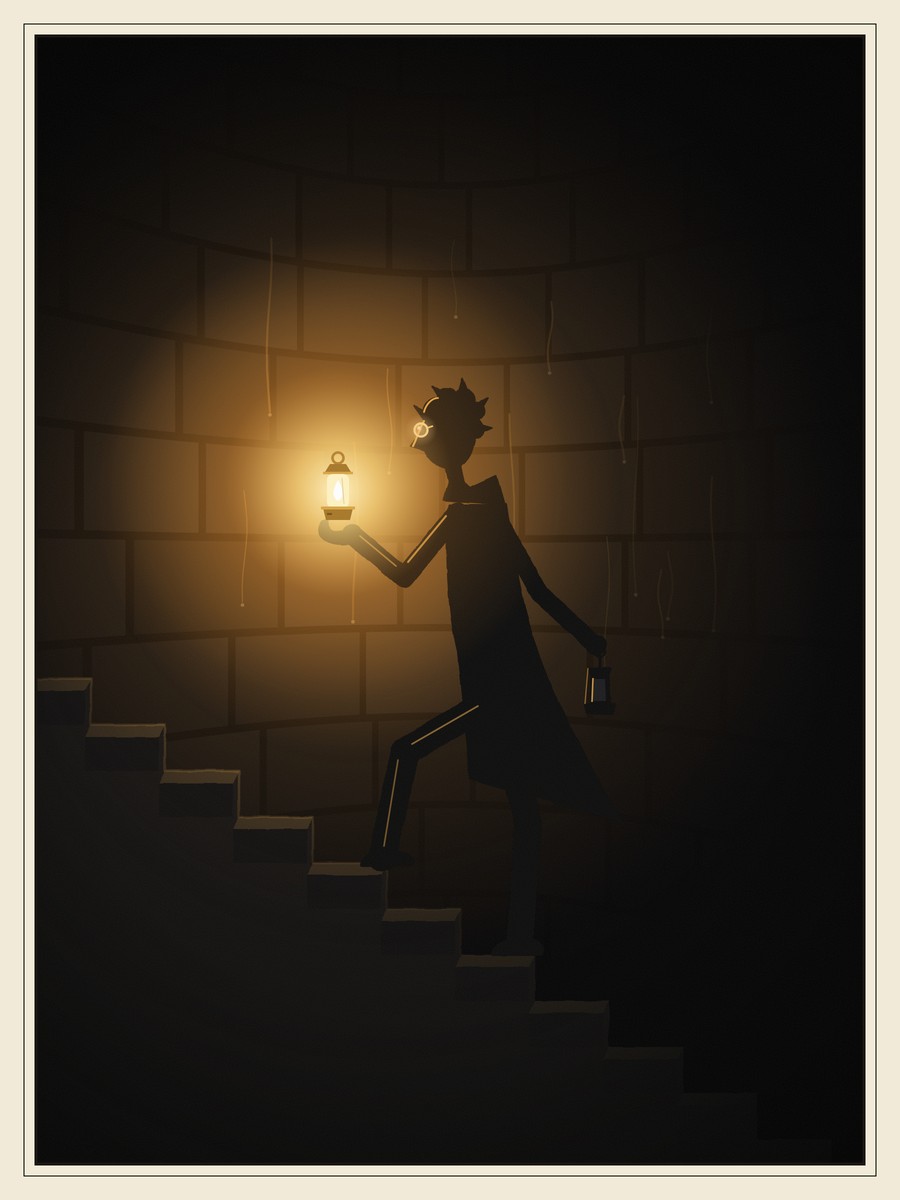
He held up the night-lamp, and started down.
“One,” he whispered. “Two. Three.”
The walls were close on either side, and damp, and cold enough to steam his breath. The little lamp lit three steps below him and three above, and nothing else in the world. He went down slowly, one hand on the wall.
“Fifteen. Sixteen.”
The flame dipped.
“Twenty-two. Twenty-three.”
It dipped again, and spat, and hissed. Tobin stopped. He held the lamp up to his spectacles and looked at it, and with a horrible sinking feeling he understood. He had filled it two days ago from the Hall’s own store. Guild oil. Canal water added. He had read the very page.
“No,” he whispered. “No, please, not now—“
On the thirtieth step, the night-lamp went out.
I do not know whether you have ever been in total darkness. Not the darkness of a bedroom at night, where there is always a little grey at the window or a line of light under the door — but real darkness, the kind there is under the ground, where there has never been any light at all. It is not like closing your eyes. When you close your eyes you know you could open them. In real darkness you open your eyes as wide as they will go, and it makes no difference whatever.
Tobin stood on the thirtieth step and could not move.
His hands were shaking so hard he nearly dropped the keys. His heart was going so fast it seemed to fill his whole chest. He could not tell which way was up. He could not tell how far down the stair went, or whether there were still steps in front of him at all, or whether he was standing on the edge of nothing. The dark pressed on his eyes and on his face and on his mouth. He wanted to turn and run back up. He could not even remember which way back up was.
He thought he would stand there forever.
And then, without at all meaning to, Tobin did something he had never done in his life. He had heard his mother do it, long ago, when he was very small and she thought he was asleep. His father said it was Lamplighter nonsense, and he had never tried it. He did not know how. He did not even know who he was talking to.
“If you’re there,” he whispered into the dark. His voice shook. “Whoever — whoever lit the first lamp. I can’t do this. I really can’t. Please.”
Nothing happened. No light came. The dark was exactly as dark as before.
But Tobin found, rather to his own surprise, that he had put out his foot and found the next step. And then the next.
“Thirty-one,” he whispered. “Thirty-two.”
He did not stop again. He counted every step out loud, one hand on the wet wall, and at sixty-one his foot came down on flat stone, and his outstretched hand touched iron. He felt for the lock. It took him a long time, in the dark, to find the right key. It took him even longer to fit it, because his hands would not stop shaking. But at last the bolt slid back, and the strongroom door swung open onto more darkness, and Tobin went in on his hands and knees, feeling his way along the cold floor.
His fingers touched brass.
He knew it at once — the dents, the little hook on top, the glass chimney with its hairline crack. He picked the lamp up in both hands. It was as cold as the floor. It was as cold as the stair. It was as cold as a thing that had never been lit at all.
Tobin sat back on his heels in the dark and held it.
“I know you’re not mine,” he said to it. His voice was hoarse. “I’m not going to keep you. I’m not even going to use you. I’m only taking you back to her. That’s all. She didn’t mean it. I’m taking you back to Wren.”
And in his hands, the lamp grew warm.
It came slowly, like the first warmth of a cup of tea in cold fingers. Then a spark woke in the heart of the brass, gold as a buttercup. Then a flame, small and steady and white-gold, that smelled of bread and summer — and the strongroom was full of light, and Tobin could see his own ink-stained hands, and the walls, and the open door, and the long stair climbing up and up away from him, every one of its sixty-one steps lit and golden and perfectly plain.
He was crying, a little. He did not mind.
He took the stairs two at a time.
Sergeant Bracken was asleep on his stool at the end of the passage, with his chin on his chest and his moustache going in and out. The key to the cells hung on his belt. Tobin looked at it for a long moment, and then decided he had stolen enough from grown-ups for one night.
He knelt at the door of Wren’s cell instead. She was sitting on the bench with her knees drawn up, staring at the light he carried as if she could not believe it was real.
“Hold this,” said Tobin, and passed the lamp through the bars without thinking.
Then he took out his mother’s compass. He opened the lid — Home is where the light is, said the little engraved letters inside, in the lamp’s gold glow — and very carefully, with the tip of his penknife, he prised up the glass and lifted out the long fine steel needle.
“That’s your mum’s,” said Wren.
“I can put it back. Probably. Technically, it’s only a matter of re-seating the pivot.” He bent the end of the needle against the stone floor, very slightly, and slid it into the keyhole. “It’s an old warded lock. Not like the Pellingham. You just have to feel for the — there’s a lever, and if you lift it while you turn—“
“Less talking,” whispered Wren. “More clicking.”
There was a click.
The cell door swung open with a long iron creak. Down the passage, Sergeant Bracken snorted and shifted on his stool, and did not wake.
Wren stepped out. She looked down at the lamp in her hands. She had not even noticed that she was holding it — that Tobin had simply given it to her, through the bars, the way you might hand someone back a thing they had dropped.
“I didn’t mean it,” she whispered, to the lamp, or to Tobin, or to someone else. “I never meant it. I want it. I want it.”
The lamp blazed up so brightly that the whole passage turned to gold. The ribbon on her wrist flushed red as a rose. And far away, beyond the walls of the Warden’s Hall, out across the dark city, the bells began to ring — not the slow bells of the hours, but quick, wild, jangling bells, one tower after another, all over Emberwick.
Something was terribly wrong.
Chapter 12 complete
Taken