Chapter 11 · 15 min read · 19 min listen
The Long Dark of Soot Lane
Wren was out of the door before anyone could stop her.
She did not remember the stairs of the Leaning Tower afterwards, nor the drop from the wall to the roofs below. She only remembered running, and the cold, and the sound her own breath made. Behind her she heard Old Ash call her name once, sharply, and then Tobin’s boots clattering after her, and the soft quick patter of Cinder overtaking them both.
“Wren! Wait — Wren, you don’t even know—“
“Nettle’s in the loft,” she flung over her shoulder. “Nettle’s always in the loft. She’ll be on her own.”
Up on the wall behind them a light was moving. Wren glanced back once and saw it — a tall stooped shape with a long pole, striding along the battlements towards the nearest dead Ring-lamp, the brass hook at the end of the pole held up like a question. Ash had not followed them. He had gone the other way, towards the lamps, to do the thing he had done every night for thirty years while the city laughed at him. Wren had no time to wonder whether one old man could relight a whole wall before the dark got in. She already knew the answer.
If you have ever walked into a house where the fire has been out for a week, you will know the particular cold that met them at the edge of the Low Quarter. It was not the clean cold of a winter morning. It was a stale, heavy, hopeless cold that seemed to come up out of the ground and settle on your shoulders like a wet coat, and it made you want, very badly, to sit down.
“Don’t,” said Wren, when she saw Tobin slow. “Don’t stop. That’s how it gets you.”
“How do you know?”
“I don’t. Keep running.”
The Low Quarter had never been bright. But it had always been noisy — dogs and babies and arguments, the clank of the tannery, someone singing badly in a gin-shop. Tonight there was nothing. Their own footsteps sounded far too loud. The washing-lines strung between the leaning houses hung perfectly still, and the shirts and sheets pegged on them had gone the same flat grey as the walls, so that it was hard to tell where the washing ended and the street began.
And there were people. That was the worst of it.
They were sitting in the doorways. A man on a step with a broom across his knees, staring at nothing. A woman at an open window with a teacup halfway to her mouth, not moving. Two boys Wren knew from the tannery, sitting back to back in the gutter, as quiet as stones. All of them grey. Grey faces, grey hands, grey hair. Not hurt — Wren could see them breathing — but emptied, as if someone had come along with a cloth and wiped away everything that made them who they were.
“Mister Crabbe,” said Wren, stopping in front of the man with the broom. “Mister Crabbe, it’s Wren. You chased me off your step last week, remember? For sitting on it?”
The man looked at her. His eyes were the colour of dishwater.
“Who?” he said politely.
Wren backed away from him. Tobin had his hand over his mouth. His night-lamp, hooked to his collar, was burning steadily, and in its little circle of yellow light the colour of the cobbles came back very faintly — a hint of brown, a smudge of moss-green between the stones — and then faded again at the edge, like the tide going out.
Cinder growled.
At the end of the lane, where it opened onto the canal, the Hollows were drifting.
There were five of them, or six — it was hard to count, because they did not quite keep their edges. They were like smoke poured into the outline of a person, tall and thin and faceless, and they did not walk so much as lean forward and let the dark carry them. They made no sound at all. Where they passed, a front door that had been painted some colour once was suddenly no colour whatever. A cat on a wall went grey from nose to tail and sat down, quite still, and did not wash itself.
Wren did not wait to see more. She ducked under a washing-line, round the back of the chandler’s, and in through the broken gate of Gristle Mott’s sweep yard.
The yard was empty. The brushes stood against the wall in their racks. Mott’s own window above the coal store was shuttered tight — he had a Flame token nailed to the shutter, Wren noticed, a little tin disc winking in the gloom, and it was doing exactly as much good as Tobin had said it would. She scrambled up the ladder to the loft where the little sweeps slept, and put her head through the hatch.
“Nettle?”
Four small faces looked back at her out of the straw, white and terrified, but not grey. Not yet. Tam and the two Hallet boys and little Sal, huddled in a heap under one blanket.
“Where’s Nettle?”
“She went out,” whispered Sal. “When the lamps went. She said you’d be out there in the dark and you’d want someone with you. She said—“ Sal’s lip wobbled. “She said Wren’s not scared of anything but Wren still ought to have someone.”
Wren stood quite still on the ladder.
“Which way?”
“Bakery,” said Tam. “She said she’d look at the bakery first. You always go there.”
“Stay here. Don’t open the hatch for anyone but me. Not even Mott. Especially not Mott.”
She slid down the ladder without using the rungs.
They found her outside Mrs Fenn’s.
The bakery stood near the bottom of Soot Lane, with its bow window and its sign of a wheatsheaf, and on any other night it would have smelled of tomorrow’s loaves rising. Tonight the window was dark. Mrs Fenn herself was sitting just inside the open door, in her chair, where she had sat every day since the Hollows came the first time — grey, quiet, her floury hands folded in her lap — and her five children were crowded round her knees, the youngest asleep against her. The children had not been touched. They were simply too frightened to leave their mother, and too small to know what else to do.
And on the step outside, with her back against the doorpost, sat Nettle.
She was very small. She always had been, but she looked smaller now, with her knees drawn up and her arms round them. And she was grey. Her freckles were gone — not faded, gone, as if they had been rubbed out. Her hair was the colour of ash. Her lips were the colour of ash. Her eyes were open and looking at the street, but they were not looking at anything in it.
Three Hollows stood over her. They were bending down, slowly, the way a person bends to look into a well.
Wren did not think. She tore the lamp out of her coat and ran at them.
“Get off her! Get away from her, you — you filthy great — get off!”
She swung the lamp at the nearest Hollow like a club. She had seen it flare white-gold in this very lane, on the day the Hollows first came over the wall. She had seen them shriek and run. She wanted that now. She wanted them burned. She wanted them to hurt the way she hurt.
The lamp barely glowed.
It was as though she were swinging a cold coal. The little flame inside the cracked chimney shrank down to a bead, a pin-point, a dull orange smudge. The Hollow she had swung at did not even flinch. It turned its blank no-face towards her, and the cold coming off it was so bitter that it made her teeth ache.
“Burn!” shouted Wren. “Go on! Burn them!”
She swung again. The light grew dimmer. Behind her she heard Tobin shout something, and the small steady glow of his night-lamp came up beside her — ordinary Guild oil, watered oil, but it was something, and the Hollows leaned back from it a little, the way you lean back from a draught. Cinder darted in among them, snapping, her tail-spark blazing, and sneezed a shower of sparks into the nearest grey shape. It drifted back a pace. Only a pace. Then all three began, very slowly, to lean in again.
“It’s not working,” gasped Tobin. “Wren, it’s not working, why isn’t it—“
“I know it’s not working!”
She shoved past the Hollows — it was like shoving through freezing fog, and for a moment the whole world went grey at the edges and she could not remember why she was there — and dropped to her knees on the step in front of Nettle.
“Nettle. Nettle, it’s me.”
Nettle turned her head. She looked at Wren for a long moment, with polite, empty eyes.
“Who are you?” she said.
She did not lisp. That was the thing Wren could not bear, afterwards, when she thought about it. Nettle had always lisped, ever since her two front teeth fell out — Wren, you’re the betht — and now her voice was smooth and flat and perfectly correct, as though the lisp had been part of her and had been wiped away with all the rest.
“It’s Wren,” said Wren. Her voice cracked in the middle. “You know me. I’m Wren. I give you my crusts. I taught you to climb a stack. You said I was the best. You said it about a hundred times, you said it till I told you to shut up—“
“I don’t know anyone called that,” said Nettle, and turned back to look at the street.
Wren did not tell this part of the story often, and when she did, she told it quickly. She knelt on the step of Mrs Fenn’s bakery with the cold lamp in her hand and the Hollows leaning over her, and something inside her that had held on all her life — through Mott and the debts and the cold garret and the empty belly and all the years of knowing that nobody gives anybody anything — simply let go. She was too tired to swing the lamp again. She was too tired to shout. She had nothing left to fight with and nothing to bargain with. She had no buttons and no money, no plan and no clever lie. There was nothing she could do.
So she stopped trying to do anything.
She did not raise the lamp. She did not aim it at the Hollows. She only turned to Nettle and held it out to her in both hands, low down, the way you might hold out a cup of milk to a very small child.
“Here,” she said. “Here, Nettle. It’s for you. You don’t have to do anything. You don’t have to pay. It’s just for you.”
And the lamp blazed.
It did not flicker up. It did not slowly brighten. It blazed, all at once, as if it had only been waiting to be asked properly — a great soft burst of golden-white light that filled the doorway and spilled into the lane and ran up the fronts of the leaning houses like sunrise running up a hill. It was warm. It was so warm that Wren felt it on her face like a hand. It smelled of bread, and of summer, and of something else she had no name for.
And in that light, Nettle’s freckles came back.
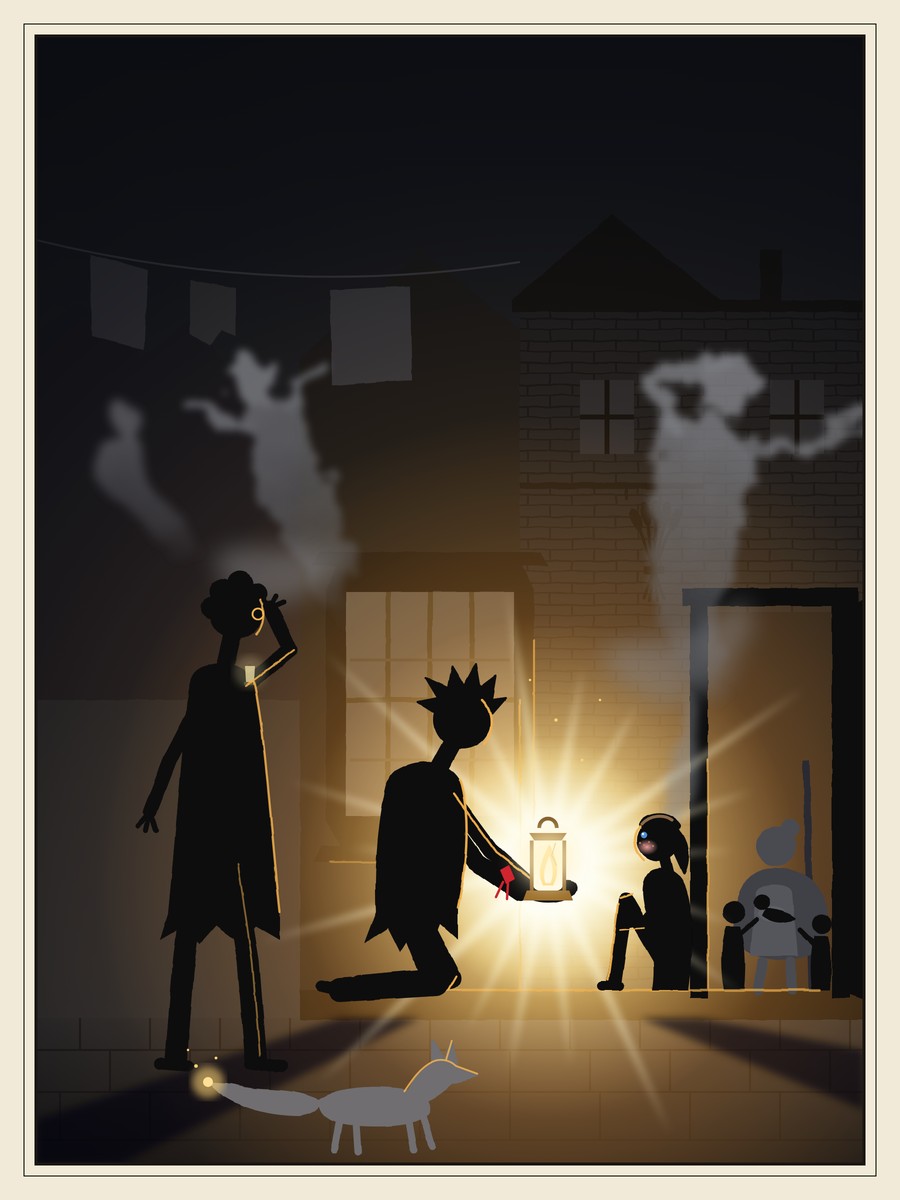
They came back one at a time, like stars coming out — first one on her nose, then three across her cheek, then all of them at once, a whole spattered handful. Then the pink came into her cheeks, faint and then deeper, the way colour comes into a cold hand when you hold it to the fire. Then her hair, not grey but mousy-brown and tangled. Then her eyes — and they were not dishwater-coloured at all, Wren saw. They were blue. She had never in her life known that Nettle’s eyes were blue.
Nettle blinked. She looked at the lamp. Then she looked up at Wren, and her whole small face crumpled with relief.
“Wren?” she said. “Wren, I wath looking for you. I wath looking for you everywhere.”
Behind them the Hollows screamed.
It was the same high, thin, tearing shriek Wren had heard on market day, like a nail drawn slowly down a slate. They reeled back out of the light. Where its edge touched them, they seemed to fray, like smoke in a gust, and then they were fleeing — not drifting now, but fleeing, streaming away down Soot Lane and over the canal and back towards the dark gap in the wall, and the cold went with them.
The lane was silent. Then, somewhere up the street, a dog barked. It was the first ordinary sound Soot Lane had made all night.
Wren did not hear it. She had her arms round Nettle, and the lamp was squashed between them, and it did not burn either of them in the least.
“You great lump,” she said into Nettle’s hair. “You great, stupid lump. What did you go out for?”
“For you,” said Nettle, muffled. “Thomebody had to.”
They went into the bakery, because it was the nearest door and because Mrs Fenn’s children were crying. Tobin shut the door behind them and wedged a chair under the handle, and Cinder sat down in front of it with her tail-spark glowing and her ears up. The lamp stood on the counter between the empty bread trays, and its light filled the little shop to every corner. In it, Hettie Fenn’s dress turned out to be green.
“Green,” she whispered, holding out the skirt. “Is that what green is?”
Tobin was walking up and down, which was what he did instead of being afraid.
“It’s the law,” he said. “It must be. What Ash told us. It cannot be bought, stolen or earned. Only given. When you used it to get something — even something good, even getting them away from her — it wouldn’t. Because that was taking. Using it. But when you just gave it—“ He pushed his spectacles up his nose with a sooty finger. “It’s not a weapon at all, is it? It’s a — it’s a present. It only works as a present. That’s extraordinary. Technically, that’s the most extraordinary—“
“Stop it,” said Wren.
He stopped.
She was sitting on the floor against the counter with Nettle half asleep in her lap. She did not look at the lamp. She did not want to look at it. For the first time since she had found it in the flue at Thornbury House, it frightened her — more than the Hollows had, more than Mott ever had. Because she understood it now, a little, and she did not like what she understood.
All her life Wren had known how the world worked. Everything costs. You want bread, you pay for it or you nick it. You want a roof, you work it off. You want somebody to look after you, you’d better be useful, or they’ll stop. It was a hard way to live, but at least you knew where you were. You knew the rules. You could be clever about them.
But you could not be clever about this. You could not trick it, or bargain with it, or make it do anything. It only did what it did when you let go. When you gave it away. And Wren had never in her life given anything away without a reason, and she did not know how to do it twice, and she did not know what it would cost her in the end.
“It’s not fair,” she said in a low voice.
“What isn’t?”
“That it won’t fight. That it’s got to be given.” She glared at the lamp. “What use is that? What use is a thing you can’t keep hold of?”
Tobin opened his mouth, and then, for once in his life, shut it again without saying anything.
In the corner Mrs Fenn sat in her chair with her floury hands in her lap, grey and quiet, her five children round her knees. Wren looked at her for a long moment. Then she lifted Nettle gently off her lap, and got up, and picked up the lamp. Her hands were not quite steady.
She had taken one step towards Mrs Fenn’s chair when Cinder began to growl.
It was not her Hollow-growl. It was lower, angrier. Tobin went to the window and lifted a corner of the blind.
“Lights,” he said. “Lanterns. Lots of them. Coming up the lane.”
Wren came and looked. Up from the canal end of Soot Lane came a procession of lanterns, swinging, a dozen at least, and in their yellow glow she could see the dark coats and brass buttons of the Warden’s guard, and the glint of their pikes. And walking in front of them all, puffing and wheezing, his big red knuckles wrapped round a lantern of his own, was a man she would have known anywhere, by his shape alone, by the way he walked, by the smell of gin she could almost smell from here.
Gristle Mott stopped in the middle of the lane. He lifted his lantern high. And then he turned to the guards behind him and pointed straight at the bakery window.
“In there,” he said. “That’s her. That’s the witch-girl. Now where’s my reward?”
Chapter 11 complete
The Long Dark of Soot Lane