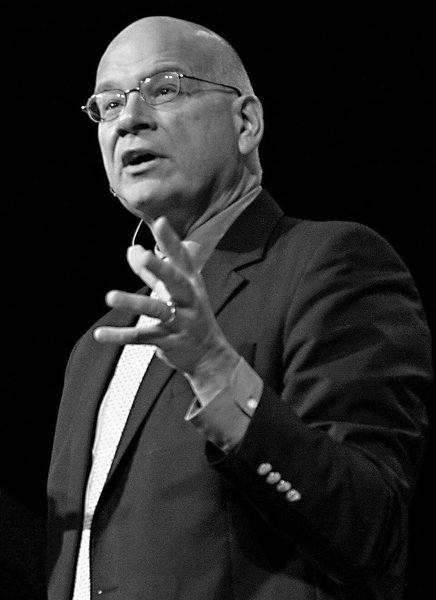
Biography
- 1950 Born
- 1975 Married
- 1989 Redeemer
- 2008 Reason for God
- 2023 Died
The less we attempt to make this world into a heaven, the more we are able to enjoy it.
Timothy Keller spent his working life explaining Christianity to people who did not believe it — the doubters, the artists, the young professionals of secular Manhattan who had come to New York to get away from the churches of their childhood. He was patient with them, and famous for it. What is less remembered is that the man who taught a skeptical city about God spent decades feeling that he had under-taught the one thing that mattered most, and did not learn to pray deeply himself until a cancer diagnosis drove him to it in middle age. He wrote his best-known book on prayer at sixty-three, out of that late and costly schooling. And then, at the very end, the doctrines he had preached for half a century had to be tested in his own body — and he reported, without drama, that they held.
A nominal faith made real
He was born on 23 September 1950 in Allentown, Pennsylvania, and raised in the eastern part of that state. He was baptized Catholic — his mother was Italian-American — and the family later attended a Lutheran church, so that religion was always around him without ever quite becoming his own. By his own account he did not come to a serious, personally-held Christian faith until he was at university.
That happened at Bucknell, where he took his degree in 1972. As a student he was drawn into a living evangelical faith through InterVarsity Christian Fellowship on the campus — the ordinary machinery of a student ministry, a few friends and some books and a Bible studied seriously, doing its ordinary work on a young man who had grown up with the forms of religion but not its heart. It is worth pausing on how undramatic that is. No crisis, no vision — a college student moving, over a season, from nominal religion to something he would give the rest of his life to.
He went on to Gordon-Conwell Theological Seminary, taking his M.Div. in 1975; among his teachers there were Richard Lovelace and Roger Nicole. Later he earned a Doctor of Ministry from Westminster Theological Seminary in Philadelphia, in 1981, working on urban mission under Harvie Conn. His theology settled where it would stay: Reformed, confessional, Presbyterian, in the tradition of the two writers he cited most warmly all his life — C.S. Lewis, whose reasonableness he borrowed, and Jonathan Edwards, whose sense of the beauty of God he never stopped preaching.
In 1975 he married Kathy, born Kathy Kristy — Kristy is a maiden name, not a nickname. She is central, and not as background. She had trained at Gordon-Conwell too; she edited and sharpened his work, co-authored The Meaning of Marriage with him, and was a full partner in everything that followed, not least in the founding of Redeemer. They had three sons. Nearly every good thing his ministry produced was, in some real sense, a thing the two of them made together.
Hopewell, and then the hardest city
His first pastorate was not a glamorous one. From 1975 to 1984 — about nine years — he served West Hopewell Presbyterian Church in Hopewell, Virginia, a blue-collar, small-town congregation. This was his apprenticeship: the unrecorded labour of visiting, burying, marrying, and week-by-week preaching that makes a pastor before anyone has heard his name. He learned there to speak plainly to people who had no patience for jargon, a habit that would serve him strangely well in a very different place.
In 1989 he and Kathy did an unlikely thing. They moved to secular Manhattan to plant a new church — a Reformed, confessional congregation aimed at exactly the skeptical, professional, largely unchurched New Yorkers least likely to want one. Redeemer Presbyterian Church was, on paper, a bad idea. It grew instead into thousands, meeting across multiple services, and became one of the most studied models of thoughtful urban ministry in the English-speaking world. Keller preached as though skeptics were always in the room, because they were; he answered their objections respectfully and pointed past himself to Christ rather than scoring points.
The less we attempt to make this world into a heaven, the more we are able to enjoy it.
— Timothy Keller, “Growing My Faith in the Face of Death,” The Atlantic (2021)
Out of Redeemer came institutions larger than any one congregation. With D.A. Carson he co-founded The Gospel Coalition, a network for gospel-centered evangelicalism. He co-founded and chaired Redeemer City to City, a church-planting organization that helped start hundreds of churches in cities around the world. He wrote steadily — The Reason for God in 2008, which made him a bestseller; The Prodigal God the same year; Counterfeit Gods; Every Good Endeavor; some thirty books in all. In 2017 he stepped down from the senior pastorate to give his remaining strength to training and to writing.
The cancer that taught him to pray
For all of this, Keller was candid that his own prayer life had lagged behind his teaching. The turn came around 2002, when he was diagnosed with thyroid cancer and treated for it. He and Kathy have said plainly, on the record, that the brush with mortality drove them to rebuild their prayer life from the foundations — they began praying together every night, and reworked the devotional habits of decades. He would later admit he had under-taught prayer for years and had to be taught it himself.
The book that grew partly out of that discipline was Prayer: Experiencing Awe and Intimacy with God, published in 2014. Its argument is simple and hard to hold together: that prayer is at once awe — the adoration of God’s glory — and intimacy — the finding of his grace — and that to lose either is to lose prayer. He wanted to unite two streams the church usually sets against each other: the communion-centered tradition that savours God’s presence, and the kingdom-centered tradition that asks and labours and aligns itself with God’s will. Mature prayer, he insisted, holds both. And it is never free-floating technique or self-soothing; it is response, conversation and encounter with a God who has already spoken in Scripture, and he sent readers to the Psalms and to Augustine, Luther, Calvin, and Owen to learn how.
Prayer, then, is both awe and intimacy, struggle and reality.
— Timothy Keller, Prayer: Experiencing Awe and Intimacy with God (2014)
Facing his own death
In 2020 Keller was diagnosed with pancreatic cancer, an advanced case, and was treated for roughly three years. He had, as it happened, just published a short book called On Death — a teacher of others on dying who was now handed his own.
What followed is the reason his name belongs among men of prayer. He did not fall silent, and he did not perform. He wrote and spoke about facing death, the nearness of God, and a felt reality of Christ that he said grew sweeter as his strength failed — that the things he had preached for fifty years stopped being doctrines held at arm’s length and became, in his phrase, real. The clearest record of it is an essay he published in The Atlantic in March 2021, “Growing My Faith in the Face of Death,” which he opened by setting his 1975 ordination beside his own diagnosis. In it he refused both denial and despair, and made the plain argument that had always been under his winsomeness:
If there is a God great enough to merit your anger over the suffering you witness or endure, then there is a God great enough to have reasons for allowing it.
— Timothy Keller, “Growing My Faith in the Face of Death,” The Atlantic (2021)
He was discharged to hospice care on 18 May 2023, and died the next day, 19 May 2023, in Manhattan, aged seventy-two. No reliable last words survive, and this account will not manufacture any; the honest record is not a deathbed scene but the years of writing in which a dying man kept teaching the church how to hope.
What he leaves
Keller was, in his last decade, a contested figure as well as a beloved one. Admirers across the church prized his patience with doubters; some critics to his right thought that same gentleness inadequate to a harder cultural moment, and some to his left faulted him on social and political questions. It is fair to record that he was widely loved and also widely argued over, and fair to leave the arguments there — he would not have wanted a biography to adjudicate them for him.
He is also, it should be said, one of the most misquoted Christians of the internet age; a great many lines attributed to him were never his. One that genuinely was his to use, though not to coin, is a gospel summary he loved to repeat — that we are more sinful and flawed than we ever dared believe, yet more loved and accepted in Christ than we ever dared hope. The phrasing descends from Jack Miller and from his own teacher Richard Lovelace; Keller reworked and carried it, and made it his signature, but it was never original to him, and he would have been the first to say so.
What he leaves, in the end, is not chiefly the institutions or the bestsellers. It is the witness of a man who taught Christianity brilliantly for twenty years before a cancer made him learn, late and humbly, to pray — and who, when a second cancer came, found the practice ready and the promises true. That is the more encouraging story for an ordinary reader. Nobody is too accomplished, too fluent, or too far along to be taught prayer from the beginning. Keller was, and he counted it the best thing that ever happened to him.
Also appears in
Questions and Answers
Who was Timothy Keller?
Timothy Keller (1950–2023) was a Presbyterian pastor who founded Redeemer Presbyterian Church in secular Manhattan in 1989 and wrote widely read books including "The Reason for God" and "Prayer: Experiencing Awe and Intimacy with God." A brush with thyroid cancer drove him to rebuild his prayer life, and facing pancreatic cancer at the end he wrote movingly of the nearness of God and the deepening of prayer. He spent his life explaining Christianity to people who did not believe it.
How did he come to a serious faith?
Born on 23 September 1950 in Allentown, Pennsylvania, he was baptized Catholic and later attended a Lutheran church, so religion was always around him without becoming his own. He came to a serious, personally-held Christian faith at Bucknell University, drawn into a living evangelical faith through InterVarsity Christian Fellowship — no crisis, no vision, just a college student moving over a season from nominal religion to something he would give the rest of his life to. He went on to Gordon-Conwell Seminary and later a Doctor of Ministry from Westminster.
Who was Kathy Keller?
In 1975 he married Kathy, born Kathy Kristy, who is central and not background. She had trained at Gordon-Conwell too; she edited and sharpened his work, co-authored "The Meaning of Marriage" with him, and was a full partner in everything that followed, not least the founding of Redeemer. They had three sons. Nearly every good thing his ministry produced was, in some real sense, a thing the two of them made together.
What was his first pastorate?
Not a glamorous one. From 1975 to 1984, about nine years, he served West Hopewell Presbyterian Church in Hopewell, Virginia, a blue-collar, small-town congregation. This was his apprenticeship — the unrecorded labour of visiting, burying, marrying, and week-by-week preaching that makes a pastor before anyone has heard his name — and he learned there to speak plainly to people who had no patience for jargon, a habit that would serve him strangely well in a very different place.
Why was Redeemer an unlikely success?
In 1989 he and Kathy moved to secular Manhattan to plant a Reformed, confessional church aimed at exactly the skeptical, professional, largely unchurched New Yorkers least likely to want one — on paper, a bad idea. It grew instead into thousands across multiple services and became one of the most studied models of thoughtful urban ministry. Keller preached as though skeptics were always in the room, because they were, answering their objections respectfully and pointing past himself to Christ.
What did he build and write?
Out of Redeemer came institutions larger than any congregation: with D. A. Carson he co-founded The Gospel Coalition, and he co-founded Redeemer City to City, which helped start hundreds of churches in cities worldwide. He wrote steadily — "The Reason for God" (2008), which made him a bestseller, "The Prodigal God," "Counterfeit Gods," "Every Good Endeavor" — some thirty books in all, drawing warmly on C. S. Lewis's reasonableness and Jonathan Edwards's sense of the beauty of God.
How did cancer change his prayer life?
He was candid that his own prayer life had lagged behind his teaching. The turn came around 2002, when he was diagnosed with thyroid cancer; he and Kathy have said plainly that the brush with mortality drove them to rebuild their prayer life from the foundations, beginning to pray together every night. A man who had preached for years suddenly found he did not know how to pray under the shadow of death, and could not afford to stay that way. He admitted he had under-taught prayer for years and had to be taught it himself.
What is his book Prayer about?
"Prayer: Experiencing Awe and Intimacy with God" (2014) grew partly out of that discipline. Its argument is simple and hard to hold together: that prayer is at once awe — the adoration of God's glory — and intimacy — the finding of His grace — and that to lose either is to lose prayer. He wanted to unite two streams the church usually sets against each other, the communion-centered and the kingdom-centered, and insisted prayer is never free-floating technique but response, conversation, and encounter with a God who has already spoken in Scripture.
How did he face his own death?
In 2020 he was diagnosed with advanced pancreatic cancer and was treated for roughly three years. He did not fall silent or perform; he wrote and spoke about facing death and the nearness of God, saying the things he had preached for fifty years stopped being doctrines held at arm's length and became, in his phrase, real. In a 2021 Atlantic essay he refused both denial and despair: "If there is a God great enough to merit your anger over the suffering you witness or endure, then there is a God great enough to have reasons for allowing it."
How did he die, and what does he leave?
He was discharged to hospice on 18 May 2023 and died the next day in Manhattan, aged seventy-two. Widely loved and also widely argued over, he would not have wanted a biography to adjudicate the arguments for him. What he leaves is not chiefly the institutions or bestsellers but the witness of a man who taught Christianity brilliantly for twenty years before a cancer made him learn, late and humbly, to pray — and who, when a second cancer came, found the practice ready and the promises true. Nobody is too accomplished or too far along to be taught prayer from the beginning.
Portrait: Frank Licorice, CC BY-SA 2.0, via Wikimedia Commons — adapted (black-and-white)