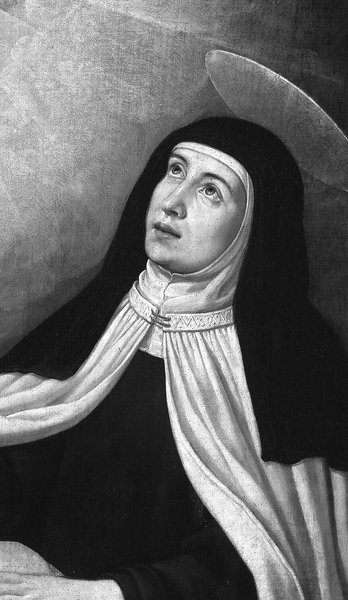
Biography
- 1515 Born
- 1535 Entered convent
- 1554 Conversion
- 1559 The vision
- 1582 Died
Mental prayer, in my opinion, is nothing else than an intimate sharing between friends; it means taking time frequently to be alone with him who we know loves us.
Teresa of Ávila is remembered now as a mystic, a saint whose visions were carved into marble by Bernini and whose books are read five centuries after her death. It is worth beginning, then, with the least mystical fact about her: for roughly twenty years she was a nun who could barely pray. She kept the hours, she wore the habit, she was inside the machine of religious life — and by her own account she spent most of those two decades restless, distracted, and half-hearted before God. The woman the Church would one day name its first female Doctor spent her first twenty years in the cloister as an ordinary, struggling, unremarkable religious. That is not a footnote to her holiness. It is the road into it.
A daughter of Ávila
She was born Teresa de Cepeda y Ahumada on 28 March 1515, in the walled Castilian city of Ávila. Her family was prosperous but carried a shadow the age did not forgive lightly: her paternal grandfather was a Jew who had converted to Christianity and been reconciled by the Toledo Inquisition in 1485. Teresa was, in the language of the time, of converso descent — a background that meant her family's standing was never quite secure in a Spain obsessed with purity of blood. She grew up bright, sociable, and fond of the world, by turns devout and vain.
Her mother, Beatriz, died when Teresa was about thirteen. The girl, grieving, went to an image of the Virgin and asked her to be a mother in her place — the first act of a life that would keep turning grief and longing into prayer. A few years later her father placed her, for a time, in a convent school; and slowly, against her own resistance and her father's initial opposition, she came to believe she was called to religious life.
In 1535 she entered the Carmelite Monastery of the Incarnation in Ávila, and she professed her vows in 1537. What followed was not a straight ascent. She fell gravely ill, so ill she was once thought dead and a grave was readied for her. She recovered, but her health was broken for life, and her prayer went slack. The Incarnation was a large, comfortable, half-worldly house where nuns received visitors and kept private property, and Teresa — charming, well-liked, easily distracted — drifted with it. She would later be unsparing about those years, blaming no one but herself for a prayer life she called mediocre and mostly abandoned.
The wounded Christ
The turn, when it came, came late and came suddenly. Around 1554, nearly forty years old and nearly twenty years a nun, Teresa passed a statue that had been brought into the convent — an Ecce Homo, an image of Christ scourged and wounded before his death. She stopped. Something in the sight of that suffering broke her open. She threw herself on the ground before it in tears and begged God to strengthen her once and for all. Around the same time she read Augustine's Confessions — one restless soul recognising itself in another — and found there the words for what was happening to her.
This is the hinge of her life. Everything the world now associates with Teresa — the visions, the reform, the books — comes after it, and none of it comes before. The mystic was born not out of natural piety but out of a woman finally surrendering, at forty, after twenty wasted years, in front of a broken image of Christ.
Prayer as friendship
Out of that surrender came the teaching for which she is loved. Teresa did not think of prayer as performance, or as a technique for the spiritually gifted. She thought of it as a relationship — plain, personal, and available to anyone willing to give it time. Her definition of mental prayer, written in the eighth chapter of her Life, is the most quoted sentence she ever wrote, and it is disarmingly simple:
Mental prayer, in my opinion, is nothing else than an intimate sharing between friends; it means taking time frequently to be alone with him who we know loves us.
— Teresa of Ávila, The Book of Her Life
Everything else in her spiritual writing is an unfolding of that line. In the Life she compared the growth of prayer to watering a garden four ways: hauling water from a well by hand, which is laborious beginner's prayer; turning a water-wheel, which is easier; letting a stream run through, easier still; and at last the rain, which asks nothing of the gardener and is given wholly by God. Years later, in The Interior Castle, she pictured the soul as a castle of clear crystal with seven sets of rooms, and the life of prayer as a journey inward through them toward the innermost chamber where God dwells. She wrote for her own nuns, in a warm, direct, sometimes teasing voice, always insisting that this friendship with God was not reserved for the extraordinary.
The fire and the spear
Teresa's mystical experiences were vivid, and she reported them as plainly as she reported everything else. The most famous, which she describes in the twenty-ninth chapter of her Life and which is usually dated to around 1559, she gives entirely as her own testimony — and it is right to receive it that way, as what she said happened to her. She saw beside her, she wrote, an angel in bodily form, small and beautiful, its face aflame. In its hands was a long golden spear tipped with fire, and it thrust the spear again and again into her heart, piercing to her very entrails. The pain, she said, was so great that she moaned aloud; yet it was so sweet that she could not wish to be rid of it, and it left her all on fire with a great love of God.
It is this scene that Bernini later froze in marble in Rome. Teresa herself would have been wary of the attention; she distrusted spiritual experiences that a soul went looking for, and always turned her nuns back from raptures toward the ordinary, hidden work of love and obedience. The fire in the heart, for her, was never the point. The friendship was.
Barefoot, and on the road
A woman that alive to God could not stay content in a lax and comfortable house. Teresa became convinced that the Carmelite life needed to return to its roots — small communities, strictly enclosed, living in real poverty, at prayer. In 1562 she founded the first reformed convent, St Joseph's in Ávila, consecrated on 24 August. The nuns there owned nothing, took no endowment, wore coarse habits and sandals of rope and straw. From those bare feet came the name that stuck: the Discalced, the "unshod," Carmelites.
The opposition was immediate and fierce. The city authorities of Ávila took her to law, alarmed at an unendowed convent with no visible means of support. Churchmen were uneasy about a woman who taught mental prayer so boldly, in an age when the Inquisition watched such things closely and a nun's inner life could be treated as dangerous. Teresa met all of it with a combination the record keeps insisting on: she was a genuine contemplative and a shrewd, funny, indefatigable organiser. Over the next twenty years, in poor health and over bad Castilian roads, she founded convent after convent across Spain.
In 1567, at Medina del Campo, she met a young friar, small and intense, who wanted to carry the same reform to the men of the order. His name was John of the Cross, and he would become one of the greatest poets and mystics of the Christian tradition in his own right. Together they launched the reform among the friars, whose first house opened at Duruelo in 1568. It was a costly partnership. From around 1575 a bitter jurisdictional war broke out between the Discalced and the older Calced ("shod") Carmelites; John was seized and imprisoned by his opponents; Teresa was, for a time, confined and silenced. Only in 1580 were the Discalced finally recognised as a separate province, and the reform secured.
Through it all she carried a small piece of paper, found after her death in her breviary in her own hand — a few lines that hold the whole temper of a life lived under illness, suspicion, lawsuits and the road:
Let nothing disturb you, let nothing frighten you; all things are passing; God never changes. Patience obtains all things. Whoever has God lacks nothing; God alone suffices.
— Teresa of Ávila, the "Nada te turbe" found in her breviary
What she left, and one word she did not say
Teresa died on the night of 4–15 October 1582 at Alba de Tormes, worn out by a last journey. The dates are not a misprint: she died on the very night the Gregorian calendar took effect, when 4 October was followed directly by 15 October, which is why her feast falls on the fifteenth. She left behind a reformed order, a scattering of small poor convents, and four books that have never gone out of print — The Book of Her Life, The Way of Perfection, The Interior Castle, and The Book of the Foundations. She was canonised in 1622. On 27 September 1970, Paul VI named her a Doctor of the Church — the first woman ever so honoured, a week before the same title was given to Catherine of Siena.
One caution belongs in any honest account of her. A much-loved prayer that begins "Christ has no body now but yours, no hands, no feet on earth but yours" is very often printed under her name. It is not hers. It is a later composition, from the nineteenth or twentieth century, and however lovely it is, attaching it to Teresa is a mistake. Her real words stand on their own and need no borrowing.
What she actually leaves is smaller and stronger than any single quotable prayer. She leaves the witness of a woman who was, for twenty years, exactly the sort of tired, distracted, half-serious believer most of us recognise — and who was met, late, in front of a wounded Christ, and became one of the great friends of God. Her whole teaching can be folded back into the one sentence she gave us: that prayer is nothing more, and nothing less, than taking time to be alone with him who we know loves us. She was almost forty before she believed it. She spent the rest of her life proving it was true.
Also appears in
Questions and Answers
Where did Teresa of Ávila come from?
She was born Teresa de Cepeda y Ahumada on 28 March 1515 in the walled Castilian city of Ávila, into a prosperous family of converso descent — her paternal grandfather was a Jew reconciled by the Inquisition, so their standing was never fully secure in a Spain obsessed with purity of blood. Bright, sociable and by turns devout and vain, she lost her mother at about thirteen and went to an image of the Virgin asking her to be a mother in her place. Against her own resistance and her father's initial opposition, she entered the Carmelite Monastery of the Incarnation in Ávila in 1535 and professed her vows in 1537.
Is it true she spent about twenty years as a nun who could barely pray?
Yes, and she said so herself without excuse. Soon after entering the convent she fell so gravely ill she was once thought dead and a grave was readied for her; she recovered, but her health was broken for life and her prayer went slack. For roughly two decades in that comfortable, half-worldly house — where nuns received visitors and kept private property — she was, by her own account, a distracted and mediocre religious, and she blamed no one but herself.
What was the turning point in her spiritual life?
Around 1554, nearly forty years old, Teresa passed a statue of the scourged and wounded Christ that had been brought into the convent, and the sight of that suffering broke her open. She threw herself down in tears and begged God to strengthen her once and for all so she would not offend him again. Reading Augustine's Confessions around the same time, she dated the real beginning of her prayer from that day.
How did Teresa understand prayer?
She thought of prayer not as a technique for the gifted but as a friendship open to anyone willing to give it time. In the eighth chapter of her Life she gave her most quoted definition: 'Mental prayer, in my opinion, is nothing else than an intimate sharing between friends; it means taking time frequently to be alone with him who we know loves us.' She insisted this closeness with God was never reserved for the extraordinary.
What was the vision of the angel and the 'transverberation'?
In the twenty-ninth chapter of her Life, usually dated to around 1559, Teresa described seeing beside her an angel in bodily form, small and beautiful, its face aflame, holding a long golden spear tipped with fire that it thrust again and again into her heart. The pain, she wrote, was so great she moaned aloud, yet so sweet she could not wish to be rid of it, leaving her all on fire with love of God; it is the scene Bernini later carved in marble in Rome. For all such vivid raptures, though, Teresa was sober and practical, distrusting experiences a soul went looking for and steadily turning her nuns back toward the hidden, ordinary work of love and obedience — the fire in the heart was never the point for her, the friendship was.
What was her reform of the Carmelites, and why the name 'Discalced'?
Convinced the Carmelite life needed to return to its roots, Teresa founded a first reformed convent, St Joseph's in Ávila, in 1562 — small, strictly enclosed, and living in real poverty, the nuns owning nothing and wearing coarse habits with sandals of rope and straw, from which came the name that stuck: the Discalced, or 'unshod,' Carmelites. The opposition was fierce; the city took her to law over an unendowed convent, and churchmen were uneasy about a woman teaching mental prayer so boldly in the age of the Inquisition. Over the next twenty years, in poor health and over bad Castilian roads, she founded convent after convent across Spain, meeting all of it as both a genuine contemplative and a shrewd, funny, indefatigable organiser.
What was her relationship with John of the Cross?
In 1567 at Medina del Campo, Teresa met a young friar named John of the Cross, who wanted to carry the same reform to the men of the order, and together they launched it among the friars, whose first house opened at Duruelo in 1568. The partnership was costly: a bitter jurisdictional war broke out with the older Calced Carmelites, John was seized and imprisoned by his opponents, and Teresa herself was for a time confined and silenced. Only in 1580 were the Discalced recognised as a separate province, securing the reform.
What books did Teresa of Ávila write?
She left four books that have never gone out of print: The Book of Her Life, The Way of Perfection, The Interior Castle, and The Book of the Foundations. In The Interior Castle she pictured the soul as a castle of clear crystal with seven sets of rooms, the life of prayer being a journey inward toward the innermost chamber where God dwells. She wrote in a warm, direct, sometimes teasing voice, mostly for her own nuns.
What is the 'Nada te turbe' prayer found in her breviary?
After her death a small slip of paper in her own hand was found in her breviary, bearing the lines: 'Let nothing disturb you, let nothing frighten you; all things are passing; God never changes. Patience obtains all things. Whoever has God lacks nothing; God alone suffices.' Known by its Spanish opening 'Nada te turbe,' it holds the whole temper of a life lived under illness, suspicion, lawsuits and the road.
How did she die, and why is she called a Doctor of the Church?
Teresa died on the night of 4–15 October 1582 at Alba de Tormes, worn out by a last journey; the odd dates are real, because she died the very night the Gregorian calendar took effect, which is why her feast falls on 15 October. She was canonised in 1622, and on 27 September 1970 Pope Paul VI named her a Doctor of the Church — the first woman ever so honoured, for the enduring value of her teaching on prayer.