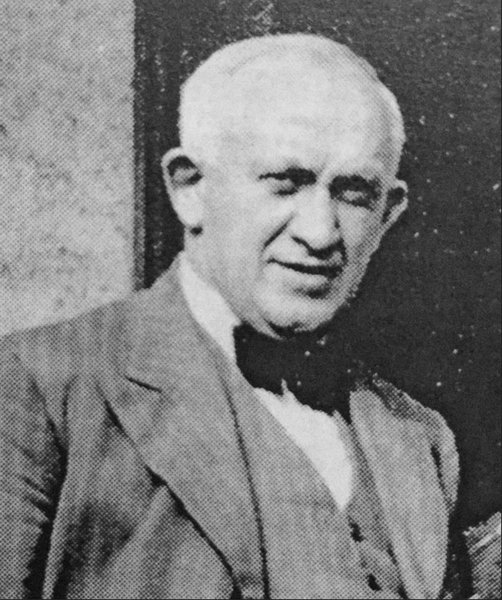
Biography
- 1879 Born
- 1901 America
- 1906 Surrender
- 1912 Africa
- 1950 Died
I am God, and I am come to ask you to give your body to Me that I may work through it… But if I come in, I come as God, and you must go out… I shall not mix Myself with your self.
Rees Howells left school at twelve for the tinplate mill and the coal mine, and he is remembered today for something almost the opposite of that hard, ordinary start: a life given over so completely to prayer that his biographer could find no better word for him than intercessor. He founded a Bible college that took no fees and made no appeals, and during the Second World War he gathered a hundred people in a Welsh house to pray every night for months. What he taught about prayer — that it can cost the one who prays as much as it asks of God — is the reason his name has outlived him. His story is also a study in how carefully a devotional life must be told, because the most dramatic claims made for it are claims of faith, not of proof.
A collier from Brynamman
He was born on 10 October 1879 at Brynamman, in Carmarthenshire, the sixth child of Thomas and Margaret Howells. It was a Welsh-speaking mining district, and there was no money for a long education. He left elementary school at twelve and went to work in a local tinplate mill and then in the coal mine, as boys of that valley did.
In 1901 he emigrated to America, following the tinplate trade to the mills of Pittsburgh and Connellsville in Pennsylvania. It was there, and not in chapel-going Wales, that his faith came alive. Under the influence of a Jewish convert and evangelist named Maurice Reuben, and of the writings of Professor Henry Drummond, he was converted — somewhere around 1902 to 1904; the exact time and place were never firmly recorded. What is clear is that a young Welsh miner went to America for work and came home, in 1904, a changed man.
He returned to a country that was itself on fire. The Welsh Revival of 1904–05, under Evan Roberts, had swept the valleys, and Howells came back into the middle of its aftermath, working again as a coal miner among people newly awakened. But conversion, for him, turned out to be only the first door.
The surrender at Llandrindod
In 1906 he attended the convention at Llandrindod Wells — the Welsh equivalent of the Keswick holiness meetings. Norman Grubb, whose biography Rees Howells: Intercessor is the source for almost everything intimate that we know about him, calls what happened there the most revolutionary event of his life after his conversion. Howells described it as a total and unconditional surrender, and he spoke of it ever afterward as a meeting in which the Holy Spirit asked to take possession of him.
Howells said the Spirit spoke to him in terms that left no room to bargain — that if God came in, He came as God, and the old self would have to go out. In his own recollection the words were plain and severe:
I am God, and I am come to ask you to give your body to Me that I may work through it… But if I come in, I come as God, and you must go out… I shall not mix Myself with your self.
— the words Howells said the Spirit spoke to him at Llandrindod Wells, 1906 (as recorded by Norman Grubb)
It is worth being exact about what this is. It is Howells, years later, recounting an inner voice — a thing told from the inside, not a transcript. But the effect on his life was outward and lasting. From that surrender he dated everything that followed: the giving away of money and comfort, the long nights of prayer, the strange and costly ministry that made his name.
What he meant by intercession
Howells drew a sharp line between ordinary prayer and what he called intercession, and it is here that Grubb's account is most useful. In Grubb's telling, Howells's intercession had three marks — identification, agony and authority.
Identification meant that the one who prayed did not stand at a distance from the person he prayed for, but stepped into their place — sharing their poverty, their hunger, their loneliness, modelled on the way Christ took the place of sinners. In practice this was not a feeling but a cost: Howells gave away money he needed, food he wanted, hours he could not spare, and lived among the people he was burdened for. Agony meant travailing in prayer, praying through, until an inward assurance came that Grubb reports Howells calling gaining the position. And authority was what remained once identification and agony had done their work — a settled confidence to pray for the outcome and expect it.
Identification, agony and authority.
— Norman Grubb's account of the three marks of Rees Howells's teaching on intercession
Each such victory Howells called a position of intercession — a permanent place of prevailing prayer, won once, at real personal cost, and never surrendered. His early positions were among the poorest: tramps and homeless men, orphans, and the sick and dying. He took them as burdens, not as projects, and he paid for them out of his own means and his own comfort.
One of those early burdens marked him more deeply than any other. Grubb records that a close acquaintance was dying of consumption, and Howells was drawn into an intense and prolonged intercession over her sickness. In the best-known telling, the dying woman, brought to a settled assurance of God's love, prayed not that she would be healed but that no one else would ever have to suffer as she had. She died. Howells came out of it having learned, as he had not before, what it means to stand in another person's place and not be spared.
Africa: the Rusitu revival
Around 1912 the Howellses — he had married Elizabeth Hannah Jones, "Lizzie," of Brynamman in December 1910 — believed themselves called to Africa. They joined the South Africa General Mission and were given charge of the Rusitu station in Gazaland, on the border of Mozambique and what was then Southern Rhodesia, now Zimbabwe. They reached the field in 1915.
What happened there is one of the few large episodes of his life attested well beyond Grubb's devotional pages. Within about six weeks of Howells beginning to preach on revival, the meetings changed. Dated from October 1915, a revival broke out that lasted some fifteen months, centred on Rusitu and Silinda and spreading through the region. Howells, who had spent years learning to pray one dying woman into peace, now watched a whole country-side moved at once. The line remembered from him, reported through Grubb, is a plain man's astonishment:
You can never describe those meetings when the Holy Spirit comes down!
— Rees Howells on the Rusitu revival, as reported by Norman Grubb
The Howellses returned to Wales around 1920, and Rees turned to the work that would occupy the rest of his life.
A college built on prayer
After an American preaching tour in 1922 he resolved to found a Bible college, loosely modelled on Moody Bible Institute in Chicago. He bought the Glynderwen estate at Swansea, and the Bible College of Wales opened on Whit Monday, 1924.
Its distinctive was its economy. There were no fixed fees and no fundraising appeals; the needs of the college were, in the language of that world, prayed in. The tradition preserved by Grubb says he began with only a few shillings and that money came, again and again, at the very hour it was needed — enough to buy not only Glynderwen but Sketty Isaf, Derwen Fawr, and later the Penllergaer estate. The exact sums and dates belong to devotional memory rather than to an audited ledger, and are best left as what they are: a testimony that the college met its bills without ever asking a donor for them.
Those who sat under him did not always have words for the impression he made. Grubb preserves one listener's:
There is someone here among us, and I feel like going round the country with him, carrying his bag and cleaning his boots.
— a listener describing the effect of Rees Howells, as recorded by Norman Grubb
On Boxing Day, 26 December 1934, at Derwen Fawr, Howells received what he called the Every Creature vision — a burden to intercede that the whole world should have the chance to hear the gospel. Staff and students gave New Year's Day 1935 to prayer and fasting over it. It set the pattern for the college's most famous, and most delicate, chapter.
The war years — what is documented, and what is believed
When war came in 1939 the college turned its whole life toward prayer. This much is documented, in Grubb and in the college's own prayer diaries: from the outbreak of the war they held prayer meetings every evening, running from around seven o'clock to midnight and beyond, and did not miss a single day. Grubb describes something like a hundred people praying as though they had been called to fight on the Western Front. The diaries record intensive intercession for Dunkirk over 22–29 May 1940, and the college prayed its way through the Battle of Britain. Howells put his conviction into print in a 1940 book, God Challenges the Dictators.
That is the documented part, and it is remarkable enough. But it is important to say clearly what is not established. The college believed — and many who tell its story still believe — that this praying turned the tide: that it lay behind the halt before Dunkirk and the outcome over southern England. That is a conviction of faith, a reading of a real correlation between the nights of prayer and the events of the war. It is not a demonstrated historical cause, and it would be dishonest to present it as one. What can be said without exaggeration is that a community of Christians prayed, night after night, for the deliverance of their country, and that they believed their prayers were heard. The praying is a matter of record. The verdict on it is a matter of faith.
Death and legacy
Rees Howells died on 13 February 1950, aged seventy-one. His son, Samuel Rees Howells, succeeded him as director of the college, and the work he had prayed into being outlived him.
He wrote little that is widely read, and much of what we know of his inner life reaches us through one devoted biographer, which is a reason for care rather than for doubt. The care is the point. Howells taught that prayer is not a way of getting God to do easy things at a distance, but a way of being drawn so far into another's need that the praying costs you something — your money, your comfort, your peace, sometimes your health. That teaching does not depend on any wartime claim being proved. It stands on a dying woman prayed into peace, on tramps and orphans taken in, on a mission station in Gazaland where the roof seemed to lift, and on a college that paid its way for a generation without ever passing a plate. Those are the things Rees Howells actually did, and they are enough.
Also appears in
Questions and Answers
Who was Rees Howells?
Rees Howells (1879–1950) was a Welsh coal miner turned intercessor whose life of costly, sacrificial prayer became the pattern taught in his biography by Norman Grubb. He founded the Bible College of Wales at Swansea in 1924, running it without fees or fundraising appeals, and led its community in sustained wartime intercession for Britain. What he taught about prayer — that it can cost the one who prays as much as it asks of God — is the reason his name has outlived him.
What was his background?
He was born on 10 October 1879 at Brynamman in Carmarthenshire, the sixth of eleven children in a Welsh-speaking mining district, and left elementary school at twelve for the tinplate mill and the coal mine. In 1901 he emigrated to America, following the tinplate trade to Pennsylvania, and it was there — under a Jewish convert and evangelist named Maurice Reuben, and the writings of Henry Drummond — that his faith came alive, around 1902 to 1904. He returned to Wales in 1904 a changed man.
What was the surrender at Llandrindod?
In 1906 he attended the convention at Llandrindod Wells, the Welsh equivalent of the Keswick holiness meetings, and Norman Grubb calls what happened there the most revolutionary event of his life after his conversion. Howells described it as a total and unconditional surrender in which the Holy Spirit asked to take possession of him — in his recollection the words were plain and severe: "if I come in, I come as God, and you must go out." From that surrender he dated everything that followed.
What did he mean by intercession?
He drew a sharp line between ordinary prayer and what he called intercession, which Grubb reports as having three marks — identification, agony and authority. Identification meant that the one who prayed did not stand at a distance but stepped into the place of the person prayed for, sharing their poverty and loneliness at real cost. Agony meant travailing in prayer, praying through until an inward assurance came. And authority was the settled confidence that remained, to pray for the outcome and expect it.
What were his early "positions of intercession"?
Each victory Howells called a position — a permanent place of prevailing prayer, won once at real personal cost and never surrendered. His early positions were among the poorest: tramps and homeless men, orphans, and the sick and dying, whom he took as burdens rather than projects and paid for out of his own means and comfort. One marked him most: an intense, prolonged intercession over a woman dying of consumption, from which he emerged having learned what it means to stand in another's place and not be spared.
What happened at Rusitu in Africa?
Around 1912 the Howellses believed themselves called to Africa; they joined the South Africa General Mission and were given charge of the Rusitu station in Gazaland, reaching the field in 1915. What happened there is attested well beyond Grubb's pages: within about six weeks of Howells beginning to preach on revival, a revival broke out, dated from October 1915, that lasted some fifteen months and spread through the region. Of all the answers he is remembered for, this is the clearest and best attested — a sustained work he had prayed toward and could only stand inside of.
How was the Bible College of Wales built?
After an American preaching tour he resolved to found a Bible college, and the Bible College of Wales opened at Swansea on Whit Monday, 1924. Its distinctive was its economy: there were no fixed fees and no fundraising appeals; the needs of the college were, in the language of that world, "prayed in." The college's own testimony is that its estates were bought without a single appeal — that Howells and his students prayed, and the money arrived, often at the last possible hour.
What were the war years at the college?
When war came in 1939 the college turned its whole life toward prayer. This is documented: from the outbreak they held prayer meetings every evening, from around seven o'clock to midnight and beyond, and did not miss a single day — something like a hundred people praying as though called to fight on the Western Front. The prayer diaries record intensive intercession for Dunkirk over 22–29 May 1940, and the college prayed its way through the Battle of Britain.
How should the wartime claims be weighed?
With care. It is documented that the community prayed, night after night, for the deliverance of their country, and that they believed their prayers were heard. The college believed — and many still believe — that this praying turned the tide, lying behind the halt before Dunkirk and the outcome over southern England. That is a conviction of faith, a reading of a real correlation, not a demonstrated historical cause. The praying is a matter of record; the verdict on it is a matter of faith.
What does he leave?
He died on 13 February 1950, aged seventy-one, and his son Samuel succeeded him as director of the college. Much of what we know of his inner life reaches us through one devoted biographer, which is a reason for care rather than doubt. His teaching does not depend on any wartime claim being proved: it stands on a dying woman prayed into peace, on tramps and orphans taken in, on a mission station in Gazaland where the roof seemed to lift, and on a college that paid its way for a generation without ever passing a plate.
Portrait: Bible College of Wales archive, via Great Life Publishing