Where to start reading
Sermons by Phillips Brooks (5)
The Beauty of a Life of Service
Taking Christ's promise that the Son makes us free, Brooks argues that freedom is given not from service but into it. He points to the cross as the symbol of a life that does not live for itself, insists that a man best helps the world by being his best for its sake, and traces the unseen reach of sin and service. He ends by calling his hearers to be unselfish in religion and to claim their freedom in service.Thought and Action
Speaking to business men on a Monday noon, Brooks argues that faith in Christ does not chain the mind but sets it free. He strips Christianity down to its centre, the person of Jesus Christ, and urges hearers to test it by undertaking a life too noble to live without him. Honouring the earnest sceptic, he ends with the prayer "Lord, I believe, help Thou mine unbelief."The Duty of the Christian Business Man
Closing a series of meetings for business men, Brooks holds that God is always pleading with every soul, that religion is life itself rather than something added to it, so no one is too busy for it. He gives plain counsel—put away sin, do your duty, pray, read the Bible, join the Church—and charges Christian business men to prove business can be made Christian, ending with a call to be men in the power of Jesus Christ.True Liberty
Speaking to business men at a weekday service, Brooks takes Christ's promise that "the truth shall make you free" and argues that the new life is not imprisonment but liberty, the fullest opportunity to be and do one's best. Duty, belief and the giving up of sin all enlarge a man rather than restrict him. Sin loses its glamour, no one may say he has done his best, and he urges his hearers to claim the freedom with which the Son makes free.The Christ in Whom Christians Believe
Preaching on John 8, Brooks puts aside theological systems and returns to the first disciples, whom Jesus won by his character until they could only say, "Lord, to whom shall we go?" The Christian faith is following that same Christ, present now, who judges every act of daily life, comforts the sorrowing, and gives a faith that need never be outgrown. Brooks closes by urging his hearers to receive the present Christ and become sons of God.Biography
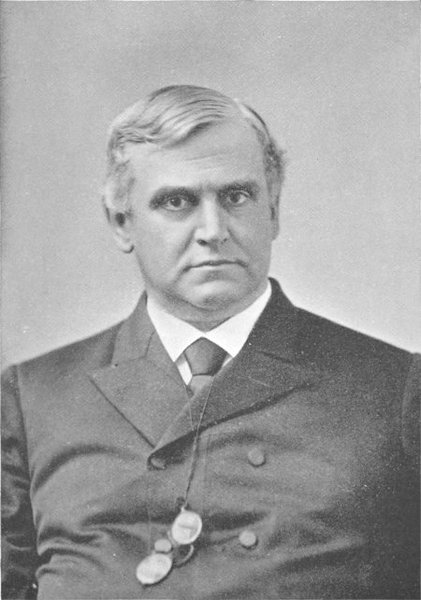
Every December, in churches and living rooms and on frosty street corners across the English-speaking world, people sing a quiet carol about a sleeping town under the stars. Few of them could name the man who wrote it. Phillips Brooks would probably have liked it that way. He was the most celebrated preacher in America in his day, a towering figure in every sense — he stood some six feet four — and yet the thing he cared about most was not his own fame but the simple, astonishing news that God had come close to ordinary people in Jesus Christ. His life began, however, not with a triumph but with a humiliating failure, and it was out of that failure that his calling grew.
He was born in Boston on 13 December 1835, the second of six sons of William Gray Brooks, a hardware merchant, and Mary Ann Phillips, whose family had given New England a long line of ministers and the academies at Andover and Exeter. Through his father’s side he descended from John Cotton, the great Puritan divine of the first generation. When Phillips was about four, his mother, a woman of deep and earnest faith, led the family from the Unitarian church of their fathers into St. Paul’s Episcopal Church on Tremont Street, and it was there that the boy grew up.
It was a home ordered around God and around the children. Family prayers were said every morning before the day’s work began, and again at nine o’clock at night. On Sundays the family went to church twice, and each child learned a hymn to recite to the household in the evening; by the time he went to seminary, Phillips could repeat some two hundred from memory. His mother would sit at her sons’ bedsides repeating Bible stories as they fell asleep, and she never stopped praying for them. Four of those six boys would one day enter the ministry.
Phillips went through the Boston Latin School and on to Harvard, graduating in 1855, a quiet, bookish, sharply witty young man who loved Greek and Latin literature and kept his inner life very much to himself. He had not yet been confirmed, and religion, though it surrounded him, was not something he spoke about.
Failure at the Threshold
In September 1855, not yet twenty, he returned to the Latin School as a teacher. For a few months all went well. Then he was put in charge of a class of thirty-five rough, unruly boys who had already driven out two masters before him. He could not hold them. By February 1856 he was forced to resign. The headmaster offered him a cold kind of comfort: he had never known a man who failed as a schoolmaster to succeed at anything else. Brooks was cut to the quick. One relative who knew him then remembered him as humiliated and utterly broken down, unable to see in what direction he could turn. The memory of that winter stayed with him to the end of his life.
Yet even in that dark season something steady in him refused to accept the verdict. In his private notebook he wrote:
I have failed myself most signally in teaching school, but I am not yet quite ready to acknowledge myself wholly unequal to all this wide world’s work.
— Phillips Brooks
For months he waited and read and wondered. At last he went to call on Dr. Alexander Vinton, the rector of St. Paul’s, to ask what a man should do who wished to study for the ministry. Dr. Vinton mentioned that a candidate was usually confirmed first, and that conversion was usually expected before confirmation. Brooks answered honestly that he did not know what conversion meant. To his great credit the old rector did not turn him away. He encouraged him, and pointed him to the Episcopal seminary at Alexandria, in Virginia. In the autumn of 1856, telling almost no one but his father and mother, Phillips Brooks set off south.
Learning to Pray
The Virginia Theological Seminary was a world away from the cool reserve of Harvard. On his first evening he was taken to a prayer meeting, and it shook him. “I had never been at a prayer-meeting in my life,” he later recalled; he sat “bewildered and ashamed” at the warmth with which those young men prayed. He was also quick to notice that some of the most fervent of them had not learned their Greek, and he resolved that in his own life devotion and hard study must never again be separated. But the deeper lesson was the one he learned on his knees.
On Sunday, 12 July 1857, at twenty-one, he was confirmed at St. Mary’s Church in Dorchester. That evening his mother wrote a few lines that were found among her papers after her death.
Philadelphia
Brooks was ordained deacon in Virginia on 1 July 1859 and went straight to a small, struggling congregation, the Church of the Advent in Philadelphia. Almost at once people began to come to hear him. He spoke at an extraordinary speed, the words pouring out, but what held his hearers was not technique. It was the sense that here was a man who believed, with all his large heart, every word he said, and who loved the people in front of him. In 1862 he was called to the larger Church of the Holy Trinity on Rittenhouse Square, where he stayed for seven years.
These were the years of the Civil War, and they brought sorrow close. His younger brother George, who had enlisted as a soldier, died of illness in 1863. In April 1865, the nation’s joy at the war’s end was turned to grief by the death of President Lincoln. “The whole land is deep in sorrow,” Brooks wrote in his diary, “and there is nothing to do but to pray for help.” When the President’s body lay in Independence Hall, Brooks preached on the life and character of Lincoln from the psalm that tells how God took David from the sheepfolds to shepherd His people “with a faithful and true heart.” The sermon was published at once and became one of the most remembered of his ministry.
A Night in Bethlehem
Worn out, Brooks was given a year’s leave, and in the autumn of 1865 he travelled through Europe and on to the Holy Land. On Sunday, 24 December, he rode on horseback from Jerusalem to Bethlehem. Before dark he went out to the fields where tradition says the shepherds kept watch over their flocks by night, and he watched shepherds still leading their sheep home to fold. Then he went to the ancient Church of the Nativity for the long Christmas Eve service, which ran from ten at night until three in the morning. A few months later he wrote home to the children of his Sunday school about that night, how, “standing in the old church at Bethlehem, close to the spot where Jesus was born,” with the church “ringing hour after hour with the splendid hymns of praise to God,” it seemed again and again as if he could hear the voices of his own children at home, singing of the Saviour’s birth.
Three years passed. For Christmas 1868 Brooks wrote a simple carol for those same Sunday-school children and gave it to Lewis Redner, the church organist, to set to music. Redner struggled for a tune, and it came to him, he later said, in the night just before the carol was to be sung. The children of Holy Trinity sang “O Little Town of Bethlehem” that Christmas for the first time. Neither man imagined that the world would go on singing it — “The hopes and fears of all the years are met in thee tonight.”
Trinity Church, Boston
In 1869 Brooks answered a call home to Boston, to Trinity Church, and there he would remain for twenty-two years. In November 1872 the Great Boston Fire swept through the city, and on a Sunday morning at four o’clock old Trinity on Summer Street went up in flames. Brooks watched her burn, carried out some books and robes, and wrote that “she died in dignity.” Scores of his own people had lost everything, but he marvelled at their courage and cheerfulness. Out of the ashes rose the great Romanesque church by the architect H. H. Richardson on Copley Square, consecrated on 9 February 1877. In those same weeks Brooks gave the Lyman Beecher Lectures at the Yale Divinity School, published as Lectures on Preaching. They opened with a definition that preachers have quoted ever since.
Preaching is the communication of truth by man to men. It has in it two essential elements, truth and personality. Neither of those can it spare and still be preaching.
— Phillips Brooks
Preaching, he said, is “the bringing of truth through personality.” He meant that God’s truth must pass through a whole human life, its thought and love and character, before it can truly reach another human heart. His own sermons were proof of it. Crowds filled Trinity Sunday after Sunday; he preached at Westminster Abbey and before Queen Victoria; his volumes of sermons were read far beyond Boston. Yet his message was never complicated. Again and again he called people to see themselves as children of God, and to rise to the life that Christ made possible. One of his sermons, “Going up to Jerusalem,” holds words that many have carried with them.
O, do not pray for easy lives. Pray to be stronger men! Do not pray for tasks equal to your powers. Pray for powers equal to your tasks! Then the doing of your work shall be no miracle. But you shall be a miracle.
— Phillips Brooks
For all his fame, he was a pastor at heart. He never married, and he poured his affection into his congregation, his many friends, and above all children, whom he loved to have about him. His gift in the sickroom was something people spoke of with wonder; he could sit silently by a bed and leave strength behind him. He wrote letters of comfort by the hundred. When a young girl named Helen Keller, blind and deaf, was brought to him for her first teaching about God, he spoke with her patiently of the Father’s love. Afterwards she said that she had always known there was a God, but had not known His name. She wrote to him for the rest of his life, and he told her, “The reason why we love our friends is because God loves us.”
Bishop, and the Last Days
In 1891 the Diocese of Massachusetts elected him its bishop, and on 14 October of that year he was consecrated in Trinity Church before a crowd that overflowed into Copley Square. He gave himself to the work of a bishop with the same open-hearted energy, travelling constantly to the parishes, small and great, of the diocese. But his time was short. In January 1893, already suffering with a heavy cold and a sore throat, he preached without notes at a small Boston church on Christ feeding the multitude in the desert. Within a few days he was confined to bed. In the early hours of Monday, 23 January 1893, he died at his home in Boston. He was fifty-seven.
Boston mourned as it had mourned few men. At his funeral the Stock Exchange closed, flags flew at half-mast, and thousands who could not get into Trinity stood bareheaded in Copley Square. Harvard students carried his body on their shoulders, and he was laid to rest at Mount Auburn Cemetery. The Episcopal Church now remembers him each year on 23 January. His church still stands on Copley Square, and his sermons still speak of a God who is near. And each Christmas, wherever the old carol is sung, the man who once failed to manage a classroom of boys is still teaching children, and their parents, to say the prayer he wrote for them: “O holy Child of Bethlehem, descend to us, we pray; cast out our sin, and enter in, be born in us today.”
Questions and Answers
Who was Phillips Brooks?
Phillips Brooks (1835–1893) was an American Episcopal clergyman, rector of the Church of the Holy Trinity in Philadelphia and then for twenty-two years of Trinity Church, Boston, and from 1891 Bishop of Massachusetts. He was one of the most admired preachers of his age, and he wrote the Christmas carol “O Little Town of Bethlehem.”
What kind of home did Phillips Brooks grow up in?
He was born in Boston on 13 December 1835, the second of six sons of William Gray Brooks and Mary Ann Phillips, and grew up at St. Paul’s Episcopal Church on Tremont Street. Family prayers were said morning and evening, the children learned a hymn every Sunday, and four of the six brothers eventually entered the ministry.
Did Phillips Brooks fail as a teacher before he became a minister?
Yes. After graduating from Harvard in 1855 he taught at the Boston Latin School, but he could not control an unruly class that had already driven out two masters, and in February 1856 he had to resign. He was deeply humiliated, yet wrote in his notebook that he was “not yet quite ready to acknowledge myself wholly unequal to all this wide world’s work.”
How did he come to study for the ministry?
In 1856 he asked Dr. Alexander Vinton, his rector at St. Paul’s, how to prepare for the ministry, frankly admitting that he did not know what conversion meant. Dr. Vinton encouraged him anyway and sent him to the Episcopal seminary at Alexandria, Virginia, where the fervent prayer meetings of his fellow students taught him to pray, and he was confirmed on 12 July 1857.
What did his mother write on the day he was confirmed?
Mary Ann Brooks, who had prayed for her sons all their lives, wrote that she would thank God forever that He had answered her lifelong prayers in making Phillips a Christian and His servant in the ministry. The note was found among her papers after her death.
Where did Phillips Brooks serve in Philadelphia?
He was ordained deacon in July 1859 and went first to the small Church of the Advent in Philadelphia, where crowds soon came to hear him. In 1862 he moved to the Church of the Holy Trinity on Rittenhouse Square, and in April 1865 he preached a much-remembered sermon on the life and character of President Lincoln while the President’s body lay in the city.
How did Phillips Brooks come to write “O Little Town of Bethlehem”?
On Christmas Eve 1865, during a journey to the Holy Land, he rode from Jerusalem to Bethlehem, saw the shepherds’ fields at dusk, and attended the long night service in the Church of the Nativity. Three years later he wrote the carol for the children of his Sunday school, and his organist Lewis Redner set it to music for its first singing at Christmas 1868.
What did he mean by calling preaching “truth through personality”?
In his Yale Lectures on Preaching, given in early 1877, he defined preaching as “the communication of truth by man to men,” with two essential elements, truth and personality, neither of which it can spare. He meant that God’s truth must pass through the whole life and character of the preacher in order to reach the hearts of others.
What happened to Trinity Church during his years in Boston?
Brooks became rector of Trinity Church in 1869, and in November 1872 the old church on Summer Street was destroyed in the Great Boston Fire; he watched it burn and wrote that “she died in dignity.” The congregation built a new church on Copley Square, designed by H. H. Richardson and consecrated on 9 February 1877, where Brooks preached to great crowds for the rest of his rectorship.
When did Phillips Brooks become a bishop, and how did he die?
He was elected Bishop of Massachusetts in 1891 and consecrated in Trinity Church on 14 October that year, but served only about fifteen months. After a short illness that began with a severe sore throat, he died at his Boston home early on 23 January 1893, aged fifty-seven, and was buried at Mount Auburn Cemetery after a funeral at which thousands stood in Copley Square.