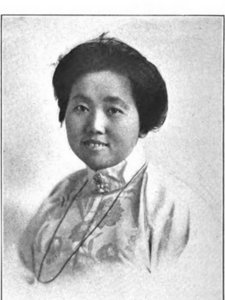
Biography
So often I find in the morning I earn a good fee, and in the evening I spend it on a very poor case.
On the first day of the third moon of 1873, in the river city of Kiukiang — today’s Jiujiang, in Jiangxi province — a young Chinese pastor knelt beside his wife and gave their newborn daughter back to God. They named her Maiyü, “Beautiful Gem,” and before she was a day old they had agreed on something almost unheard of in Central China: her feet would never be bound. Her father was a pastor of the Methodist Episcopal mission, in charge of a chapel in Kiukiang; her mother was the first convert of the missionary Gertrude Howe’s work among Chinese women, and ran a day school for girls. The child would grow up as Shi Meiyu, and the English-speaking world would come to know her as Dr. Mary Stone.
The decision cost the girl something. Unbound feet marked her out for ridicule from adults and children alike. One day an older girl stopped her on the road to school and refused to let her pass unless she knelt and bowed to her own bandaged feet; little Maiyü would not, and only her mother’s help got her through. Relatives warned that no family would ever take her as a daughter-in-law.
Her mother taught her at home, and before she was eight she had memorized the Gospel of Matthew and the catechism in Chinese. Then her father did something even more startling than leaving her feet alone. Impressed by the work of the American medical missionary Dr. Kate Bushnell among the women and children of Kiukiang, he brought his eight-year-old daughter to her and said, “Here is my little girl. I want you to make a doctor of her.” There was no such thing as a Chinese woman physician. Maiyü was placed under Gertrude Howe at the mission’s girls’ boarding school, and spent most of the next ten years there, studying in Chinese and English for a medical course that did not yet exist for anyone like her.
Ann Arbor
In 1892 Miss Howe took Maiyü and her friend Ida Kahn (Kang Cheng), who had grown up in Howe’s own household, to the United States. Both girls passed the entrance examinations of the University of Michigan’s medical department — arithmetic, algebra, rhetoric, history, physics and Latin — and their progress was watched with real curiosity. Professors struggled with her name, so she took its English meaning: Shi is “stone,” and Mary Stone she became.
While she studied, the cause of her childhood followed her across the ocean. Her mother had kept her own feet bound, so that no one could say she had spared her daughters out of ignorance rather than conviction; now Mary wrote urging her to unbind them, and at the mission’s 1894 meeting Mrs. Shi stood before a large crowd and explained why she was doing so. The last shoes she wore bound and the first she wore free were mailed to her daughter in Michigan.
In 1896 Mary Stone and Ida Kahn received their medical degrees, among the very first Chinese women to earn one in the United States. After a summer in the clinics of Chicago — where Dr. I. N. Danforth, who became her lifelong friend, opened the city’s hospitals to her — the two young physicians sailed home and reached Kiukiang in the autumn.
The hospital at Kiukiang
They had expected months of suspicion. Instead patients arrived on their third day home and kept coming. By December they had rented dispensary rooms and rebuilt a Chinese house as a hospital, and by July 1897 they had seen more than two thousand dispensary patients. The building was soon packed beyond bearing. In 1898 Mary wrote home that twenty-one sleepers were crowded into a room the size of a small cottage, an oven by evening in the summer heat.
The new building was ready in 1900 — on the very day the furniture went in, the American consul ordered foreign women and children out of Kiukiang as the Boxer violence spread, and the missionaries persuaded the two Chinese doctors to go with them to Japan. They came back after six months to find the hospital untouched. But that troubled season left a wound in the family: Mary’s father, travelling the country on a preaching tour at the time of the Boxer uprising, was beaten by a mob, and Burton records that those injuries were probably the cause of his death. The hospital was formally opened in December 1901.
Soon after, Ida Kahn went to open medical work in Nanchang, and Mary carried Kiukiang alone. Her day began with prayers in the hospital chapel, then rounds, then a class of nurses, then hours in the dispensary, then house calls on women who could not come to her. She stood on a stool to reach her operating table, and Danforth judged that no Chicago surgeon was doing better work. She charged the rich and spent it on the poor:
So often I find in the morning I earn a good fee, and in the evening I spend it on a very poor case.
— Mary Stone
When the Yangtze flooded in 1901 and refugees poured to her gates, she gave out rice and quilts with the medicine, and at Christmas fed them a square meal. It gave the staff, she wrote, an opportunity to tell them “of the greatest Gift to mankind,” and though they were too rushed even to sit down to their own meals, “we felt it was the happiest Christmas we have ever had.”
An army of nurses
The work that may have mattered most was the one she began out of necessity. With a hundred beds and sometimes a hundred and twenty outpatients a day, she said, she “had to multiply myself by training workers,” and she chose young women from the Christian schools and gave them a course modelled on American training schools. When an American nurse was offered to help her, she gently declined: she wanted the hospital to show Chinese women that they could do things they had never dreamed of, and to show the world that only lack of opportunity had held them back. She trusted her nurses, and she believed God did too.
Surely the Lord values the workers as well as His work, and we who want our work to prosper cannot afford to ignore the interests of those upon whom we depend so largely for success.
— Mary Stone
Her faith ran through every part of the work. Each morning she led a service in the chapel while the nurses held another upstairs; Bible women, among them her own mother, taught the waiting crowds in the dispensary; nurses spent their afternoons off visiting patients’ homes with the gospel, and went out with Bible women to villages beyond reach of any doctor. A missionary walking through the wards one evening heard a low murmur and realized that at every bed someone was praying.
In 1907, after eleven years of almost unbroken labour, an attack of appendicitis forced her to America for surgery in Chicago under Danforth’s care. She went with Jennie Hughes, a young Methodist missionary teacher at Kiukiang who would become her companion and co-worker for the rest of her life. Convalescence turned into a speaking tour. Danforth called her appendix “that blamed thing.” She called it “that blessed thing, because it brought me to this country and people have been so kind to me.” She came home to build a new wing and a nurses’ home. During the 1911 Revolution she turned her hospital over to the care of the wounded, declined the revolutionaries’ white badge so that she could treat both sides, and with two nurses cared for the captured Manchu governor, whom no one else dared approach, until he died.
Leaving the mission
In 1918 Mary handed the Danforth Hospital to her younger sister, Dr. Phebe Stone, and spent a year of advanced study at Johns Hopkins on a Rockefeller scholarship. When she returned to China in 1920, she and Jennie Hughes broke with the Methodist mission they had served for nearly a quarter of a century.
The break should be told plainly and fairly. Stone and Hughes understood it as a matter of conscience: they were troubled by the liberal, modernist theology then gaining ground in the mission boards, which seemed to them to treat social service as a substitute for the gospel rather than its fruit, and they wanted to keep the old-fashioned faith in the authority of Scripture and the need for conversion. Historians who have studied the records, notably Connie Shemo, add other strands — a long dispute between Hughes and mission leaders over what the Bible school should teach, frustration at foreign control of the hospital Mary had built, and the unequal pay of Chinese and foreign workers. These are not contradictory accounts. The quarrel over modernism was real and fierce across China in those years, and it was tangled with a deeper longing that Chinese Christians should lead their own church.
Bethel
With Phebe Stone, the two women founded the Bethel Mission in Shanghai in 1920, independent of any denomination and supported by faith. Within less than a decade it held a hospital and nursing school — Mary’s domain — primary and secondary schools, an orphanage, and, after a revival in 1925, a Bible school under Hughes. Mary still taught a weekly Bible class to her student nurses, praying that they would go out as nurse-evangelists. She and Hughes raised a household of orphaned and needy children in their own home.
Out of Bethel’s students came the Bethel bands: small teams of young evangelists, musically gifted and earnest, who went from church to church holding revival meetings. In 1931 Andrew Gih and fellow Bethel graduates formed the Bethel Worldwide Evangelistic Band, and that same year the young preacher John Sung accepted Mary Stone’s invitation to join it. For nearly three years the band criss-crossed China, holding thousands of meetings during one of the great awakenings of Chinese Protestant history, before Sung parted from it to preach on his own. Much of the independent Chinese church that weathered the decades ahead was shaped by the men and women Bethel trained.
Then came war. In 1937 the Japanese assault on Shanghai brought the compound to ruin, and Bethel’s people scattered inland and to Hong Kong, where the work took root again and continues today. Mary and Jennie went to the United States to raise support, and by 1939 they had settled in Pasadena, California, with their adopted daughters. Jennie Hughes died in 1951, after some forty-five years at her friend’s side.
A gem that was not marred
Mary Stone died in Pasadena on 30 December 1954, at eighty-one. She had been born into a world where a woman doctor was undreamed of and an unbound foot was a disgrace, and she had answered both with patience rather than protest — by doing the work, training others to do it, and pointing her patients past herself to the Great Physician. Christians may weigh the 1920 split differently, but no one who met her in the wards doubted where her strength came from. Writing of the open doors in the homes of rich and poor alike, she put her hope in workers more than in buildings:
The cry now is not for open doors, for we have free entrance into the homes of the rich and poor. What we need now is an efficient force of trained evangelistic workers to … follow up the seed thus sown broadcast on such receptive soil.
— Mary Stone
Her parents had prayed, on the day she was born, that their Beautiful Gem would belong to God and never be marred. Thousands of women in Jiangxi, Shanghai and Hong Kong — patients, nurses, orphans and evangelists — came to know the Saviour because that prayer was answered.
No books or sermons in the library yet for this writer.
Questions and Answers
Who was Mary Stone (Shi Meiyu)?
Mary Stone, born Shi Meiyu (1873–1954), was a Chinese Christian physician from Jiujiang who in 1896 became one of the first Chinese women to earn a medical degree in the United States. She ran the Danforth Memorial Hospital in Jiujiang for some twenty years, trained a generation of Chinese nurses, and in 1920 co-founded the independent Bethel Mission in Shanghai.
What was her childhood like?
She was born in Kiukiang (Jiujiang) in 1873 to a Methodist pastor and his wife, a teacher who was the first convert of missionary Gertrude Howe's work among women. Her parents dedicated her to God at birth and refused to bind her feet, so she grew up mocked for her natural feet. Before she was eight she had memorized the Gospel of Matthew.
Why did she become a doctor?
Her father admired the American medical missionary Dr. Kate Bushnell and brought his eight-year-old daughter to her, asking that she be made a doctor. She studied for about ten years under Gertrude Howe at the mission girls' school to prepare for a medical course.
Where did she study medicine?
In 1892 Gertrude Howe took her and her friend Ida Kahn to the University of Michigan, where both earned medical degrees in 1896. She adopted the English form of her name, Mary Stone, because Shi means stone. While she studied, her mother publicly unbound her own feet at a mission meeting in 1894.
What was the Danforth Memorial Hospital?
After returning in 1896, Stone and Kahn treated patients in a crowded rented house in Kiukiang. Dr. I. N. Danforth of Chicago gave a new hospital in memory of his wife, built from the young doctors' own plans; it was ready in 1900 and formally opened in December 1901. Stone later ran it alone, sometimes seeing over two thousand patients a month.
How did she train nurses?
With a hundred beds and heavy outpatient crowds, she said she had to multiply herself by training workers. She gave young Christian women a course modelled on American nursing schools and declined an American nurse, wanting the hospital to show what Chinese women could do. Her nurses also prayed with patients and carried the gospel to villages.
How did her faith shape the hospital?
Each day began with prayers in the hospital chapel, Bible women taught waiting patients, and nurses visited homes with the gospel. She charged wealthy patients and spent the fees on the poor. One frightened patient, taught to pray by a young nurse, faced her operation unafraid and went home asking the doctor to tell her village about Jesus.
Why did she leave the Methodist mission in 1920?
After a year of study at Johns Hopkins, she and her colleague Jennie Hughes left the Methodist mission in 1920. They saw it as a stand against the modernist theology spreading through the mission boards, which they felt put social service in place of the gospel. Historians add other factors, including disputes over the Bible school, foreign control of the hospital, and unequal pay for Chinese workers.
What was the Bethel Mission?
Founded in Shanghai in 1920 by Mary Stone, her sister Dr. Phebe Stone and Jennie Hughes, Bethel was an independent faith mission with a hospital and nursing school, schools, an orphanage and a Bible school. Its student evangelistic bands held revival meetings across China, and in 1931 the preacher John Sung joined the Bethel Worldwide Evangelistic Band at her invitation.
How did her life end?
When Japan attacked Shanghai in 1937, Bethel moved to Hong Kong, where its work continues, and Stone and Hughes went to the United States to raise support, settling in Pasadena, California. Hughes died in 1951, and Mary Stone died in Pasadena on 30 December 1954, aged eighty-one.