New to John Milton? Start with
Paradise Lost
All works · 6 hr 50 min read
Biography
When I consider how my light is spent, Ere half my days in this dark world and wide, And that one talent which is death to hide Lodged with me useless, though my soul more bent To serve therewith my Maker, and present…
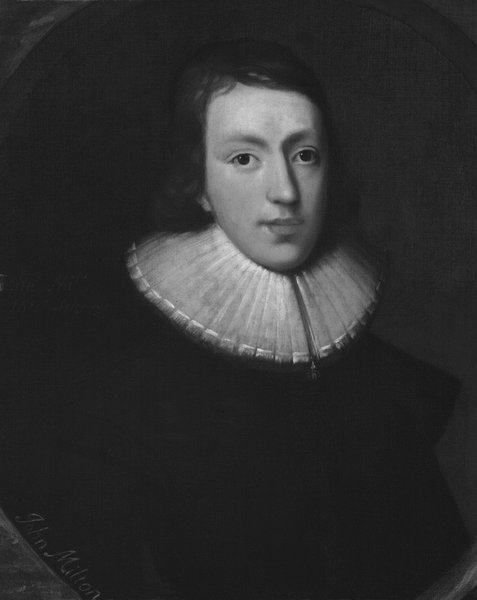
John Milton wrote the greatest poem in the English language about the fall of man, and he wrote it blind, out of favour, and lucky to be alive. He had spent twenty years of his prime arguing in prose for causes that lost, and had buried two wives and two of his children. Then, in a small house in London, with friends and hired readers taking down his lines, he set out to tell the whole story of sin and grace — from the war in Heaven to the promise of a Redeemer — and to “justify the ways of God to men.” Christians of every tradition have been reading it with profit ever since.
A scholar from Bread Street
He was born on 9 December 1608 in a house on Bread Street, in Cheapside, in the City of London. His father, also John Milton, was a scrivener and in his leisure a composer of real accomplishment. Under tutors and at St Paul’s School the boy learned Latin, Greek and Hebrew, French and Italian, and he later remembered that from the age of twelve he seldom went to bed before midnight, a habit he believed began the ruin of his eyes.
At sixteen he went up to Christ’s College, Cambridge, where his fair looks and fastidious manners earned him the nickname “the Lady of Christ’s.” He had been expected to enter the ministry of the Church of England, but he came to feel that he could not in conscience take the oaths a clergyman must swear under the bishops of his day. He gave himself instead to six more years of private study in his father’s houses outside London, in the hope, as he later wrote, of leaving something so written to aftertimes as they should not willingly let it die.
The early poems
The poet showed himself early. On Christmas morning 1629, at twenty-one, he wrote “On the Morning of Christ’s Nativity,” an ode in which the pagan oracles fall silent and the old gods flee before the Child in the manger; it is still read at Christmas. In 1637 a Cambridge acquaintance, Edward King, was drowned in the Irish Sea, and Milton’s elegy for him, “Lycidas,” turned a conventional lament into a meditation on early death and on corrupt shepherds of the Church, and ends in heaven, where the saints “wipe the tears for ever from his eyes.”
Italy, and the call home
In 1638 he set out on a long tour of the Continent. In Florence he visited Galileo, old, blind and a prisoner of the Inquisition in his own house at Arcetri — the one contemporary named in Paradise Lost. He meant to go on to Sicily and Greece, but news of the troubles between King and Parliament turned him back.
Twenty years of prose
Back in London he took in pupils, and from 1641 he poured out pamphlets against the rule of bishops. In 1642 he married Mary Powell, the young daughter of a Royalist family in Oxfordshire. Within weeks she went home to her parents and did not come back for three years. In that bitter interval Milton wrote The Doctrine and Discipline of Divorce and three further tracts, arguing that a marriage without “fit conversation” — without true companionship of mind — was no marriage, and that Scripture allowed it to be dissolved. It scandalised his Puritan allies, and most Christians since have judged it too easy on the gospel’s hard words about divorce, though it was the work of an unhappy man reading his own trouble by the light of Scripture. In 1645 Mary returned — kneeling to beg his pardon, his nephew Edward Phillips remembered — and he took her back. They had four children together.
When Parliament moved to license every book before it could be printed, he answered with Areopagitica (1644), the most famous defence of a free press in English. “Give me the liberty to know, to utter, and to argue freely according to conscience, above all liberties,” he wrote. His liberty had its limits — he would not extend toleration to Roman Catholics — but the book has outlived the age that ignored it.
After the execution of Charles I in 1649, Milton defended the deed in print, and in March of that year the new Council of State made him its Secretary for Foreign Tongues, writing the Republic’s Latin letters to the courts of Europe. He served Cromwell’s government almost to the Restoration, and his Latin Defence of the English People (1651) made him famous across the Continent.
Blindness
His sight had been failing for years, and he was warned that the work on his Defence would cost him what remained of it. He finished it anyway, and by early 1652 he was totally blind, at forty-three. The same year brought heavier losses. Mary died in May 1652, a few days after the birth of their third daughter, Deborah, and within weeks their only son, John, died in infancy. Milton was left in darkness with three small girls. In 1656 he married Katherine Woodcock, and by every account the marriage was happy; but she died in February 1658, a few months after giving birth to a daughter who died soon after her.
Out of the first darkness came the sonnet later editors titled “On His Blindness.” It wrestles with the parable of the talents: how can a servant whose one gift is buried render a true account to his Master? Patience gives the answer.
When I consider how my light is spent,
— John Milton, Sonnet XIX
Ere half my days in this dark world and wide,
And that one talent which is death to hide
Lodged with me useless, though my soul more bent
To serve therewith my Maker, and present
My true account, lest he returning chide;
“Doth God exact day-labour, light denied?”
I fondly ask. But Patience, to prevent
That murmur, soon replies, “God doth not need
Either man’s work or his own gifts; who best
Bear his mild yoke, they serve him best. His state
Is kingly. Thousands at his bidding speed,
And post o’er land and ocean without rest:
They also serve who only stand and wait.”
The Restoration
When the monarchy returned in 1660 Milton had every reason to fear for his life. He had defended the killing of a king. He went into hiding; his books defending the regicide were burned by the common hangman; and in the autumn he was arrested and held in custody. He was released on 15 December 1660, after paying fees that his friend the poet Andrew Marvell, then a member of Parliament, protested in the House were excessive. In 1663 he married Elizabeth Minshull, a young woman who cared for him faithfully to the end.
Paradise Lost
He composed the great poem in the late 1650s and early 1660s, dictating in blank verse — without rhyme, which he called the invention of a barbarous age. When plague came to London in 1665, a young Quaker who read to him, Thomas Ellwood, found him a cottage at Chalfont St Giles in Buckinghamshire, and there Ellwood was lent the finished manuscript. In April 1667 he sold the rights to a printer for £5, with £5 more to come, and Paradise Lost appeared that autumn in ten books. In 1674, the year of his death, he issued the second edition, dividing two of the books to make twelve and setting a prose “Argument” before each — the form in which the poem is read here.
Its opening prayer to the Holy Spirit gives the whole purpose of the work.
What in me is dark / Illumine, what is low raise and support; / That to the highth of this great argument / I may assert the Eternal Providence, / And justify the ways of God to men.
— John Milton, Paradise Lost, Book I
The poem opens in Hell, where Satan and his angels lie stunned on a burning lake, and Satan is magnificent — so magnificent that William Blake would say Milton was “of the Devil’s party without knowing it.” But Milton is showing how splendid evil can look, and how it shrinks: by the end Satan is a serpent hissing in the dust. In Heaven the Son offers himself to die for man while all the angels stand mute; in Eden Adam and Eve live in a love that is innocent and full of joy; then the temptation, the fall, the bitter quarrel, and at last their tears of repentance before God. In the final books the archangel Michael shows Adam the history to come, down to the Seed of the woman who will crush the serpent’s head, and Adam bursts out in wonder at a grace that can bring good from his own ruin.
O Goodness infinite, Goodness immense! / That all this good of evil shall produce, / And evil turn to good.
— John Milton, Paradise Lost, Book XII
When Ellwood returned the manuscript at Chalfont, he asked Milton what he had to say of Paradise found. Later Milton showed him Paradise Regained, a shorter epic of Christ’s victory over Satan’s temptations in the wilderness, and told him he owed the poem to that question. It was published in 1671 together with Samson Agonistes, a tragedy of the blind champion of Israel, “eyeless in Gaza.”
An honest account
Milton was a man of strong and sometimes stubborn convictions, and not all of them were the Church’s. After his death a long Latin treatise, De Doctrina Christiana, lay forgotten among state papers until it was found in 1823 and published in 1825. In it he argued from Scripture that the Son, though divine, was neither coeternal nor equal with the Father — a view near to the ancient Arian heresy — and that the whole person, soul with body, sleeps in death until the resurrection. It also defended his views on divorce and denied that Scripture forbade polygamy. Christians who honour him have to say plainly that on the Trinity the treatise departs from the creeds. Readers still argue over how much of it reaches the poem, but many have found in Paradise Lost nothing a believer cannot read with gladness.
Death and legacy
Milton died of gout, quietly, on 8 November 1674, and was buried beside his father in the chancel of St Giles Cripplegate in the City of London. Readers of every Christian tradition have found in it the biblical story made vivid: the pride of the fallen angel, the goodness of creation, and the grace that answers sin with a Saviour. In 1942 C. S. Lewis published A Preface to Paradise Lost, defending the poem against critics who found it cold or who made Satan its hero. Lewis argued that Milton’s theology is, in the main, the common faith of Christendom, and that Satan, for all his splendour, is a study in self-deceiving pride, never meant to be admired.
The poem ends not in despair but in hope. Adam and Eve, forgiven and promised a Redeemer, shed some natural tears and wipe them soon. “The world was all before them, where to choose / Their place of rest, and Providence their guide.” Hand in hand they go out of Eden. It is a fitting picture of the man who wrote it: blind, bereaved and defeated in everything the world counts success, yet still trusting that the ways of God are good.
Books by John Milton (1)
Questions and Answers
Who was John Milton?
John Milton (1608–1674) was an English poet and writer, born in Bread Street, Cheapside, in the City of London. After the early poems he wrote at Cambridge and twenty years of prose pamphlets, he served the Commonwealth as Secretary for Foreign Tongues, went totally blind by early 1652, and afterwards dictated Paradise Lost, his epic of the fall of man, written to “justify the ways of God to men.”
Where did John Milton study?
Milton learned Latin, Greek and Hebrew, French and Italian under tutors and at St Paul’s School in London, and at sixteen went up to Christ’s College, Cambridge, where his looks and manners earned him the nickname “the Lady of Christ’s.” He had been expected to enter the ministry, but felt he could not in conscience take the oaths a clergyman had to swear under the bishops of his day, and gave himself instead to six more years of private study.
What were Milton’s early poems?
On Christmas morning 1629, at twenty-one, Milton wrote “On the Morning of Christ’s Nativity,” an ode in which the pagan oracles fall silent and the old gods flee before the Child in the manger; it is still read at Christmas. In 1637 he wrote “Lycidas,” an elegy for the drowned Edward King that becomes a meditation on early death and on corrupt shepherds of the Church, and ends in heaven.
Did John Milton meet Galileo?
Yes. On his tour of the Continent in 1638 Milton visited Galileo in Florence, when the astronomer was old, blind and a prisoner of the Inquisition in his own house at Arcetri. Galileo is the one contemporary named in Paradise Lost. Milton meant to travel on to Sicily and Greece, but news of the troubles between King and Parliament turned him back to England.
What did Milton argue in Areopagitica and the divorce tracts?
After his young wife Mary Powell went home to her family, Milton wrote The Doctrine and Discipline of Divorce and three further tracts, arguing that a marriage without true companionship of mind was no marriage and could be dissolved; it scandalised his Puritan allies. In Areopagitica (1644) he opposed the licensing of books before printing: “Give me the liberty to know, to utter, and to argue freely according to conscience, above all liberties.” He would not extend that toleration to Roman Catholics.
When did John Milton go blind?
Milton’s sight had been failing for years, and he was warned that writing his Latin Defence of the English People (1651) would cost him what remained of it. He finished it anyway and was totally blind by early 1652, at forty-three. Out of that darkness came the sonnet later editors titled “On His Blindness,” which ends: “They also serve who only stand and wait.”
What losses did Milton suffer in his family?
His first wife, Mary, died in May 1652, a few days after the birth of their third daughter, Deborah, and within weeks their only son, John, died in infancy. In 1656 he married Katherine Woodcock, a happy marriage, but she died in February 1658, a few months after giving birth to a daughter who also died. In 1663 he married Elizabeth Minshull, who cared for him faithfully to the end.
What happened to Milton at the Restoration?
Having defended the execution of Charles I and served Cromwell’s government, Milton went into hiding when the monarchy returned in 1660. His books defending the regicide were burned by the common hangman, and in the autumn he was arrested and held in custody. He was released on 15 December 1660, after paying fees that his friend Andrew Marvell protested in Parliament were excessive.
How did Milton write Paradise Lost?
Blind, he dictated the poem in blank verse to friends and hired readers. John Aubrey recorded that he rose at four in the morning, had the Hebrew Bible read to him first, and then sat in contemplation before dictating. The poem appeared in ten books in 1667; in 1674, the year of his death, Milton issued the second edition in twelve books with a prose Argument before each. Paradise Regained and Samson Agonistes followed in 1671.
Was John Milton orthodox in his beliefs?
Not entirely. His Latin treatise De Doctrina Christiana, found in 1823 and published in 1825, argued that the Son, though divine, was neither coeternal nor equal with the Father, a view near to the ancient Arian heresy, and that soul and body sleep in death until the resurrection. Readers still argue how much of it reaches the poem, and C. S. Lewis’s A Preface to Paradise Lost (1942) defended the poem’s theology as, in the main, the common faith of Christendom.