Where to start reading
Start with
The Spiritual Exercises
Books by Ignatius of Loyola (1)
Biography
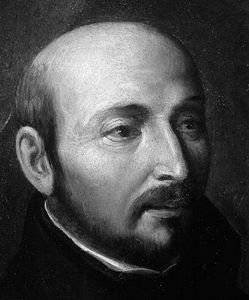
Ignatius of Loyola is remembered as the founder of the Jesuits, one of the most disciplined and far-reaching religious orders the church has known. It is worth beginning somewhere humbler: with a vain young soldier lying in bed in his family’s house with a shattered leg, bored, asking for romances of knights and ladies to pass the time, and being handed instead a life of Christ. Nearly everything that followed — the order, the schools, the missions to the ends of the earth — grew out of what happened to him in that bed, and out of what he learned there about the movements of his own heart. He wrote it down as a handbook for helping others find God: The Spiritual Exercises.
A courtier with a sword
He was born Íñigo López de Oñaz y Loyola, probably in 1491 — the traditional date is 23 October, though some historians think he was born a little earlier — in the castle of Loyola near Azpeitia, in the Basque province of Gipuzkoa in northern Spain. He was the youngest of thirteen children of a family of the minor nobility, proud and quarrelsome. His mother died soon after his birth, and the boy was nursed by the wife of the local blacksmith. His native tongue was Basque, not Spanish, a fact his translators still notice in the plainness of his written style.
As a youth he became a page in the household of Juan Velázquez de Cuéllar, treasurer of the kingdom of Castile, and there he learned the life of a courtier: dancing, fencing, gambling, the pursuit of women, and duelling. He modelled himself on the heroes of the chivalric romances, above all Amadís de Gaula, and he wanted fame. One biographer calls him a fancy dresser and a rough swordsman, sensitive to insult. At about eighteen he entered the service of the Duke of Nájera.
The cannonball at Pamplona
On 20 May 1521, a French and Navarrese army attacked the fortress of Pamplona, which Íñigo was helping to defend. A cannonball, ricocheting off a wall, smashed his right leg. He was carried home to Loyola, and there, with no anaesthetic, he underwent a series of operations in which the bones were set, broken again and reset. He survived, but the leg was left shorter than the other. He would limp for the rest of his life, and his military career was over.
The convalescence was long. To fill the hours he asked for the romances of chivalry he loved, but there were none in the castle. His sister-in-law, Magdalena de Araoz, brought him what there was: the Life of Christ by Ludolph of Saxony, and a collection of lives of the saints. Ludolph taught his readers to place themselves in imagination inside the Gospel scenes — to stand by the manger, to watch and listen — and that way of praying would become the heart of the Exercises.
His mind still wandered off into daydreams of the great deeds he would do for his king and for a royal lady he loved. But he began to notice something. When he dreamed of worldly glory, the dream delighted him while it lasted and left him dry and dissatisfied afterwards. When he dreamed of following Christ as the saints had, the joy remained long after the dream had ended. It was the first lesson in what he would later call the discernment of spirits: learning to read the after-effects of one’s thoughts and desires, and to tell which come from God and which do not.
A sword left at Montserrat
When he could walk again, he resolved to go as a pilgrim to Jerusalem and to do penance for his past life. In March 1522 he came to the Benedictine monastery of Montserrat, high in the mountains of Catalonia. There he examined his whole life and made a full confession. He gave away his fine clothes to the poor and put on a garment of sackcloth.
From Montserrat he walked to the nearby town of Manresa, and stayed there about a year. He begged for his keep, later doing chores at a local hospital in exchange for food and lodging, and practised a hard, rigorous penance. He knew deep consolation there, and he also learned to be wary of spiritual experience itself: a beautiful shape that appeared to him again and again in the air and filled him with delight he came in the end to judge was not from God.
The pilgrim goes to school
In 1523 he finally reached Jerusalem, hoping to spend his life there near the places where Christ had walked. The Franciscans who had charge of the holy places would not allow it, and within weeks he was sent home. He concluded that, if he was to help souls, he needed an education. So, at about thirty-three, the former courtier sat down among schoolboys in Barcelona to learn Latin grammar.
From there he went on to the University of Alcalá, studying theology and Latin in 1526 and 1527. Devout groups known as alumbrados, “the enlightened,” were then under the Inquisition’s suspicion, and a layman with no degree in theology preaching in the street looked dangerous. At Alcalá he was singled out and questioned by the Inquisition, and later released.
In Paris he studied at the strict Collège de Montaigu and then at the Collège Sainte-Barbe, and around this time he began to use the Latin name Ignatius, probably as a variant of Íñigo that foreigners understood better. In Paris he gathered companions — Peter Faber, Francis Xavier, Diego Laínez, Alfonso Salmerón, Nicolás Bobadilla and Simão Rodrigues. On 15 August 1534, in a chapel on the hill of Montmartre, Ignatius and six companions, only one of them a priest, took solemn vows together, binding themselves to the work of their lives.
The Society of Jesus
The companions planned to go to the Holy Land, but war between Venice and the Ottoman Empire made the voyage impossible. In 1537, at Venice, Ignatius and most of the others were ordained priests. Instead of Jerusalem they went to Rome and offered themselves to the pope. In 1540 Pope Paul III approved their new order, the Society of Jesus, and in 1541 Ignatius was elected its first Superior General. To the usual vows of poverty, chastity and obedience he added a fourth: a special vow of obedience to the pope to go wherever he might send them.
From Rome Ignatius governed the young order, drafting the Society’s Constitutions with his secretary Juan Alfonso de Polanco, and sending his companions out — Francis Xavier to India and the East, others across Europe to preach, teach and found schools. Its guiding principle became Ad maiorem Dei gloriam, “for the greater glory of God.”
In 1548 Paul III formally approved the Spiritual Exercises. The examiners, his bull records, had found them “full of piety and holiness.” It is a set of instructions for the one who guides a retreat, laid out over four “Weeks” lasting about thirty days. It opens with a single sentence that sets out the purpose of human life:
Man is created to praise, reverence, and serve God our Lord, and by this means to save his soul.
— Ignatius of Loyola, The Spiritual Exercises, Principle and Foundation
Everything else follows from that. If we are made for God, then health or sickness, riches or poverty, honour or dishonour, a long life or a short one, are to be desired only so far as they help us toward him. The first Week leads the person through the reality of sin; in its first meditation he is asked to imagine Christ on the cross before him and to speak with him, asking “what I have done for Christ, what I am doing for Christ, what I ought to do for Christ.” The later Weeks move through the life, death and resurrection of Jesus, inviting the one praying to enter each scene with all the senses, as Ludolph had taught Ignatius in his sickbed. Again and again Ignatius insists that the point is not information but encounter:
For it is not knowing much, but realising and relishing things interiorly, that contents and satisfies the soul.
— Ignatius of Loyola, The Spiritual Exercises, Second Annotation
Woven through the book are the rules for the discernment of spirits, the fruit of his own experience at Loyola and Manresa. He describes consolation and desolation with a precision that still helps people today, and gives counsel born of hard experience: “In time of desolation never to make a change.” There are also rules for thinking with the church, written in the age of the Reformation, which ask the retreatant to put the judgment of the church above his own. One of them, which says that “the white which I see, is black, if the Hierarchical Church so decides it,” has troubled many readers. It belongs to Ignatius’s conviction that the same Spirit guides both the believer and the church.
A last offering
Ignatius was not an easy man. He was a soldier who had become a saint, and he kept a soldier’s will; the Constitutions he wrote asked his men for an absolute self-denial and obedience. Yet the Exercises open with a plea for charity in judging others — that every good Christian should be “more ready to save his neighbor’s proposition than to condemn it” — and the last Week closes with a contemplation on the love of God, which begins with the note that “love ought to be put more in deeds than in words.” At its centre is the prayer for which he is best known, the offering of a whole life back to the one who gave it:
Take, Lord, and receive all my liberty, my memory, my intellect, and all my will—all that I have and possess. Thou gavest it to me: to Thee, Lord, I return it! All is Thine, dispose of it according to all Thy will. Give me Thy love and grace, for this is enough for me.
— Ignatius of Loyola, The Spiritual Exercises, Contemplation to Gain Love
In his last years his health failed. Around 1553 he dictated the story of his early life to a younger Jesuit, the account through which we know most of what happened at Loyola and Manresa. He died in Rome on 31 July 1556, probably of the “Roman fever,” a severe form of malaria; an autopsy found that he had also long suffered from stones in his kidneys and bladder. He was buried in Rome, and his remains now lie in the Church of the Gesù. He was beatified in 1609 and canonized on 12 March 1622, and in 1922 Pope Pius XI named him patron of spiritual retreats.
Why read the Exercises
The edition offered here is Father Elder Mullan’s translation of 1914, made directly from the Spanish “Autograph” — the copy Ignatius himself corrected and used in giving the Exercises. Mullan kept close to Ignatius’s plain wording, so that readers could feel sure they were reading the saint’s own words, and he warned that the book is not meant to be read quickly but to be “pondered word for word and under the direction of a competent guide.” Read straight through, it can seem dry. Prayed slowly, it has formed saints, missionaries and ordinary believers for nearly five hundred years.
What Ignatius leaves is less a method than a way of looking: the conviction that God is at work in every created thing and in the stirrings of every heart, and that a person can learn, with patience and honesty, to notice where he is leading. It began with a wounded man who was handed the wrong book. He spent the rest of his life helping others find what he had found, and learn to say with him, “Give me Thy love and grace, for this is enough for me.”
Questions and Answers
Who was Ignatius of Loyola?
Ignatius of Loyola (1491–1556) was a Basque nobleman and soldier who became a priest and founded the Society of Jesus, the Jesuits. He is best known for The Spiritual Exercises, his handbook of prayer and discernment.
What was Ignatius like as a young man?
Born Íñigo López de Oñaz y Loyola, the youngest of thirteen children, he grew up as a page in the household of the treasurer of Castile. He loved dancing, fencing, gambling, duelling and tales of chivalry, and he longed for fame as a soldier.
What happened to Ignatius at Pamplona?
On 20 May 1521, while the fortress of Pamplona was under attack by a French and Navarrese army, a cannonball shattered his right leg. Painful operations without anaesthetic left him with a limp for life and ended his military career.
How was Ignatius converted?
During his convalescence at Loyola there were no romances of chivalry to read, so he read a life of Christ by Ludolph of Saxony and lives of the saints. He noticed that dreams of worldly glory left him dry, while dreams of following Christ left lasting joy, and this was the beginning of his teaching on discernment.
What did Ignatius do at Montserrat and Manresa?
In March 1522 at the monastery of Montserrat he made a full confession, gave away his fine clothes, and after an all-night vigil hung his sword and dagger at the altar of the Virgin. He then spent about a year at Manresa in poverty and penance, praying some seven hours a day and drafting the first outline of the Spiritual Exercises.
Why did Ignatius go back to school?
After a pilgrimage to Jerusalem in 1523, where he was not allowed to stay, he decided he needed an education to help souls. He studied Latin grammar in Barcelona at about thirty-three, then at Alcalá, where the Inquisition questioned him and released him, and finally at the University of Paris.
How did the Society of Jesus begin?
In Paris Ignatius gathered companions including Peter Faber and Francis Xavier, and on 15 August 1534 they took solemn vows together at Montmartre. Ordained in Venice in 1537, they offered themselves to the pope, and Paul III approved the Society of Jesus in 1540, with Ignatius elected its first Superior General in 1541.
What is The Spiritual Exercises?
It is a set of instructions for guiding a retreat of about thirty days in four “Weeks,” moving from the purpose of human life and the reality of sin through the life, death and resurrection of Christ. It includes rules for the discernment of spirits and the prayer “Take, Lord, and receive,” and was approved by Pope Paul III in 1548; the edition published here is Elder Mullan’s 1914 translation from the Spanish Autograph.
What is the Principle and Foundation?
It is the opening meditation of the Exercises, which begins “Man is created to praise, reverence, and serve God our Lord, and by this means to save his soul.” From it Ignatius teaches that all created things are to be used only so far as they help a person toward that end.
When did Ignatius die, and how is he remembered?
He died in Rome on 31 July 1556, probably of malaria, and his remains lie in the Church of the Gesù. He was canonized on 12 March 1622, his feast is kept on 31 July, and in 1922 Pope Pius XI named him patron of spiritual retreats.