Where to start reading
Sermons by Frances Ridley Havergal (8)
Our Lives Kept for Jesus
Havergal asks why the consecration sung in "Take my life" so often feels weak, and finds two causes: doubting that the Lord truly heard and accepted the offering, and never asking Him to keep what He took. She urges readers to entrust even their trust to Christ, pictures consecration as land made over to a new owner and cultivated by degrees, and ends by inviting the young to a life that is "a deal better" than they thought.Our Moments Kept for Jesus
Taking the hymn line "Keep my moments and my days," Havergal argues that consecrating time in large sweeps stays vague, and that we must commit not only years, weeks and days but each moment to the Lord. Moments are where temptation strikes and where God often does His greatest work, and He sets His heart on us every moment. She ends by asking readers to entrust every moment to Him, to be filled with His praise.Our Hands Kept for Jesus
Starting from her prayer that our hands may move at the impulse of Christ's love, Havergal asks readers to bring their hands to the Lord to be emptied, cleansed and filled, as the priests' hands were laid on the offerings before being filled with consecrations. She applies this to ordinary work, letter-writing, gentleness and skill, and lands on the love of Christ as the one impulse that moves and keeps the hands.Our Voices Kept for Jesus
Taking the hymn line "Keep my voice, and let me sing / Always, only, for my King," Havergal urges singers to give their voices wholly to Christ rather than to self-pleasing and society. She advises asking the Master about every song, commends singing Scripture's own words, and challenges teachers, parents and young men alike. She closes with the joy of singing for Jesus now and for ever above.Our Lips Kept for Jesus
Taking up the prayer that her lips be kept and filled with messages from God, Havergal urges consecrated Christians to trust Christ really to keep them, not merely to ask it. She traces how He purifies and fills the lips, warns against idle talk and mere entertaining, and tells of a girl who longed for a word about the Saviour that never came. She closes by asking whether lips given to Christ should take in the drink that ruins thousands.Our Wills Kept for Jesus
Havergal challenges the belief that God can keep everything but our wills, a belief that limits his promises to our own experience. She grounds hope in the promise that God works in us "both to will and to do", and in the picture of a bride glad to please her husband. When the will is surrendered, God's will is seen as love in action, and the chapter ends with Jean Sophia Pigott's hymn of resting in that will.Our Selves Kept for Jesus
Taking the last line of her hymn, "Keep my self, that I may be Ever, only, all for Thee", Havergal argues that even self can be subdued to Christ and kept for Him, since His people are His special treasure. She insists that "all" must be sealed with "only", for there is no consecration without separation, shows how a kept self brings kept influence, and ends with the joy of being for Him for ever.Christ for Us
From Hosea's words "So will I also be for thee," Havergal shows how Christ answers every detail of our consecration with His own self-giving. She moves through twelve gifts, His life, eternity, hands, feet, voice, lips, wealth, wisdom, will, heart and love, each "for thee," and lands on the greatest: Christ Himself, all His Godhead and manhood, for ever. The chapter ends in the whole-hearted cry to be "Ever, ONLY, ALL for Thee!"Biography
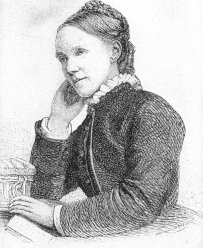
Few hymns have been sung by so many people who could not tell you who wrote them as “Take my life, and let it be.” It is short, plain, almost childlike: a string of little couplets, each handing over one more piece of a life — hands, feet, voice, lips, money, mind, will, heart — until nothing is left but the self, and that goes too. Its writer, Frances Ridley Havergal, was a gifted, quick, laughing woman who could have had a brilliant career as a singer or a scholar. Instead she spent the last years of her short life trying to mean every line of that hymn. The remarkable thing is how literally she did.
A Rectory Childhood
She was born on 14 December 1836 at the rectory of Astley, in Worcestershire, the youngest of the six children of the Rev. William Henry Havergal and his wife Jane. Her father was a clergyman and composer of church music, and the house was full of books and tunes. Frances was quick almost to a fault. Her sister Maria recorded that at four years old she could read the Bible, and she was writing verse by seven. She would later learn French, German and Italian, and enough Greek and Hebrew to read the Scriptures in their original tongues; she sang beautifully and played the piano with real skill.
Cleverness did not make her a Christian, and she knew it. Looking back, she remembered a childhood of real, troubled longing for an assurance she did not have. When she was eleven her mother fell gravely ill. Jane Havergal spoke to her youngest daughter with great tenderness: “You are my youngest little girl, and I feel more anxious about you than the rest. I do pray for the Holy Spirit to lead you and guide you.” She died on 5 July 1848, and the motherless girl carried those words for years.
The light came at fourteen. Early in 1851, after a term at a boarding school at Belmont where for the first time she had spoken openly with others about her soul, she found herself confiding in Caroline Cooke, a friend of the family who would soon become her stepmother. One evening, at twilight, sitting alone with her on the drawing-room sofa, Frances poured out how much she longed to know she was forgiven. Miss Cooke asked her a simple question: if Christ were to come at that very moment, could she not trust Him? Could she not commit her soul to Him? “Then came a flash of hope across me,” Frances wrote, “which made me feel literally breathless.” She ran upstairs, knelt in her room, and there, by her own account, “I committed my soul to the Saviour … and earth and heaven seemed bright from that moment — I did trust the Lord Jesus.”
Gifts Laid Down, Gifts Taken Up
The years that followed were full and, for the most part, happy. In 1852 she went with her father and stepmother to Germany and studied at the Louisenschule in Düsseldorf. Back in England she taught Sunday school, collected for the Church Missionary Society, and began to publish poems. One of the earliest to become widely known was written in Germany in 1858. She had come in tired and sat down opposite a picture bearing a motto, and at once the lines came to her: “I gave My life for thee.” She pencilled them on a scrap of paper, read them over, was dissatisfied, and tossed them into the fire. The paper fell out unburnt. Months later she showed it to her father, who encouraged her to keep the verses and wrote a tune for them himself.
Her father’s death came suddenly. On Easter Day 1870 he was struck down by apoplexy and died forty-eight hours later without regaining consciousness. Frances had loved him dearly and had shared all his musical work; she gave herself afterwards to editing his tunes and to preparing the music for the hymnbook Songs of Grace and Glory. Her own books of verse were finding a wide readership. Yet by her own later testimony, something was still missing. Her faith was real, but there had been, as Maria put it, “sunless ravines.”
Advent Sunday, 1873
Toward the end of 1873, while she was staying with relatives at Winterdyne near Bewdley, a friend sent her a tiny book called All for Jesus. It described a fullness of surrender and of joy that she knew she had not reached, and she wrote to its author, “I want Jesus to speak to me … that I may speak for Him to others with real power. It is not knowing doctrine, but being with Him, which will give this.” A few sentences in the reply — on Christ’s power to keep those who abide in Him, and on the continual cleansing of His blood — went straight home. Later she told her sister exactly when the light broke.
Yes, it was on Advent Sunday, December 2nd, 1873, I first saw clearly the blessedness of true consecration. I saw it as a flash of electric light, and what you see you can never unsee. There must be full surrender before there can be full blessedness.
— Frances Ridley Havergal
She believed it was God’s own direct teaching through the Scriptures. The word that opened the door was a single verb in 1 John 1:7: the blood of Jesus Christ His Son cleanseth us from all sin. She had never before noticed that it was a continual present tense — “not a coming to be cleansed in the fountain only, but a remaining in the fountain.” The change, Maria wrote, “lifted her whole life into sunshine,” and those who lived with her saw it in the most ordinary and most testing place of all: the cheerful obedience of her home life.
Ten Persons in the House
Within weeks of that Advent Sunday — the index to her collected poems dates it to 4 February 1874 — Frances went for a short visit to Areley House, a few miles from her birthplace. She later told the story herself, simply, in a letter.
Take my life, and let it be / Consecrated, Lord, to Thee. … Take my silver and my gold; / Not a mite would I withhold. … Take myself, and I will be / Ever, only, ALL for Thee.
— Frances Ridley Havergal
What makes the hymn more than a fine sentiment is that she went on, quietly, cashing its promises. “Take my voice, and let me sing always, only, for my King” became the rule of her singing from that winter on. Years later, in August 1878, the couplet about silver and gold caught up with her. “It has come over me this morning,” she told Maria, “that I shall send all my jewellery to the Church Missionary Society.” Nearly fifty pieces were packed off, including a jewel cabinet she said was fit for a countess; she kept only a few keepsakes of her parents and her little niece, and paid their value to the Society. “I don’t think I need tell you,” she wrote, “I never packed a box with such pleasure.”
Peace in the Valley
Consecration did not mean an easy road. In the autumn of 1874, returning from Switzerland, she caught typhoid fever and was brought very low; by the middle of November her family thought her life hung in the balance.
Other blows fell. Not long afterwards the premises of the firm printing her musical edition of Songs of Grace and Glory burned to the ground, and with them the greater part of her manuscript, of which she had kept no copy. It was out of seasons like these that she wrote, with no trace of cheap comfort, the hymn many still sing as a word of rest:
Like a river glorious is God’s perfect peace, / Over all victorious in its bright increase. … Stayed upon Jehovah, hearts are fully blest; / Finding, as He promised, perfect peace and rest.
— Frances Ridley Havergal
Her pen kept moving. Little devotional books poured out — My King, Royal Commandments, Royal Bounty, Morning Bells and Little Pillows for children — alongside a vast correspondence with strangers who wrote to her for help. In October 1877 she wrote the rallying call “Who is on the Lord’s side? Who will serve the King?”, and in 1878 gathered her later hymns, many with her own tunes, into Loyal Responses. She worked for missions, for the Young Women’s Christian Association and for temperance. She longed to go to India and could not; instead, she said of her jewels, “I can’t go to India, but I can help to send some one.”
Splendid to Be So Near the Gates
In 1878 her stepmother died, the Leamington home was broken up, and that autumn Frances went to live with Maria at Caswell Bay, on the Gower coast near the Mumbles and Swansea. She was also finishing a prose book that would serve as a long meditation on her own hymn, taking it couplet by couplet as a prayer to be kept as well as taken. In it she pressed home the point that had freed her: if we ever truly said “Take my life,” He heard it. “For with Him hearing means heeding.” She finished revising the proofs of Kept for the Master’s Use shortly before she died.
In late May 1879 she caught a chill; fever and inflammation set in (peritonitis, by most accounts), and the pain was severe. When the doctor told her she was seriously ill, she answered, “If I am going it is too good to be true!” Over the following days her family heard her say again and again, “Splendid to be so near the gates of heaven!” She sent a message to the young women she had taught: “God’s promises are all true, and the Lord Jesus is a good big foundation to rest upon.”
There is no bottom to God’s mercy and love; all His promises are true, not one thing hath failed.
— Frances Ridley Havergal
At dawn on Whit Tuesday, 3 June 1879, the end came. Her last thought for others was that everyone she loved should be told, “Trust Jesus.” Her sister repeated the hymn “Jesus, I will trust Thee,” and Frances, clearly though faintly, sang the whole verse to her own tune. After a last spasm of pain she settled back on her pillows with the words, “There, now it is all over! Blessed rest!” For some minutes her face shone as if she saw her King; she tried to sing once more, reached one high note, and, as her brother commended her soul to her Redeemer, she was gone. She was forty-two. She was carried home to Astley and buried in the churchyard where her father lay.
Kept for the Master’s Use was published that same year, the hymns were gathered into her Poetical Works, and Maria’s Memorials of her sister went through edition after edition. Her life was short and, outwardly, small: she never married, never reached the mission field, and spent much of her strength on illness. But she had found a way of giving that did not depend on going anywhere. She simply kept handing over whatever was in her hands — her voice, her pen, her jewels, her days — and trusting that He who had asked for them had really taken them. Every congregation that still sings her couplets is singing her answer to the question with which all real devotion begins.
Questions and Answers
Who was Frances Ridley Havergal?
Frances Ridley Havergal (1836–1879) was an English poet, hymn writer and devotional author, best known for the consecration hymn “Take my life, and let it be.” She also wrote “Like a river glorious,” “I gave my life for thee” and “Who is on the Lord’s side?”, along with devotional books such as Kept for the Master’s Use.
Where was she born, and what was her family like?
She was born on 14 December 1836 at the rectory of Astley in Worcestershire, the youngest of six children of the Rev. William Henry Havergal, a clergyman and composer of church music. She could read the Bible by four, wrote verse by seven, and grew up to read the Scriptures in Greek and Hebrew as well as speaking several modern languages.
How did her mother’s death affect her?
Her mother, Jane, died on 5 July 1848, when Frances was eleven. Before she died she told her youngest daughter that she felt especially anxious for her and prayed for the Holy Spirit to lead and guide her, words Frances carried for years.
When did Frances Havergal come to trust in Christ?
Early in 1851, at fourteen, she confided her longing for forgiveness to Caroline Cooke, who soon afterwards became her stepmother. Asked whether she could not commit her soul to her Saviour at once, she felt “a flash of hope,” ran upstairs, knelt in her room, and there trusted the Lord Jesus.
How did she come to write “I gave my life for thee”?
She wrote it in Germany in 1858, after sitting down, tired, opposite a picture bearing those words as its motto. Dissatisfied with her pencilled lines, she threw them into the fire, but the paper fell out unburnt; her father later encouraged her to keep them and wrote a tune for them.
What happened to her on Advent Sunday 1873?
On 2 December 1873, after reading a small book called All for Jesus, she “first saw clearly the blessedness of true consecration,” as she later told her sister, likening it to “a flash of electric light.” The truth that opened it was that Christ’s blood goes on cleansing, and that He who cleanses has power to keep, so she yielded herself wholly to Him and trusted Him to keep her.
What is the story behind “Take my life, and let it be”?
Shortly afterwards (her collected poems date it 4 February 1874) she spent five days at Areley House, where there were ten persons, some unconverted and some unhappy Christians, and she prayed, “Lord, give me all in this house!” Before she left every one had received a blessing, and on her last night, too happy to sleep, she spent the hours in praise while the hymn’s couplets formed in her heart, ending “Ever, only, all for Thee.”
Did she really give away her jewellery because of the hymn?
Yes. In August 1878 she decided that “Take my silver and my gold” meant sending nearly fifty pieces of jewellery to the Church Missionary Society, keeping only a few family keepsakes, whose value she paid in. She wrote that she had never packed a box with such pleasure.
What trials did she face, and what did she write in them?
In 1874 she nearly died of typhoid fever, and was restored after many had prayed for her; a fire at the printers also destroyed most of her manuscript for a hymnbook’s musical edition, which she had to redo. Out of such years came hymns of trust like “Like a river glorious,” the call “Who is on the Lord’s side?” in 1877, and many small devotional books.
How did Frances Ridley Havergal die?
She died at Caswell Bay near Swansea, where she was living with her sister Maria, on Whit Tuesday, 3 June 1879, aged forty-two, after a short and painful illness. She spoke often of how “splendid” it was to be so near the gates of heaven, sang a verse of “Jesus, I will trust Thee” at the end, and was buried at Astley; Kept for the Master’s Use, whose proofs she had just finished, was published later that year.