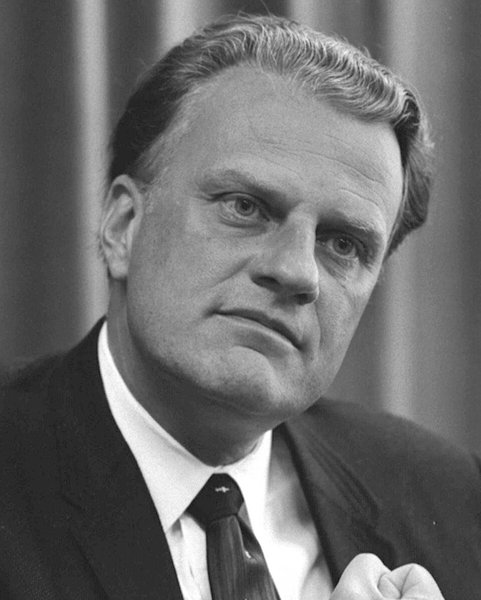
Biography
- 1918 Born
- 1934 Converted
- 1943 Married
- 1949 LA Crusade
- 2018 Died
Preacher of the Gospel of the Lord Jesus Christ
He preached the gospel, in person, to more people than anyone who has ever lived — by his own organization's count, some 215 million of them, in stadiums and rice paddies and cathedral squares across 185 countries — and when he came to choose the words for his grave, he asked for none of that. The marker at the Billy Graham Library in Charlotte gives his name, a reference to John 14:6, and four plain words for the work: Preacher of the Gospel of the Lord Jesus Christ. That is the whole of the ambition he would own. A man who could fill Seoul with a million people wanted to be remembered as a country preacher who told them about Jesus.
Preacher of the Gospel of the Lord Jesus Christ
— the epitaph Billy Graham chose for his own gravestone
A dairy farm outside Charlotte
William Franklin Graham was born on 7 November 1918, on the family dairy farm near Charlotte, North Carolina, into a church-going Reformed Presbyterian household where the chores started before dawn. It was an ordinary rural Southern boyhood, and nothing in it marked him out.
The turn came when he was sixteen. In 1934 a travelling evangelist named Mordecai Ham held a revival in Charlotte, and Graham — by his own account more curious than convicted at first — went, and went forward, and made his decision for Christ. Every account of his life, including his own memoir, treats that night as the hinge. He did not become a preacher that evening; he became a Christian, and the preaching would take years to find its shape.
It took, in fact, a false start and a long apprenticeship. He enrolled at Bob Jones College in 1936 and lasted only about a semester, finding its fundamentalism airless. He moved to the Florida Bible Institute near Tampa, and it was there, not in any classroom crisis but in the slow settling of a young man's mind, that he became sure he was called to preach. He was ordained in the Southern Baptist Convention in 1939. Then came Wheaton College in Illinois, where he graduated in 1943 with a degree in anthropology — and where he met Ruth McCue Bell, a daughter of medical missionaries to China. They married that same year in Montreat, North Carolina, and stayed married sixty-three years, until Ruth's death in 2007.
Modesto: four resolutions before the fame
Before any of the crowds, there was a small room in Modesto, California, in 1948, and a decision that may have mattered more than any sermon. Graham had watched travelling evangelists wreck themselves and their witness — on money, on women, on lies about their crowds, on rivalry with the local church — and he did not intend to join them. With his three closest associates — song leader Cliff Barrows, soloist George Beverly Shea, and Grady Wilson — he sat down and resolved four safeguards for the work ahead.
They would handle money honestly: no love-offering abuses, a fixed salary, audited and open finances, and no pleading for cash from the platform. They would guard against even the appearance of sexual impropriety — the rule, which later took Graham's name, that none of them would travel, meet, or dine alone with a woman other than his wife. They would tell the truth about numbers, and never inflate a crowd or a count of conversions. And they would not compete with local pastors or criticize them, but work through the churches and hand converts back to them.
It was not a signed document, and no manifesto was published that day; the catchy name, the Modesto Manifesto, came later. They were four spoken resolutions four young men made to keep each other honest. But it is one of the most admirable and best-documented facts of his life, and it goes a long way to explain the plainest thing about him: across six decades at the very top of American religion, he finished without a money scandal and without a sex scandal. The guardrails held because he built them before he needed them.
The tent that would not come down
The breakthrough came in Los Angeles in 1949. Graham and his team pitched a great circus-style tent — the "Canvas Cathedral" — at Washington Boulevard and Hill Street, and scheduled three weeks. The crowds kept coming, and the three weeks stretched to eight. Press attention (the newspaper magnate William Randolph Hearst is said to have told his editors to "puff Graham") turned a regional preacher into a national figure almost overnight.
What followed was without precedent. Over roughly six decades he held some 400 crusades across more than 185 countries and territories. The BGEA — the Billy Graham Evangelistic Association, which he founded in Minneapolis in 1950 — estimates that he preached in person to around 215 million people, and that more than three million responded to his invitation to come forward. His largest single live audience, more than a million, gathered in Seoul in 1973. These are the organization's own tallies, and are best held as its estimates rather than bare fact; but even discounted, they describe a reach no evangelist before him approached.
The close was always the same. As the congregation sang the old hymn Just As I Am — Charlotte Elliott's words, "just as I am, without one plea" — Graham would invite people to leave their seats and come forward to Christ. That invitation, repeated in hundreds of cities and dozens of languages, is the image the world keeps of him: a tall man with an open Bible, and a slow river of people walking down toward a platform while the hymn went round again.
Around the preaching he built a machine to carry it — the radio programme Hour of Decision from 1950, World Wide Pictures, Decision magazine from 1960, and a team, Barrows and Shea and Wilson, that stayed with him for life.
Carried on prayer
Graham never claimed the fruit was his. He credited prayer as the engine of anything that came of the crusades, and named it, again and again, as one of the keys to the work. That was not only pulpit modesty; it was method. The crusades were prepared on prayer long before Graham arrived in a city. For months beforehand, host cities were organized into local prayer groups and cottage prayer meetings — ordinary people meeting in front rooms to pray for their neighbours by name — and the BGEA regarded this groundwork as essential to whatever happened once the singing began.
It is worth being careful here, because the legend runs ahead of the record. The vivid private-prayer scenes that attach themselves to famous preachers — the exact hours risen, the tears, the words wrestled out before dawn — are mostly devotional embroidery, and Graham deserves better than embroidery. What can be said plainly is enough: he taught the primacy of prayer, he built his life's work on organized intercession, and he refused to take credit that he believed belonged to God and to the people who had prayed.
A sinner who preached grace
He was not a spotless man, and the honest telling of his life needs two hard things in it.
The first is his entanglement with political power. Graham was pastor and confidant to a line of American presidents from Truman to Obama, but he was closest to Richard Nixon, and that closeness compromised him. He came to see it. In his memoir he wrote that Nixon's candidacy had "muffled those inner monitors that had warned me for years to stay out of partisan politics." Asked late in life what he would do differently, he said he would have steered clear of politics, and added:
Looking back I know I sometimes crossed the line, and I wouldn't do that now.
— Billy Graham, Christianity Today, 2011
That is not the language of a man defending himself. It is a mature Christian correcting his own record in public, and it should be read as strength, not merely as stain.
The second is graver. On 1 February 1972, in an Oval Office conversation recorded on Nixon's taping system, Graham made antisemitic remarks — agreeing with Nixon about a Jewish "stranglehold" on the media, and saying it had to be broken, with further disparaging words. When the National Archives released the tapes in 2002, the remarks became public, and there was no softening the fact of them. Graham did not try to soften it. He apologized publicly and without reserve, said the words did not reflect his heart, and spoke of the Jewish people with plain contrition:
I don't ever recall having those feelings about any group, especially the Jews, and I certainly do not have them now.
— Billy Graham, public apology, 2002
This was real sin, and it will not do to file it under "just politics" or "out of character." A man who had preached to millions that they needed grace was shown, on tape, to need it himself — and, shown it, he repented in the open. There is no cleaner illustration of his own message than that. The gospel he preached was never that good men go to heaven; it was that sinners are forgiven. He turned out to be one of the sinners.
A change of address
Ruth died in 2007, and Graham lived on another eleven years at their home in Montreat, in the North Carolina mountains. He had already handed the work to his son Franklin, who succeeded him at the head of the BGEA and Samaritan's Purse. He died at home on 21 February 2018, aged ninety-nine.
The nation marked it in a way it had marked almost no one. He lay in honor in the Capitol Rotunda in Washington — the fourth private citizen in the country's history to be granted it, and the first religious leader — which stirred a small debate about church and state that he would probably have found amusing. Then they took him home to Charlotte and buried him beside Ruth at the foot of a cross-shaped walkway, in a plain plywood coffin built by prison inmates. The most famous preacher of his century went into the ground in a box a convict had made.
Graham liked to say, late in life, that when people heard he had died they should not quite believe it — that he would simply have changed his address, gone home. He was borrowing the thought; D. L. Moody had said very nearly the same thing a hundred years before, and Graham knew it and did not mind. It was the one boast he allowed himself, and it was not really a boast. It was the content of what he had told 215 million people: that there is a home, and a way to it, and that the way is a person. He spent a long life pointing at it. The four words he chose for his stone ask to be remembered for nothing more.
Also appears in

Questions and Answers
Where did Billy Graham grow up, and how did he become a Christian?
He was born on 7 November 1918 on the family dairy farm near Charlotte, North Carolina, into a church-going Reformed Presbyterian household where the chores started before dawn. Nothing in that ordinary rural boyhood marked him out until he was sixteen, when in 1934 a travelling evangelist named Mordecai Ham held a revival in Charlotte. Graham went, by his own account more curious than convinced, walked forward, and made his decision for Christ. Every account of his life, including his own memoir, treats that night as the hinge.
How did Graham find his calling to preach, and where was he educated?
It took a false start and a long apprenticeship. He enrolled at Bob Jones College in 1936 but lasted only about a semester, then moved to the Florida Bible Institute near Tampa, where he grew sure he was called to preach and was ordained a Southern Baptist in 1939. He went on to Wheaton College in Illinois, graduating in 1943 with a degree in anthropology.
Who was Ruth Bell, and how long were they married?
Ruth McCue Bell was a daughter of medical missionaries to China, whom Graham met while both were students at Wheaton College. They married in 1943 in Montreat, North Carolina, and stayed married sixty-three years, until Ruth's death in 2007. Graham lived on another eleven years at their mountain home in Montreat.
What was the Modesto Manifesto, and did it really keep him free of scandal?
In 1948, in a small room in Modesto, California, Graham and his three closest associates — Cliff Barrows, George Beverly Shea, and Grady Wilson — resolved four safeguards for the work ahead: honest, audited finances with no pleading for money from the platform; strict truthfulness about crowd and conversion numbers; cooperation with local pastors rather than rivalry; and a rule against any of them travelling, meeting, or dining alone with a woman other than his wife. It was never a signed document, and the catchy name came later, but the guardrails held. Across six decades at the very top of American religion he finished without a money scandal and without a sex scandal.
What was the crusade that made Billy Graham famous?
The breakthrough came in Los Angeles in 1949, where his team pitched a great circus-style tent, the "Canvas Cathedral," and scheduled three weeks. The crowds kept coming and the three weeks stretched to eight, and press attention turned a regional preacher into a national figure almost overnight. What followed was without precedent: roughly 400 crusades in more than 185 countries and territories over some six decades.
How many people did Billy Graham preach to?
By the count of the Billy Graham Evangelistic Association, which he founded in Minneapolis in 1950, he preached in person to around 215 million people, with more than three million responding to his invitation to come forward — reaching, by that reckoning, more people face to face than perhaps anyone who has ever lived. His largest single live audience, more than a million, gathered in Seoul in 1973. These are the organization's own estimates and are best held as such, but even discounted they describe a reach no evangelist before him approached. He also built a machine to carry the message, including the radio program Hour of Decision from 1950 and the magazine Christianity Today, which he helped found in 1956.
What was his message, and why did crusades close with "Just As I Am"?
His preaching was plain and Bible-centered — he was known for the refrain "The Bible says" — and it was never that good men go to heaven but that sinners are forgiven. At the close, as the congregation sang the old hymn "Just As I Am," he would invite people to leave their seats and come forward to Christ. That image of a slow river of people walking toward the platform while the hymn went round is the one the world keeps of him; he later borrowed the hymn's title for his 1997 autobiography, Just As I Am.
Did Billy Graham stand against racial segregation?
Yes. In 1953, at a crusade in Chattanooga, Tennessee, he found the seating roped off to keep Black and white attendees apart, and when the head usher refused to remove the ropes, Graham walked down and personally tore them down himself. He told the ushers the ropes would stay down or they could hold the crusade without him, and from then on he made integrated meetings his settled policy — a striking stand more than a decade before the 1964 Civil Rights Act.
How did Graham handle his ties to presidents and the controversy over the Nixon tapes?
He was pastor and confidant to presidents from Truman to Obama, but was closest to Richard Nixon, and that closeness compromised him; he later wrote that Nixon's candidacy had "muffled those inner monitors that had warned me for years to stay out of partisan politics." Worse, a 1972 Oval Office recording released in 2002 caught him making antisemitic remarks, agreeing with Nixon. He did not try to soften it: he apologized publicly and without reserve, saying, "I don't ever recall having those feelings about any group, especially the Jews, and I certainly do not have them now," and late in life added, "Looking back I know I sometimes crossed the line, and I wouldn't do that now."
How did Billy Graham spend his final years, and when did he die?
Diagnosed with Parkinson's disease in his seventies, he slowed over the years and handed the work to his son Franklin, retiring to the family home in Montreat, North Carolina. He died there on 21 February 2018 at the age of ninety-nine. He lay in honor in the Capitol Rotunda — the first religious leader ever granted it — and was then buried beside Ruth in Charlotte in a plain plywood coffin built by prison inmates, under a gravestone reading simply "Preacher of the Gospel of the Lord Jesus Christ."