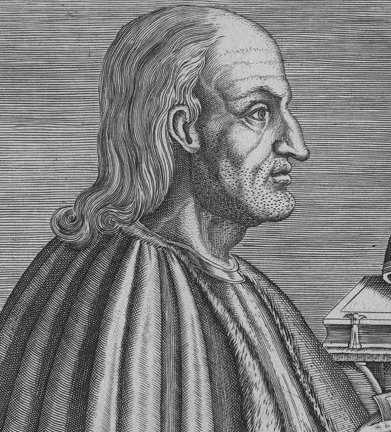
Biography
- 1033 Born
- 1060 Monk
- 1078 Abbot
- 1093 Archbishop
- 1097 Exile
- 1109 Died
Although I often and earnestly directed my thought to this end, and at some times that which I sought seemed to be just within my reach, while again it wholly evaded my mental vision, at last in despair I was about to…
Anselm of Canterbury is remembered for an argument, which is unfortunate, because the argument is embedded in a prayer and was never meant to be prised out of it. The Proslogion is not a work of philosophy with some devotional decoration; it is a man on his knees, addressing God directly for its entire length, who happens partway through to see something and cannot stop himself from working it out on the page. Read as a treatise it is clever. Read as it was written, it is one of the most moving things in medieval literature.
He was born in Aosta, in the Alpine north of Italy, in 1033. His mother Ermenberga was devout and, by every account, the parent he loved; his father Gundulf was harsh, and after his mother died the household became intolerable. At about twenty-three Anselm left home, crossed the Alps, and spent three years wandering through Burgundy and France with no settled plan, a detail his admirers tend to hurry past and which is probably the most human thing about him.
What ended the wandering was a teacher. Lanfranc, the most famous scholar in northern Europe, was prior of a small, poor monastery at Bec in Normandy, and Anselm went to hear him. In 1060, aged twenty-seven, he took vows there. He became prior three years later and abbot in 1078, and for over thirty years Bec was the whole of his life: teaching, arguing gently with his own students, and writing the books that made his name while nobody outside the cloister was watching.
Faith seeking understanding
The first of them, the Monologion, was written because his monks asked for a meditation on God that used reasoning alone, without appeal to Scripture's authority. It worked, but it took many linked arguments, and that dissatisfied him. He wanted to know whether one argument existed that needed nothing but itself.
His own account of what happened next is the best thing ever written about intellectual obsession:
Although I often and earnestly directed my thought to this end, and at some times that which I sought seemed to be just within my reach, while again it wholly evaded my mental vision, at last in despair I was about to cease, as if from the search for a thing which could not be found.
— Anselm, preface to the Proslogion
He first called the book Faith Seeking Understanding, and that phrase is the key to everything he did. He is not building a ladder from doubt up to belief. He is a believer trying to see what he already trusts, and he says so in the first chapter, in a sentence that has been quoted for nine hundred years:
I do not seek to understand that I may believe, but I believe in order to understand. For this also I believe, that unless I believed, I should not understand.
— Anselm, Proslogion 1
And the chapter that contains it does not read like scholarship at all. It opens with an invitation that could be printed on its own as a devotional text:
Then, a few lines later, the ache underneath: Lord, if thou art not here, where shall I seek thee, being absent? But if thou art everywhere, why do I not see thee present? That is not a rhetorical set-up. That is the actual question, and the argument that follows is his attempt to answer it for himself.
The kind of teacher he was
Bec under Anselm was not a severe house, and that was deliberate. Eadmer preserves an exchange with an abbot who complained that the boys in his care were incorrigible — beaten day and night, he said, and they only got worse. Anselm asked him what he supposed a young tree would look like if it were hemmed in on every side so that it could not put out a branch, and told him that souls need room in the same way. He is one of the very few people of his century on record as thinking that beating children produced worse adults.
His letters carry the same quality. They are affectionate to a degree that startles modern readers, addressed to monks and former students in language of open love, and they keep returning to the same practical counsel: do not measure yourself against others, do not despair at your own slowness, hold on. A man capable of the tightest reasoning in Europe spent a great deal of ink telling anxious people to be less hard on themselves.
Canterbury, and two exiles
In 1093, entirely against his will, he was made Archbishop of Canterbury. William Rufus had kept the see vacant for four years in order to pocket its revenues, and only filled it when he thought he was dying. The story that the bishops had to force the pastoral staff into Anselm's clenched fist comes from Eadmer, the monk who followed him for years and wrote his life; whatever the precise choreography, nobody disputes that he did not want it.
The sixteen years that followed were mostly conflict. Anselm believed the church's offices were not the king's property; Rufus, and then Henry I, believed otherwise. He went into exile twice, in 1097 and again in 1103, and spent years abroad appealing to Rome. He was not a natural fighter — his letters are full of longing for the quiet of Bec — but he did not give way, and the settlement eventually reached in England became a model for the wider investiture struggle.
The first exile produced his other great book. Cur Deus Homo, Why God Became Man, asks the question a sceptic would ask: given that God is God, why the incarnation? Why not simply forgive? Anselm's answer, worked out as a dialogue with his student Boso, is that sin is not a debt God is owed in the way a merchant is owed money, but a dishonouring of the order of things that only a human being could repay and only God could afford. It is the origin of what later theology calls the satisfaction account of the atonement, and it has been argued with ever since, which is a form of compliment.
He was also willing to be argued with, publicly and in his own book. A monk named Gaunilo wrote a rebuttal of the Proslogion's central argument, cheerfully titled In Behalf of the Fool — the fool of Psalm 14 who says in his heart there is no God. Anselm wrote a reply, and then asked that from then on Gaunilo's objection and his answer be copied together with the book itself. The standard edition still prints all three, which means that for nine centuries the most famous argument in medieval theology has travelled with its best contemporary refutation attached, at the author's own insistence.
The prayers
Alongside all this he wrote prayers and meditations, circulated to friends and to noblewomen who asked for them, and they are unlike anything before them in Latin. Earlier prayers were mostly liturgical and corporate; Anselm's are private, extravagant, emotionally naked, addressed to Christ and to the saints in the first person singular, full of self-accusation and sudden tenderness. They did more than any of his arguments to change how ordinary Western Christians prayed, and they are the reason that a great deal of later medieval devotion sounds the way it does.
He died on 21 April 1109, at Canterbury, in Holy Week. Eadmer records that he had said he would like to live a little longer because there was a question about the origin of the soul that he did not think anyone else would solve if he did not. That is Anselm exactly: dying, and still curious.
What he leaves is a demonstration that the two halves people keep separating were never separate for him. He thought hard because he loved God, and the thinking turned back into prayer as naturally as breathing. His most famous argument sits in the middle of a chapter that ends in praise, and if you take it out of that setting to test it, you have the right to — but you are no longer reading Anselm.
No books or sermons in the library yet for this writer.
Questions and Answers
Who was Anselm of Canterbury?
Anselm (1033–1109) was a monk of Bec who became an unwilling Archbishop of Canterbury and was exiled twice for refusing to treat the church's offices as the king's property. He is remembered for the argument at the heart of the Proslogion, but that book is a prayer from first line to last, written by a man who said he did not seek to understand in order to believe, but believed in order to understand — and his private prayers changed how the medieval West prayed.
What kind of book is the Proslogion?
It is not a work of philosophy with some devotional decoration but a man on his knees, addressing God directly for its entire length, who happens partway through to see something and cannot stop himself from working it out on the page. Read as a treatise it is clever; read as it was written, it is one of the most moving things in medieval literature — and its famous argument was never meant to be prised out of the prayer it sits in.
What was his early life?
He was born in Aosta, in the Alpine north of Italy, in 1033. His mother Ermenberga was devout and the parent he loved; his father Gundulf was harsh, and after his mother died the household became intolerable. At about twenty-three Anselm left home, crossed the Alps, and spent three years wandering through Burgundy and France with no settled plan, until a teacher ended it: Lanfranc, at the small monastery of Bec, where Anselm took vows in 1060.
What does "faith seeking understanding" mean?
He first called the Proslogion "Faith Seeking Understanding," and the phrase is the key to everything he did. He is not building a ladder from doubt up to belief; he is a believer trying to see what he already trusts. As he wrote in the first chapter, "I do not seek to understand that I may believe, but I believe in order to understand. For this also I believe, that unless I believed, I should not understand."
How did his famous argument come to him?
He wanted a single argument that needed nothing but itself, and it nearly broke him: "at last in despair I was about to cease, as if from the search for a thing which could not be found." When he tried to give it up, it forced itself on him "with a kind of importunity," and one day, wearied with resisting, "in the very conflict of my thoughts, the proof of which I had despaired offered itself." He received it as a gift rather than an achievement.
What kind of teacher was he?
Bec under Anselm was not a severe house, and that was deliberate. When an abbot complained that the boys in his care were incorrigible, beaten day and night and only getting worse, Anselm asked what a young tree would look like if it were hemmed in on every side so that it could not put out a branch, and said souls need room in the same way. He is one of the very few of his century on record as thinking that beating children produced worse adults.
How did he become archbishop, and why exile?
In 1093, entirely against his will, he was made Archbishop of Canterbury; William Rufus had kept the see vacant for four years to pocket its revenues, and the bishops had to force the pastoral staff into Anselm's clenched fist. The sixteen years that followed were mostly conflict — he believed the church's offices were not the king's property, and Rufus, then Henry I, believed otherwise — and he went into exile twice, in 1097 and 1103, rather than give way.
What is Cur Deus Homo?
"Why God Became Man," written during his first exile, asks the question a sceptic would ask: given that God is God, why the incarnation — why not simply forgive? Anselm's answer, worked out as a dialogue with his student Boso, is that sin is not a debt God is owed like money but a dishonouring of the order of things that only a human being could repay and only God could afford. It is the origin of what later theology calls the satisfaction account of the atonement.
Was he willing to be argued with?
Remarkably so. A monk named Gaunilo wrote a rebuttal of the Proslogion's central argument, cheerfully titled "In Behalf of the Fool," and Anselm wrote a reply — then asked that from then on Gaunilo's objection and his answer be copied together with the book itself. For nine centuries the most famous argument in medieval theology has travelled with its best contemporary refutation attached, at the author's own insistence.
What did his prayers achieve, and how did he die?
Alongside all his arguments he wrote prayers and meditations, circulated to friends — private, extravagant, emotionally naked, addressed to Christ and the saints in the first person, and unlike anything before them in Latin. They did more than any of his arguments to change how ordinary Western Christians prayed. He died on 21 April 1109 at Canterbury in Holy Week, having said he would like to live a little longer to solve a question about the soul's origin — dying, and still curious.