Biography
The great and blessed event, which we have this day met to celebrate, is a striking proof, that the God of heaven and earth is the same, yesterday, and to-day, and for ever.
Absalom Jones was born on November 6, 1746, in Sussex County, Delaware, a slave in the household of the Wynkoop family. He was still small when his master took him from the fields to wait on him in the house, and there a quiet hunger took hold of him. He saved the pennies that visitors gave him, bought himself a primer, and, as he later wrote, “begged to be taught by any body that I found able and willing to give me the least instruction.” A spelling book followed, and then, among his growing stock of books, a Testament. While other boys spent their leisure hours at play, he read. “By this course,” he remembered, “I became singular, and escaped many evils, and also saved my money.”
Half a century later, preaching on the day the slave trade ended, the boy with the Testament would tell his people what a lifetime had taught him:
The great and blessed event, which we have this day met to celebrate, is a striking proof, that the God of heaven and earth is the same, yesterday, and to-day, and for ever.
— Absalom Jones
In 1762, when he was sixteen, his world was broken apart. His mother, five brothers and a sister were sold, and he was brought to Philadelphia with his master, Benjamin Wynkoop, to wait in the store, pack goods and carry them out. Yet even here he found a way forward: a clerk set him copies to imitate, and he was soon able, as he put it, “to write to my mother and brothers, with my own hand.” In 1766 he asked leave to attend a night school for one quarter and spent it learning arithmetic — addition, subtraction, weights and measures — the plain tools of a man who meant to earn his way.
Freedom bought by the hour
In 1770 Absalom married Mary Thomas, who was also enslaved. Almost at once he set about buying her freedom, before his own. Her mistress, Sarah King, named a price of forty pounds. With his father-in-law, John Thomas, he drew up an appeal and called on leading Quakers of the city; some lent and some gave, and they raised thirty pounds. Sarah King forgave the rest. Then, for seven years, while still serving his own master by day, Jones worked until twelve or one o’clock at night to help Mary earn a living and to pay back every borrowed shilling.
Only when that debt was cleared did he ask for his own freedom. In 1778 his master refused. Jones bought a small house and lot instead, knowing that as long as he was a slave even that could be taken as his master’s property, and he kept asking. On the first of October, 1784, at the age of thirty-seven, he received his manumission. He stayed on in Wynkoop’s service at good wages, built two more small houses on his lot, and wrote of the whole long struggle without bitterness, as “the little estate that a kind Providence has put in my hands.”
On their knees at St. George’s
By the 1780s Jones was worshipping at St. George’s Methodist Episcopal Church on Fourth Street, where many of the Black people of Philadelphia gathered, and where he and his friend Richard Allen served as lay preachers among them. Allen was a younger man, born a slave in Philadelphia, converted under Methodist preaching, and like Jones a buyer of his own freedom. The two were drawn together by a shared burden. In April 1787 they founded the Free African Society, a mutual-aid fellowship that pledged a shilling a month to support members in sickness and to care for widows and fatherless children; its founding minute says the two men had “often communed together” in sorrow over the condition of their people.
As the Black congregation at St. George’s grew, it was told to sit apart, in the newly built gallery. Allen left the only eyewitness account of what happened next. The elder had just said, “Let us pray,” and the people had gone down on their knees, when Allen heard scuffling and looked up to see one of the trustees pulling Absalom Jones off his knees: “you must get up — you must not kneel here.”
The date of that walkout is disputed. Older accounts, following Allen’s memoir, place it in 1787; many historians now argue for late 1791 or 1792, when the gallery was actually being built and the officials Allen describes were in office. Whatever the year, the meaning is the same. A man had been told he was not fit to kneel beside his brothers before God, and he answered by building a house of prayer where no one could tell him so again.
The African Church
Out of the Free African Society grew a plan for a church, raised with the help of Quaker friends and of Dr. Benjamin Rush. When the question came of which communion to join, the two friends parted ways in peace. Allen could not leave Methodism and went on to found Bethel Church, the mother church of the African Methodist Episcopal denomination. The majority chose the Episcopal Church and asked Jones to be their pastor. The African Church was opened and dedicated for worship on July 17, 1794, and that autumn it was received into the Episcopal Church of Pennsylvania as the African Episcopal Church of St. Thomas — the first Black Episcopal congregation in the United States.
Jones did not take up the call lightly. His letter of acceptance to the trustees, dated October 21, 1794, is the clearest window we have into his heart. The call, he wrote, was “of such a serious nature as to cause me to tremble at the thought of such an undertaking.”
The church’s convention dispensed with the usual requirement of Greek and Latin, and in August 1795 Bishop William White ordained him a deacon. He was later ordained priest — on September 21, 1802, by the Episcopal Church’s own reckoning, though the church’s nineteenth-century historian records him as reported a priest in 1804 — and so became the first Black priest in the Episcopal Church. He had been forty-eight at his first ordination — a man who had learned his letters from pennies and a primer.
The fever year
Before St. Thomas’s had even opened, Jones and Allen faced the gravest test of their lives. In the late summer of 1793 yellow fever swept Philadelphia, killing thousands and emptying the city of everyone who could flee. A notice in the papers asked the people of colour to come forward and nurse the sick, on the mistaken belief that they could not catch the disease. Jones, Allen and a few others met to decide what to do.
We found a freedom to go forth, confiding in him who can preserve in the midst of a burning fiery furnace, sensible that it was our duty to do all the good we could to our suffering fellow mortals.
— Absalom Jones and Richard Allen, 1794
The first house they entered held a dying man, his wife already dead beside him, and two helpless children. They nursed the sick, procured nurses, bled patients under Dr. Rush’s direction and carried away the dead when almost no one else would touch them. The belief proved false: Black Philadelphians caught the fever and died like everyone else. When the plague was over, the publisher Mathew Carey printed an account that singled out Black nurses for profiteering. Jones and Allen answered in January 1794 with A Narrative of the Proceedings of the Black People, During the Late Awful Calamity in Philadelphia, laying out their accounts to the penny: they had buried several hundred poor people and strangers without asking anything, and were out of pocket by £177. To that defence they added a plea to the slaveholders of America, grounded in Scripture: “We wish you to consider, that God himself was the first pleader of the cause of slaves.”
A pastor and a petitioner
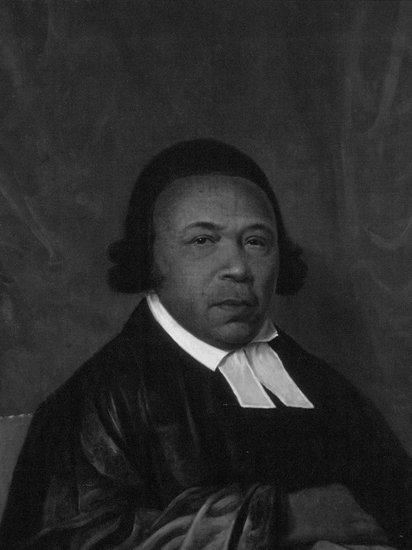
For more than twenty years Jones served St. Thomas’s, and the people loved him less for his preaching than for his presence. A later rector of St. Thomas’s, William Douglass, wrote that his sermons were earnest and impressive, but “it was never thought that his forte was in the pulpit”; what endeared him to all was his evenness of temper and “his repeated visitations among the people, especially the sick of his flock.” He kept a day school, and the church’s registers record 268 adult baptisms and 927 infant baptisms between 1796 and 1818. A portrait painted by Raphaelle Peale in 1810 shows him in clerical black, a book in his hands — calm, broad-shouldered, attentive.
That gentleness did not make him quiet about injustice. In 1797 and again in 1799 he joined other free Black men of Philadelphia in petitioning Congress — first on behalf of freed people who had fled re-enslavement in North Carolina, and then against the slave trade and the cruelties of the fugitive slave law. The House received the second petition with open hostility and declined to give it any encouragement. Jones kept praying and kept pressing.
The God who comes down
On January 1, 1808, the law ending the importation of slaves into the United States took effect, and Jones preached a thanksgiving sermon at St. Thomas’s on Exodus 3:7–8: “I have surely seen the affliction of my people.” It is searing in its description of the slave ships, the auction block and the overseer’s whip, and yet overflowing with praise. God, he told his people, had not been indifferent: “every tear they shed, was preserved, and every groan they uttered, was recorded.”
He has seen the affliction of our countrymen, with an eye of pity.
— Absalom Jones
He did not let the celebration end in the church. He urged his hearers to carry their thanks home to their families and their closets, to pray for those still in bondage, to live humbly and soberly, and above all to teach their children “the principles of the gospel of Jesus Christ, whereby they may become wise unto salvation.” He prayed that enslaved people would be given the means to read the Scriptures, so that “even while they are the slaves of men,” they might become “the freemen of the Lord.” He even wondered aloud whether God might bring some good out of the whole dark history — perhaps raising up a Joseph among their children to carry the gospel back to Africa — a hope many Black Christians of his generation shared, offered not to excuse the trade but to refuse to believe that God had abandoned them in it.
Absalom Jones died on February 13, 1818, at the age of seventy-one, and was buried beneath the shadow of the church he had founded. His epitaph remembered a man who, “born a slave,” was “principally instrumental in founding the African Church of St. Thomas,” where he served faithfully for twenty-two years. The Episcopal Church now keeps February 13 in his memory. He had begun life saving pennies for a primer, and ended it having taught a whole people to pray, to read, and to kneel before God without asking anyone’s leave.
Sermons by Absalom Jones (1)
Questions and Answers
Who was Absalom Jones?
Absalom Jones (1746–1818) was born enslaved in Delaware, bought his wife’s freedom and then his own, and became the founding pastor of the African Episcopal Church of St. Thomas in Philadelphia. Ordained by Bishop William White, he was the first Black priest in the Episcopal Church, and he spent his life shepherding his people and pleading their cause before God and the nation.
How did he learn to read?
Taken from the fields as a small boy to wait on his master in the house, he saved the pennies visitors gave him and bought a primer, begging anyone willing to teach him. A spelling book followed, and then, among other books, a Testament. He later wrote that his love of books kept him apart from the amusements of other boys and helped him escape many evils.
What happened when he came to Philadelphia?
In 1762 his mother, five brothers and a sister were sold, and he was brought to Philadelphia with his master to work in a store. A clerk set him copies to imitate so that he could write to his mother and brothers in his own hand, and in 1766 he was allowed one quarter at a night school, where he learned arithmetic.
How did he win freedom for his wife and himself?
In 1770 he married Mary Thomas, who was enslaved, and soon bought her freedom for thirty pounds raised from Quaker friends, her mistress forgiving the remaining ten. For seven years he worked until midnight or later to repay the debt. His own request for freedom was refused in 1778, but he kept asking, and on October 1, 1784, his master, Benjamin Wynkoop, granted his manumission.
What happened at St. George’s Methodist Church?
Jones and Richard Allen were lay preachers among the Black members of St. George’s in Philadelphia. When Black worshippers were told to sit in the new gallery, a trustee pulled Jones off his knees during prayer; Jones asked him to wait until prayer was over, and then the Black members walked out together. Older accounts date this to 1787, but many historians now place it in late 1791 or 1792.
What was the Free African Society?
Founded by Jones and Allen in April 1787, the Free African Society was a mutual-aid fellowship whose members paid a shilling a month to support one another in sickness and to care for widows and fatherless children. It grew into the congregation that became the African Church of Philadelphia.
What did he do in the 1793 yellow fever epidemic?
When yellow fever emptied Philadelphia, Jones, Allen and others answered a public call to nurse the sick, trusting the God who preserves in the burning fiery furnace. They nursed, bled patients under Dr. Benjamin Rush, and buried the dead, often unpaid. When Mathew Carey accused Black nurses of profiteering, they answered in 1794 with A Narrative of the Proceedings of the Black People, showing they had lost money in the work.
How did he become the first Black Episcopal priest?
The African Church was dedicated on July 17, 1794, and received into the Episcopal Church that autumn as St. Thomas’s, with Jones as its pastor; he accepted the call trembling, putting his trust in God. The requirement of Greek and Latin was waived, Bishop White ordained him deacon in August 1795, and he was ordained priest in 1802 (one older source says 1804).
What is his Thanksgiving Sermon of 1808?
On January 1, 1808, the day the American ban on importing slaves took effect, Jones preached on Exodus 3:7–8, declaring that God had seen the affliction of his people and come down to deliver them. He urged his congregation to give daily thanks, pray for those still enslaved, live humbly, teach their children the gospel, and keep the first of January each year as a day of thanksgiving.
How is Absalom Jones remembered?
He served St. Thomas’s for twenty-two years, loved for his gentle manner and his visits to the sick, and joined other free Black men in petitioning Congress in 1797 and 1799. He died on February 13, 1818, aged seventy-one, and was buried at the church he founded; the Episcopal Church keeps February 13 in his memory.