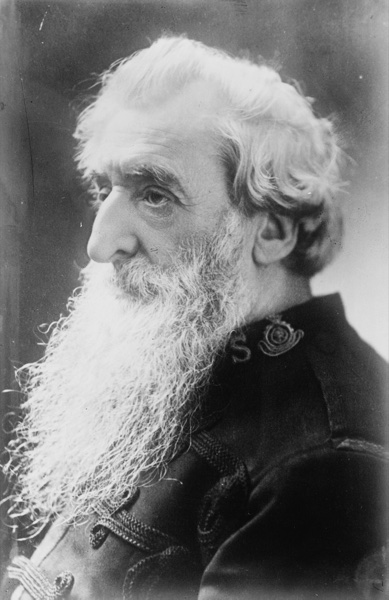
In brief
Speaking on holiness at Exeter Hall, Booth turns Zacharias’s horn of salvation into a conquering Christ who does not merely toss sin from corner to corner but tosses it out of the heart and annexes it as his own. Hearing is not enough, he insists; believe as Mary did, and “there shall be a performance.”
This morning's meeting is set apart for the consideration and attainment of Holiness. There are many people here who have been considering this subject for a long time, but they have not gone any further than the consideration. I met a young man, one day, in the north, who said to me, "I have been thinking and talking about the blessing of Holiness for a long time, and have been going to consecrate myself fully to the Lord, but, yesterday afternoon, at three o'clock, 1 went upstairs AND DID IT." There are doubtless many here who have been considering the subject of this entire Consecration for a long time; I hope this morning you have come to Exeter Hall TO DO IT. If you do nothing more than consider and hear, you will go away very little, if any, forwarder than when you came. I am going to read a few verses out of the first chapter of Luke, commencing at the sixth verse. I like to fall back upon this book—I like to show that we have not made the "Salvation Army," as the little children say, sometimes, "out of our own heads," but that it is in this old book, which everybody here and everybody everywhere else, who profess to have any hope of Heaven, regard, as the charter and foundation of their faith.
I want to see, this morning, if there is not something said in the Bible about Holiness of heart as definitely as we Salvationists say it, although in somewhat different phraseology. The prophecy I am going to read was descriptive of the work our Lord Jesus Christ was to accomplish in the hearts and lives of His own people. It not only referred to HIM, describing HIM, but it specially referred to and described what He should do for those who received Him—what He should do for and in them, not in the glory land up yonder, but down HERE ON THE EARTH.
Now, let us go down and speak in supplication to our hearts, and beg of them to receive all the blessedness which Jesus Christ died to procure for us, for which He is now interceding with the Father, and for the accomplishment of which He has sent the Holy Ghost, this very morning, to persuade us to accept. It seems to me that our position should not be so much that of knocking at the door of Heaven to ask God to come and do something for us, as that of knocking at the door of our own hearts to beseech them to put away all their stupid prejudices and all their obstinate unbelief—to put away that unbelief which when beaten away from one hiding-place does not give in and give up the controversy and own itself defeated, but goes and hides behind another bush, and when it is dislodged from that, it is only to seek another shelter—carrying on a sort of guerilla warfare which is always dodging and always being beaten, but never giving in. Oh! I say let us beg of ourselves to put all this away, and to determinately say, "Oh, my Lord, Thou art true, and Thou art almighty, and Thou art able to deliver me, and Thou shalt do for me and in me, let the consequences be what they may, ALL THE GOOD PLEASURE OF THY WILL—THY WILL BE DONE." They have been altering the Lord's Prayer without consulting me, but I am glad they have not altered that glorious verse, "Thy will be done on earth as it is done in Heaven,"
Before I read these verses, I want to make a remark on the character of Zacharias, the speaker. One of the first questions I always ask about a candidate, or about anybody who wants to be an officer in this Army, is, "Is he a good man?" I should think that question always comes into everybody's mind when they sit down to listen to any man who offers to speak to them about religion. For if people think the speaker is no better than they are, they will regard his preaching as so much talk, which they can notice or not just as it suits their inclinations. Now, Zacharias was a good man; we read that "he was righteous before God, walking in all the commandments and ordinances of the Lord, blamelessly." Consequently, let us carefully listen to what he has to say:—
"And His father Zacharias was filled with the Holy Ghost, and prophesied, saying, Blessed be the Lord God of Israel, for He hath visited and redeemed," etc.
You know that in those times when the conquering generals returned from their victorious campaigns to the cities or countries that sent them forth, they had triumphal entries, and it was customary to gird or fix upon the conquering hero a sort of horn, making him into a sort of human unicorn; signifying, I suppose, that he had been tossing his enemies, and that he had come back a CONQUEROR! Now, God hath raised up for us a great tossing Conqueror! a great conquering Saviour. He hath raised up for us a HORN OF SALVATION in the house of His servant David.
"As He spake by the mouth of His holy prophets, which have been since the world began: That we should be saved from our enemies, and from the hand of all that hate us; to perform the mercy promised to our forefathers, and to remember His holy covenant; the oath which He sware to our father Abraham, that He would grant unto us; that we, being delivered out of the hands of our enemies, might serve Him without fear, in holiness and righteousness before Him, all the days of our life."
We are the children of Abraham because we are believing children. In order that we may more clearly see the meaning of this prophecy, and its bearing on our own experience, let me put it into the first person,—
"As He spake by the mouth of His holy prophets, which have been since the world began: That I should be saved from my enemies, and from the hands of all that hate me."
God grant that may be your experience. Amen!
It is a charge brought against us by some that we make a hobby of the subject of Holiness, that, like Paganini with his violin, we are always fiddling on one string. If it were so—I don't know,—but if they brought that charge against him, I suppose he could have replied, or somebody could have replied for him, that he was able to bring more music out of his one string than his rivals could bring out of their four; and if it is true that we are too frequently engaged on this one topic, I think there are a good many people here this morning who can bear witness that there has been brought out of it some music wonderfully beautiful, wonderfully enthralling, which music has been made a wonderful blessing to them, and to many who are round about them. But I take exception to the correctness of this charge. I say, varying the figure, we are running our "Hallelujah Pullman Express" to Heaven, not on one line, but on three.
The first line of these rails we call pardon, and I am sure we very often talk about that.
The second we term purity—a clean heart, with a clean life; and
The third we term SACRIFICE, or the giving up of all that we possess to the service of our great Lord and Sovereign.
That is, first, saved from hell, and having the consciousness of it, with our feet consciously on the rock of Salvation.
Secondly, saved from inward, as well as outward sin; and
Thirdly, having been saved from the penalty and power of sin; being enabled by grace to devote all we possess to the great work of being the saviours of those who are round about us. We are compelled to go over somewhat the same ground as on former occasions, and to give line upon line; and in the passage I read over to you there seems to me to be these three definite things. There is, first, deliverance from sin; secondly, the Deliverer, Jesus Christ; and, thirdly, the service we owe to this Deliverer and Saviour, "that we may serve Him in holiness and righteousness all the days of our lives." It is this deliverance from sin, in which so many hearts here are interested, and about which there is such a growing inquiry throughout the land—DELIVERANCE FROM SIN.
We read that Jesus Christ came that He might deliver us out of the hands of our enemies. Our iniquities are the enemies referred to here. I suppose even the most rigid literalists will not want to make this out to refer to the deliverance of the Jews from the Roman yoke. If they do, we all know that it never took place, and we all know also that the whole teaching of the Bible can be brought to show that spiritual deliverance is the work which Jesus Christ undertook, and which He wants to accomplish for us. Hence, Peter, in speaking to the Jews of the purpose of God in the resurrection, says that God, having raised up His Son Jesus, hath sent Him to bless them. But how was this to be done. How did God propose to make these Jews blessed? By freeing them from the Roman yoke, by sending them good trade, by sending them easy circumstances, or by giving them healthy bodies? No, on none of these lines; the Father had sent Him to bless them, to make them truly blessed, by turning everyone from them—away from his iniquities.
Even so, Jesus Christ has come to you and to me, to deliver us from SIN. No one would want to localise this purpose, or contract it, by saying He was intended to save a man from getting drunk, from telling lies, or swearing, or thieving—that is, to take the outworks, while the very citadel, the heart, is left infected with pride, selfishness, envy, hatred, revenge, bad temper, and everything that is bad, rotten, devilish, and unlike God. Surely, to DELIVER him, He must not only break the neck of the open and outward foes who have domineered over him, but He must destroy those inward enemies, and save us out of the hands of all that is devilish in our own secret passions, tempers, and dispositions.
Now, I think I hear you say, "How far can I be saved in this direction? Is there such a thing as an uttermost salvation? I am wonderfully saved already. I do now enjoy a wonderful salvation. A wonderful change has been wrought within me. I am not what I used to be by any comparison, but still I am conscious that there is sin within me—sin of which I alone am conscious," for every man has, so to speak, two characters. He has a character with which the outer world is conversant, and an inward character which is only known to him and his Maker. Of this inner character many may say, there are in it blots and blurrs, much that is selfish, much that is devilish, much of which they would be ashamed to have the record transcribed on paper and read out before their fellow-men, but there they are, evils springing up, roots of bitterness continually grieving them, pricking them and bringing them into bondage; and the cry often goes up to Heaven from such hearts, "Can I be saved from these inward sins?" I answer, in the words of this man, who spake full of the Holy Ghost, "He came to save you out of the hand of your enemies," that is, out of their grip—make you free from their power—so deliver you that they shall have no hold upon you, in order that you may serve God in holiness and righteousness all the days of your life.
Now, mark the duration of this deliverance. Not merely for a few minutes just before you die, nor for an hour or two in a Holiness Convention,—for some of you know you have been in Heaven sometimes in such meetings as we are holding to-day. There have been seasons and days in your memory, that is, they have been to you as the days of Heaven on the earth, and you said, "Oh if they could but have lasted!" Thank God! you can have them over again, and they may last. There is a deliverance—a deliverance from all sin—that can last all the days of your life, if you live to be as old as Methusaleh; and if you get properly saved, I shall be very sorry for you to die at all. May the Lord save you properly, and then people will be sorry when they hear about your funeral.
People say this is applicable to Heaven; they believe in Holiness in Heaven; they would all be sad if I were to come and announce, "Mary Jones, I have had information from Paradise that you will go into a bad temper when you get up there." "Then," I think Mary Jones would say, "1 don't want to go there." There are very few of you who would care to go to Heaven if you expected you were going to carry in with you the peevishnesses, and devilishnesses, and selfishnesses which mar and spoil your peace on earth. "Oh," you would say, "if Heaven is not going to be a holy place, all the joy, and glitter, and spangle about it has gone for me. I want to go where I shall be holy; to go away from my evil self." There is only one place where you can get away from your evil self, and that is in the fountain of Christ's blood. There is no other place. If you went to Heaven as you are from Exeter Hall this morning, you would wake up in Heaven much as you are in Exeter Hall, or as you were in your home yesterday. But, oh! if this morning you, my comrades, my brethren, my friends, if we all could help one another, if the Holy Ghost would help us to get our hearts into the river of Christ's blood; there, and there only, we should get away from our heart plagues, for that blood, we should find, cleanses from all sin.
That blood avails for you, and can and will avail to-day for you if you will. It is for you all the days of your life. Oh! I do like that. I call it Salvation on earth. It is down here in this dying, doomed world—this world that people say is getting worse every day. This world wants holy men, and holy women, who are saved out of the hand of their enemies; and, when they are saved, they will rush into the fire and the flood to save other people out of the hands of their enemies.
BUT HOW IS THIS GOING TO BE DONE? Here is the answer.
It is by this horn of Salvation, my comrades, which God has raised up for us. Thank God He has. I am not afraid of being damned, (Triumphant responses.) Some of these people behind me used to be afraid of it, but they are saved from fear now, for the Lord has raised up a Conqueror, and His name is called Jesus, because He should save His people, not only from the consequences of their sins, but from the sins themselves. I wish people were as anxious to be saved from sin as they are to be saved from the penalty. What should we think of the man who said, "I don't care so much about a bit of thieving. I don't see any particular harm in it, but the evil I see is being caught and put in prison. That is what I object to"? There are some people who say there is no harm in doing wrong except you are found out. Now, what should we say of people who talked in that fashion?
Oh, hell is a calamity, looked at in one sense, in the same way as our prisons are; but our prisons are a necessity, and hell is a necessity, and if men will sin, then men must suffer. If men will be thieves, we must have a prison for them, and if men will sin, then God must have a prison to put sinners in.
I thank God, He came to save me from its burning, and my wife, and children, and this great multitude of people; and by His grace, I am going to do what I can, as long as He lets me live, to get other people saved. I have laid myself, and my family, my goods, and my hours, on the altar, and I will try and get others to do the same.
But the Conqueror, this Unicorn, came not only that He might save us from the punishment of sin, but from the sin itself. You never need sin any more, Here is a Saviour for you. Do you hear? YOU NEVER NEED SIN ANY MORE. Here's the Conqueror. He is coming this way. He can toss His enemies. He can toss them out of your heart; but some people's notions of this tossing very much resemble the predicament in which many of our unfortunate farmers are found this season with their crops—they cannot get the blessed sunshine long enough to gather them in, and so they are always tossing them about, and when they get them pretty well dried there comes another shower, and then they have to toss them again. Now this is just the notion many have, or seem to have, of the Saviour's work. They think He just comes and tosses their sins from one corner into another, turns them over every now and then, and lets them have an airing at Holiness Councils, Revival Meetings, and the like, but leaves them, in the main, very much the same, all the time, as He found them. I tell you this is all a mistake. This Unicorn, if you will let Him, will do something more effectual than that. He has strength enough to toss the pride, and temper, and selfishness not only from one corner into another, but out of your hearts entirely, He is not the sort of conqueror to do after the fashion they are doing just now in the Transvaal,—as to the rightness of which I am advancing no opinion. He does not want to deal with you as the British Government is dealing there, that is, to go and ride about and show their flags, and then go away and leave a sort of resident magistrate or adviser behind to say, "You had better not do this, or you had better not do that." No! No!! NO!!! He will conquer, and He will not only conquer, but He will annex your heart, and make it His own territory, over which He will reign absolutely. Thank God! He is Almighty to save and Almighty to keep.
Does anyone here say, "How is it this has not been done in me?" I will read you just one verse of the same chapter, which will explain this to you. Referring to Mary, the blessed Mother of our Lord, the Holy Ghost says, in the 45th verse, "And blessed is she that believed, for there shall be a performance of these things which were told her from the Lord." Now, remember the passage I am always quoting, "God is no respecter of persons." So far as your own salvation is concerned, you are on a level with the blessed Mother. Oh! have there not been some wonderful things told you? You have heard that you can have victory over sin, that you can have peace flowing like a river—you have been told that your joy may be full, indescribable, unspeakable, and full of glory—you have heard what you may be made—you have heard that you can be turned into a saviour of men—that your days can be like the days of Heaven on earth; and I know not what other wonderful things you have not heard, and if hearing would have made you blessed there are few in Exeter Hall would be more blessed than you; but there is something more than hearing necessary to complete your blessedness, it is the performance you want.
I remember hearing of a man who was always going about hearing lectures, and he met a friend one day in the street who said, "Where have you been?" "Oh," he said, "I have been to hear the most wonderful lecture on the training of children; it was so clever. Where have you been?" The other replied, "I have been at home DOING IT." It is the doing that is lacking. You have heard, and heard, and heard again, until you have almost got weary of the theme. Now it has been a new book, then a new preacher—now a new friend, and then you have been off to new meetings, Conferences or Councils or the like, but you have got no forwarder. Oh! may God let there be a PERFORMANCE. But how can the performance be? Here it is. "Blessed is she that believeth, for there shall be a performance of those things which were told her,"—that is, to the women that believed, for there is nothing promised to any one else; and, thank God, this is for the men as well as for the women; and to everyone of us, whether man or woman, if we will but believe, there shall be a performance of the things which have been told us from the Lord.
"He that believeth, shall be saved." It is not to him that hears, to him that desires, to him that feels, to him that agonizes, to him that consecrates, But it is promised and assured and given to him that believes.
Now what do you say? Are you prepared to follow in the blessed Virgin's track? Will you accept the divine message that this full and holy salvation is for you, bought for you, promised to you, given to you, that it is yours—YOURS NOW, JUST NOW, that Jesus according to His word saves you now? Then there shall be a performance of all the things that have been told you from the Lord—not one jot or tittle shall fall to the ground. All shall come to pass. You shall receive the Christ, the living sanctifying victorious Christ. And with Him, the great tossing Conqueror, you shall be victorious over all your enemies, you shall be holy, you shall be blessed among men and blessed for evermore. The Lord grant it may be so. Amen.
Questions for reflection
- What does Booth mean by calling Christ a "horn of salvation" and a "great tossing Conqueror"?
- Booth explains that conquering generals returning from victory had a sort of horn fixed on them, "signifying, I suppose, that he had been tossing his enemies." God has raised up such a Conqueror in Jesus, who can toss pride, temper and selfishness "out of your hearts entirely."
- What are the three "lines" of salvation Booth describes in this sermon?
- Answering the charge that Salvationists play on one string, Booth says they run their "Hallelujah Pullman Express" to Heaven on three lines: pardon, purity (a clean heart with a clean life), and sacrifice, the giving up of all we possess to the service of the Lord.
- How does Booth use the Transvaal to illustrate how Christ deals with sin in the heart?
- Booth says Christ does not merely ride about showing His flag and then leave an adviser behind, as the British were doing in the Transvaal. "He will conquer," and He will "annex your heart, and make it His own territory, over which He will reign absolutely."
- Why does Booth point to Mary's belief in Luke 1:45 as the key to holiness?
- Booth says hearing about full salvation is not enough; "it is the performance you want," and the promise of performance is to "she that believed." It is not promised to him that hears, desires, feels, agonizes or consecrates, but to him that believes that Jesus saves him now.
Discussing this sermon with a group? See Ochorus for small groups
Public domain. Source text from the original edition.
Cite this sermon
Copy a citation in the style you need.
- MLA
- Booth, William. “The Conqueror.” Sermon, 1881. Ochorus, https://ochorus.com/sermons/the-conqueror/.
- Chicago
- Booth, William. “The Conqueror.” Sermon, 1881. Ochorus. https://ochorus.com/sermons/the-conqueror/.
- Chicago footnote
- William Booth, “The Conqueror,” sermon, 1881, Ochorus, https://ochorus.com/sermons/the-conqueror/.
- BibTeX
- @misc{booth1881conqueror, author = {Booth, William}, title = {{The Conqueror}}, year = {1881}, howpublished = {Sermon, 1881}, publisher = {Ochorus}, url = {https://ochorus.com/sermons/the-conqueror/} }