Where to start reading
Start with
The Epistle and Martyrdom of Polycarp
Books by Polycarp of Smyrna (1)
Biography
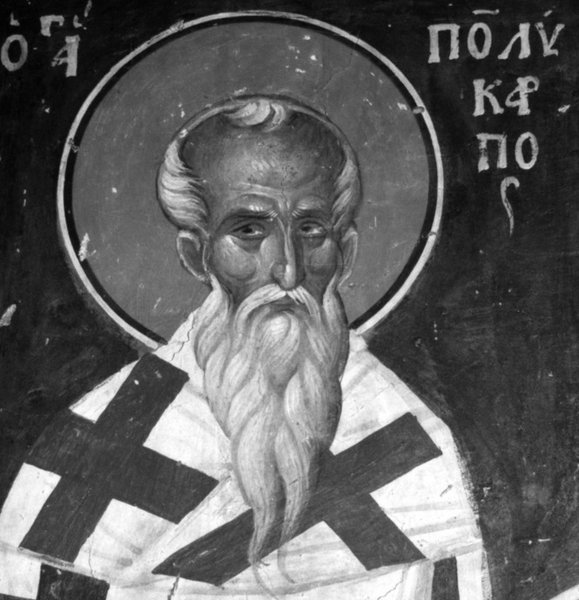
The early church left us mostly argument — letters against error, careful explanations of the faith. Polycarp of Smyrna left a little of that too. But what the church has treasured about him for almost nineteen centuries is not an argument. It is an old man, arrested at supper-time, who had food set out for the men who came to take him, asked for an hour to pray, and prayed for two. It is the same old man, hours later, in a roaring stadium, refusing to curse the Lord he had served for eighty-six years.
A hearer of the apostles
Almost nothing is known of Polycarp’s early life, and it is better to say so than to fill the gap. The traditional dates, about 69 to about 155, are worked backward from his own words at his trial. What we have instead is a memory. Irenaeus, later bishop of Lyons in Gaul, heard Polycarp as a boy and never forgot him:
I could describe the very place in which the blessed Polycarp sat and taught; his going out and coming in; the whole tenor of his life; his personal appearance; how he would speak of the conversations he had held with John and with others who had seen the Lord.
— Irenaeus, remembering his teacher
That John, Irenaeus understood, was the apostle. Tertullian says the same, and Jerome adds that John himself ordained Polycarp bishop of Smyrna, a busy port on the Aegean coast of what is now western Turkey. It is an early tradition, and a cherished one, but it rests largely on Irenaeus’s boyhood memory set down many years later, and it is fair to hold it in that light. The old scholar James Ussher even wondered whether Polycarp was the “angel” — the messenger or leader — of the church in Smyrna, to whom the risen Christ says in Revelation, “Be thou faithful unto death, and I will give thee a crown of life.” That is only a guess. Anyone who reads the end of his story will see why someone wanted to make it.
A friend in chains
Polycarp first steps clearly into history receiving a prisoner. Early in the second century Ignatius, bishop of Antioch in Syria, was being taken under guard toward Rome to die, and his guards stopped at Smyrna. Polycarp welcomed him; a later account says the two had once been fellow disciples of John. Ignatius, moving on, wrote a letter to Polycarp himself, counselling him as a father might.
Polycarp kept faith with his friend. When the church at Philippi asked for Ignatius’s letters, he gathered all he had and sent them, asking in return for any certain news of what had become of him. It is partly because of that small act of care that those letters reach us at all.
A letter to Philippi
That reply, the Epistle to the Philippians, is the only writing of Polycarp’s that survives. It is short, plain and pastoral, woven almost entirely out of Scripture. He writes, he says, only because they asked, and neither he nor anyone like him can come up to the wisdom of “the blessed and glorified Paul.” He even admits they know the Scriptures better than he does. What he offers is the faith as it was handed down: Christ, who suffered for our sins and whom God raised from the dead; salvation “by grace … not of works”; and a life of love, honesty and mercy that answers to it.
At its heart is a sorrow. Valens, once a presbyter, or elder, at Philippi, had fallen into covetousness and disgraced his office. Polycarp does not soften the sin, but he prays that the Lord would grant Valens and his wife true repentance, and tells the church to call them back “as suffering and straying members.” Firm, and with the door left open.
With false teaching he was sterner. Some said Christ had only seemed to have a body. Whoever does not confess that Jesus Christ has come in the flesh, Polycarp writes, echoing John, is antichrist, and whoever twists the Lord’s words to deny the resurrection and judgment is “the first-born of Satan” — a phrase Irenaeus says he once used to the face of the teacher Marcion. His remedy was simple: “let us return to the word which has been handed down to us from the beginning.” And with it, endurance:
Let us then be imitators of His patience; and if we suffer for His name’s sake, let us glorify Him.
— Polycarp, Epistle to the Philippians
A visit to Rome
Late in life, when Anicetus was bishop of Rome, Polycarp travelled west to meet him. Their churches kept Easter differently: Polycarp, following the custom of Asia — and, Eusebius records, what he had kept with John — on the fourteenth of the Jewish month of Nisan, the day of Passover, whatever the weekday; Rome always on a Sunday. Irenaeus says they quickly agreed on other matters, but neither could persuade the other on this. So they disagreed and stayed in full communion, and Anicetus invited Polycarp to celebrate the Lord’s Supper in his own church, a mark of great honour.
Eighty and six years
His death is told by the church of Smyrna itself, in a letter to the church at Philomelium and through it to the whole church — one of the earliest accounts of a Christian martyrdom outside the New Testament. Persecution had broken out; after a young man named Germanicus faced the beasts bravely, the crowd shouted, “Away with the Atheists; let Polycarp be sought out!” — atheists, because Christians refused the gods. The letter honestly records a man named Quintus who volunteered for martyrdom and then lost his nerve and sacrificed, and draws the lesson: the gospel does not teach us to hand ourselves over.
Polycarp did not. At his people’s urging he withdrew to a farmhouse. Three days before his arrest, while praying, he saw his pillow as if on fire, and said to those with him, “I must be burnt alive.” He moved again, but a young servant of his household was tortured until he told where he was.
They came on a Friday evening, armed as if against a robber. He could have slipped away, but said, “The will of God be done,” and went down to meet them. Struck by his age, some wondered why so much effort had been spent to catch such a venerable man. He had food and drink set before them and asked only for an hour to pray.
On the road into the city, officials urged him to say “Lord Cæsar” and offer incense; when he would not, they pushed him from their carriage and he hurt his leg, and walked on as if nothing had happened. As he entered the stadium, the letter says, a voice came from heaven: “Be strong, and show thyself a man, O Polycarp!” No one saw the speaker, but the Christians there heard it.
The proconsul, the Roman governor, tried to spare him: think of your age; swear by the fortune of Cæsar; revile Christ, and I will let you go. Polycarp answered:
Eighty and six years have I served Him, and He never did me any injury: how then can I blaspheme my King and my Saviour?
— Polycarp, before the proconsul
Whether those years were his whole life or the years since he came to faith, we cannot say; the traditional birth year of 69 assumes the first. Either way, the sentence is less about arithmetic than about a Master who had never dealt unjustly with him. Threatened with beasts, he told the governor to call them. Threatened with fire, he said:
Thou threatenest me with fire which burneth for an hour, and after a little is extinguished, but art ignorant of the fire of the coming judgment and of eternal punishment, reserved for the ungodly.
— Polycarp, in the stadium at Smyrna
The crowd roared that this was “the teacher of Asia, the father of the Christians,” and demanded he be burned. When they moved to nail him to the stake he asked to be left as he was: the One who gave him strength to bear the fire would hold him still. So they only bound him, and he looked up to heaven and prayed.
What followed, the Smyrnaean Christians say they saw. The fire arched around him like a ship’s sail filled with wind, and he glowed within it like bread baking or gold in a furnace, with a fragrance like incense. When it did not consume him, an executioner stabbed him, and from the wound, they write, came a dove and so much blood that it put out the fire. These are the church’s own words, offered as testimony. The version Eusebius quoted lacks some of these wonders, and our translation’s editors suspect “the dove” is a copyist’s slip. What no one has doubted is the courage at the centre of the story.
The birthday of his martyrdom
Fearing the Christians would worship him, the authorities had his body burned. The church’s reply is one of the clearest early statements of where devotion belongs: Christ, as the Son of God, they adore; the martyrs, as disciples of the Lord, they love. They gathered his bones, “more precious than the most exquisite jewels,” and resolved to meet each year on the anniversary of his death — one of the earliest witnesses to that custom. His day is still kept on 23 February.
The year is less certain. The letter names the proconsul Statius Quadratus, and from that many date the martyrdom to about 155 or 156; Eusebius placed it later, in the 160s. A date in the later 150s fits best with the memories of Ignatius and John, but it remains a reckoning, not a certainty.
Reading Polycarp today
Our book brings his two witnesses together in the 1885 Ante-Nicene Fathers translation of Alexander Roberts and James Donaldson: Polycarp’s own Epistle to the Philippians and the Smyrnaean church’s Martyrdom of Polycarp. Both can be read in a sitting. The first lets us hear a pastor a generation or two after the apostles — humble, steeped in Scripture, gentle with the fallen and firm against error. The second shows that same pastor when everything was at stake, and finds him unchanged.
He did not seek martyrdom, and he did not flee it. He fed the men who arrested him and prayed for them. He kept faith with a friend in chains and a church in trouble, and kept communion with a brother he could not agree with. And at the end, offered his life for a single word against Christ, he looked back over eighty-six years and found no wrong his King had ever done him. It is a long faithfulness, quietly kept, and still worth following.
Questions and Answers
Who was Polycarp of Smyrna?
Polycarp was a second-century bishop of Smyrna, a port city on the Aegean coast of what is now western Turkey. He is counted among the Apostolic Fathers and is honoured as a saint and martyr by Catholic, Orthodox, Anglican and Lutheran churches alike.
Did Polycarp really know the apostle John?
That is the early tradition. Irenaeus, who heard Polycarp as a boy, remembered him speaking of his conversations with John and others who had seen the Lord, and Tertullian and Jerome say the same; Jerome adds that John ordained him. The tradition rests largely on Irenaeus’s boyhood memory, written down many years later.
When was Polycarp born?
No record of his birth survives. The traditional year of about 69 is worked backward from his words at his trial, “Eighty and six years have I served Him,” which may mean his age or the years since he came to faith.
What was Polycarp’s connection with Ignatius of Antioch?
When Ignatius was being taken under guard toward Rome to die, his guards stopped at Smyrna, where Polycarp welcomed him, and Ignatius later wrote a letter to Polycarp. Afterward Polycarp gathered Ignatius’s letters and sent them to the church at Philippi, which helped preserve them.
What does Polycarp’s Epistle to the Philippians teach?
It is a short pastoral letter, woven out of Scripture, that urges faith in Christ who suffered and rose, salvation by grace, and a life of love, honesty and mercy. It grieves over a fallen presbyter named Valens and asks the church to call him back, while warning firmly against those who denied that Christ came in the flesh.
Why did Polycarp visit Anicetus in Rome?
Late in life he travelled to Rome to talk with its bishop, Anicetus, about differences between the churches of Asia and Rome. They could not agree on the date of Easter, which Polycarp kept on the fourteenth of Nisan and Rome on a Sunday, but they stayed in full communion, and Anicetus let Polycarp celebrate the Lord’s Supper in his church.
How was Polycarp arrested?
During a persecution in Smyrna he withdrew to the countryside at his people’s urging, but a servant of his household was tortured into revealing where he was. When the searchers came he refused to escape, saying “The will of God be done,” had food set before them, and prayed for two hours.
What did Polycarp say at his trial?
When the proconsul urged him to revile Christ and go free, he answered, “Eighty and six years have I served Him, and He never did me any injury: how then can I blaspheme my King and my Saviour?” Threatened with fire, he replied that the governor’s fire burned only for an hour, while the fire of the coming judgment was eternal.
How did Polycarp die, and when?
He was bound to a stake and burned, and the Smyrnaean letter says the fire arched around him without consuming him, so that he was stabbed and his blood put out the flames. The letter dates it to the proconsulship of Statius Quadratus, usually reckoned about 155 or 156, though Eusebius placed it later and the year remains uncertain; his feast is kept on 23 February.
What is The Epistle and Martyrdom of Polycarp?
It brings together Polycarp’s only surviving writing, his Epistle to the Philippians, and the Martyrdom of Polycarp, the Smyrnaean church’s letter describing his arrest and death, in Roberts and Donaldson’s 1885 Ante-Nicene Fathers translation. Both are short, and together they show a humble pastor’s teaching and the faith he kept to the end.