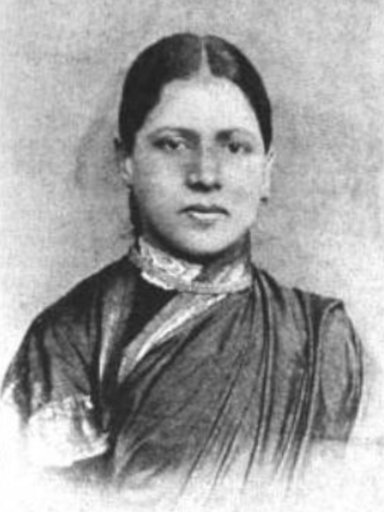
Biography
Let me show that even a simple Indian girl can do something useful.
Krupabai Satthianadhan lived only thirty-two years, and for much of that short life she was ill. Yet she left behind two novels in English that made her, in the words of the friend who wrote her memoir, “the first of Indian women novelists” — and, running beneath both books, the quiet testimony of a young woman who had met Christ in her loneliness and never let Him go. In her last months, dictating chapters to her husband with a raging fever, she gave the reason she kept on writing.
Let me show that even a simple Indian girl can do something useful.
— Krupabai Satthianadhan
A Brahmin household turned to Christ
She was born at Ahmednagar, in the Bombay Presidency, on 14 February 1862, the thirteenth child of Haripunt and Radhabai Khisty. Her parents were remembered as the first Brahmin converts to Christianity in the Bombay Presidency. Their great struggle was over before any of their children were born, but Krupabai grew up on its story, and years later she told it — lightly fictionalised, with her father renamed Harichandra — in her first novel. It is difficult, her memoirist wrote, to over-rate what a Brahmin gave up in renouncing the faith of his fathers: friends, position, wealth, nearly everything men hold dear.
In her daughter’s telling, Haripunt’s turning came one evening as the Gospel he had been reading rose before him in a new light: Christ stooping beside a blind beggar, healing the sick, raising the fallen, and at last dying on Calvary. “Such love! I will follow Thee, my Saviour,” she has him cry. “All I have I leave to follow Thee.” Radhabai, a child-wife, at first felt herself trapped in a missionary’s house and polluted by it; she threw her jewels at her husband’s feet and begged him to take her home. Only slowly, through his patience and the kindness around her, did she yield — and in the end, her daughter wrote, she “found a rich harvest of joy and happiness” in the religion her husband had embraced.
Haripunt spent the rest of his life as a Christian missionary, and the home the Khistys made was, in Krupabai’s words, one where “the Christian life … was of a simple apostolic type.” The children wore coarse clothes their mother sewed, the girls owned no jewels, and the boys took to manual labour as readily as to books. Radhabai never learned to read, but she set no barrier in the way of her children’s schooling. Krupabai’s father died while she was still small, and an elder sister and her brother Bhasker took up the work of teaching the younger ones.
Bhasker and the mountain-top
Bhasker, much older than she, became the great influence of her childhood. She was a fiercely bright little girl who insisted on sitting in while her brothers studied — and who corrected their sums — and it was Bhasker who stood her friend. When the family moved to the hills of the Upper Deccan for his failing health, the two walked the mountain paths together at dawn. On one such morning, watching the sun break through the mist, he told her that a land before the light of Christianity comes is like that dark hillside, and that the Gospel brings everything into its true beauty, as the sun does.
Bhasker did not live long. Her account of his death in Saguna is among the most moving pages she wrote: the brother telling their mother, “We are all pilgrims. I am going before, and you will follow me,” charging his younger brothers to “Be real torch-bearers,” and the little sister clinging to his neck crying that he must not die. For months afterwards the children would gather round their mother at dusk, and she would hold them and say, “Yes! God, God alone is left now.” But Krupabai confessed that she “failed to understand God’s ways,” and that her grief was “intense, almost rebellious.” Her health suffered for months.
Lonely at school, found by Christ
Partly in hope of rousing her, she was sent to study with missionary ladies and then to the Zenana Mission school in Bombay. She was so far ahead of girls her age that she could not be placed in any class and was allowed her own course of study. She was also, her memoirist admitted, intensely self-conscious and over-sensitive, and the school was not easy for her. In Saguna she tells of being labelled the “ungodly one” by the pious girls of a prayer union, and of fleeing to the garden afterwards to weep. There, misunderstood on every side, she found herself longing for a love “that can cover even one’s deficiencies,” and a silent prayer rose “to Bhasker’s God and mine.”
In the novel the bitterness drained out of her that day; she wanted to embrace the very girls who had hurt her, and the words kept singing in her ears, “Jesus is near and all is well.” Saguna is a novel, and its scenes are shaped and idealised; but her friend and memoirist, who knew her from her student days, called it “essentially an autobiography,” and these pages ring with the sound of a real conversion.
The first Indian woman at Madras Medical College
At the Bombay school she came under the influence of an American woman doctor, and set her heart on medicine. Her friends hoped to send her to England to study, but her health was judged too frail. Madras Medical College had just opened its doors to women, and so, still in her teens, she travelled alone from Bombay to Madras. She was received there into the home of the Rev. W. T. Satthianadhan, a respected Tamil clergyman, and his wife and daughters, and spent a happy year with them while attending lectures. When she first entered the lecture hall, the whole body of students rose and cheered her: she was, her memoirist wrote, the first Indian lady to join their ranks. By the end of the year she had won several prizes and stood first in every subject but chemistry. A former head of the college later remembered her as “one of the sweetest characters I ever knew.”
But after the strain of examinations her health broke down completely, and she was never strong enough to return to her medical studies. It was one of the griefs of her life that the dream of qualifying, perhaps in England, was never fulfilled.
A marriage of shared purpose
In 1881 she married Samuel Satthianadhan, the son of the household that had welcomed her, just returned from nearly four years at Cambridge. It may have cost her something: she had once written, “How hard it seemed to my mind that marriage should be the goal of a woman’s ambition.” But she found in him a companion whose aims matched her own, and whose feet, as she put it, were “planted on the Rock of Ages.”
Christ was ours. God was ours. Heaven was ours, and our lives were to be one full and joyous song.
— Krupabai Satthianadhan
For nearly two years they lived at Ootacamund in the Nilgiri hills, where Samuel was headmaster of the Breeks Memorial School. The mountains revived her, and she set out at once to be useful. She spent hours each week visiting women in their zenanas, helped improve the teaching at the Hobart School for Indian girls, and started a small school for Muslim girls, whom no one had yet provided for; it later grew into a sizeable school under the Church Missionary Society. Here too she began to write — descriptive pieces for the South India Observer, published as the work of “an Indian lady.”
Writing through weakness
In 1884 Samuel was posted to Rajahmundry. There she broke a blood-vessel without warning and spent about a year as a complete invalid. At Kumbakonam her strength slowly returned, and she loved to gather people of every condition round her sofa to hear their joys and sorrows. In 1886 they moved to Madras, where Samuel later became professor of logic and philosophy at the Presidency College. There, urged by her husband and a friend, she began to write about what she knew best — her own childhood. The result was Saguna: A Story of Native Christian Life, serialised in the Madras Christian College Magazine in 1887–88 and later published as a book in 1895. It was reviewed warmly in English journals, and Queen Victoria herself accepted a copy.
Not every reader was pleased. Her satirical chapter on a Christian village of poor converts was taken as an attack by some of the very people she meant to serve, and her memoirist felt it fair to her memory to explain that she had wished only to describe its quaintness and the troubles of converts left without careful oversight. The book’s heart, though, was her own home — a picture, the memoirist thought, that should be read by all who doubted what Christianity had done for India.
Soon after the last chapter appeared, her only child was born — a baby lent to its parents, her memoirist wrote, “for a few short months.” The little one’s death nearly cost Krupabai her own life, and her husband wrote that “she was never herself after this great loss.” Yet she did not complain, but moved about quietly, trying to make herself useful. A journey to her old home in Bombay only exhausted her, and in a Madras hospital she was told that her illness — tuberculosis, as later accounts name it — must sooner or later prove fatal. She received the news, her friend wrote, “with her usual quiet strength and sweetness.” The deaths of her husband’s mother and father, whom she had loved since they first took her in, followed close behind.
Kamala, and the last months
She wrote all the more. A history of her father-in-law’s conversion came first, then sketches of her mother-in-law’s life and schools, and then a second novel, Kamala: A Story of Hindu Life. Some of its chapters she worked out in her hospital bed; much of it was written at Coonoor in the Nilgiris in 1893. When she could no longer hold a pen she dictated, and some of the last chapters were taken down by her husband while her temperature stood at 104 degrees.
Kamala is the story of a Hindu child-wife, and it shows how deeply Krupabai loved the women of her country who did not share her faith. She wrote with tenderness of the burdens they bore — “Blame not the poor Indian woman for her love of jewellery,” she pleaded, since jewels were often all that would be left to her if she were widowed. She drew Kamala’s quiet goodness with a loving hand, and pleaded with English readers to understand such women.
She lived to see Kamala appear in the same journal that had carried Saguna. In April 1894 she was taken again to Coonoor, tenderly nursed by her husband and his sister. Her friend wrote that her cheerfulness never forsook her, and that “her strong faith burnt more brightly as death approached.” Tennyson’s “Crossing the Bar” — “Sunset and evening star, and one clear call for me” — was often on her lips. She returned to Madras, but the sudden death of the sister-in-law who had nursed her was more than her weakened body could bear, and she died peacefully in August 1894. She was buried beside her child in the cemetery at Purasawalkam in Madras. Kamala was published as a book that same year, and Saguna the next.
Within months of her death her name was given to memorials in Madras — remembered at the medical college that had cheered her and at the University — honouring a young woman who had opened doors for those who came after her. She left no children, and she never sought fame. But the vow she made with Bhasker on the mountain-top was kept. Her books carry, as her memoirist wrote, “the pure and earnest spirit which breathes in every line,” and in them a lonely schoolgirl’s prayer still sounds: “Stand by me, Christ, and all will be right.”
No books or sermons in the library yet for this writer.
Questions and Answers
Who was Krupabai Satthianadhan?
Krupabai Satthianadhan (1862–1894) was an Indian Christian writer from western India, remembered as one of the first Indian women to write novels in English. She wrote Saguna: A Story of Native Christian Life and Kamala: A Story of Hindu Life, studied medicine for a year at Madras Medical College, and started a school for Muslim girls at Ootacamund before dying of a long illness at thirty-two.
What family was she born into?
She was born at Ahmednagar in the Bombay Presidency on 14 February 1862, the thirteenth child of Haripunt and Radhabai Khisty, remembered as the first Brahmin converts to Christianity in that presidency. Her father gave up wealth, position and family to follow Christ and became a Christian missionary, and her mother, at first bitterly opposed, came in time to share his faith.
Who was her brother Bhasker?
Bhasker was her much older brother, who encouraged her studies and became the great spiritual influence of her childhood. On a mountain-top in the Deccan he asked her to promise that her life would be devoted to God's glory, and the two knelt and prayed together. His early death left her in deep grief for many months.
How did she come to faith in Christ herself?
At the Zenana Mission school in Bombay she felt lonely and misjudged, and in her autobiographical novel Saguna she describes weeping in the garden after being called ungodly. There she prayed to her brother's God, longing for Christ who understood human longings, and wrote, "Him I needed, and He came and I found joy." Her prayer was, "Stand by me, Christ, and all will be right."
Is Saguna a true story?
Saguna is a novel, and its scenes and names are shaped and idealised, so it should be read with care. But the friend who wrote her memoir, who knew her from her student days, called it essentially an autobiography, and its accounts of her parents' conversion, her brother and her schooling follow her own life closely.
What happened when she studied medicine?
Inspired by an American woman doctor, she went alone from Bombay to Madras Medical College, which had just opened to women, and lived with the family of the Rev. W. T. Satthianadhan. Her memoirist says the students rose and cheered her as the first Indian lady among them, and she won several prizes in her first year. Her health then broke down, and she was never able to resume her studies.
Whom did she marry?
In 1881 she married Samuel Satthianadhan, the son of the household that had welcomed her in Madras, who had just returned from Cambridge. She wrote that their feet were planted on the Rock of Ages and that Christ, God and heaven were theirs. They lived at Ootacamund, Rajahmundry, Kumbakonam and Madras as his educational work took them.
What work did she do besides writing?
At Ootacamund she visited women in their zenanas, helped improve the teaching at the Hobart School for Indian girls, and started a small school for Muslim girls, which later grew under the Church Missionary Society. She also began writing articles for local papers under the name of an Indian lady.
What sorrows did she face?
She suffered long illnesses, including a year as an invalid at Rajahmundry. Her only child died after a few months, and her husband wrote that she was never herself after that loss. She was then told her illness, tuberculosis, would prove fatal, and soon afterward she lost her husband's parents, whom she dearly loved.
How did her life end?
She kept writing, dictating the last chapters of Kamala to her husband with a high fever and saying she wanted to show that a simple Indian girl could do something useful. Her friend wrote that her strong faith burned more brightly as death approached. She died in Madras in August 1894, aged thirty-two, and was buried beside her child; memorials in her name were set up in Madras soon afterward.