Where to start reading
Start with
The First Apology
Books by Justin Martyr (2)
Biography
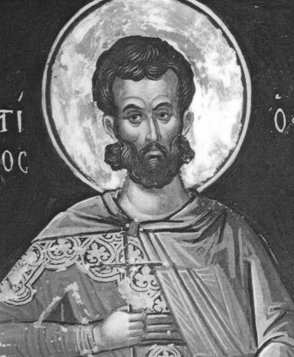
Justin is one of the few saints who carries his whole story in his name. He was a philosopher who became a Christian and never stopped thinking of himself as a philosopher, and he died a martyr, a witness, rather than give up what he had found. He left us some of the earliest surviving defences of the faith addressed to a Roman emperor, one of the earliest descriptions of Christian Sunday worship, and a moving account of his own long search for God. He was not a polished writer, nor always fair to those he argued with, but he was brave and honest.
A seeker from Samaria
He was born in Flavia Neapolis, a Roman city in Samaria built near the ancient town of Shechem, where Nablus stands today. The date is uncertain; modern scholars usually put it about the year 100, though the older translators of his works suggested a decade or so later. His family was not Jewish. He opens his First Apology by naming himself “Justin, the son of Priscus and grandson of Bacchius,” a Latin name and a Greek one, and he speaks of himself as a Gentile, uncircumcised, with little knowledge of Hebrew.
He was well educated and had means enough to travel and study. What he wanted was not a career but to know God, and in his world that search was called philosophy.
The schools of the philosophers
Years later, in his Dialogue with Trypho, Justin told the story with humour at his own expense. He first gave himself to a Stoic teacher, but after a long time learned nothing more about God, “for he did not know himself, and said such instruction was unnecessary.” He moved on to a Peripatetic, a follower of Aristotle, who after a few days asked him to settle the fee; Justin decided he was no philosopher at all. A famous Pythagorean told him he must first master music, astronomy and geometry, and sent him away when he admitted he had not. Impatient, he turned at last to the Platonists.
Here, for a time, he thought he had arrived. A respected Platonist had lately settled in his city, and Justin spent every hour he could with him. “And the perception of immaterial things quite overpowered me, and the contemplation of ideas furnished my mind with wings,” he wrote, “so that in a little while I supposed that I had become wise; and such was my stupidity, I expected forthwith to look upon God, for this is the end of Plato’s philosophy.”
Something else was working on him too. In his Second Apology he tells how, while he was still delighting in Plato, he heard Christians slandered as monsters and then saw them face death without fear. No one living in secret wickedness, he reasoned, would welcome death like that.
An old man by the sea
He liked to walk alone in a field not far from the sea, where he could think without interruption. One day he became aware that an old man, “exhibiting meek and venerable manners,” was following him at a little distance. They fell into conversation, and the old man began gently to question him. What is philosophy? What is God? Can the mind see God by its own power? One by one Justin’s confident answers gave way.
Then Justin asked the question that every seeker reaches in the end: if not even the philosophers have the truth, where can anyone turn? The old man pointed him to the prophets, men older than all the philosophers, who “spoke by the Divine Spirit,” foretold what would come and what was now taking place, and proclaimed the Son of God, the Christ.
Then the old man went away, and Justin never saw him again. He never even tells us his name. But he tells us what happened inside him:
But straightway a flame was kindled in my soul; and a love of the prophets, and of those men who are friends of Christ, possessed me; and whilst revolving his words in my mind, I found this philosophy alone to be safe and profitable.
— Justin Martyr, Dialogue with Trypho, chapter 8
Where this happened is not certain. It is commonly placed at Ephesus, but it may have been anywhere on the road between Palestine and Rome. What is certain is the direction of his life from then on.
The philosopher’s cloak
Justin did not stop being a philosopher; he simply believed he had found the true philosophy. He went on wearing the plain cloak that marked a philosopher in the street, and it opened doors. The Dialogue begins with a stranger greeting him in a public colonnade, “Hail, O philosopher!”, simply because of what he wore.
In the reign of the Emperor Antoninus Pius (138–161) he came to Rome and opened his own school, teaching the faith to whoever came. One of his pupils was a young Syrian named Tatian, who would later become a writer himself and who remembered his teacher as “the most admirable Justin.” It was a dangerous calling: a Christian could be denounced and put to death simply for bearing the name.
A petition to the emperor
It was against that injustice that Justin wrote his most famous work. The First Apology, usually dated about 155, is addressed to Antoninus Pius, to his adopted sons, one of them the future Marcus Aurelius, to the Senate and to the whole Roman people. An “apology” here means a defence, a speech for the accused. Justin presents it “in behalf of those of all nations who are unjustly hated and wantonly abused, myself being one of them.”
His request is simple: try Christians for what they have done, not for their name. If they are criminals, punish them; if they are not, stop putting them to death. And he speaks with a freedom that must have startled its readers:
For as for us, we reckon that no evil can be done us, unless we be convicted as evil-doers or be proved to be wicked men; and you, you can kill, but not hurt us.
— Justin Martyr, First Apology, chapter 2
To the rumours that Christians were atheists and worse, Justin replies by describing how they actually live. Those who once loved money now share what they have with anyone in need; those who once hated people of other nations now live alongside them, “and pray for our enemies.” He argues at length from the prophets that Jesus is the one they foretold.
He also offers a bold and generous idea. Christ, he says, is the Word, the divine Reason (in Greek, the Logos), and every race of human beings has shared in him. Wherever philosophers or poets said something true, they said it by a seed of that Word sown in them; Socrates, he argues, lived by reason, and was put to death on the charge of bringing in new gods. In the Second Apology he puts it in a single sentence:
Whatever things were rightly said among all men, are the property of us Christians.
— Justin Martyr, Second Apology, chapter 13
Justin did not mean that Plato and Christ were the same; he says plainly that their teachings are “not in all respects similar.” He meant that the whole truth, glimpsed in part by the wise, is found in Christ.
Near the end of the book Justin opened the door of the church and let the emperor see what Christians do when they gather: how a new believer is baptised, how the bread and wine are blessed and shared, and what happens every week.
A long conversation with Trypho
The Dialogue with Trypho, written a few years later, is the longest of Justin’s surviving works. It records, or recreates, a debate over two days with Trypho, a Jew who had fled the recent war in Judaea, probably the revolt of Bar Kokhba, and was living in Greece. After telling the story of his conversion, Justin argues through page after page of Scripture that Jesus is the Messiah of whom the law and the prophets speak.
It must be said honestly that the Dialogue is hard reading today. Justin is often harsh toward the Jewish people, and later writers took up such arguments in ways that did real harm; historians count works like this among the roots of Christian hostility to Jews. Yet the two men argue as friends. Trypho admits at the end that he has been “particularly pleased with the conference,” and asks Justin to remember them as friends when he sails away.
A witness in Rome
Justin seems to have known how his story would end. In the Second Apology he wrote that he expected to be plotted against, perhaps by a Cynic philosopher named Crescens, whom he had questioned in public and found to know nothing of what he attacked. According to Tatian and the historian Eusebius, that is very nearly what happened: in the reign of Marcus Aurelius, after disputing with Crescens, Justin was denounced to the authorities.
He was tried with six companions, among them two slaves he had taught, before Junius Rusticus, the prefect of Rome. An ancient account of the trial, the Martyrdom of Justin, survives. In one English rendering, when the prefect ordered them all to sacrifice to the gods, Justin answered, “No one in his right mind gives up piety for impiety.” Threatened with torture, he said that to suffer for the Lord Jesus Christ and so to be saved was their desire. They were scourged and beheaded. The exact year is unknown, but Rusticus held office from 162 to 168, and the date usually given is about 165.
The young man who had once expected to look upon God by the power of his own mind died for the God who had shown himself in Christ. He had written years before that Christians welcome death as a debt that every person owes; now he paid it.
What he leaves us
The church remembered him at once. Irenaeus spoke of his martyrdom, and Tertullian, a generation later, called him both philosopher and martyr. He is honoured as a saint by Catholic, Orthodox and Oriental Orthodox Christians, by Lutherans and Anglicans, and his feast is kept on 1 June. A church at Sacrofano, a few miles north of Rome, claims his relics.
We publish his First Apology, in the nineteenth-century translation of Marcus Dods and George Reith, and we plan to publish the Dialogue with Trypho as well. The Apology is not elegant, but it is a rare window into the church barely a century after the apostles: how Christians prayed, worshipped, shared their goods and faced the courts. And it is the voice of a man who had searched every school for the truth, found it, and was willing to say so to the most powerful ruler on earth.
Questions and Answers
Who was Justin Martyr?
Justin Martyr, also called Justin the Philosopher, was a second-century Christian teacher and apologist, born about 100 and martyred in Rome about 165. He is remembered for his First and Second Apologies, written in defence of Christians, and for his Dialogue with Trypho.
Where was Justin Martyr born?
He was born in Flavia Neapolis in Samaria, near ancient Shechem, where Nablus stands today. He was a Gentile, not a Jew, and names himself the son of Priscus and grandson of Bacchius.
Which philosophers did Justin study with before he became a Christian?
By his own account he tried a Stoic, who taught him nothing about God, then a Peripatetic, who asked for his fee, then a Pythagorean, who sent him away for not knowing music, astronomy and geometry. He then became a Platonist and for a time expected to look upon God through Plato’s philosophy.
How was Justin Martyr converted?
Walking alone in a field near the sea, he met an old man who questioned his philosophy and pointed him to the Hebrew prophets, who foretold Christ, and told him to pray that the gates of light would be opened to him. Justin writes that a flame was kindled in his soul, and he found the Christian faith to be the only safe and profitable philosophy.
Why did Justin keep wearing a philosopher’s cloak?
He believed that in Christ he had found the true philosophy, so he went on dressing and teaching as a philosopher. In the Dialogue with Trypho a stranger greets him in the street as a philosopher simply because of his dress.
What did Justin do in Rome?
In the reign of Antoninus Pius he settled in Rome and opened a school where he taught the Christian faith. One of his pupils was Tatian, who later called him “the most admirable Justin.”
What is Justin Martyr’s First Apology about?
Written about 155 and addressed to the Emperor Antoninus Pius, his sons, the Senate and the Roman people, it asks that Christians be judged by their deeds and not condemned for their name alone. It describes how Christians live, argues from the prophets that Jesus is the Christ, and gives one of the earliest descriptions of baptism, the Eucharist and Sunday worship. The translation published here is that of Marcus Dods and George Reith.
What did Justin teach about the Word, or Logos?
He taught that Christ is the Word of God, in whom every race of people has had some share, so that whatever was rightly said by philosophers and poets belongs to Christians. He saw the fullness of that truth in Christ, while the wise before him had only seeds of it.
What is the Dialogue with Trypho?
It is Justin’s longest surviving work, an account of a debate with Trypho, a Jew who had fled the war in Judaea, in which Justin tells his conversion story and argues from the Scriptures that Jesus is the Messiah. It is often harsh toward the Jewish people, yet it ends with the two men parting as friends and Justin praying for them.
How did Justin Martyr die?
In the reign of Marcus Aurelius, after he had disputed with the Cynic philosopher Crescens, he was denounced and tried with six companions before Junius Rusticus, the prefect of Rome. They refused to sacrifice to the gods and were scourged and beheaded, about 165; his feast is kept on 1 June.