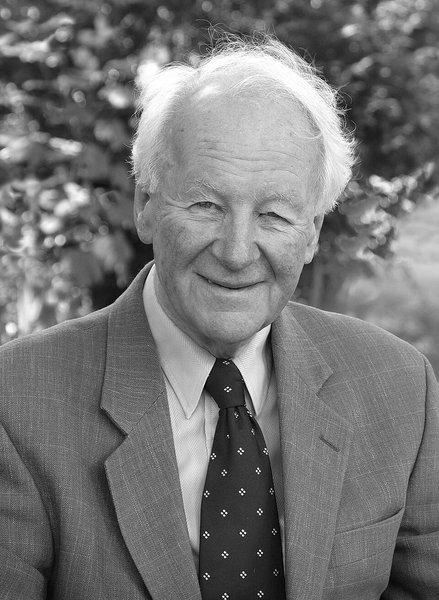
Biography
- 1921 Born
- 1938 Converted
- 1950 Rector
- 1974 Lausanne
- 2011 Died
I could never myself believe in God, if it were not for the cross.
Most lives that shape a movement do so by restlessness — a man moves from cause to cause, church to church, country to country, and the sum of the motion is the influence. John Stott’s life ran the other way. He was born a short walk from All Souls, Langham Place, in the West End of London; he was converted at school and mentored by letter; he was ordained into that one church and stayed there, in one form or another, until he died. From that single fixed point he did more to shape worldwide evangelical Christianity in the twentieth century than almost anyone alive. He is proof that depth in one place can reach further than breadth across many.
A doctor’s son who heard a sentence
He was born in London on 27 April 1921, the son of Sir Arnold Stott, a Harley Street physician and a convinced agnostic, and of a mother of Lutheran background who took her children to All Souls. It was a household of two settlements — the father’s reason, the mother’s faith — and the boy grew up respecting both.
The decisive thing happened at Rugby School. In 1938 a clergyman named Eric Nash — known to a generation of English schoolboys simply as “Bash” — spoke to the school Christian Union, and on 13 February the seventeen-year-old Stott gave his life to Christ. What made the moment last was what Nash did next. He wrote to the boy every week for about five years, patiently, one letter at a time, teaching him how to follow Christ and how to think. Stott never forgot that a man had taken that much trouble over one young convert. The whole shape of his later ministry — the personal attention, the raising up of the next person, the conviction that the church grows by discipling one soul at a time — was set by those letters.
He went up to Trinity College, Cambridge, took a double first, and was ordained in 1945. His first post was as a curate at All Souls, the church of his childhood. Five years later, in 1950, at the age of twenty-eight, he was made its rector. He would hold that connection for the rest of his life — rector until 1975, then rector emeritus — one man and one church across six decades.
The disciplined morning
To understand everything he built, you have to start where he started every day, because he started it the same way for most of his adult life.
He rose at about five o’clock. Before his feet were properly on the floor, before the post or the diary or the demands of a large parish could reach him, he greeted God — and he greeted him as three Persons, one at a time, so that the first act of the day was not a request but a recognition of who God is. Then came the reading. He followed the plan of Robert Murray M’Cheyne, the young Scottish minister of a century before, working through several chapters of the Bible each day so that the whole of it passed under his eye, year after year, and the Old Testament and the New were always being read together.
Then the notebook came out. It was a small thing, held shut with a rubber band, its pages covered in tiny handwriting and ruled into four columns — one for evangelism and new converts, one for people facing hard decisions, one for the sick and the bereaved, and one for everything else. Down those columns ran the names of people he prayed for by name, day after day, many of whom never knew they were on the list. The man who would help write the theology of a global movement kept its foundations in a rubber-banded pocket book, praying through a column of names before most of the world was awake.
It is worth saying plainly what this was and was not. It was not a gift of temperament; it was a discipline, kept when he felt like it and when he did not, for decades. The public influence everyone can see grew out of a private practice almost nobody saw.
One church, and a world of pastors
Out of that fixed point the work spread astonishingly. At All Souls he built a preaching ministry admired far beyond his own tradition — careful, biblical, unshowy, always trying to let the text say its own thing rather than making it say his. Between 1952 and 1977 he led some fifty university missions around the world, and from 1959 he was an honorary chaplain to the Queen. He wrote more than fifty books; Basic Christianity, published in 1958, has sold around two million copies in more than sixty languages, and The Cross of Christ (1986) is generally reckoned his masterwork.
Then there was the matter of the money. Around 1969 Stott founded what grew into the Langham Partnership, and to fund it he did something most successful authors never contemplate: he gave away the income from his own books and speaking. The royalties and honoraria that could have made a bestselling clergyman wealthy went instead to train pastors in the majority world — scholarships for gifted teachers from Africa, Asia and Latin America, help for national preachers, the supply of good books where there were none. He had learned from Bash that the way you serve the church is by building up the next person; he simply did it at the scale of continents, and paid for it out of his own pocket. He lived, all his life, simply and single, in a modest flat, and let his wealth become other men’s training.
In 1974 he chaired the committee that drafted the Lausanne Covenant, one of the founding documents of modern world evangelicalism, holding together in a single statement the call to evangelism and the call to social responsibility. In 1982 he founded the London Institute for Contemporary Christianity, to help ordinary believers think Christianly about their work and their world. In 2005 Time named him one of the hundred most influential people alive. Through all of it he remained, to the students and pastors who loved him, simply “Uncle John” — and, in his spare hours, a devoted birdwatcher who could write a whole book, The Birds Our Teachers, on what the created world had to teach about the God who made it.
I could never myself believe in God, if it were not for the cross.
— John Stott, The Cross of Christ
The line is worth weighing. A man who had thought about the faith as rigorously as any of his generation located the whole reason for his believing not in an argument but in a crucifixion — the point at which, he held, the love and the justice of God meet.
“I would pray more”
Late in his life someone asked John Stott what he would do differently if he had his ministry again. The answer he is reported to have given was not about strategy or books or missions. It was two words about the notebook and the early mornings: he would pray more.
Coming from that man, it is not false modesty and it is not a platitude. It is the most consistent thing he could have said. Everyone else measured his life by its output — the covenant, the institute, the fifty books, the pastors trained. He measured it by the one hidden practice from which all of that had come, and judged that even he, who had kept it for a lifetime, had not given it enough.
Nothing except Christ crucified
He preached and taught into old age, then withdrew quietly to a home for retired clergy. He died on 27 July 2011, at Lingfield in Surrey, at the age of ninety, with friends reading Scripture and playing Handel at his bedside.
His gravestone carries no summary of his achievements. It carries the verse he had preached and lived by — the apostle Paul’s resolve to know “nothing except Jesus Christ and him crucified.” It is exactly the epitaph the life asks for. He held one church for one lifetime, gave his wealth away to raise up others, and built a worldwide influence on a rubber-banded notebook and a five o’clock greeting to the Trinity. The doctor’s son who was written to, week after week, by a man who cared about one convert, spent the rest of his years writing back — in letters, in books, in prayers by name, in pastors he would never meet — the same patient answer.
Also appears in
Questions and Answers
Who was John Stott?
John Stott (1921–2011) was rector of All Souls, Langham Place, for his whole ministry and one of the principal architects of modern world evangelicalism — chief framer of the Lausanne Covenant and founder of the Langham Partnership. A clear Bible teacher, lifelong single, and disciplined man of prayer, he gave away his royalties to train pastors across the world. He is proof that depth in one place can reach further than breadth across many.
How was he converted?
He was born in London on 27 April 1921, son of a Harley Street physician who was a convinced agnostic and a mother who took her children to All Souls. The decisive thing happened at Rugby School: in 1938 a clergyman named Eric Nash — "Bash" — spoke to the school Christian Union, and on 13 February the seventeen-year-old Stott gave his life to Christ. What made it last was what Nash did next: he wrote to the boy every week for about five years, patiently teaching him how to follow Christ and how to think.
How did that shape his ministry?
Stott never forgot that a man had taken that much trouble over one young convert, and the whole shape of his later ministry — the personal attention, the raising up of the next person, the conviction that the church grows by discipling one soul at a time — was set by those letters. He went up to Trinity College, Cambridge, took a double first, was ordained in 1945 to a curacy at All Souls, and in 1950, at twenty-eight, was made its rector — one man and one church across six decades.
What was his morning discipline?
To understand everything he built, start where he started every day, the same way for most of his adult life. He rose at about five o'clock and greeted God as three Persons, one at a time — "Good morning, heavenly Father; good morning, Lord Jesus; good morning, Holy Spirit" — so the first act of the day was recognition, not request. Then he read his daily portion on Robert Murray M'Cheyne's plan, before the post or the diary could reach him. Recognition first, requests afterward, kept for the better part of a lifetime.
What was his prayer notebook?
A small thing, held shut with a rubber band, its pages covered in tiny handwriting and ruled into four columns — one for evangelism and new converts, one for people facing hard decisions, one for the sick and bereaved, and one for everything else. Down those columns ran the names of people he prayed for by name, day after day, many of whom never knew they were on the list. The man who helped write the theology of a global movement kept its foundations in a rubber-banded pocket book.
What did he build from that one church?
An astonishing amount. At All Souls he built a preaching ministry admired far beyond his own tradition — careful, biblical, unshowy. Between 1952 and 1977 he led some fifty university missions around the world, and wrote more than fifty books; "Basic Christianity" (1958) has sold around two million copies in more than sixty languages, and "The Cross of Christ" (1986) is generally reckoned his masterwork. In 2005 Time named him one of the hundred most influential people alive.
What did he do with his money?
Around 1969 he founded what grew into the Langham Partnership, and to fund it he did something most successful authors never contemplate: he gave away the income from his own books and speaking. The royalties that could have made a bestselling clergyman wealthy went instead to train pastors in the majority world — scholarships for gifted teachers from Africa, Asia and Latin America, and good books where there were none. He had learned from Bash that you serve the church by building up the next person, and did it at the scale of continents.
What was his part in the Lausanne Covenant?
In 1974 Stott chaired the committee that drafted the Lausanne Covenant, one of the founding documents of modern world evangelicalism, holding together in a single statement the call to evangelism and the call to social responsibility. In 1982 he founded the London Institute for Contemporary Christianity, to help ordinary believers think Christianly about their work and their world. To the students and pastors who loved him he remained simply "Uncle John."
What did he say he would do differently?
Late in life, asked what he would do differently if he had his ministry again, his reported answer was not about strategy or books or missions but two words about the notebook and the early mornings: he would pray more. Coming from that man, it is not false modesty. Everyone else measured his life by its output; he measured it by the one hidden practice from which all of it had come, and judged that even he, who had kept it for a lifetime, had not given it enough.
How did he die, and what is on his gravestone?
He preached and taught into old age, then withdrew to a home for retired clergy, and died on 27 July 2011 at Lingfield in Surrey, aged ninety, with friends reading Scripture and playing Handel at his bedside. "I could never myself believe in God," he had written, "if it were not for the cross." His gravestone carries no summary of his achievements — only the verse he had preached and lived by, the apostle Paul's resolve to know "nothing except Jesus Christ and him crucified."
Portrait: Langham Partnership International, CC BY 3.0, via Wikimedia Commons — adapted (black-and-white)