Where to start reading
Start with
The Letters of St. Jerome
Books by Jerome (1)
Biography
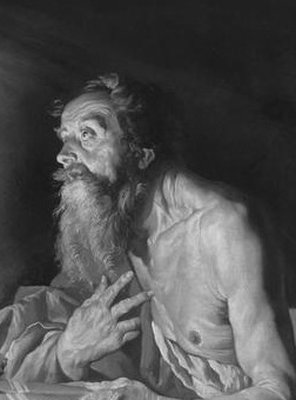
Jerome is the saint painters loved to put in a study: an old man bent over a book, a skull on the desk, a lion dozing at his feet. The lion is a legend, added long after his death. The books are not. For half a century this restless, brilliant, quarrelsome man gave himself to the words of Scripture, and the Latin Bible he made was the Bible of Western Christendom for a thousand years. He was also, by the witness of his own letters, proud, thin-skinned and quick to wound. Both things are true, and his life is worth telling only if both are told.
A student in Rome
He was born Eusebius Sophronius Hieronymus at Stridon, a small town near Aquileia on the borders of Dalmatia and Pannonia. The year is uncertain; it is usually given as about 342, though his translator Fremantle preferred 345 and others place it as late as 347. His parents were Catholic Christians of moderate wealth, but he was not baptised as a child. As a young man he went to Rome with his friend Bonosus to study rhetoric under the grammarian Aelius Donatus, and there he fell in love with Cicero, Virgil and Plautus and began to collect a library.
He also, he later confessed, fell into sin, and suffered bouts of guilt afterwards. Yet on Sundays he and some young Christian friends would go down into the catacombs among the tombs of the martyrs and apostles, where the darkness and the lines of the dead brought home to him the terror of judgment. Somewhere in those years the drift turned into faith, and he was baptised in Rome, probably around 366.
After some years in Gaul and at Aquileia, where a band of young friends, among them Rufinus, gathered round him to live for God, Jerome set out for the East about 373 and came at last to Antioch, worn out and ill. There, in the middle of Lent, he fell into a fever so severe that his friends began to prepare his funeral, and there he had the dream which became the most famous page of his letters. He had been fasting, he admits, only so that he might go back afterwards to Cicero; when he turned to the prophets their style seemed rude and repellent. Now he found himself dragged before the judgment seat of Christ:
Asked who and what I was I replied: “I am a Christian.” But He who presided said: “Thou liest, thou art a follower of Cicero and not of Christ. For ‘where thy treasure is, there will thy heart be also.’”
— Jerome, Letter XXII, to Eustochium
Scourged in the dream, he cried out for mercy and swore that if he ever again possessed or read worldly books he would have denied his Lord. He woke with his eyes drenched with tears, and insisted it had been no idle dream. In later life he did quote the pagan authors, and his enemies never let him forget the oath. But the night at Antioch settled the direction of his life: from then on his great love was the Bible, and the classics he had mastered became tools in its service.
The desert and the call to Rome
Around 374 Jerome went out into the desert of Chalcis, east of Antioch, a wilderness so full of hermits that it was called the Syrian Thebaid. For four or five years he lived in a cell, wore sackcloth and fasted hard. It was not the peace he had hoped for. Years later he told Eustochium, without sparing himself, how the memories of Rome pursued him there, and how, with a body wasted by fasting, his mind still burned with desire. In the desert he also began to learn Hebrew from a converted Jew, a study of much toil that he kept up all his life, he said, lest the language leave him.
Church quarrels at Antioch drove him out of the desert in 379. Bishop Paulinus ordained him a presbyter, though he declined, then and always, the active ministry. He sat under Gregory of Nazianzus at Constantinople, and in 382 came to Rome for a council. Pope Damasus quickly saw what kind of scholar he had. He kept sending Jerome questions about the Bible, and asked him to revise the Latin Gospels and the Psalter, which circulated in many differing copies. That request was the beginning of the work we now call the Vulgate.
The women of the Aventine
In Rome Jerome found a circle hungry for what he had to give. In the house of the widow Marcella on the Aventine hill, noble Roman women met to pray, to sing the psalms in Hebrew, which some learned for the purpose, and to read the Scriptures under his guidance. Among them were the widow Paula, heiress of one of the great families of Rome, and her daughters Blesilla and Eustochium. To Eustochium he addressed his long treatise on virginity, Letter XXII, telling her to make the Bible her pillow: “Let sleep overcome you, the roll still in your hands; when your head falls, let it be on the sacred page.”
Here a modern reader, and especially a Protestant one, meets the Jerome who is hardest to love. He held, as many in his age did, that consecrated virginity was a higher calling than marriage, and said so with relish: “I praise wedlock, I praise marriage, but it is because they give me virgins.” His satire of the Roman clergy was savage. And his counsel had a cost. Blesilla, a young widow, took up the hard life he urged and died within a few months; at her funeral the crowd cried “The monks to the Tiber!”, and his letter urging Paula to restrain her grief struck many as heartless. When Damasus died in December 384, Jerome lost his protector. Rumours about his friendship with Paula led to an inquiry by the Roman clergy, and in August 385 he left Rome for good.
Bethlehem and the Hebrew truth
Paula and Eustochium followed him East, and in 386 they settled at Bethlehem for the rest of their lives. With Paula’s fortune they built a monastery for men under Jerome, a convent for women under Paula, and a guest-house for pilgrims from every corner of the world. Paula gave so freely that she died in debt, and Jerome and his brother sold what remained of their family property to keep the houses going.
In his cell, surrounded by his books, Jerome did the work of his life. He had first revised the Latin Old Testament from the Greek Septuagint, but he saw that the Greek versions disagreed and that the only way to settle them was to go back to the Hebrew, the Hebraica veritas, the Hebrew truth, as he called it. Between about 391 and 405 he translated the Old Testament from the Hebrew, helped by a Jewish teacher who came to him by night like Nicodemus. Most Christians, Augustine among them, held the Septuagint to be inspired, and Jerome was attacked as an innovator. He kept going. To the Roman senator Paulinus he wrote about the study of the Bible in words that still speak to anyone who loves it:
I beg of you, my dear brother, to live among these books, to meditate upon them, to know nothing else, to seek nothing else. Does not such a life seem to you a foretaste of heaven here on earth?
— Jerome, Letter LIII, to Paulinus
Commentaries on the prophets, a catalogue of Christian writers called On Illustrious Men, and letters to Spain, Gaul and Africa flowed from his pen. Sulpicius Severus, who visited him, said he was always reading or writing and never rested day or night.
A sharp pen
These years were also full of controversy, and here honesty is needed. When the Roman monk Jovinian taught that virginity, marriage and widowhood were equal in God’s sight for those who lived in faith, Jerome answered with such contempt that his own friends in Rome tried to keep the book from circulating, thinking he had exalted virginity at the expense of marriage. When Vigilantius, a priest of Gaul, preached against the veneration of relics and night vigils, Jerome wrote against him what his translator judged the most violent and the least reasonable of all his controversial writings. Worst was the break with his old friend Rufinus over the writings of Origen, a public quarrel Jerome kept up even after Rufinus died.
Yet the picture is not only dark. He was remembered as kind to the weak and the poor and entirely free of greed. His correspondence with the younger Augustine began badly: a critical letter of Augustine’s went astray for years and circulated before it reached Bethlehem, and Jerome, suspecting an ambush, warned him that an old man could still be a dangerous opponent. But Augustine answered with patience and deep respect, and the friendship that followed was real. In his last years Jerome hailed him as “the restorer of the ancient faith.”
When the city fell
Jerome’s last years were heavy with loss. Paula died in January 404, whispering the psalms, “Lord, I have loved the habitation of thy house”, until her breath failed. Then, in August 410, Alaric and the Goths took Rome. Refugees crowded into Bethlehem, and Jerome, who had left the city in disgrace a quarter of a century before, wept for it. Writing to Principia about the death of Marcella, he could hardly go on:
My voice sticks in my throat; and, as I dictate, sobs choke my utterance. The City which had taken the whole world was itself taken; nay more famine was beforehand with the sword and but few citizens were left to be made captives.
— Jerome, Letter CXXVII, to Principia
Around 416 a mob sympathetic to Pelagius, whom Jerome had written against, attacked the monasteries at Bethlehem, killing some inside and burning the buildings; Jerome escaped in a tower. Eustochium died in 418. He worked on his commentary on Jeremiah until his last illness cut it short, tended, it is believed, by the younger Paula and Melania. He died at Bethlehem in 420, traditionally on 30 September, and was buried near the cave of the Nativity beside Paula and Eustochium.
The letters he left
The Letters of St. Jerome, in the 1893 translation by W. H. Fremantle and his collaborators, gathers 150 letters, most of them his own. Few books from the ancient church bring us so close to a living person. Here are the dream at Antioch, the tears in the desert, his letter on the best way to translate, his counsel to monks, widows and young mothers, his grief for Paula and his lament for Rome. Readers will find things to argue with, above all in his views of marriage and the ascetic life. But they will also find a man who loved the Scriptures with his whole heart, and who, with all his faults, spent his life making God’s word speak to people in their own tongue.
Questions and Answers
Who was Jerome?
Jerome (Eusebius Sophronius Hieronymus, c. 342–420) was a priest, scholar and ascetic, one of the four great Latin Fathers of the church. He is best known for the Latin translation of the Bible that became the Vulgate, and for his letters.
Where was Jerome born and educated?
He was born at Stridon, near Aquileia on the borders of Dalmatia and Pannonia, to Christian parents of moderate wealth. As a young man he studied rhetoric in Rome under the grammarian Aelius Donatus and came to love the Latin classics.
When was Jerome baptised?
He was not baptised as a child. After a student youth he later confessed was sinful, and Sunday visits to the tombs of the martyrs in the catacombs, he was baptised in Rome, probably around 366.
What was Jerome’s Ciceronian dream?
During a severe fever at Antioch around 374 he dreamed he stood before the judgment seat of Christ, said he was a Christian, and was told, “Thou liest, thou art a follower of Cicero and not of Christ.” He tells the story in Letter XXII, and it turned him from pagan literature to the study of Scripture.
What did Jerome do in the Syrian desert?
For four or five years, from about 374, he lived as a hermit in the desert of Chalcis east of Antioch, fasting, praying and fighting temptation. There he also began to learn Hebrew from a converted Jew.
What did Jerome do in Rome under Pope Damasus?
From 382 to 385 he was a trusted adviser to Pope Damasus, who asked him to revise the Latin Gospels and Psalter, the beginning of the Vulgate. He also taught the Scriptures to a circle of Roman women, including Marcella, Paula and Eustochium.
Why did Jerome leave Rome?
His sharp satire and ascetic teaching made enemies, and the death of the young widow Blesilla after taking up the hard life he urged turned many against him. After Damasus died in 384, rumours about his friendship with Paula led to an inquiry by the Roman clergy, and he left Rome in August 385.
What did Jerome do at Bethlehem?
From 386 until his death he lived at Bethlehem, heading a monastery built with Paula’s fortune beside her convent and a guest-house for pilgrims. There, between about 391 and 405, he translated the Old Testament from the Hebrew and wrote commentaries on the prophets.
Who were Jerome’s main opponents?
He wrote fiercely against Jovinian, who held virginity and marriage equal in God’s sight, and against Vigilantius, who opposed the veneration of relics, and he broke publicly with his old friend Rufinus over Origen. His early exchanges with Augustine were tense, but they ended in a warm friendship.
What is The Letters of St. Jerome?
It is the 1893 English translation by W. H. Fremantle and his collaborators of 150 letters, most of them Jerome’s own. They include his account of the Ciceronian dream, his counsel to monks and widows, his memorial of Paula, and his lament for the sack of Rome in 410, ten years before his death at Bethlehem in 420.