Where to start reading
Start with
The Shepherd of Hermas
Books by Hermas (1)
Biography
Most writers on these shelves left a life that can be told. Hermas left one book, The Shepherd, and the few things it lets slip about the man who wrote it down. He was a Christian of Rome and a former slave, married, with children who had grieved him, once rich and rich no longer. Yet for two or three centuries his book was among the most loved in the church, read aloud in congregations and copied into Bibles.
A former slave in Rome
The book opens abruptly, in the first person: “He who had brought me up, sold me to one Rhode in Rome.” That is all we know of his childhood. Years later he met Rhode again and came to love her as a sister. Once, helping her out of the Tiber, he thought how happy he would be with a wife so beautiful and good. That passing thought, he says, was all.
The rest comes in pieces, mostly through rebukes. His wife, he is told, “does not restrain her tongue”; his sons have blasphemed the Lord and betrayed their parents, and Hermas, who loved them, failed to correct them. He had been in business, and not honestly. When the Shepherd tells him to love the truth, he weeps that “I never spake a true word in my life”. He had lost his money too. “When you were rich, you were useless,” he is told; “but now you are useful and fit for life.” His visions come to him out in the country, and many readers have pictured him working land outside the city, though the book never quite says so.
Which Hermas?
Who this man was has been argued over since antiquity, and the claims do not fit together. The most widespread ancient view tied him to the apostles. In Romans 16:14 Paul greets a Christian in Rome named Hermas. Origen thought this was our author, and Eusebius and Jerome repeated the idea. If the Clement named in the book is Clement of Rome, its story is set around the year 90.
The Muratorian fragment, an early list of the church’s books usually dated around 170, says otherwise: “Hermas wrote The Shepherd very recently, in our times, in the city of Rome, while bishop Pius, his brother, was occupying the chair of the church of the city of Rome.” Pius led the Roman church around 140 to 155. On this account Hermas was not Paul’s friend but a bishop’s brother, two generations later.
Both cannot be true. Some modern critics have thought Hermas a character invented for the story. The editor of our edition conjectured that Hermas and his brother were grandchildren of the Hermas Paul greeted. The book was written in Rome, in Greek, most likely in the first half of the second century, by a man who calls himself Hermas.
The old woman who grew young
In the first vision Rhode appears from the opened heavens to accuse him. Then an old woman in a splendid robe sits before him on a great white chair. God is angry, she says, less for that thought than for his neglected household; he must keep warning his sons. A year later she gives him a little book to copy. He copies it letter by letter without understanding it, and its meaning comes only after fifteen days of fasting and prayer. A young man in a dream tells him who she is. She is not the Sibyl, the prophetess of Roman legend, as Hermas had guessed: “It is the Church.” She is old because she was created first of all.
She then shows him a great tower rising on the waters, built of shining square stones that fit so closely the joins cannot be seen. The tower is the Church. Other stones are cracked, too short, or round, and each stands for a kind of believer: the quarrelsome, the half-hearted, the rich whose wealth must be cut away before they can be squared. Some are set aside but not far off, because they may yet be used if they repent while the tower is still building.
Across the visions the woman changes. First she is very old and must sit. Then her face is youthful though her hair is white. Then she is young and joyful, and at last she meets him dressed as a bride. The change, Hermas learns, was in him and his fellow believers. Their spirits had grown old through doubt and worldly cares, and as they repented they were made young. “Those, therefore, who repent completely and with the whole heart,” he is told, “will become young and firmly established.”
The shepherd at the door
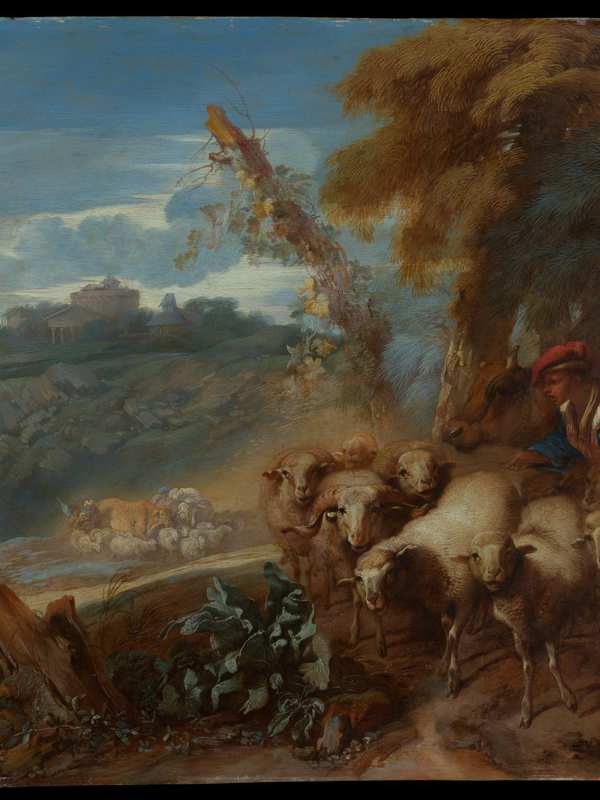
The fifth vision gives the book its name. Hermas has been praying at home when a man of glorious appearance comes in, dressed as a shepherd in a white goatskin, with a staff in his hand. He has been sent to live with Hermas for the rest of his days. He is the angel of repentance, and he gives Hermas twelve commandments and ten similitudes, or parables, to write down.
The commandments are plain moral teaching, and their theme is the undivided heart. Believe in one God. Be simple and guileless, like a child. Speak evil of no one. Give to the needy without fretting over who deserves it. Tell the truth. The Shepherd keeps warning against the man he calls “double-souled,” who half trusts and half doubts and has the Lord on his lips but not in his heart. When Hermas protests that the commandments are too hard, the Shepherd answers that they are hard only to a divided heart:
Put, therefore, ye who are empty and fickle in your faith, the Lord in your heart, and ye will know that there is nothing easier or sweeter, or more manageable, than these commandments.
— Hermas, The Shepherd, Commandment Twelfth
The ninth commandment brings this to prayer. Hermas is not to talk himself out of asking because he has sinned so much, but to ask with all his heart and without doubting, and to keep asking when the answer is slow.
For He is not like men, who remember evils done against them; but He Himself remembers not evils, and has compassion on His own creature.
— Hermas, The Shepherd, Commandment Ninth
A book the early church read
The book travelled far, into Latin, Coptic, Ethiopic and other tongues. Our translator calls it perhaps the most popular book in the church of the second, third and fourth centuries. He records that Irenaeus quoted it as Scripture, Clement of Alexandria said it spoke divinely, and Origen thought it divinely inspired. Its Greek text was copied at the end of the great manuscript Bible known as Codex Sinaiticus. Others held back. The Muratorian fragment allowed private reading but not public reading in church, since the book came after the apostles, and Tertullian scorned it as apocryphal. In the end the church did not receive it into the New Testament.
Two teachings were debated then and still are. The first is repentance after baptism. The Shepherd agrees with teachers who said baptism is the only repentance, then announces that by God’s mercy a believer who falls has “opportunity to repent but once.” Some heard a stern limit, and the rigorist Novatian is said to have drawn on it; others heard a door opened where it had seemed shut. The second is its way of speaking about Christ. One parable describes the pre-existent Holy Spirit dwelling in a chosen flesh that served it faithfully, which some read as Jesus being adopted as Son. J. N. D. Kelly called the book’s Christology “an amalgam of binitarianism and adoptionism,” while Bogdan Bucur reads the passage differently. Yet the same book calls the Son of God “older than all His creatures”. A reader need not settle these questions to profit from it.
Reading the Shepherd today
We publish The Shepherd of Hermas in F. Crombie’s translation from the Ante-Nicene Fathers of 1885, with all five Visions, twelve Commandments and ten Similitudes. Its translator compared its old popularity to that of Bunyan’s Pilgrim’s Progress. It is a long, homely allegory, sometimes repetitive and sometimes very moving, in which ordinary Roman Christians are called to wholehearted repentance.
Its author stays in shadow. What we can see is the man the book shows: a sinner who did not hide his sins, a father who learned late to speak to his children, a doubter told again and again not to doubt. The aged woman grew young before his eyes because he and those like him turned back to God with their whole hearts. A tired and divided heart can be made young again, and the tower is still being built.
Questions and Answers
Who was Hermas?
Hermas was a Christian of Rome, probably of the early second century, who wrote The Shepherd, one of the most widely read Christian books of the second, third and fourth centuries. Almost everything known about him comes from what the book says of itself.
What does The Shepherd tell us about Hermas’s life?
It says he was raised in another’s household and sold as a slave to a woman named Rhode in Rome. He was married, his wife is rebuked for her tongue, and his sons had blasphemed the Lord and betrayed their parents; he confesses that he had been dishonest in business and is told that he had once been rich but was now useful because his riches were gone.
Was Hermas the Hermas greeted by Paul in Romans 16:14?
Origen thought so, and Eusebius and Jerome repeated the idea, which would place the book in the first century. Only a minority have followed it since, and it conflicts with the other ancient claim that Hermas was the brother of a second-century bishop of Rome.
Was Hermas the brother of Pope Pius I?
The Muratorian fragment, an early list of the church’s books usually dated around 170, says Hermas wrote The Shepherd “very recently, in our times” while his brother Pius was bishop of Rome, around 140 to 155. This cannot be reconciled with the view that he was Paul’s friend, and some modern critics think Hermas is a character invented for the story.
When was The Shepherd of Hermas written?
The date is uncertain. The mention of a Clement, if he is Clement of Rome, would set the story around the year 90, while the Muratorian fragment points to the time of Pius, about 140 to 155; most place the book in Rome in the first half of the second century.
Who is the old woman in Hermas’s visions?
She is the Church, old because she was created first of all. Over the visions she grows younger, from a weak old woman in a chair to a joyful young woman and at last a bride, and Hermas is told the change reflects believers whose weary spirits are renewed as they repent with the whole heart.
What is the tower in The Shepherd of Hermas?
The tower, built on the waters out of square stones, is the Church, and the stones are believers. Well-fitted stones are those who lived faithfully and at peace, while cracked, short or round stones stand for the quarrelsome, the half-hearted and the rich, some of whom may still be used if they repent while the tower is building.
What is in The Shepherd of Hermas, and who is the Shepherd?
The book has five Visions, twelve Commandments and ten Similitudes, or parables, published here in F. Crombie’s 1885 Ante-Nicene Fathers translation. The Shepherd is the angel of repentance, sent to live with Hermas, and his commandments call for a simple, undivided heart, warning against the double-souled believer who half trusts and half doubts.
What does Hermas teach about prayer?
The ninth commandment tells Hermas not to hold back from asking God because he has sinned much, but to ask with all his heart and without doubting, since God does not remember evils as men do. If the answer is slow he is to keep asking rather than waver.
Why is The Shepherd of Hermas not in the Bible?
Some early writers treated it as Scripture and it was copied into Codex Sinaiticus, but the Muratorian fragment allowed only private reading because it came after the apostles, and Tertullian rejected it as apocryphal. The church did not receive it into the New Testament, and its teaching that a believer may repent only once after baptism and its way of speaking about Christ have long been debated.