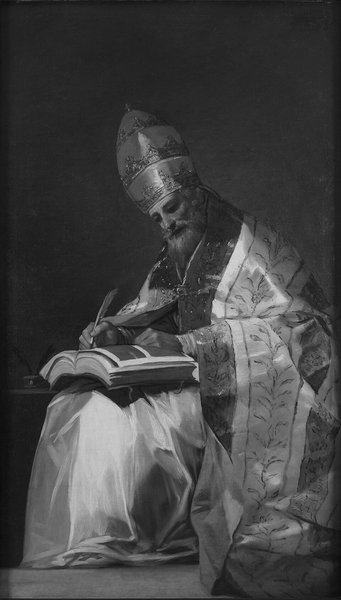
Biography
- 540 Born
- 574 Became monk
- 579 Papal envoy
- 590 Pope
- 604 Died
The government of souls is the art of arts.
Most of the shepherds the church remembers were poor men who climbed. Gregory of Rome was the opposite: a man at the very top of Roman society who climbed down, on purpose, into a monastery — and then was hauled back up against his will to carry the heaviest office in the Western church. He is remembered as a pope, a saint, one of the four great Latin Doctors. But the truer name for him, the one that runs under everything else he did, is pastor. He wrote the book that taught the West how to care for souls, and he tried to live it while feeding a starving city, ransoming its captives, and walking it through a plague.
The prefect who walked away
He was born around 540 in Rome, into a wealthy patrician family of the old senatorial rank — the kind of household that had governed the city for generations. It was also a devout house, and church-tied: his mother, Silvia, and two of his aunts are venerated as saints. He was given the best education the sixth century could offer, and he rose fast. By about 573, still only in his early thirties, he had become Prefect of the City of Rome — the highest civil office the city had to give. He had, in worldly terms, arrived.
And then, around 574, he gave it all away. Not in a moment of collapse, and not lightly. The record says he came to the decision only after long prayer and a hard inward struggle, and then he acted with the thoroughness of a man who does not do things by halves. He turned his own family home on the Caelian Hill into a monastery under the patronage of St Andrew, and became a monk there. The Sicilian estates he had inherited he gave up as well, using them to found six more monasteries on the island. The prefect of Rome became one of the brothers.
It is worth being careful here, because the sources are. He is often called the abbot of St Andrew's, but there is no firm evidence he ever held that title; what is certain is that he lived there as a monk, and by his own later testimony those were the happiest and most settled years of his life. He had found the thing he wanted, and it was quiet.
Dragged back into the world
The quiet did not last. In 579 he was made a deacon and sent to Constantinople as apocrisiarius — the pope's envoy at the imperial court — to plead for help against the Lombards, the people then overrunning Italy. He spent years in that role before returning to Rome and to St Andrew's, around 585 or 586, hoping to resume the monastic life he loved.
Then, in 590, the plague took Pope Pelagius II, and the city turned to Gregory. He is widely described as the first monk to become pope, and he wanted no part of it. He tried to refuse. Everything we know of him says the refusal was sincere — that he genuinely dreaded the office, and grieved the loss of his monastery. When he could not escape it, he did a very Gregory thing: he sat down and wrote a book about why a man in his position should be terrified, and how, having been given the burden anyway, he must carry it.
The art of arts
That book is the Book of Pastoral Rule — in Latin the Regula Pastoralis — written around 590. It began partly as his own apologia, an explanation of why he had wanted to flee such an office. It became something far larger: for roughly the first millennium and a half of Western Christianity, the single most influential book ever written on the care of souls. In 813 its study was made obligatory for bishops under Charlemagne. Three centuries after Gregory's death, King Alfred the Great had it translated into Old English and sent a copy to every bishop in England. Few books have shaped so many pastors for so long.
Its argument is set out in a single sentence that has never been improved upon:
The government of souls is the art of arts.
— Gregory the Great, Book of Pastoral Rule, Book I
He meant it as a warning before it was a compliment. If leading souls is the highest of all the arts, then no one should presume to practise it who would not presume to practise medicine or teaching without training and fear. The whole of his first book is an argument against entering the office lightly. The pastor must be humble; he must want the work for the work's sake and not for the standing it brings; and — this is the note Gregory returns to again and again — he must not let the crush of outward business hollow out his inner life.
Gregory knew that danger from the inside, because his own days were now buried in administration. Rome's poor had to be fed, its captives ransomed, its enemies negotiated with; the letters and accounts never stopped. And he watched what that kind of load does to a man's soul, and named it exactly:
The mind, occupied with earthly cares, is emptied of the solidity of inward fear; and, estranged from the business of self-examination, it does not even consider the losses it is suffering.
— from the Book of Pastoral Rule, Book I
That is not the observation of a theorist. It is a man describing his own temptation — the pastor so consumed with running things that he stops examining himself, and does not even notice how much he is losing. Gregory's remedy was never to withdraw from the work; it was to keep the inner watch alive in the middle of it. His long third book is a catalogue of contrasted people — rich and poor, joyful and grieving, the meek and the quick-tempered — each, he insists, to be admonished differently, because souls are not interchangeable and a good shepherd learns them one at a time.
Servant of the servants of God
The title Gregory chose for himself has outlived every grander one. He called himself servus servorum Dei — the servant of the servants of God. He did not coin the phrase; it is older than he is. But he took it up as his own name for the office and made it the standard style of the popes, and he did so pointedly, as a rebuke of pride. When the Patriarch of Constantinople styled himself the "Universal Bishop," Gregory recoiled from the arrogance of it, and answered the swelling title with a shrinking one. The man who governed the Western church would be known, in his own hand, as the servant of God's servants.
He governed as the title promised. When famine and plague pressed on Rome, he administered the church's own estates — the "patrimony of Peter" — to feed the hungry, and he emptied the papal treasury to buy back the captives the Lombards had carried off. Pastoral care, in Gregory's hands, was not only counsel; it was bread and ransom money. And when imperial authority in Italy grew too weak to protect the city, it was Gregory who negotiated with the Lombards to spare Rome.
Leading a city in repentance
His very first act as pope set the pattern. Rome in 590 was a plague city, and Gregory's answer to it was not administrative but pastoral: he called the whole population out to walk the streets in penitence, imploring God to lift the pestilence, the new shepherd leading his frightened flock in repentance and prayer.
Later ages could not leave the story plain. A medieval legend grew up that as the procession wound past Hadrian's great mausoleum, the Archangel Michael was seen atop it sheathing his sword — the sign that the plague was ending — and that the building has been called the Castel Sant'Angelo, the Castle of the Angel, ever since. That is a beautiful story and it is a legend; the sober fact underneath it is simply a pope who met a plague by leading his people in prayer.
Not Angles, but angels
Gregory's most enduring pastoral legacy reached a people he never saw. In 596 he sent a monk named Augustine — Augustine of Canterbury — with a band of brothers to carry the gospel to the pagan Anglo-Saxons of Britain. Augustine landed in Kent in 597, and from that mission the English church grew; English tradition still calls Gregory the Apostle of the English.
There is a cherished story about why he sent them. The historian Bede, writing around 731 — well over a century after Gregory's death — records that Gregory once saw fair-haired boys for sale in the Roman slave market, and asked where they were from. Told they were Angli, Angles, he is said to have answered that they were not Angles but angels, non Angli sed Angeli, and to have resolved from that moment to send the good news to their people. It is one of the most repeated stories in the history of the English church. It is also Bede's telling, set down long after the fact, and it should be received as the church has cherished it — as tradition, not as a documented saying from Gregory's own mouth. What is certain, and enough, is the mission itself: an old, overworked pope in a shrinking city who still found it in him to send the gospel to the edge of the known world.
The song under his name
Gregory died on 12 March 604. The church named him one of its four great Latin Doctors and called him, simply, the Great. His writings shaped Western worship, and he did reorganize the liturgy of Rome — which is almost certainly the seed of the tradition that his name became attached to. For centuries the plainsong of the Western church has been called Gregorian chant. But the attribution is traditional and grew up long after him; historians doubt that Gregory composed or codified that body of music, and honesty requires us not to hand him a legend as a fact. His name rests on the chant the way it rests on the slave-market pun — lovingly, and at a distance.
What he leaves the shepherds
Strip away the legends and a very solid man remains, and he is more useful than the legends. Gregory is the pastor who did not want the job, said so, and did it faithfully for fourteen years anyway. He is the administrator who knew that administration could eat a soul alive, and kept watch against it in himself. He fed the poor from his own church's lands, spent its treasure on ransoming slaves, met a plague on his knees at the head of his people, and sent the gospel to a nation he would never meet — all while insisting, in the book that outlived him by more than a thousand years, that the care of souls is the highest and most fearful art there is.
To every pastor since who has felt too small for the work, Gregory is a strange comfort: the man who felt exactly that, and was right, and served anyway.
The government of souls is the art of arts.
— Gregory the Great, who spent fourteen years proving how hard he meant it
Also appears in
Questions and Answers
Who was Gregory the Great?
Gregory the Great (c.540–604) was Prefect of Rome who renounced the city's highest civil office to become a monk, and the reluctant pope who wrote the West's most influential manual of pastoral ministry, the Pastoral Rule. He fed Rome through famine and plague, ransomed captives, and sent the mission that converted the English. He is remembered as a pope and a Doctor of the church, but the truer name for him, running under everything else, is pastor.
Why did he give up the office of Prefect?
He was born around 540 into a wealthy patrician family of old senatorial rank, and rose fast — by about 573, still in his early thirties, he had become Prefect of the City of Rome, the highest civil office the city had to give. Then, around 574, he gave it all away, after long prayer and a hard inward struggle: he turned his family home on the Caelian Hill into a monastery, used his inherited Sicilian estates to found six more, and became a monk. Those, by his own testimony, were the happiest and most settled years of his life.
How did he become pope?
The quiet did not last. In 579 he was made a deacon and sent to Constantinople as the pope's envoy, spending years pleading for help against the Lombards, before returning to his monastery. Then in 590 the plague took Pope Pelagius II and the city turned to Gregory — widely described as the first monk to become pope. He wanted no part of it and tried to refuse; when he could not escape it, he sat down and wrote a book about why a man in his position should be terrified, and how he must carry the burden anyway.
What is the Book of Pastoral Rule?
Written around 590, it began partly as his own apologia for wanting to flee the office and became, for roughly the first millennium and a half of Western Christianity, the single most influential book ever written on the care of souls. In 813 its study was made obligatory for bishops under Charlemagne; King Alfred the Great had it translated into Old English and sent a copy to every bishop in England. Its argument is set out in a sentence never improved upon: "The government of souls is the art of arts."
What did he mean by "the art of arts"?
He meant it as a warning before it was a compliment: if leading souls is the highest of all the arts, then no one should presume to practise it who would not presume to practise medicine or teaching without training and fear. His whole first book argues against entering the office lightly — the pastor must be humble, must want the work for its own sake and not the standing it brings, and must not let the crush of outward business hollow out his inner life.
Did he write from experience of that danger?
Yes — from the inside. His own days were now buried in administration: Rome's poor to be fed, its captives ransomed, its enemies negotiated with, the letters never stopping. He named the temptation exactly: "The mind, occupied with earthly cares, is emptied of the solidity of inward fear; and, estranged from the business of self-examination, it does not even consider the losses it is suffering." His remedy was never to withdraw from the work but to keep the inner watch alive in the middle of it.
Why did he call himself the servant of the servants of God?
The title he chose has outlived every grander one. He took up the phrase "servus servorum Dei" — the servant of the servants of God — as his own name for the office and made it the standard style of the popes, pointedly, as a rebuke of pride. When the Patriarch of Constantinople styled himself the "Universal Bishop," Gregory recoiled from the arrogance and answered the swelling title with a shrinking one: the man who governed the Western church would be known, in his own hand, as the servant of God's servants.
How did he govern in famine and plague?
As the title promised. When famine and plague pressed on Rome he administered the church's own estates — the patrimony of Peter — to feed the hungry, and emptied the papal treasury to buy back the captives the Lombards had carried off; pastoral care, in his hands, was not only counsel but bread and ransom money. When imperial authority grew too weak to protect the city, it was Gregory who negotiated with the Lombards to spare Rome.
How did he lead the city through the plague?
His very first act as pope was pastoral, not administrative: Rome in 590 was a plague city, and he called the whole population out to walk the streets in penitence, imploring God to lift the pestilence — the new shepherd leading his frightened flock in repentance and prayer before organising any relief. A medieval legend grew up that as the procession passed Hadrian's mausoleum, the Archangel Michael was seen sheathing his sword, and the building has been called the Castel Sant'Angelo ever since; the sober fact underneath is a pope who met a plague by leading his people in prayer.
What was his mission to the English?
In 596 he sent a monk named Augustine — Augustine of Canterbury — with a band of brothers to carry the gospel to the pagan Anglo-Saxons of Britain; Augustine landed in Kent in 597, and English tradition still calls Gregory the Apostle of the English. Bede, writing well over a century later, records that Gregory once saw fair-haired boys in the Roman slave market and, told they were Angli, answered that they were "not Angles but angels" — a cherished tradition rather than a documented saying. What is certain is the mission itself, sent by an overworked pope to the edge of the known world. He died on 12 March 604.